Over 18 million freelancers compete on Upwork, yet fewer than 1% ever achieve Expert-Vetted status. The difference isn’t always skill level.
It’s profile conversion rate.
Your Upwork profile isn’t a digital resume. It’s a conversion engine that either turns profile views into interview invitations or silently loses opportunities, leaving you wondering why proposals go unanswered. Platform data shows that with 794,000 active clients and an average freelancer rate of $39 per hour, the market exists. But reaching those clients requires more than technical ability.
You need a profile that clients trust within 15 seconds of landing on your page.
This guide breaks down the exact optimization framework used by consistently hired freelancers. Not theory—execution. We’ll cover profile structure, algorithmic visibility, positioning strategy, and the conversion elements that separate shortlisted profiles from ignored ones.
Whether you’re starting your freelancing journey or rebuilding your presence, understanding how to build a high converting Upwork profile determines how efficiently you convert platform visibility into paid contracts.
Why Your Upwork Profile Conversion Rate Matters More Than Your Skills
Here’s the uncomfortable truth: your profile could be receiving views right now without generating a single interview request.
This happens when your profile exists but doesn’t convert. Clients scan fast. Upwork’s official guidance emphasizes that your profile picture, headline, and first paragraph create immediate impressions that determine whether clients keep reading or move to the next freelancer.
The profile-to-interview conversion formula looks like this: Profile View → Trust Signal → Interview Invitation. Each element must reduce perceived risk while increasing perceived competence.
The Profile-to-Interview Conversion Formula
Think of your profile as a landing page, not a biography. Effective client acquisition strategies show that your profile functions as your online storefront—the place where clients decide whether to engage or scroll past.
Every section answers a silent client question:
- Does this person understand my problem?
- Can they deliver the outcome I need?
- Will they communicate clearly?
- Can I trust them with my budget?
Answer these four questions within the first 200 words of your profile. Everything else is secondary.
What Upwork’s Algorithm Actually Ranks (2026 Update)
Upwork’s search algorithm doesn’t surface freelancers randomly. Platform behavior analysis reveals that Job Success Score carries 25-30% weight in ranking decisions, while keyword relevance, response time, and profile completion round out the remaining factors.
The algorithm scans for specific signals. Optimization testing revealed that the system prioritizes keywords, listed skills, and tool mentions over descriptive prose. This means “JavaScript developer experienced in React, Node.js, and MongoDB” outperforms “passionate developer who loves creating beautiful code.”
Your profile must balance human psychology with algorithmic requirements. Write for clients, but structure for search.
This same principle applies across digital platforms—Neemesh achieved a 150% increase in organic traffic within 3 months for NoCostTools by implementing modular micro-tools architecture combined with SEO-driven landing pages targeting utility search intent. On Upwork, your profile operates as a search-optimized landing page where keyword placement, structural clarity, and outcome focus determine whether the algorithm surfaces you to clients.
How Job Success Score Affects Your Visibility
The Job Success Score (JSS) serves as Upwork’s quality filter. Recent client preference data confirms that 80% of clients value communication skills equally with technical abilities, and JSS serves as a proxy for both.
A score above 90% signals reliable performance. Between 80-89%, you’re competitive but not prioritized. Below 79%, your profile loses visibility in search results, and client recommendations drop significantly.
JSS updates every two weeks based on contract outcomes, client feedback, and long-term client relationships. You can’t directly control it, but you can influence it through project selection, communication quality, and deadline adherence. New freelancers start without a score. This actually creates an opportunity if you position your profile strategically.
The 6 Core Elements of a High Converting Upwork Profile
Profile optimization isn’t about filling every field. It’s about optimizing the elements clients actually read.
Focus on these six areas, and your conversion rate improves measurably within 2-4 weeks.
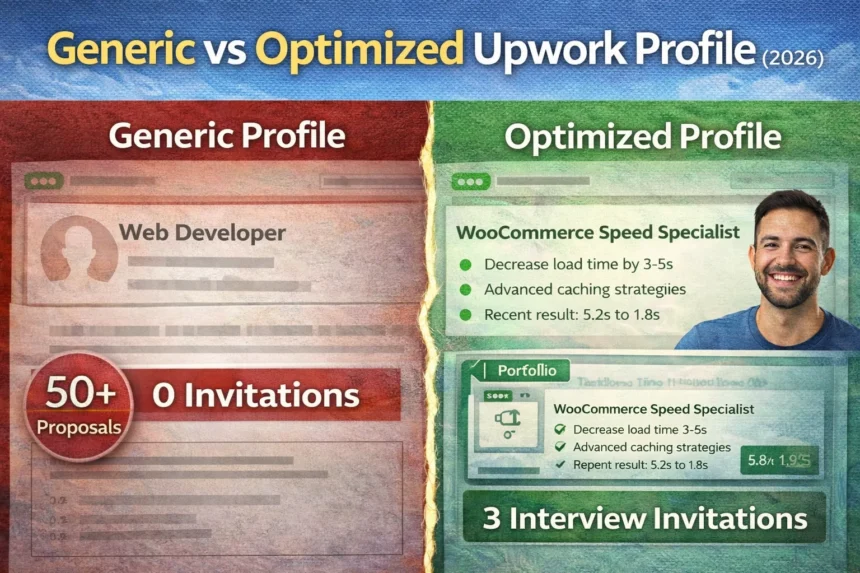
Professional Title Formula (Skill + Outcome + Market)
Most freelancers write generic titles that disappear in search results.
❌ “Experienced Web Developer” ❌ “Professional Content Writer” ❌ “Digital Marketing Expert”
These titles communicate nothing specific. Clients scan dozens of profiles. Vague positioning loses to specific positioning every time.
The formula that increases click-through rate: Skill + Outcome + Target Market
Examples:
Draw from proven niche categories that consistently convert when crafting your title:
- “WooCommerce Speed Optimization | Reduce Load Time by 3–5 Seconds.”
- “B2B SaaS Content Writer | SEO-Driven Blog Posts That Generate Demo.s”
- “Shopify Conversion Designer | Turn Traffic Into Sales With Data-Backed U.X”
Profile optimization research demonstrates that headlines between 70-80 characters perform best, and your title must contain your primary niche keyword while signaling measurable outcomes.
Your title appears in search results before clients see your full profile. Make it specific enough that ideal clients recognize themselves in your positioning. Consider how high-demand skills that command premium rates can inform your title strategy—specialization beats generalization.
Overview Structure That Hooks in 2 Lines
Upwork truncates your overview in preview mode. Only the first two lines appear before the “Read More” expansion.
This is your real hook—and most freelancers waste it.
❌ “Hi, my name is John and I have 7 years of experience in web development…”
Nobody cares about your name or generic experience statement. Your opening must create a pattern interrupt with specificity.
✅ “If your WooCommerce store loads above 4 seconds, you’re likely losing 20-30% of conversions before checkout even loads.”
This opener accomplishes three things: identifies the target client, names their problem with specificity, and quantifies the cost of inaction.
After your hook, structure your overview like this:
Who You Help: “I work with B2B SaaS companies…” Core Problem: “…that struggle to convert organic traffic into qualified demo bookings.” Solution Framework: “My approach combines search intent analysis, structured SEO architecture, and conversion-focused content strategies.” Micro-Proof: “Recent results: 38% increase in demo bookings within 90 days.” Execution Breakdown: Brief bullet list of your process. Clear CTA: “If this sounds relevant, let’s discuss your specific needs.”
Keep paragraphs under 4 lines. Use bullets for scannability. Write in client language, not industry jargon.
Your overview should read like a conversation, not a resume. If you’re discussing strategic pricing aligned with your positioning, mention it naturally within your value proposition rather than as an isolated detail.
Portfolio Strategy for Zero-Review Freelancers
New freelancers often ask: “How do I build a portfolio without clients?”
You create proof-of-concept projects that demonstrate specific outcomes.
Every portfolio entry should follow this structure:
- Project Title: “Shopify Product Page Optimization”
- Problem: “Low conversion rate (1.2% on mobile devices).”
- Action: “Redesigned product layout, rewrote benefit-focused copy, added social proof.”
- Result: “Increased conversion to 2.3% in 30-day A/B test.”
Numbers increase perceived competence. Even mock projects gain credibility when you show before/after metrics, methodology, and thinking process.
Create 3-5 portfolio entries aligned with your headline niche. Do not upload random work samples across unrelated categories. A content writer showing logo designs creates confusion. A developer showing mixed languages and frameworks appears unfocused.
Portfolio alignment matters more than portfolio size. Three strong, niche-specific entries outperform ten scattered samples.
If you’re choosing the right freelancing platform, portfolio requirements vary—but on Upwork specifically, structured case study entries convert better than generic work samples.
Skills Section Optimization (Quality Over Quantity)
Don’t add 50 skills to your profile.
The algorithm reads skill relevance, not skill quantity. Optimization testing revealed that Upwork’s search engine scans your listed skills as primary matching signals.
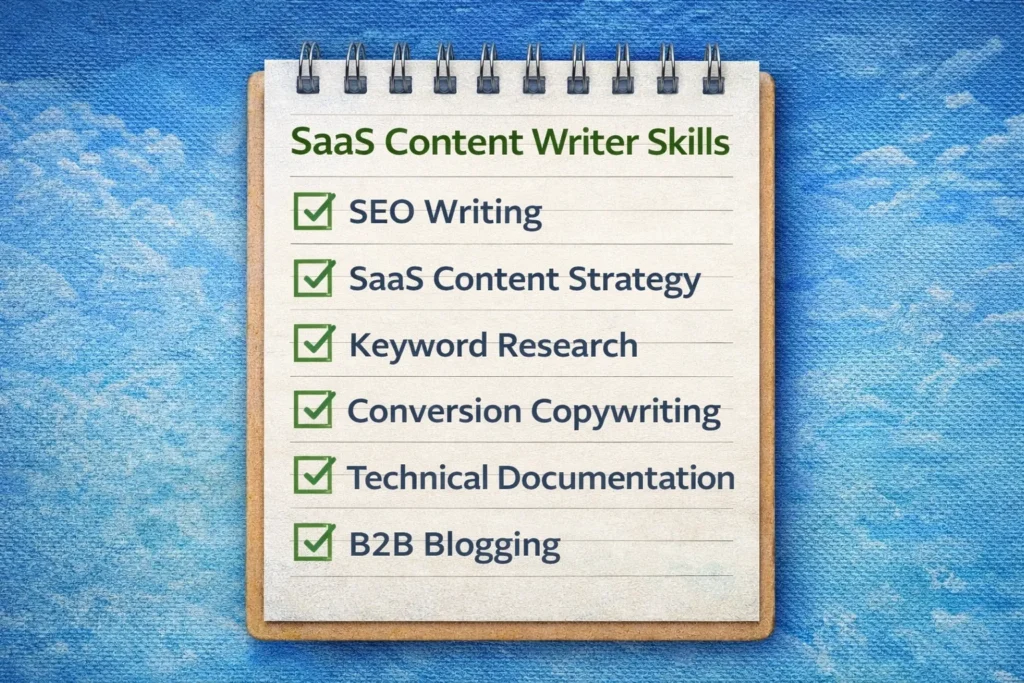
Add 10-15 focused skills directly related to your niche positioning. For a SaaS content writer, that means:
- SEO Writing
- SaaS Content Strategy
- Keyword Research
- Conversion Copywriting
- Technical Documentation
- B2B Blogging
Each skill should appear naturally in your overview, portfolio descriptions, or service offerings. Consistency between your title, overview, skills list, and portfolio creates algorithmic trust.
Random skill additions dilute your positioning. If you’re a web developer, listing “social media management” and “graphic design” confuses both the algorithm and potential clients about your actual specialization.
How to Build Profile Authority Without Client Reviews
New freelancers face a cold-start problem: clients want reviews, but you can’t get reviews without clients.
Break this cycle through strategic authority building that doesn’t require prior platform history.
Certifications and Tests That Actually Matter
Upwork offers skill tests across hundreds of categories. Take tests relevant to your niche and display top scores on your profile.
A 90th percentile score on “SEO Writing” or “JavaScript” serves as third-party validation when you lack client reviews. Clients filtering search results often sort by skill test scores alongside JSS.
External certifications work too. Google Analytics certification, HubSpot Content Marketing, Facebook Blueprint—these add legitimacy to your claimed expertise. Don’t list every certification you’ve ever completed. Display 2-3 that directly support your positioning.
Creating Proof-of-Concept Portfolio Entries
Mock projects aren’t fake work if you treat them as real case studies.
Choose actual businesses or real problems in your target market. Conduct genuine analysis. Create solutions you’d deliver to paying clients. Document your process, reasoning, and projected outcomes.
Example: A conversion copywriter targeting e-commerce clients could analyze three real product pages, identify specific conversion barriers, rewrite the pages, and present them as optimization proposals. The fact that you weren’t hired to do this work matters less than demonstrating you can identify problems and produce solutions.
Your portfolio proves capability. Client reviews prove reliability. In the early stage, capability gets you shortlisted—then your proposals close deals.
Positioning Over Experience in Early Stage
A specialized profile with zero reviews often outperforms a generic profile with five reviews.
Why? Because specificity reduces perceived risk. When a client searches “Shopify speed optimization,” they want a Shopify specialist, not a generalist who sometimes works on Shopify projects.
Your positioning statement becomes your primary trust signal: “I exclusively optimize WooCommerce stores for conversion and load speed” signals more focus than “I’m a full-stack developer with 8 years of experience.”
Clients hire specialists. Position yourself as one from day one, even if you’re building your portfolio. Your narrow positioning actually makes it easier to compete against experienced freelancers who remain too broad.
What Is the Upwork Job Success Score and How Does It Impact Your Profile?
Job Success Score (JSS) is Upwork’s metric for freelancer performance, calculated from client feedback, project outcomes, and long-term client relationships. Upwork’s scoring methodology indicates that scores above 90% are considered excellent, while scores below 79% negatively affect profile visibility and search ranking.
The score updates every two weeks based on your most recent contracts. New freelancers don’t start with a score, you remain unscored until you complete a few contracts and receive feedback.
Your JSS impacts visibility in multiple ways. High scores (90%+) unlock Rising Talent or Top Rated badges. Low scores reduce search ranking, decrease invitation frequency, and can disqualify you from certain client searches that filter for minimum JSS thresholds.
What influences your JSS:
- Contract completion rate
- Client feedback and star ratings
- Repeat clients (long-term relationships weighted positively)
- Private feedback left by clients
- Projects closed early or marked incomplete
What doesn’t influence JSS:
- Proposal acceptance rate
- Profile views or response time
- Connects spent
- Number of active contracts
You can’t directly manipulate JSS, but you can influence it through client selection, communication quality, and project management. Avoid high-risk projects in your first 5-10 contracts. Under-promise and over-deliver. Request feedback explicitly if clients seem satisfied but forget to leave reviews.
Your JSS trajectory matters more than your current score. A 92% that’s rising looks better algorithmically than a 95% that’s declining.
Common Profile Mistakes That Kill Your Interview Rate
Most freelancers don’t realize their profile is the problem until they’ve sent 50+ proposals without responses.
These three mistakes account for 70% of low-conversion profiles.
Generic Positioning (“Virtual Assistant” vs. Specialized Role)
“Virtual Assistant” is not a position—it’s a category containing 200 sub-specializations.
Clients don’t search for “virtual assistant.” They search for “email management VA,” “calendar scheduling specialist,” or “customer support VA with Zendesk experience.”
Every time you position broadly, you compete with tens of thousands of freelancers. Every time you specialize, you compete with hundreds. The math is simple: narrow positioning increases your conversion rate because you appear more relevant to specific client needs.
If you offer multiple services, create separate profiles or choose your strongest service as your primary positioning. You can mention secondary skills in your overview, but your title and first paragraph must signal one clear specialty.
Long Paragraphs and Wall-of-Text Syndrome
Clients scan profiles on mobile devices during commutes, between meetings, or while multitasking.
A 400-word paragraph loses them immediately.
Your overview should contain 8-12 short paragraphs with strategic bullet points. Each paragraph should make one point, then stop. White space increases readability. Bullet lists create visual breaks.
If your overview looks dense, rewrite it. If you’re explaining complex services, break them into numbered steps or bullet frameworks. Make scanning effortless.
Portfolio Misalignment With Headline Niche
Your portfolio should support your positioning, not contradict it.
If your title says “B2B SaaS Content Writer,” but your portfolio shows e-commerce product descriptions, real estate blog posts, and travel writing, clients see inconsistency. They wonder if you truly specialize in SaaS content or if you’re just positioning that way because it’s trendy.
Remove irrelevant samples. Better to show three perfectly aligned portfolio entries than ten mixed-category samples. Your portfolio is proof of positioning—make it reinforce your claims rather than raise doubts.
How Long Does It Take to See Results From Profile Optimization?
Hiring behavior analysis demonstrates that most clients hire within 3 days of posting a job, which means profile visibility matters immediately. But optimization results follow a specific timeline.
Weeks 1-2: Profile indexing updates as Upwork’s algorithm re-scans your content for keywords and relevance signals. You may notice slight changes in search placement.
Weeks 3-4: Improved profile conversion begins showing in metrics. If you’re sending proposals at the same volume, you should see a 20-30% increase in profile views and slightly higher response rates.
Weeks 5-8: Direct invitations typically start arriving as your improved search ranking surfaces your profile to clients browsing freelancer listings. Marketplace transaction data confirms that active clients regularly browse profiles even when not actively hiring.
Weeks 9-12: Compounding effects as completed projects add to your portfolio, reviews strengthen your JSS, and algorithmic trust builds through consistent profile engagement.
The key variable is proposal volume. An optimized profile won’t generate invitations if you’re not actively applying to jobs. Your profile works alongside your proposal strategy, not instead of it.
Send 10-15 high-quality proposals per week while your profile optimization takes effect. Combine this with our beginner acquisition strategy for the fastest results. This dual approach, active outreach plus passive discoverability, creates the fastest path to consistent contracts.
Profile Optimization Checklist (Audit-Ready Framework)
Use this 10-point audit system to evaluate your current profile:
1. Headline Clarity: Does your title state exactly what you do, for whom, and what outcome you deliver?
2. First-Line Hook: Do your opening two lines identify a specific problem your ideal client faces?
3. Outcome Focus: Does your overview mention measurable results or specific deliverables rather than vague “quality work” promises?
4. Portfolio Alignment: Do all portfolio entries support your headline niche, or are there unrelated samples creating positioning confusion?
5. Paragraph Length: Is every paragraph under 4 lines, or do you have dense text blocks that reduce readability?
6. Skills Relevance: Have you listed 10-15 focused skills, or did you add 40+ random skills hoping to match more searches?
7. Keywords Naturally Integrated: Does your overview include your target keywords in natural sentence flow, or does it read like you stuffed keywords awkwardly?
8. Clear Process: Do you explain how you work (discovery, strategy, execution, testing) in bullet or numbered format?
9. Social Proof Elements: Have you added certifications, test scores, or other authority signals for clients to reference?
10. Strong CTA: Does your profile end with a clear invitation to start a conversation?
Score yourself honestly on each point. Seven or below means your profile needs immediate revision. Nine or ten means you’re optimizing for conversion, not just completion.
Final Strategy: Your Profile as a Conversion System
Building a high-converting Upwork profile isn’t about impressing clients—it’s about reducing their decision friction.
Every element should answer “why hire this person?” faster than your competitors answer that question. Specific positioning beats vague experience. Outcome-focused language beats skill listing. Niche-aligned portfolios beat scattered samples.
Your profile converts when clients see themselves in your positioning, trust your capability through structured proof, and feel clear about what working with you looks like. This clarity—not creativity or personality—drives interview invitations.
Start with your headline. Rewrite your overview opening. Audit your portfolio for alignment. Add 2-3 certifications or test scores. Then let your profile work alongside your proposals.
The combination of an optimized profile and writing proposals that actually convert profile views into contracts creates consistent client flow. Your profile gets clients to your door. Your proposals get them through it. Use our proven proposal framework to convert those profile visitors into contract discussions.
Optimization is ongoing. As you complete projects, update your portfolio. As your positioning evolves, refine your headline. As your rates increase, adjust your value proposition. Your profile should reflect your current capability and positioning, not where you were six months ago.
The Upwork marketplace rewards specialists who communicate clearly. Position sharply, prove competence structurally, and watch your interview rate improve within weeks.