In her third week of freelancing, a former school teacher in Mumbai sent her ninth cold email of the month to a SaaS startup she’d been following on LinkedIn. They replied within two hours. The brief: a 900-word onboarding guide at $80. She had no agency background, no bylines at major publications, and no formal writing credentials. What she had was a niche, two sample pieces, and a proposal that spoke directly to what the client actually needed.
That is not an unusual story in 2026. It is, increasingly, the normal one.
Remote work has restructured how income is earned globally. The global freelance market now represents a multi-billion dollar segment of the knowledge economy, with content writing consistently ranking among its fastest-growing categories. Meanwhile, AI has created a counterintuitive effect: as the volume of generated content has surged, the demand for writers who can produce genuinely informed, strategically structured work has intensified rather than declined. Clients who publish at scale know the difference between content that performs and content that fills space, and they pay accordingly.
The objections are predictable: “I don’t have experience.” “I’m not a professional writer.” “Isn’t the market saturated?” These concerns deserve direct answers, not reassurance. Writing for clients online does not require a journalism degree, a published portfolio, or years of prior work. It requires a specific approach, some patience with early-stage rates, and an honest understanding of where demand actually lives. This guide covers exactly that, structured, realistic, and built for beginners starting from zero in 2026.
What Is a Freelance Writer Side Hustle?
Before anything else, it’s worth being precise about what this actually means. A freelance writer side hustle involves writing content for clients who pay per project, per word, or on a retainer basis. The key distinction is this: you are writing for others, not building your own audience.
This separates freelance writing from blogging (where income is indirect, through ads or affiliate commissions on your own site), content creation (YouTube, social media, etc.), and full-time copywriting careers (which typically involve a salary and an employer). As a side hustle, freelance writing sits in its own lane, lower commitment than full-time employment, more immediate income than blogging, and scalable in direct proportion to the hours you invest.
Clients range from startups that need SEO blog content to SaaS companies requiring technical documentation to small businesses that need email sequences. The work arrives through platforms like Upwork and Fiverr (understanding which platform fits your style), or through direct outreach to companies whose content you’ve noticed needs improvement.
How Much Can You Make as a Freelance Writer?
Income potential is the question most beginners fixate on, and it deserves a clear, honest breakdown rather than aspirational numbers. The figures below reflect what writers at different stages actually earn, not what marketing copy claims is possible.
| Stage | Experience | Per Article | Hourly Rate | Monthly Example |
|---|---|---|---|---|
| Beginner | 0–6 months | $15–$40 | $20–$30/hr | 2 articles/week × $75 = $600/mo |
| Intermediate | 6–18 months | $50–$150 | $50–$75/hr | 4 articles/week × $100 = $1,600/mo |
| Advanced | 18+ months | $200–$500+ | $100–$200+/hr | Retainer clients = $3,000–$8,000/mo |
Beginner Range (0–6 Months)
At the start, expect to earn between $15 and $40 per article on platforms, or roughly $20 to $30 per hour for structured work. These numbers are low because you are building credibility, not because writing is undervalued. Two articles per week at $75 each produces $600/month, a genuine, realistic figure for someone who has chosen a niche and sends proposals consistently.
Intermediate Range (6–18 Months)
Once you have 10 to 15 completed projects and a clear niche, rates shift substantially. $50 to $150 per article becomes normal, and hourly rates of $50 to $75 are achievable for structured ongoing work. At four articles per week averaging $100, monthly income reaches $1,600, a meaningful supplemental income that often funds the transition to larger client relationships.
Advanced Range (18+ Months)
Specialist writers who cover SaaS, finance, legal tech, or cybersecurity with demonstrated expertise routinely charge $100+ per hour and structure their work around monthly retainer clients rather than per-project fees. This stage is not the starting point; it is what a consistent, strategic effort builds toward over time.
The freelance rates guide covers the pricing mechanics in much more detail, including how to calculate a target hourly rate based on your income goals.
How to Start a Freelance Writing Side Hustle: 5 Steps

Step 1: Pick a Writing Niche
Generalist writers compete with everyone. Niche writers compete with far fewer people and command higher rates almost immediately. The significance lies in specificity: a client who needs SEO blog posts for a cybersecurity product is not looking for a good writer—they’re looking for a writer who understands their space.
Productive niches for 2026 include SEO blog writing, SaaS content marketing, email copywriting, LinkedIn ghostwriting, and technical writing. The selection criteria should reflect two things: areas with clear market demand, and subjects you can write about with some existing familiarity. A teacher transitioning to freelancing has a structural advantage in EdTech content. A former accountant has a clear path into finance writing.
Niche selection is what accelerates income—not writing faster or bidding on more jobs. For a detailed view of which specializations pay the most, the high-paying freelance skills guide for 2026 provides benchmarked rate data across more than fifteen categories.
Step 2: Build 2–3 Sample Pieces
The absence of client work is not a barrier to having a portfolio it is an invitation to create one. Write two or three sample pieces in your chosen niche and publish them somewhere accessible: Medium, a personal Google Docs link, or a basic portfolio page.
Mock client samples are entirely legitimate here. The goal is not to deceive anyone, it is to demonstrate that you understand the format, the tone, and the purpose of the content type you’re pitching. Clients care about quality and relevance, not whether the piece ran on a live site.
To make a mock sample credible, treat it like a real brief. For a SaaS niche, a prompt like this works well: “Write a 900-word blog post for a project management tool explaining why remote teams underuse async communication and what that costs them in productivity.” A sample built around a specific problem, specific audience, and specific outcome signals professional instinct far more than a generic “here’s what I can do” piece. For an email copywriting niche, write a three-email onboarding sequence for a hypothetical B2B software product. For a finance niche, write a 700-word explainer breaking down a concept your target clients frequently publish about. The specificity of the brief is what elevates the sample.
Two strong, targeted samples outperform five generic ones at every stage of the client evaluation process. For more details on building a freelance portfolio from scratch, the freelance portfolio guide covers layout, platform selection, and what to include at each stage of experience.
Step 3: Choose a Platform or Direct Outreach Strategy
The best freelancing platforms for beginners in 2026 compare the major options in detail, but a brief orientation is useful here.
Upwork suits writers who can articulate their value clearly. Our beginner acquisition guide shows exactly how to land your first writing client within 5-10 days, and who are patient enough to build a profile history over several weeks. Competition is higher, but so is average project value. Fiverr works well for writers who can productize their service offering, define deliverables at defined prices attracts buyers who prefer certainty over negotiation.
Direct outreach is slower to start but produces the best long-term results. Identify companies in your niche whose content quality is inconsistent or whose blog hasn’t been updated in months. Send a concise, specific email explaining what you noticed and what you’d offer to fix it. LinkedIn operates similarly—connect with marketing managers and content leads at companies you’d like to work with, and engage genuinely before pitching.
Step 4: Send Proposals That Convert
Most beginner proposals fail for the same reason: they focus on the writer rather than the client. A proposal that converts follows a specific structure. Open with a personalized observation that demonstrates you have actually read their content. Follow with a specific, actionable suggestion, not “I can improve your blog,” but “your recent post on X misses the search intent for that keyword, here’s how I’d approach it differently.” State your rate clearly, and close with a single, low-friction call to action.
The proposal writing guide covers this structure with worked examples. The principle is consistent across platforms: proposals that demonstrate specific knowledge of the client’s situation outperform generic applications at every rate level.
Step 5: Price Strategically From the Start
Early pricing is not about what you’re worth, it is about what builds credibility fastest. Month one is for collecting testimonials and completed samples, not maximizing hourly output. Charge rates that get you hired without underselling to the point where clients question your legitimacy; $25 to $40 per article is a viable starting point for most niches.
After 10 completed projects, raise rates by 20 to 30 percent. After 20 projects with positive feedback, raise them again. This graduated approach reflects a structural reality: rates increase when clients have evidence of value, and evidence only accumulates through work.
Common Beginner Mistakes That Slow Income Growth
Writing without a niche is the most costly early mistake. It extends the time to first quality client relationship and keeps rates low because there is no clear reason for a specialist client to choose you over a competitor.
Charging too low for too long creates a different problem: clients who expect ongoing discounts and projects that drain more time than they pay for. Price increases are hardest with existing clients who are anchored on early rates.
Not collecting testimonials after completed work is a missed compounding asset. One strong testimonial from a satisfied client does more for proposal conversion than a portfolio of three samples.
Skipping contracts exposes beginners to scope creep, late payment, and disputes with no recourse. Even a basic one-page contract specifying deliverables, timeline, and payment terms changes the professional dynamic of a client relationship.
Ignoring the tax structure of self-employment income leads to surprises at year’s end. Freelance income is taxable, and in most jurisdictions, writers need to set aside a percentage of each payment for quarterly or annual tax obligations.
Is Freelance Writing Saturated in 2026?
This question deserves a precise answer rather than reassurance. The low-skill end of the market, generic blog posts, basic product descriptions,and content with no strategic depth is genuinely competitive and often pays poorly. AI tools have automated a meaningful portion of this work, and the writers who competed primarily on volume have faced real pressure.
What this analysis misses is where demand actually concentrates. Brands publishing AI-generated content at scale are now facing a quality-differentiation problem. Clients who need SEO content that converts, SaaS writing that demonstrates technical fluency, or long-form thought leadership that builds topical authority cannot source that work from a language model alone. They need writers who understand search intent, who can synthesize industry research, and who produce content that reads as genuinely informed.
The market is underserved at the specialist level. AI writing editors, strategists who can guide content cluster architecture, and writers with verifiable domain expertise are seeing increased demand, not decreased. The saturation is real in the commodity tier; the specialist tier remains structurally undersupplied.
Side Hustle vs. Full-Time Freelancing: How to Think About the Transition
| Factor | Side Hustle | Full-Time |
|---|---|---|
| Hours per week | 10–20 | 40+ |
| Income stability | Supplemental | Primary |
| Risk level | Low | Higher |
| Growth potential | Moderate | Unlimited |
| Best suited for | Building skills and income alongside a job | After establishing consistent client relationships |
Most writers who transition successfully to full-time freelancing do so after reaching a reliable monthly income that covers at least 70 percent of their fixed expenses. That threshold varies by individual, but the structural logic is consistent: freelancing full-time requires a client base, not just a skill set. The freelance vs. full-time comparison explores this decision in greater depth, including how to assess when the transition makes financial sense.
30-Day Action Plan for Freelance Writing Beginners
Most people who want to start freelance writing don’t fail because they lack ability. They stall because the first month has no structure, and without structure, every task feels equally optional. The plan below fixes that. Each week ends with a concrete output—not a feeling of progress, but an actual asset that the next week builds on.
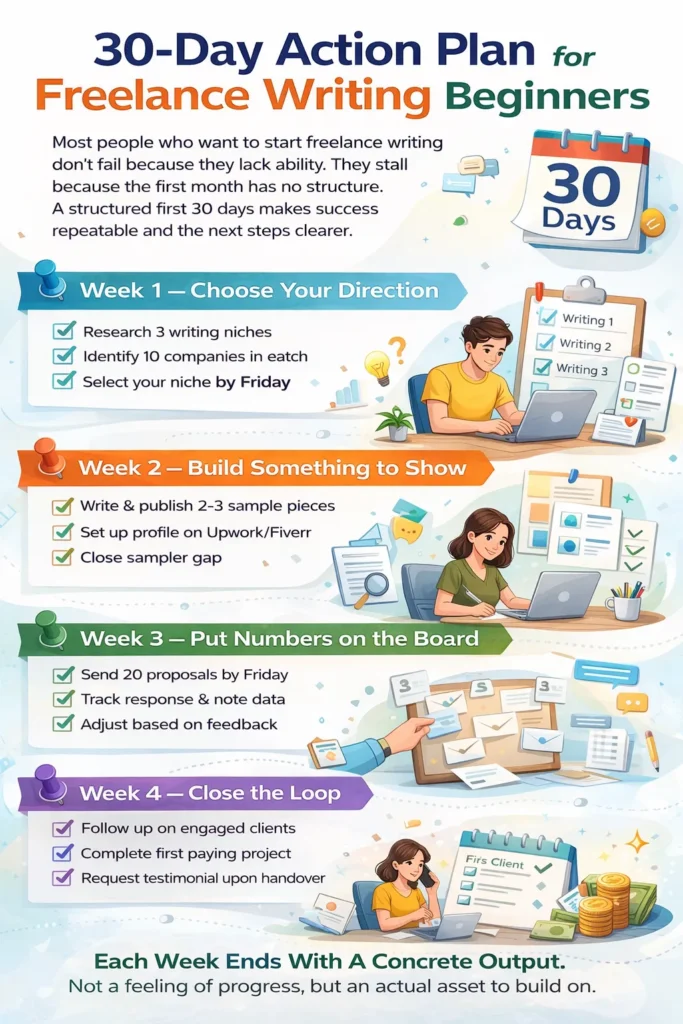
Week 1 — Choose Your Direction. Research three potential writing niches. For each one, identify 10 companies that publish content regularly and note the quality and frequency of what they produce. By the end of the week, choose the niche where market demand is clearest and your existing knowledge is most applicable. This decision is not permanent—but making it is what makes everything else possible. By Friday, you have a direction. That alone puts you ahead of the majority of people who say they want to start freelancing.
Week 2 — Build Something to Show. Write two or three sample pieces in your chosen niche using a specific, client-realistic brief (see Step 2 above). Publish them on Medium or in a well-organized Google Doc folder. Set up a profile on Upwork or Fiverr with a description that names your niche, your content type, and who you write for. By the end of Week 2, you have something most applicants don’t: a reason for clients to say yes. A profile without samples is a pitch without proof. This week closes that gap.
Week 3 — Put Numbers on the Board. Send 20 proposals. The number matters more than the perfection of any single one, because early proposals are data collection as much as they are outreach. Track which opening lines generate replies, which niches attract more responses, which platforms feel more active. Adjust the approach mid-week if early results signal a direction. By Friday, you have real-world feedback on your positioning—something no amount of research before sending produces.
Week 4 — Close the Loop. Follow up on any proposal that received engagement. Close the first project at whatever rate gets the work done, deliver it to a standard that earns a testimonial, and ask for one explicitly at handover. That testimonial is not a nice addition to your profile—it is the single asset that makes Week 1 of the next month structurally different from Week 1 of this one. The cycle that began with a niche decision ends with proof of delivery. What follows compounds from there.
Frequently Asked Questions
Is freelance writing a good side hustle in 2026?
Freelance writing remains one of the most accessible online side hustles available because the barrier to entry is low, the tools required are minimal, and demand for quality written content continues to grow alongside the volume of content being produced. The qualification is that income scales with specialization—writers who develop genuine niche expertise earn substantially more than those who remain generalists.
Can complete beginners start freelance writing without experience?
Yes, with a specific approach. The prerequisite is not prior client work—it is the ability to produce sample pieces that demonstrate understanding of a format and audience. Beginning with lower-rate projects on platforms like Upwork or Fiverr provides the first client relationships and testimonials that unlock higher-rate work over time.
How long does it take to earn $1,000 per month from freelance writing?
Most beginners who follow a structured approach—niche selection, portfolio samples, consistent outreach—reach $1,000 per month within three to six months. The variables are outreach volume, niche selection, and the rate at which early feedback is incorporated. Writers who send 20+ proposals per week and adjust their approach based on response data tend to reach this threshold faster.
Do I need a degree to become a freelance writer?
No degree is required. Clients evaluate samples and proposal quality, not credentials. A background in a relevant field (finance, technology, healthcare) can accelerate niche positioning, but the determining factor is always the quality of the writing itself and the writer’s demonstrated understanding of the client’s needs.
How do I find clients as a new freelance writer?
The most reliable starting path combines platform work with direct outreach. Upwork and Fiverr provide access to clients who are already searching for writers; direct email outreach targets companies that may not have considered hiring freelance help. LinkedIn is particularly productive for writers focused on B2B content, where marketing managers are accessible and often receptive to writers who demonstrate specific knowledge of their industry.
The Strategic Takeaway
Freelance writing in 2026 positions writers to generate meaningful supplemental income with a relatively short runway from start to first payment. The structural advantage lies in specialization: writers who develop expertise in high-demand niches, such as SEO content, SaaS writing, and technical documentation, occupy a market segment that AI tools and commodity competition have not eroded. What this requires is not talent in some innate sense, but a methodical approach to building credibility, raising rates over time, and concentrating effort where client demand is clearest.
What separates writers who sustain income from those who plateau after the first few projects is rarely the quality of their prose. It is the consistency of their outreach. Writers who treat proposal-sending as a weekly non-negotiable—not something done when inspiration strikes accumulate client relationships at a rate that compounds. Each completed project produces a testimonial. Each testimonial improves conversion on the next proposal. Each rate increase reflects demonstrated rather than assumed value. The mechanism is straightforward; the discipline required to execute it is what most people underestimate.
The 30-day plan above is not aspirational scaffolding, it is a functional sequence that produces the specific outputs (portfolio, profile, proposals, first client) that compound into sustainable income. The writers who follow it consistently, even imperfectly, tend to see results. The writers who wait until they feel ready tend not to start at all.
Start with the niche. Build the samples. Send the proposals. The rest follows from the work itself.