Imagine spending months writing a detailed guide, ranking on page one of Google, and still watching your traffic fall month after month.
That is not a hypothetical. It is what thousands of website owners are experiencing right now because of Google Zero Search Traffic: the moment when Google’s AI answers your reader’s question before they ever reach your site.
The phrase gained serious attention after Roger Lynch, CEO of Condé Nast (the company behind Vogue and Vanity Fair), told his teams to plan as if Google sends them zero traffic. Then Google I/O 2026 arrived and made the concern much harder to dismiss.
For bloggers, affiliate marketers, students building side income, and anyone running a content website — especially in India where English-language content is growing fast, this shift demands a clear-eyed response. Not panic. A plan.
What Is Google Zero Search Traffic, and Why Is Everyone Talking About It Now?
Google Zero Search Traffic refers to a future (already partially here) where Google’s AI features answer user questions directly on the search page, leaving no reason for the user to click through to any website.
The term “Google Zero” was popularized after Roger Lynch of Condé Nast used it internally. He clarified he does not expect traffic to literally hit zero, but he does expect it to shrink to a single-digit percentage of total referrals for publishers who rely on search-driven content.
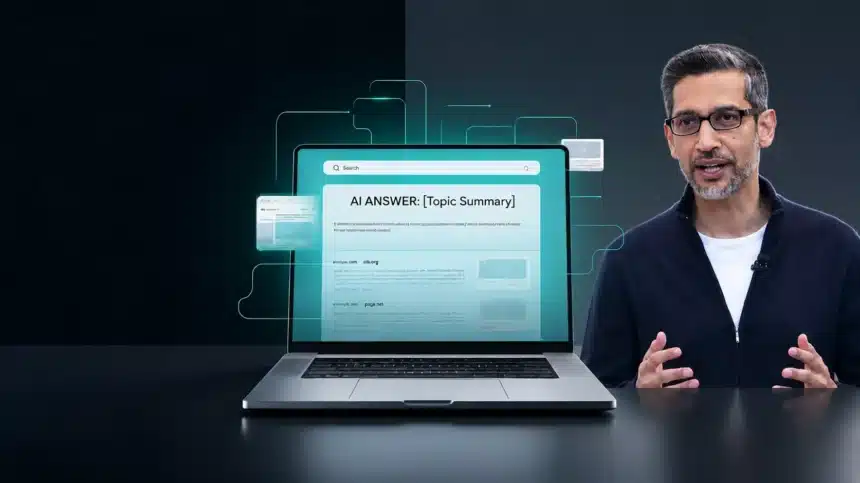
What made this more serious is what Google unveiled at its annual developer conference on May 19-20, 2026. Google Search VP Liz Reid announced that AI Mode is now available in over 200 countries, with conversational AI queries growing rapidly. The interface is no longer just a search box. It is an AI assistant that researches, summarizes, and responds, often without sending the user anywhere else.
Google CEO Sundar Pichai, speaking on the NYT Hard Fork podcast after Google I/O 2026, pushed back on the idea that links will disappear. He described Search’s transformation as “a continuum” in which “sources and links will always be there as part of it.” That is a reassuring statement, but the data tells a more complicated story.
The Real Numbers: How Much Traffic Has Already Been Lost?
This is not speculation. The traffic declines are measurable, documented, and accelerating.
According to Similarweb data cited by Search Engine Journal, zero-click searches now make up 69% of all Google queries. That means for every 10 searches, nearly 7 end without a single website being visited.
The situation is sharper when AI Overviews are present. SparkToro and Exposure Ninja report that when an AI Overview appears, the zero-click rate hits 80 to 83%. The user asked. Google answered. Your page never loaded.
For publishers specifically, Chartbeat tracked 2,500+ news sites globally and found Google search referrals declined by 33% in 2025 alone. A Similarweb report published in 2026 found traffic to news sites dropped 26% in the 12 months after Google launched AI Overviews.
People Inc., the parent company of People magazine and Entertainment Weekly, saw its Google Search traffic fall from 65% of total traffic (three years ago) to the high 20% range today. Business Insider reported a 55% drop in monthly search traffic between April 2022 and April 2025.
The Reuters Institute for the Study of Journalism surveyed media executives worldwide and found they expect search traffic to decline by 43% on average over the next three years. About one in five respondents expected losses above 75%.
These are not small websites. They are large, well-funded publishers. For a student blogger or independent affiliate site in India, the margin for error is even smaller.
Why This Matters for Bloggers and Online Earners
The Google Zero conversation has mostly been covered through the lens of large Western publishers. The real story for EduEarnHub readers is different, and in some ways more urgent.
Google expanded AI Overviews to India, the UK, Japan, Indonesia, Mexico, and Brazil in August 2024, and then rolled it out to 100+ additional countries by October 2024. AI Mode is now available in 200+ countries. This means Indian websites, Hindi and English both, are now subject to the same zero-click dynamics.
Consider what this means for common content categories in India:
Informational queries (“what is GST”, “how to apply for a PAN card”, “difference between mutual fund and SIP”) are exactly the type of query AI Overviews answer completely. A page ranking #1 for “how to calculate income tax” may now receive 34.5% fewer clicks even without dropping a single position, according to Ahrefs data cited by 12AM Agency.
Affiliate content built around product comparisons and “best of” lists is also under pressure. Lifestyle, utility, and “best of” content have seen the steepest AI Overview growth of any category in 2025, which means recipe blogs, gadget comparison sites, and consumer product guides are among the hardest hit.
Tutorial and how-to content is now being answered inline. A student who once searched “how to use Excel VLOOKUP” and clicked through to a tutorial blog now gets the steps directly from Google. This is useful for the student but damaging for the tutorial site’s traffic and AdSense revenue.
Neemesh encountered this directly while building content on NoCostTools.com. Pages targeting utility-based queries (word counters, converters, generators) started showing reduced click volume despite maintaining page-one positions, because Google increasingly surfaces tool-like answers and featured snippets that resolve the query without requiring a click. The response was to build actual interactive tools, not just content about tools. That structural distinction — content that requires interaction versus content that just informs — has become one of the most important traffic variables of 2026.
What Content Types Are Most at Risk?
Not all content is equally affected. The 12AM Agency analysis of publisher data identifies a clear pattern:
Content with a narrow information gap is most at risk. This means any query where the full answer fits in a paragraph: definitions, simple how-tos, basic comparisons, FAQs with short answers, and beginner-level explainers.
Organic CTR for “What is” and “Definition” type queries has dropped by 61% since AI Overviews became widespread. The #1 blue link now sees a 34.5% CTR decline when an AI Overview sits above it.
Content with a wide information gap holds up better: original research, step-by-step processes requiring human judgment, niche expertise that AI cannot synthesize accurately, tools and calculators, community forums, and deep-dive analysis with unique data.
This distinction matters for planning. If your content strategy is built around surface-level explanations and basic listicles, the pressure will continue. If it is built around original insight, useful tools, and trusted expertise, the picture is more durable. You can also read our guide on how to become AI literate to understand how AI systems evaluate and use content, which directly informs how to write for this new environment.
What Is GEO, and Why Do Bloggers Need to Understand It?
GEO stands for Generative Engine Optimization. It is the discipline of structuring content so that AI systems (Google AI Overviews, ChatGPT, Perplexity, Bing Copilot) can easily extract, cite, and recommend it.
Traditional SEO is optimized for a search engine’s crawl and ranking algorithm. GEO optimizes for an AI’s synthesis and citation behavior.
Search Engine Land describes GEO as a long-term visibility discipline: content that is easy for AI systems to retrieve, understand, and reuse is most likely to appear in generative AI responses. AI systems pull individual passages, not full pages, which means structure and clarity matter more than length.
The core GEO practices are:
Answer-first formatting. Write a direct, self-contained answer to the main question in the first 100 words of each section. AI systems are trained to extract these passages.
Question-based headings. Structure sections around questions your audience actually asks. This maps to how AI breaks down complex queries into sub-queries before searching.
Source citations. AI systems evaluate source credibility when deciding which pages to cite. Pages that link to authoritative external sources are more likely to be cited themselves.
Schema markup. Article, FAQ, and Author schema help AI systems parse and attribute content correctly. This is now standard practice for sites that want visibility in AI-generated answers.
Original data and statistics. AI systems preferentially cite sources that contain unique, specific, verifiable data. A post with original survey results or first-hand case study data is more citable than a post summarizing what others have already published.
Brands cited in AI Overviews receive 120% more organic clicks per impression than non-cited sources, according to Seer’s April 2026 analysis. Being cited in an AI answer is now a meaningful traffic source in its own right.
For a deeper look at the AI tools shaping how content is created and optimized in 2026, that guide is worth reading alongside this one.
How to Build Traffic That Does Not Depend on Google
The most durable long-term response to Google Zero is not just better SEO. It is owning a direct relationship with your audience.
Ben Smith, editor-in-chief of Semafor, put it clearly when he told Forbes that his company intentionally built around direct audience relationships instead of search traffic. “We’ve built around a direct connection to a highest-common-denominator audience and so don’t anticipate being affected,” he said. Semafor is a relatively young publication, which shows this approach is viable for new entrants.
The practical equivalent for bloggers and content site owners involves several parallel strategies:
Email list building. An email subscriber is a direct relationship that Google cannot interrupt. Medium suggests building email lists, SMS communities, and branded apps as the primary defense against algorithm volatility. Even a list of 2,000 engaged subscribers in a niche generates more reliable traffic than 10,000 monthly visitors from search.
Branded search. When someone searches for your site or your name specifically, that is a branded query. Google does not intercept these with AI Overviews. Building brand recognition through consistent publishing, social presence, and community participation creates a traffic channel AI cannot absorb.
Interactive tools and resources. This is the highest-value content format right now. A calculator, a template, a quiz, or a downloadable resource requires the user to visit the page. AI cannot replicate an interactive tool inline. Neemesh’s experience with NoCostTools confirms this: tools pages consistently outperform pure content pages in terms of traffic resilience.
Niche depth over breadth. Search Engine Land notes that focused niche sites can outperform larger brands when their expertise is clearer, better structured, and tightly aligned with specific audience needs. Smaller sites do not need to compete with Wikipedia or major publishers. They need to own a specific, well-defined topic cluster.
If you are thinking about what skills generate reliable income in this environment, the highest-paying skills in 2026 are increasingly those that cannot be automated: strategic consulting, technical problem-solving, client relationship management, and original content production.
What Google’s Response Actually Means
Sundar Pichai’s statement that Search is “a continuum” and that links will remain part of it is worth taking seriously, but not at face value.
Google has also acknowledged that AI Overviews can be “more opinionated than they should be.” In a separate interview with Nilay Patel on The Decoder podcast after Google I/O 2026, Pichai responded to a live search result by saying the AI answer was “probably more opinionated than it should be for the particular query.” That is an honest acknowledgment that the system is still being calibrated.
Penske Media Corporation, publisher of Rolling Stone, Variety, and The Hollywood Reporter, filed a federal antitrust lawsuit against Google in February 2026, alleging that AI Overviews “cannibalize” publisher traffic by using publisher content to generate answers that eliminate the traffic publishers once received in return for providing that content. The legal battle will likely take years, but it represents a formal challenge to the economics of the current arrangement.
The practical implication is that Google is under real pressure, both reputational and legal, to ensure publishers continue receiving meaningful traffic. That may result in adjustments to how AI Overviews cite and link to sources. Sites that have already invested in GEO and source-backed content will be best positioned to benefit when those adjustments arrive.
A Practical Checklist for Bloggers in 2026
Based on everything above, here is a concrete starting point for any blogger or content site owner evaluating their position:
Audit your content for information gap width. Go through your top 20 pages by traffic. Which ones answer a question in one paragraph? Those are at highest risk. Flag them for either expansion (add depth, original examples, downloadable resources) or consolidation.
Add answer capsules to every section. For each major heading in your posts, write a 40-60-word direct answer at the top of the section. This makes content GEO-friendly without requiring a full rewrite.
Start an email list this week. The best time to start was two years ago. The second-best time is now. Even a simple newsletter sign-up with a useful lead magnet creates a direct audience relationship.
Add one interactive element per key page. A calculator, a comparison table, a checklist, or a downloadable template turns a static content page into something that requires a user to engage.
Check your schema markup. At minimum, add Article schema and Author schema to every post, and FAQ schema to any post with a questions section. This costs nothing and directly improves AI citation eligibility.
Understanding the AI tools available to support this work is a practical next step for anyone who wants to implement these changes without spending excessive time on technical setup.
Conclusion
Google Zero Search Traffic is not a prediction anymore. It is a measurable, ongoing shift in how search sends (or does not send) traffic to websites. The data is clear: 58% of Google searches end without a click, AI Overviews reduce CTR by 34.5% for the top result, and publishers worldwide are planning for a future with significantly less Google-driven traffic.
What this means for bloggers, students, and online earners in India is not collapse, it is a change in what kind of content and what kind of audience-building actually works.
The websites that survive and grow through this shift are the ones building original insight, interactive tools, niche expertise, and direct audience relationships. Google can answer a generic question. It cannot replicate a trusted voice in a specific community.
The three key takeaways: stop building content that AI can summarize in a sentence; start building content that requires human presence to use; and build an email list before you need it.
Have you noticed a change in your website traffic over the past year, and what has been the biggest shift in your content strategy as a result? Share your experience in the comments below.
Frequently Asked Questions
What is Google Zero Search Traffic?
Google Zero Search Traffic refers to the growing concern that Google’s AI-powered search features will reduce meaningful clicks to external websites to near zero. Rather than linking users to publishers, Google increasingly answers queries directly through AI Overviews and AI Mode. As of 2026, 58% of Google searches already end without a single click to any website, according to SparkToro data. The term was popularized after Condé Nast CEO Roger Lynch told his teams to plan as if search traffic were zero.
How much has Google traffic actually dropped for websites?
The declines are substantial and measurable. Chartbeat data covering 2,500+ news sites shows a 33% year-over-year decline in Google search referrals during 2025. Traffic to news sites fell 26% in the 12 months after AI Overviews launched, according to a Similarweb report. Individual sites have seen larger drops: Business Insider reported a 55% decline in monthly search traffic between April 2022 and April 2025, and some publishers have seen click-through rates fall by as much as 89% for specific queries.
Does Google Zero affect Indian bloggers, too?
Yes. Google expanded AI Overviews to India in August 2024 and then to 100+ additional countries by October 2024. AI Mode is now available in 200+ countries, including India. This means all content categories, informational guides, affiliate product reviews, tutorials, and how-to content are subject to the same zero-click dynamics that have reduced traffic for publishers globally.
What is GEO, and how is it different from SEO?
Generative Engine Optimization (GEO) is the practice of structuring content so that AI systems like Google AI Overviews, ChatGPT, and Perplexity can extract, cite, and recommend it. Traditional SEO optimizes for search engine rankings. GEO optimizes for AI citation behavior. The key GEO practices include answer-first formatting, question-based headings, source citations, schema markup, and original data. Sites cited in AI Overviews receive 120% more organic clicks per impression than non-cited sources, according to Seer’s April 2026 data.
What is the most effective strategy for protecting website traffic in 2026?
The most durable strategy combines GEO-optimized content with direct audience building. On the content side: write answer-first sections, add FAQ schema, include original data, and build interactive tools that require user engagement. On the audience side: build an email list, pursue branded search recognition, and focus on niche depth rather than breadth. The Semafor model, direct audience relationships rather than search dependency, is increasingly cited as the most resilient publishing approach. Small niche sites can outperform large publishers when their expertise is clearly defined and well-structured.