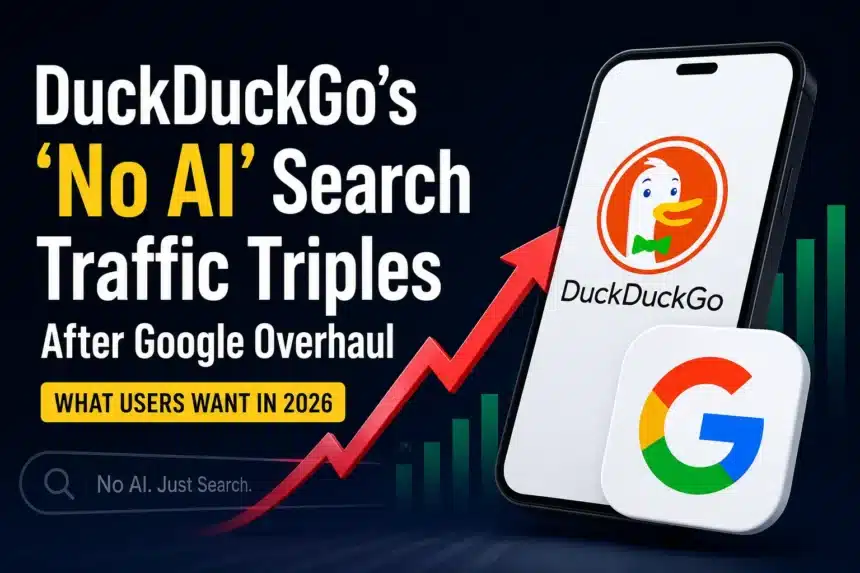
TL;DR: DuckDuckGo No AI search page saw visits triple after Google announced the biggest overhaul to its search box in 25 years at I/O 2026. The surge doesn’t mean users hate AI. It means a significant number of people want control over when and how AI appears in their results. For students, website owners, and digital creators, understanding this shift is now essential for navigating search in 2026.
For 25 years, Googling something meant one thing: type a few words, get ten blue links. That changed on May 19, 2026. At its annual I/O developer conference, Google declared the traditional search format over and replaced it with an AI-powered experience built on Gemini 3.5 Flash. The backlash was immediate. Within days, traffic to DuckDuckGo’s No AI search page had tripled, and it was still climbing.
The data doesn’t suggest people hate AI. It suggests something more precise: a meaningful portion of users never asked for AI to be the default, and now they’re actively looking for a way out. That distinction matters. It shifts the story from a simple rejection narrative to a deeper question about user autonomy in search, and what it means for students, bloggers, and anyone who depends on search traffic.
This article explains what happened, what DuckDuckGo No AI search actually does, and why the real lesson isn’t about technology preferences. It’s about control.
What Is DuckDuckGo No AI Search, and How Does It Work?
DuckDuckGo No AI search is an opt-in version of the DuckDuckGo search engine, accessible at noai.duckduckgo.com, that removes all AI-generated content from the results page. No AI summaries, no conversational chat interface, and no AI-generated images. Users get traditional web search results, the same ranked list of links that defined search for two decades, without any generative layer on top.
The feature was already available before Google’s I/O 2026 announcement, but most users didn’t know it existed. According to MacRumors, traffic hit the 3x mark on May 28, 2026, and visits had been running roughly 84 percent above baseline consistently since May 19. DuckDuckGo responded by promoting browser extensions for Chrome and Firefox that let users set the No AI page as their default address bar search engine.
This matters because it signals that demand for AI-free search isn’t a fringe position. It reflects a structural preference held by a segment of users large enough to triple traffic to a single feature page within ten days of a competitor’s announcement.
What Google Changed at I/O 2026
Google’s I/O 2026 keynote introduced what the company called the biggest upgrade to its search box in over 25 years. The traditional text input bar was replaced with an intelligent search box built on Gemini 3.5 Flash. It accepts text, images, files, and Chrome tab content. It supports conversational follow-ups and generates interactive tools directly within the results page.
The scale behind the announcement is significant. AI Mode, launched just a year earlier, had already crossed one billion monthly users, with queries more than doubling every quarter. AI Overviews, the feature that places AI-generated summaries above traditional results, now reaches 2.5 billion monthly users globally.
Google also introduced Information Agents: persistent AI processes that run 24/7 in the background, monitoring topics on your behalf and delivering synthesized updates when something changes. These agents are positioned as the next evolution of Google Alerts, available to AI Pro and Ultra subscribers in the US starting summer 2026.
This is directly relevant to readers exploring Google’s broader AI trajectory and those tracking how AI competition is reshaping the global search landscape. The I/O 2026 changes don’t represent a product update. They represent a structural shift in how the world’s most-used software handles information retrieval.
Why Did DuckDuckGo’s No AI Traffic Triple?
The response to Google’s announcement was sharp and measurable. TechCrunch reported that DuckDuckGo app installs rose 21 percent week-over-week in the US from May 20 through May 26. iOS installs jumped 33 percent, including a 69 percent spike on Memorial Day. And traffic to the No AI search page tripled within ten days of the announcement.
The reason isn’t difficult to trace. DuckDuckGo CEO Gabriel Weinberg framed it directly: “Google is force-feeding AI with no way to opt out.” That framing resonated because it matched the experience many users described. AI Overviews sometimes surface inaccurate responses. Conversational results can feel like interference for users who simply want a fast, traditional search. And the absence of a native opt-out in Google’s default interface left users with few options.
The data support a broader pattern. A DuckDuckGo survey of over 175,000 visitors found that more than 90 percent opposed mandatory AI integration in search results. The No AI traffic surge is consistent with that sentiment at scale.
The significance lies in what it reveals about user agency. When a platform removes the opt-out, users find a different platform that provides one.
Are Users Rejecting AI, or Rejecting the Loss of Choice?
The framing of this story matters more than most coverage suggests. The data doesn’t indicate that users reject AI. It indicates that users want control over when AI appears.
DuckDuckGo positions itself as “pro-choice, not anti-AI.” This isn’t just messaging. The company runs duck.ai, an AI-maximalist experience offering access to models from OpenAI, Anthropic, Meta, and Mistral. It also offers Search Assist, a feature comparable to Google’s AI Overviews, which is optional and can be turned off entirely. The same platform that saw its No AI page traffic triple also reports that its AI features rank among its most-used products.
As DuckDuckGo’s product team explained, the goal is for AI to “be present when it is helpful and tucked away when you would like to invoke it.” This is a fundamentally different product philosophy from Google’s default-on approach. One treats AI as infrastructure the user can route around. The other treats it as the primary interface with no native escape.
The practical implication is that both free AI tools and traditional search serve real user needs. The issue isn’t which one is better. It’s whether users get to choose.
What This Means for Students and Researchers
AI-assisted search is faster. For many queries, an AI Overview or a conversational answer saves genuine time. A student researching a historical event, looking up a definition, or summarizing a concept can get a direct response without reading through multiple sources. The speed benefit is real.
The problem is what gets lost when that becomes the default. Traditional search develops a skill that AI summaries don’t: the ability to evaluate sources, identify credibility signals, compare conflicting evidence, and reach an independent conclusion. These are the same skills that academic writing, professional research, and critical thinking depend on.
Neemesh, who has spent 15 years teaching STEM and computer science, has observed this pattern consistently. Students who rely on AI-generated summaries without verifying the underlying sources tend to miss context errors that only appear when reading the original material. The answer may be technically correct, while the framing is misleading.
The practical approach is to use both tools for what they’re actually good at. AI search works well for rapid orientation, definitions, and first-pass research. Traditional search, including DuckDuckGo No AI search or a structured library database, works better when source quality and reasoning accuracy matter. Students who want to strengthen their research foundations should also work on how to become AI literate rather than simply learning to use AI tools, and explore the wider landscape of AI tools designed specifically for students.
The ability to switch between AI-assisted and traditional search depending on task type is itself a skill worth building.
What This Means for Website Owners and Bloggers
The I/O 2026 announcement has direct consequences for anyone who depends on organic search traffic. The trend that is accelerating was already underway, but the scale is now harder to ignore.
As of early 2026, approximately 58 percent of Google searches end without a single click to any website. When an AI Overview is present in the results, that figure rises to 83 percent. Seer Interactive’s analysis of 25.1 million impressions found that organic click-through rate dropped from 1.76 percent to 0.61 percent on queries where AI Overviews appear, a relative decline of approximately 61 percent. For publishers whose traffic skews toward informational, how-to, or definitional content, the practical impact is significant.
This reflects a broader trend. The Reuters Institute reported in January 2026 that media executives worldwide expected search engine referrals to fall by 43 percent over the next three years due to AI summaries and chatbots. That projection now looks conservative given the scale of Google’s I/O redesign.
When Neemesh built the utility tool pages on NoCostTools.com, the pattern became visible quickly. Informational queries, particularly short-tail definitional queries like “what is a JSON formatter” or “how does a QR code work,” increasingly triggered AI Overviews that answered the question before users ever reached the site. The queries that still drove clicks were the ones where users needed a tool, not just an explanation.
The implication for website owners is structural, not tactical. Content that competes directly with AI Overviews on surface-level information will see continued pressure. Content that offers depth, original data, expert perspective, and genuine utility beyond what a summary can capture is more defensible. Brand authority, which signals to both users and algorithms that a source is worth clicking through to, becomes proportionally more valuable as AI absorbs the generic layer of search results. Traffic diversification, including scaling Pinterest and other non-Google channels, is increasingly worth the investment.
The shift from traditional SEO to what practitioners now call Answer Engine Optimization (AEO) isn’t a future consideration. It’s the current operating environment.
Key Takeaways
The DuckDuckGo No AI search story is easy to misread as a technology rejection narrative. The underlying data tells a more precise story.
A significant share of search users want choice over AI integration, not its removal. DuckDuckGo tripling traffic on a single feature page is a market signal, not a cultural statement. It reflects what happens when a major platform removes a meaningful opt-out and a competitor offers one. The reaction was fast, measurable, and still rising as of May 31, 2026.
For students, the takeaway is methodological: AI search and traditional search serve different purposes, and using both deliberately produces better research outcomes than defaulting to one. For website owners and bloggers, the signal is structural: content depth, brand authority, and traffic diversification matter more now than at any point in the past decade of SEO.
The most durable insight from this story isn’t that AI search is taking over. It’s that users are more aware of how their information environment is shaped than search platforms tend to assume.
If you’re thinking about how these changes affect your own search habits or your website’s traffic strategy, share your perspective in the comments below. What’s your current approach: AI-first, traditional search, or something in between?
Frequently Asked Questions
What is DuckDuckGo No AI search? DuckDuckGo No AI search is an opt-in version of DuckDuckGo available at noai.duckduckgo.com. It removes AI-generated summaries, the AI chat interface, and AI-created images from search results, delivering traditional web links instead. Users can set it as their default through browser extensions for Chrome and Firefox.
Why did DuckDuckGo’s No AI traffic triple in 2026? Traffic tripled following Google’s I/O 2026 announcement, which introduced the biggest overhaul to Google Search in over 25 years. The redesign made AI the default search interface with no native opt-out. Many users who preferred traditional results turned to DuckDuckGo’s No AI page as an alternative, with visits averaging 84 percent above baseline for the ten days following the announcement.
Is DuckDuckGo anti-AI? No. DuckDuckGo positions itself as “pro-choice, not anti-AI.” The company runs duck.ai, an AI-maximalist product offering access to models from Anthropic, OpenAI, Meta, and Mistral. It also offers Search Assist, an optional AI Overviews-style feature. The No AI page exists alongside these tools as a choice for users who prefer traditional search.
How does Google’s AI search overhaul affect website traffic? Google’s AI integration has accelerated the zero-click trend. As of early 2026, approximately 58 percent of Google searches end without a click to any website, rising to 83 percent when an AI Overview is present. Organic click-through rates have dropped roughly 61 percent on queries where AI Overviews appear. Publishers and bloggers in informational niches are most affected.
Should students use AI search or traditional search? The most effective approach is to use both, depending on the task. AI search is faster for orientation, definitions, and first-pass research. Traditional search is more reliable when source credibility, competing perspectives, and reasoning accuracy matter. Building the judgment to switch between them is itself a valuable research skill for academic and professional work.