Nvidia spent the last few years selling the picks and shovels of the AI gold rush. Now it wants to mine some gold too.
With Nvidia Nemotron 3 Ultra, the company that powers almost every major AI model is releasing one of its own, in the open, for anyone to download and run. And it’s aimed at the part of AI everyone is betting on next: agents that work on their own for hours at a time.
This is a bigger deal than another model launch. It’s Nvidia making a claim on the software layer of AI, the part it has so far left to everyone else.
What is Nvidia Nemotron 3 Ultra?
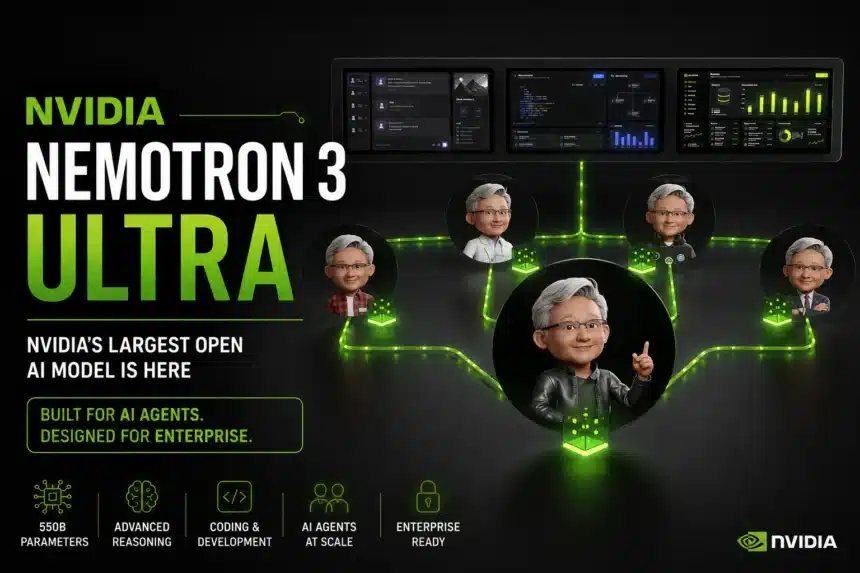
Nemotron 3 Ultra is Nvidia’s most capable open-weight AI model, with 550 billion total parameters and 55 billion active per token. It uses a hybrid Mixture-of-Experts design built for AI agents that run long, complex tasks like coding, deep research, and enterprise automation.
“Open-weight” is the part that matters for most people. Models like ChatGPT and Gemini keep their internals locked behind an API. You send a request, you get an answer, and you never see what’s inside. Open-weight models hand you the actual parameters. Anyone can download, modify, and run them freely.
Nvidia went further than most. It released the model fully open: open weights, open training data, and open recipes. So you can see the finished model and also how it was built and what it learned from.
It’s the top of a three-model lineup. The Nemotron 3 family comes in Nano, Super, and Ultra sizes. Nano is tiny and fast for high-volume work, Super (120B) sits in the middle, and Ultra is the heavyweight reasoning engine.
Why this launch actually matters
Here’s the thing most coverage misses. Nvidia doesn’t need to sell AI models to make money. It already sells the chips that everyone else needs to train and run their models. So why bother?
Because owning the hardware isn’t the same as owning what gets built on it.
Right now, when a company builds an AI agent, they pick a model from OpenAI or Anthropic or Google, and those companies decide the terms. Nvidia sells everyone the GPUs underneath, but it has no say in the layer customers actually interact with. Nemotron 3 Ultra changes that math.
Nvidia wants developers building agents on its models, on top of buying its chips. The open license is the lure. Give away a capable model for free, get developers hooked on the Nvidia software stack, and the GPU sales follow naturally because Nemotron runs best on Nvidia’s own Blackwell chips.
It’s a classic platform play. The model is the bait. The infrastructure is the business.
How big is Nemotron 3 Ultra, really?
550 billion parameters sounds enormous, and it is. But the interesting trick is that only 55 billion of them fire on any given token.
That’s what Mixture-of-Experts (MoE) does. Picture a hospital. A traditional dense model is like making every single doctor examine every single patient, the cardiologist, the dermatologist, the pediatrician, all of them, every time. Slow and wasteful.
MoE is like a smart front desk that routes you to the two or three specialists you actually need. Same depth of expertise available, fraction of the effort spent.
Dense model:   every "expert" runs on every token
MoE model:     only the relevant experts run on each token
The payoff is real. You get the knowledge of a 550B model at roughly the running cost of a 55B one. Cheaper to host, faster to respond, easier to scale across a lot of users.
And the real story is the architecture, even more than the parameter count.
The Mamba twist that keeps agents fast
Most frontier models are pure transformers. Transformers have a problem that gets worse the longer they work: attention cost grows with the square of the context length. Double the conversation, quadruple the work per step.
For a chatbot answering one question, who cares. For an agent grinding through 300 steps of a coding task, it’s fatal. The agent that flew through its first ten steps crawls through its three-hundredth.
Nvidia’s fix: build the model mostly from Mamba layers instead of attention. Mamba keeps a fixed-size running summary instead of re-reading the entire transcript every step. Updating that summary on step 300 costs the same as it did on step 3.
Nemotron mixes both. Most layers are Mamba for speed, with a smaller number of attention layers kept in for the moments that need precision. The result, per Nvidia: up to 5x faster inference and up to 30% lower cost compared with other open frontier models in its class.
So calling Ultra Nvidia’s “biggest” model is true but slightly beside the point. The whole engineering effort went into making it feel small and quick on jobs that would bog down everything else.
What can Nemotron 3 Ultra do?
It’s built for agents, so its skills cluster around tasks that take many steps and a lot of context. It supports a 1 million token context window, which is a fancy way of saying it can hold a huge amount of information in its head at once.
| Capability | What it handles |
|---|---|
| Reasoning | Multi-step planning, synthesizing conflicting evidence |
| Coding | Multi-file refactors, error recovery across long sessions |
| Agents | Tool calling, orchestration across hundreds of steps |
| Enterprise automation | All-day tool-using loops, alert triage, operations |
| Knowledge retrieval | Deep research across hundreds of sources |
| Multilingual | General-knowledge work across languages |
Nvidia trained it for the hard calls inside an agent workflow: sustaining architectural decisions across coding sessions, synthesizing contradictory evidence across research sources, or verifying chip designs across thousands of constraints.
Nvidia’s big bet on AI agents
The reason this model exists in this shape is that the industry has decided 2026 is the year of the agent.
An agent isn’t a chatbot. A chatbot answers one question and stops. An agent gets a goal, makes a plan, calls tools, reads files, checks its work, and keeps going until the job is done. These are systems that plan, call tools, inspect files, write code, remember context and keep working across a chain of tasks.
Where this shows up in practice:
- Customer support agents that pull from internal docs and resolve tickets end to end
- Coding agents that take a GitHub issue and ship a fix
- Research agents that read hundreds of sources and write you a synthesis
- Enterprise automation that triages thousands of security alerts overnight
Nvidia isn’t subtle about who it expects to use this. CrowdStrike and Palantir are already building long-running AI agents on Nemotron models for cybersecurity and operational decision-making. And it’s post-trained to work with agent frameworks like LangChain Deep Agents, OpenHands, and OpenCode.
How does it compare with GPT, Claude, and Gemini?
This is where you need to separate two different questions: how smart is it, and how open is it.
On raw intelligence, it’s good but not the best. On Artificial Analysis’s intelligence ranking, Nemotron 3 Ultra scores 48, well ahead of other open US models like Gemma 4 31B at 39 and gpt-oss-120b at 33. So among American open models, it wins comfortably.
The global picture is humbler. China’s Kimi K2.6 scores 54, and the strongest closed model, Claude Opus 4.8, hits 61. So Nvidia made the best open model in the US, while a Chinese lab still holds the open-model crown overall.
| Model | Open weights? | Intelligence Index | Best for |
|---|---|---|---|
| Nemotron 3 Ultra | Yes | 48 | Fast, self-hosted agents |
| Kimi K2.6 (China) | Yes | 54 | Strongest open model overall |
| gpt-oss-120b | Yes | 33 | Lightweight open option |
| Claude Opus 4.8 | No | 61 | Top closed reasoning |
| GPT-5.5 | No | ~60 | Top closed, broad use |
| Gemini 3.1 Pro | No | 57 | Top closed, Google stack |
Numbers from Artificial Analysis as of early June 2026. Benchmarks shift fast, so treat these as a snapshot.
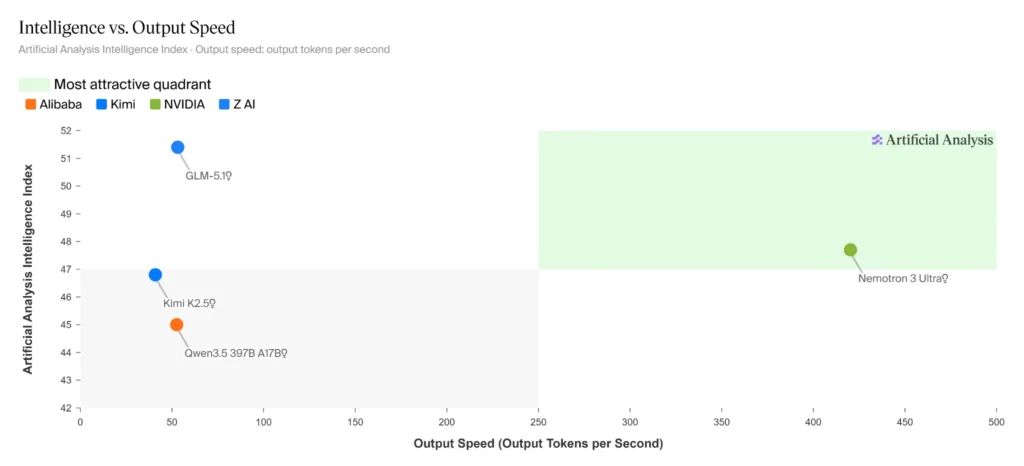
Where Nemotron pulls ahead is speed and control. On the provider DeepInfra it delivers more than 300 tokens per second, far quicker than many rivals. And because you can download it, you can fine-tune it and run it on your own machines, which no closed API lets you do.
What this means for developers
If you build with AI, the open weights are the real gift.
Closed API models like GPT and Claude don’t expose their weights, so you can’t fine-tune them on your own proprietary data. With Nemotron 3 Ultra you can. Feed it your internal vocabulary, your specialized reasoning patterns, your confidential product data, and it learns them.
The practical wins:
- Self-hosting. Run it on your own GPUs, no per-token API bill
- Fine-tuning. Adapt it to your exact domain instead of prompt-engineering around a black box
- Less vendor lock-in. You’re not betting your product on one company’s pricing or terms
The catch, and it’s a big one: you need the hardware. Hugging Face is free to use with no rate limits, but you supply your own GPU infrastructure. A 550B model is not running on your laptop. So “free and open” still means “expensive to host” unless you go through a managed provider.
What this means for businesses
For companies, the pull is data control and compliance.
Sending data to a third-party API means your data leaves your infrastructure, which creates compliance overhead for regulated industries like healthcare, finance, and legal. Self-hosting Nemotron on your own servers keeps everything inside your walls.
That’s the whole pitch for an enterprise:
- Private deployments behind your own firewall
- Data security, because nothing goes to an outside API
- Compliance in regulated industries where data residency is a legal requirement
- Cost control at high volume, where API fees would balloon
Nvidia also cleaned up the legal side. Nemotron releases are moving to OpenMDW-1.1, the Linux Foundation’s permissive license built for open AI models, covering weights, data, and recipes under one framework. That reduces the licensing guesswork that usually slows down enterprise adoption of open models.
The bigger story: Nvidia wants more than GPU money
Step back and the strategy is clear.
Nvidia already owns the infrastructure layer. Nearly every serious AI model on earth trains and runs on its chips. That’s a fantastic business, and it’s not going anywhere.
But infrastructure is one layer. Above it sit the models, the agents, and the enterprise software, and those are where the relationships with customers actually live. Nvidia has spent years becoming the company everyone needs to run AI, and with Nemotron 3 Ultra it’s making a more direct claim on what gets built on top of that infrastructure.
Give away the model, and you pull developers into a world where the easiest path runs through Nvidia’s chips, Nvidia’s software, and Nvidia’s agent tools. The free model isn’t charity. It’s the front door to a much larger house.
Why students and freelancers should care
This reaches well beyond the enterprise. It touches anyone trying to build a career around AI.
For students: open models are the best free textbook you’ll ever get. The weights, data, and recipes are all public, so you can study how a frontier-grade model is actually built instead of guessing from the outside. If you’re starting from zero, building basic AI literacy first will make everything below it click faster.
For developers: more open models means more to learn from and build on, without an API bill in your way. Pair that with cheap or free hosting tiers and you can actually experiment. The same wave is reshaping who gets hired, so it’s worth watching what entry-level AI jobs are asking for right now.
For freelancers: every open model that lands in the enterprise creates work. Companies adopting Nemotron need people who can deploy it, fine-tune it, and wire it into real workflows. That’s consulting and implementation income for anyone who learns the stack early, and it sits right next to the other high-paying freelance skills worth picking up this year.
For creators: more capable open tools means more AI-powered products in the market, which means more to use, review, and build content around. The fastest way in is to actually try the current crop, starting with a few free AI tools and seeing what sticks.
So the practical move is simple. Learn how open models work, then turn that into income by starting your own freelancing around AI implementation while the demand is still ahead of the supply.
The takeaway
Three things to remember about Nvidia Nemotron 3 Ultra.
It’s the strongest open AI model made in the US, built around speed for long-running agents rather than raw benchmark bragging rights. Nvidia is using it to push past selling chips and into owning the software layer of AI. And the agent race, not the chatbot race, is the battleground everyone is now fighting over.
So here’s the open question. If a company as powerful as Nvidia is giving away capable models for free, how long before open enterprise AI starts pulling business away from closed systems like ChatGPT and Claude?
FAQ
What is Nvidia Nemotron 3 Ultra?
It’s Nvidia’s most capable open-weight AI model, with 550 billion total parameters and 55 billion active per token, built for long-running AI agents that handle coding, research, and enterprise automation.
How large is Nemotron 3 Ultra?
550 billion total parameters, with 55 billion active at any one time thanks to its Mixture-of-Experts design. It also supports a 1 million token context window.
What is a Mixture-of-Experts AI model?
A model split into many specialized sub-networks (“experts”) where only the few relevant to a given input actually run. You get the knowledge of a huge model at the running cost of a much smaller one.
Is Nemotron 3 Ultra open source?
It’s open-weight. Nvidia released the weights, training data, and recipes under a permissive license (moving to OpenMDW-1.1), so you can download, modify, fine-tune, and self-host it.
What are AI agents?
Software that gets a goal and works toward it on its own, planning, calling tools, reading files, and iterating across many steps until the task is done, rather than answering a single question like a chatbot.
How does Nemotron compare with ChatGPT?
Nemotron 3 Ultra is open and self-hostable, while ChatGPT is closed and API-only. On raw intelligence benchmarks the top closed models still score higher, but Nemotron wins on speed, cost control, and the ability to fine-tune on your own data.