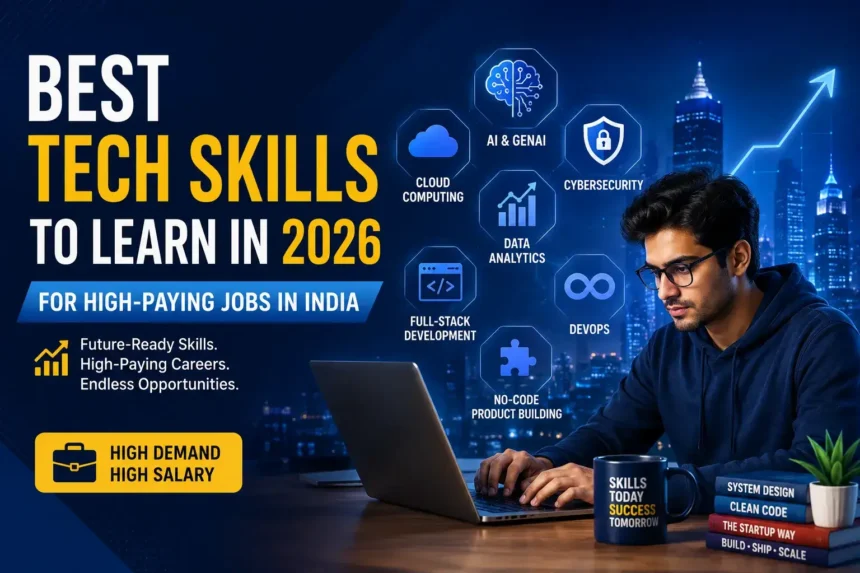
TL;DR: India's tech hiring has shifted from volume to specialization. The best tech skills to learn in 2026 for high-paying jobs in India are AI and GenAI, cloud computing, cybersecurity, data analytics, full-stack development, DevOps, and no-code product building. Each skill has verified salary data, clear job roles, and real demand from GCCs and product companies. Pick one, build projects, and apply within 6–12 months.
If you’re looking for the best tech skills in 2026, the picture is clearer than it’s ever been, and more urgent. India’s tech industry is no longer hiring for headcount. NASSCOM’s 2026 Strategic Review confirmed that hiring has shifted from volume to skill mix, driven by AI-powered productivity gains and GCC expansion. The old model, study a degree, get a service-company job, wait for promotions, is breaking down fast.
What’s replacing it is a market where the right skill earns you a seat, regardless of your college or background. Over 80% of employers now prefer practical, project-based skills over degrees alone, according to Taggd’s India Decoding Jobs 2026 report. India currently faces a 53% AI skill deficit, with over one million AI roles projected for 2026. That gap is an opportunity.
This guide covers 7 tech skills with strong demand, verified salary ranges, and clear learning paths, so you can make a decision and start today.
Why India’s Tech Job Market Shifted in 2026
Before choosing a skill, it helps to understand why the market changed. Three forces are reshaping what companies pay for.
GCCs are the new hiring engine. India now has over 2,100 Global Capability Centres generating $64.6 billion in revenue and employing 2.4 million professionals. These aren’t back-office operations anymore. They’re building AI products, cybersecurity systems, and cloud platforms for global markets. GCCs are expected to create 4.25–4.5 lakh new jobs in 2026 alone. But as one hiring analyst put it, the jobs are being created faster than the talent to fill them.
AI is changing what “IT job” means. The NASSCOM 2026 review makes clear that traditional service-company hiring is slowing, while demand for GenAI, cloud-native, and platform engineering roles is rising sharply. The Taggd report found that demand for advanced digital skills grew 42% year on year.
Reskilling is now a career strategy, not a last resort. The NIIT India Skills Gap Report 2026 ranked AI, cybersecurity, digital, and data capabilities as the most sought-after competencies. Companies are hiring against skill clusters, not job titles. This means someone with the right skill set can land a role that sounds above their experience level, if they can demonstrate it.
With this context in place, here are the 7 skills worth your time.
Skill 1: What Makes AI and Generative AI the Highest-Paying Skill of 2026?
AI and Generative AI (GenAI) currently represent the single largest demand-supply gap in India’s tech workforce. Demand for GenAI specialists surged over 300% since 2024, yet India reports a 90% shortage in GenAI-ready talent across GCCs. The result is a salary market unlike anything seen in other tech roles.
Salary ranges (2026 data):
- AI/ML Engineer (fresher): ₹6–12 LPA
- Generative AI Engineer (entry-level with projects): ₹8–12 LPA
- Mid-level ML Engineer (3–5 years): ₹25–50 LPA at product companies
- Senior GenAI/LLM Engineer: ₹45–80 LPA at top GCCs
These numbers come from Instahyre’s 2026 hiring data across 8,000+ tech roles. The key insight: GenAI roles carry a premium because the field is genuinely new, business impact is immediate, and every enterprise is building or buying a GenAI product.
What employers actually want:
GCCs are not just hiring data scientists. They’re embedding AI across legal, finance, HR, and customer operations. The EY GCC Pulse Survey 2025 found that 83% of Indian GCCs are scaling GenAI projects. Roles like “LLM Engineer,” “RAG Engineer,” and “AI Product Engineer” didn’t exist 18 months ago. They’re now among the hardest positions to fill.
Job roles to target:
- AI/ML Engineer
- Generative AI Engineer
- MLOps Engineer
- Prompt Engineer (works best combined with coding skills)
- AI Automation Specialist
How to start:
- Learn Python fundamentals (variables, functions, loops, libraries).
- Work through AI basics: NumPy, Pandas, scikit-learn.
- Study GenAI tools: ChatGPT, Claude, open-source models like Mistral and Llama.
- Build 2–3 portfolio projects: a chatbot, an AI content tool, or a retrieval-augmented generation (RAG) app.
- Push projects to GitHub. Document what the tool does and what problem it solves.
Neemesh’s teaching experience is relevant here: when introducing students to Python and AI concepts over 15 years of CS instruction, the fastest learners were those who built something usable within the first two weeks. Project-first learning beats theory-first every time. That principle applies equally to professional upskilling.
More Read

Skill 2: Cloud Computing
Cloud computing has moved from a technical specialty to a foundational layer of how companies operate. Every major enterprise, startup, and GCC runs on AWS, Azure, or Google Cloud Platform. NASSCOM estimates that cloud technologies could account for 8% of India’s GDP by 2026, and India’s data centre capacity is expected to double to 2,000 MW. That scale of infrastructure requires people who can build, manage, and secure it.
What’s changed in 2026: GCC country heads are now hiring for cloud platform engineering, SRE, and DevSecOps at a fast pace. The expectation has risen considerably. Five years ago, an AWS certification was sufficient for a strong cloud hire. Today, companies want engineers who can reason about multi-cloud architecture, zero-trust security, and cost optimization together. The title matters less than the depth.
Salary ranges:
- Cloud Engineer (fresher): ₹5–8 LPA
- Cloud Engineer (mid-level): ₹15–22 LPA
- Cloud Architect (senior): up to ₹30 LPA+
Certifications in AWS, Azure, or GCP can increase cloud salaries by 20–35%, according to 2026 hiring data.
Job roles to target:
- Cloud Engineer
- Cloud Architect
- Cloud Security Engineer
- Site Reliability Engineer (SRE)
- Cloud DevOps Engineer
How to start:
- Choose AWS as your first platform (it holds the largest market share and most job listings).
- Learn core services: EC2, S3, VPC, Lambda, RDS.
- Complete the AWS Cloud Practitioner certification (beginner-level, widely recognized).
- Build a small project: host a static website, deploy a simple API, or set up an automated backup system.
- Document the project on GitHub with the architecture diagram and cost breakdown.
Skill 3: Cybersecurity
Cybersecurity protects systems, networks, and data from attacks. As India’s digital infrastructure grows, so does the attack surface. The Taggd India Decoding Jobs 2026 report shows that India currently has a 25–30% shortfall of mid-to-senior cybersecurity specialists. GCCs are building dedicated security operations centers (SOCs) and embedding cybersecurity into every product they ship.
What this means for job seekers: The shortage at the mid-to-senior band creates genuine entry points for people who build strong foundational skills and earn recognized certifications. Security is one of the few fields where a motivated learner can close the gap to a competitive salary faster than in most other specializations.
Salary ranges:
- Cybersecurity Analyst / SOC Analyst (entry-level): ₹6–9 LPA
- Cybersecurity Engineer (mid-level): ₹12–20 LPA
- Senior Penetration Tester / Security Architect: ₹20–28 LPA+
Cybersecurity certifications can boost salaries by 20–30%.
Job roles to target:
- SOC Analyst (Level 1, 2, 3)
- Ethical Hacker / Penetration Tester
- Cybersecurity Engineer
- Cloud Security Specialist
- Security Analyst
How to start:
- Learn networking fundamentals: IP addressing, DNS, HTTP, TCP/IP, firewalls.
- Study core security tools: Wireshark (packet analysis), Nmap (network scanning), Burp Suite (web security).
- Practice on platforms like TryHackMe and Hack The Box. These platforms offer structured paths with real lab environments.
- Study the OWASP Top 10 vulnerabilities and common attack patterns.
- Build a portfolio of writeups from practice labs and CTF (Capture the Flag) competitions.
Skill 4: Data Analytics and Data Engineering
Data analytics answers business questions. Data engineering builds the pipelines that make those answers possible. Both are in strong demand, and they work together — companies that hire data engineers also need analysts to turn the output into decisions.
The business case is straightforward: Employers want people who can turn raw data into decisions. A data analyst who can present insights persuasively to leadership often progresses faster than one who builds technically excellent but uncommunicated dashboards, as the STMPL India Skills report 2026 notes. The combination of technical skill and business communication is rare and rewarded.
Salary ranges:
- Data Analyst (entry-level): ₹4–8 LPA
- Business Intelligence Developer: ₹6–12 LPA
- Data Engineer (mid-level): ₹12–25 LPA
- Data Scientist (experienced): ₹10–40 LPA
Job roles to target:
- Data Analyst
- Business Intelligence (BI) Developer
- Data Engineer
- Analytics Manager
- Data Scientist (advanced path)
How to start:
- Learn SQL first. It’s the most direct path to a data job and required for almost every analytics role.
- Add Python for data analysis: Pandas, NumPy, Matplotlib.
- Learn one visualization tool: Power BI (Microsoft stack) or Tableau (widely used in consulting and enterprise).
- Build a portfolio with 2–3 case studies using real datasets (Kaggle has free public data).
- Write up each project explaining the business question, your analysis approach, and what the data showed.
For students interested in combining data skills with AI, the path to AI/ML roles becomes much shorter once SQL and Python are solid. These are genuinely transferable foundations.
Skill 5: Full-Stack Web Development
Full-stack development means building both the frontend (what users see) and the backend (server, database, APIs) of a product. It remains one of the most versatile tech skills because it directly enables product-building — you can build something, ship it, and show it to an employer or a client.
Why it still belongs in this list: Web development isn’t being displaced by AI; it’s being augmented by it. AI tools speed up coding, but someone still needs to architect the product, write the logic, debug production issues, and own the end-to-end delivery. The TAGGD hiring report confirms that full-stack development remains talent-scarce and cost-intensive to hire for.
Salary ranges:
- Junior Web Developer: ₹3–6 LPA
- Mid-level Full-Stack Developer: ₹8–15 LPA
- Senior Full-Stack Developer: ₹15–25 LPA
- SaaS/Product-focused developer: ₹20 LPA+
Key technologies:
- Frontend: HTML, CSS, JavaScript, React
- Backend: Node.js, Python (Django/FastAPI), or Java
- Databases: MySQL, PostgreSQL, MongoDB
- Tools: Git, Docker, REST APIs
Job roles to target:
- Full-Stack Developer
- Frontend Developer
- Backend Developer
- SaaS Developer
- Freelance Web Developer
How to start:
- Learn HTML, CSS, and JavaScript together. Build simple pages from day one.
- Move to React for frontend component development.
- Learn Node.js for backend logic and API building.
- Build a full project: a portfolio site, a task management app, or a blog with a working backend.
- Host your project on GitHub. Deploy it on a free platform like Vercel or Railway so you have a live URL to share.
This skill also has the strongest freelance and remote work potential of any in this list. Neemesh’s experience building NoCostTools.com, 100+ web utilities, each with its own SEO-optimized landing page, is a practical example of how full-stack skills translate directly into product assets that generate organic traffic and returning users.
Skill 6: DevOps and Automation
DevOps combines software development and infrastructure operations to make product delivery faster and more reliable. It’s the glue between code and production. Without DevOps, even the best-written code sits in a queue.
The structural demand driver: As more companies adopt cloud infrastructure, DevOps and automation become the operating system of the engineering team. GCCs in 2026 are actively hiring for cloud platform engineering, SRE, and DevSecOps at a pace that hiring leaders describe as difficult to keep up with. The expectation of depth has also risen: companies want engineers who can reason about multi-cloud, zero-trust security, and platform reliability at the same level.
Salary ranges:
- DevOps Engineer (entry-level): ₹5–8 LPA
- Mid-level DevOps / Cloud Engineer: ₹10–22 LPA
- Senior SRE / Cloud DevOps: ₹25–35 LPA+
Cloud plus DevOps certifications increase salaries by 20–35%.
Job roles to target:
- DevOps Engineer
- Site Reliability Engineer (SRE)
- Platform Engineer
- Automation Engineer
- Cloud DevOps Engineer
How to start:
- Learn Linux fundamentals: file system, permissions, processes, shell scripting.
- Study Git and understand version control in team environments.
- Learn Docker (containers) and Kubernetes (container orchestration).
- Understand CI/CD concepts and practice with GitHub Actions or Jenkins.
- Build a project: deploy a web app with a full CI/CD pipeline. Document the architecture.
DevOps pairs naturally with cloud skills. Many engineers learn both in parallel, which considerably increases their value.
Skill 7: No-Code and AI-Powered Product Building
This skill is the entry point for students, educators, and content creators who want to build and earn online without years of engineering background. It covers no-code tools, AI-assisted content workflows, and the ability to ship a working product or website that generates income.
Why it belongs on this list in 2026: AI has compressed the time-to-market for digital products considerably. Someone who understands how to combine tools like WordPress, Webflow, ChatGPT, and affiliate marketing can build a revenue-generating product without writing a line of code. This is no longer a niche path — it’s a recognized category of indie entrepreneurship.
Earning models:
- Affiliate marketing (product recommendations with commission)
- Google AdSense on content sites
- Digital product sales (templates, guides, tools)
- Freelance no-code development
- Micro-SaaS products built on no-code platforms
Job and income roles:
- No-Code Developer
- Indie Hacker / Product Builder
- Content Creator with product
- Affiliate Site Owner
- Freelance Digital Consultant
How to start:
- Learn WordPress or Webflow for site building (WordPress is the most widely used CMS globally).
- Use AI writing tools to produce and refine content faster. This guide to AI tools for beginners covers practical starting points.
- Build a focused niche site, pick one topic you know well and publish 10–15 solid pages.
- Add affiliate links from programs like Amazon Associates, Impact, or ShareASale.
- Apply for Google AdSense once the site has consistent traffic.
This path is particularly relevant for students and educators. Neemesh’s EduEarnHub itself is a live example: an educational content site that combines AI tool coverage with earning guides, growing through organic SEO over 12+ months.
If you want to explore tools that support this path, NoCostTools.com offers 100+ free web utilities including a Word Counter, QR Maker, and JSON Formatter, all useful for content creators and no-code builders.
Skill Comparison: Salary, Demand, and Best Fit
| Skill | Fresher Salary (LPA) | Mid-Level Salary (LPA) | Best For |
|---|---|---|---|
| AI and GenAI | ₹6–12 | ₹25–50 | Engineers, CS students, career switchers |
| Cloud Computing | ₹5–8 | ₹15–22 | IT grads, network engineers, developers |
| Cybersecurity | ₹6–9 | ₹12–20 | Problem-solvers, analytical learners |
| Data Analytics | ₹4–8 | ₹10–18 | Analytical, business-focused learners |
| Full-Stack Development | ₹3–6 | ₹8–15 | Builders, freelancers, product thinkers |
| DevOps and Automation | ₹5–8 | ₹10–22 | Infrastructure-focused, process thinkers |
| No-Code and AI Products | Freelance/variable | Income-based | Students, creators, educators |
Salary data sourced from Instahyre 2026 hiring data, Scaler IT Salary Overview 2026, and Naukri high-paying skills report.
How to Choose the Right Skill for You
The most common mistake is trying to learn multiple skills at once. The market rewards depth over breadth, especially at the entry level. Here’s a decision framework based on your situation.
If you’re a CS or engineering student: Start with AI/GenAI or cloud computing. These have the highest salary premiums and the clearest learning paths. Python is a prerequisite for both.
If you’re a non-technical student or recent graduate: Full-stack web development or data analytics are the most accessible entry points. Both have free learning resources, clear project-based milestones, and strong freelance potential.
If you’re a working professional switching careers: Cybersecurity or DevOps are strong choices. They build on existing technical knowledge (networking, system administration, software development) and have recognized certification paths that signal competency to employers.
If you’re an educator or content creator: No-code and AI-powered product building is the most direct path to generating income from your existing knowledge. The skill is about combining tools intelligently, not writing code.
For anyone considering the freelance route alongside employment, the high-paying freelance skills guide for 2026 covers how these same skills translate to independent income, including rate benchmarks and platform recommendations. And if you want to understand what the entry-level AI job market actually looks like before choosing that path, the entry-level AI jobs guide breaks down role requirements and realistic expectations.
30-Day Learning Roadmap for Beginners
This is a focused starting plan, not a complete curriculum. The goal is to build enough momentum to keep going.
Week 1: Foundation Choose your skill. Spend the first week covering the core concepts only. No skipping ahead.
Week 2: Tools Get the primary tools installed and running. Write your first working script, query, or page.
Week 3: First Project Start a small project. It doesn’t need to be impressive. It needs to be yours and it needs to run.
Week 4: Share and Apply Push your project to GitHub. Write a short description of what it does and what you learned. This is your first portfolio entry.
Repeat this for 3–4 months and you’ll have 3–4 projects. Research from Taggd confirms that employers now prefer candidates with demonstrated project experience over those with credentials alone.
Conclusion
The best tech skills in 2026 aren’t secrets. They’re documented in hiring reports, salary databases, and GCC expansion plans. What separates people who capitalize on this market from those who don’t is the decision to start with one skill, build something tangible, and put it in front of employers.
India’s tech market is rewarding specialization, not generalism. The skills covered here, AI and GenAI, cloud computing, cybersecurity, data analytics, full-stack development, DevOps, and no-code product building, each have a clear path from beginner to employable. None of them require a specific degree. All of them reward consistent practice over time.
If you’re looking for a career resource to track this space, the 10 highest-paying skills 2025 article covers the global salary picture alongside India-specific data. And if you’re already employed but want to grow your income through freelancing, how to Start Freelancing in 2026 is a practical next read.
Which of these 7 skills are you planning to start learning first? Share your choice in the comments, it helps others see which paths are most popular with readers like you.
Frequently Asked Questions
1. Which is the best tech skill to learn in 2026 for freshers in India?
For freshers with a technical background, AI and GenAI offer the highest salary potential and the largest demand-supply gap. Freshers with strong Python skills and portfolio projects are landing roles at ₹8–12 LPA at product companies, significantly above the IT services average. For freshers without a coding background, full-stack web development or data analytics are more accessible starting points with clear project-based learning paths and strong freelance opportunities alongside employment.
2. How much can a cloud engineer earn in India in 2026?
Cloud engineers in India earn between ₹5–8 LPA at the entry level, ₹15–22 LPA at mid-level, and up to ₹30 LPA or more at senior levels, according to Scaler’s 2026 IT salary overview. Certifications in AWS, Azure, or GCP can increase salaries by 20–35%. The highest packages are concentrated in Bengaluru, Hyderabad, and Pune, where GCC density is highest.
3. Can I learn tech skills without a computer science degree?
Yes. Over 80% of employers now prefer practical, project-based skills over degrees alone, according to Taggd’s India Decoding Jobs 2026 report. The most effective approach is to choose one skill, complete a structured online course, build 2–3 real projects, and document them on GitHub and LinkedIn. Employers at product companies and GCCs routinely hire candidates who demonstrate technical competency through portfolio work, regardless of formal credentials.
4. Is cybersecurity a good career choice in India in 2026?
Cybersecurity is one of the strongest career choices for 2026. India currently has a 25–30% shortfall of mid-to-senior cybersecurity specialists, according to Savanna HR’s GCC skills analysis. Entry-level salaries range from ₹6–9 LPA, with strong growth to ₹20–28 LPA at the senior level. The field is also one of the few where certifications (CEH, CompTIA Security+, OSCP) have a direct and measurable impact on hiring and compensation.
5. How long does it take to become job-ready in a tech skill in India?
Most people become job-ready in 6–12 months with consistent, focused practice. The timeline depends on how much time you invest weekly (10–15 hours is a realistic target for working learners), whether you build real projects alongside coursework, and how well you document and present your work. The 2026 hiring market responds to demonstrated output, not just course completions. A GitHub profile with 3–4 well-documented projects is more valuable in most hiring decisions than a certificate without accompanying work.