Demand for AI-related freelance skills grew 109% year over year on Upwork’s U.S. marketplace in 2025, based on actual freelancer earnings rather than survey responses. That single number tells you something important about technology research trends 2026: the gap between reading about a trend and earning from it has never been smaller, but it has also never closed faster for the people who wait too long.
Most students and working professionals treat tech research as something that happens in labs, far from their daily lives. That assumption is outdated. Research breakthroughs in AI, quantum computing, and computing hardware are now showing up in freelance job listings within months, not years. This guide walks through the research trends that matter most in 2026 and explains exactly what each one means for someone trying to build skills or income around it.
What Are the Biggest Technology Research Trends in 2026?
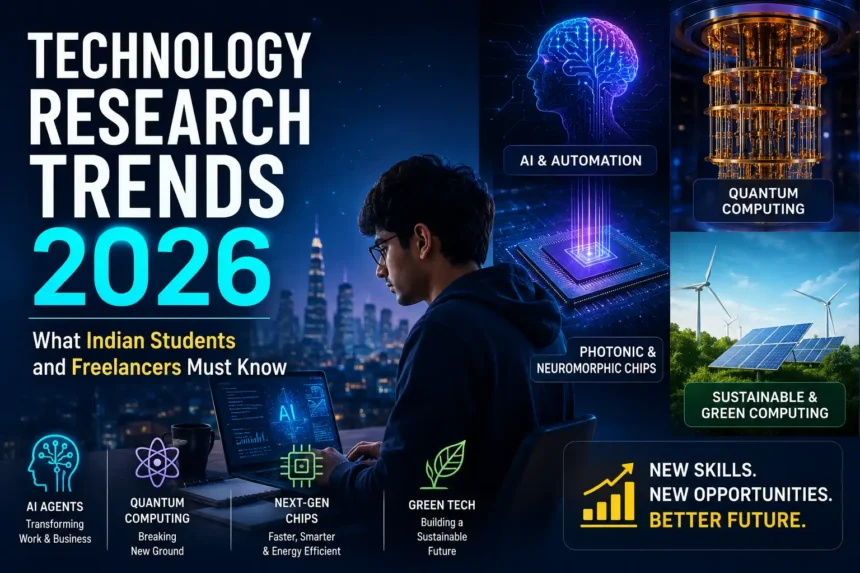
The biggest technology research trends in 2026 are AI agents moving into core business operations, quantum computing hitting new experimental milestones, light-based and neuromorphic chips designed to cut AI energy costs, and a broader shift toward sustainable or “green” computing infrastructure. Each trend reflects a move from experimental research toward practical deployment.
This shift from lab to production is the most important pattern to understand. For years, AI research existed mostly in academic papers and isolated pilot projects. That phase is ending. Industry trend reports for 2026 describe AI as becoming the backbone of enterprise architecture, meaning companies are no longer testing whether AI works. They are building permanent systems around it.
A second pattern worth noting is convergence. Quantum computing, high-performance computing, and AI are increasingly discussed together rather than as separate fields. Industry analysts have flagged this tighter integration as one of the developments to watch closely through 2026. For someone planning a career or a freelance specialty, this means narrow technical knowledge in just one area is becoming less valuable than the ability to understand how these systems connect.
A third pattern is hardware innovation aimed at solving AI’s energy problem. Researchers have created hybrid light-matter particles capable of speeding up AI computing while using far less power than traditional electronic processing. This addresses a real bottleneck: AI models are becoming expensive to run, and the next wave of research is focused on making them cheaper and faster, not just smarter.
How AI Research Is Creating Freelance Jobs Right Now
AI research is creating freelance jobs by turning experimental capabilities into commercial services that businesses now pay for directly, with the fastest-growing categories being AI video generation, AI system integration, AI data labeling, and AI chatbot development. These are not future possibilities. They are categories with measurable freelancer earnings today.
According to Upwork’s 2026 In-Demand Skills report, AI video generation and editing grew 329% year over year, the fastest of any AI category tracked. AI integration work, which means connecting AI tools into a business’s existing systems, grew 178%. AI data annotation and labeling grew 154%, and AI chatbot development grew 71%. These figures come from completed, paid jobs on the platform, not job postings or surveys, which makes them a reliable signal of what clients are actually willing to pay for.
This matters because it shows where the income opportunity sits today, not where it might sit someday. A student who learns basic prompt engineering and AI tool integration can realistically start picking up small freelance projects within a few months. For a deeper breakdown of which skills pay the most right now, this guide to high-paying freelance skills in 2026 covers specific rate ranges by specialization.
The practical starting point for most beginners is learning to use AI tools well, not building AI models from scratch. Most freelance demand right now is for people who can apply existing AI tools to real business problems: writing better prompts, automating a workflow, or cleaning up AI-generated output so it sounds human. This guide on AI tools for students is a reasonable starting point if you are beginning from zero.
More Read

Quantum Computing: Should Indian Students Start Learning It?
Indian students with a strong math or physics background can benefit from learning quantum computing basics now, but it remains a long-term specialization rather than a quick path to freelance income, since most quantum roles still sit inside research institutions and large tech companies rather than the open freelance market.
Recent research supports the idea that quantum computing is entering a more active phase. Scientists in Japan developed a new method to detect quantum “W states,” a milestone that supports faster quantum communication and more powerful computing in the future. Separately, researchers continue exploring how quantum systems and AI might work together, with industry analysts naming quantum-AI convergence as a trend to watch through 2026.
What this means for a student is straightforward. Quantum computing is not yet a field where you can expect to freelance casually the way you might with content writing or basic web development. It requires deeper, more formal study, often at the graduate level. Programs like the Google Student Researcher initiative, which explicitly includes quantum computing among its research areas, give Indian students a path into this field through structured mentorship rather than freelance trial and error.
The realistic advice is this: if you are drawn to quantum computing because you enjoy the math and physics behind it, start building that foundation now through coursework and research opportunities. If your primary goal is near-term income, your time is better spent on AI tools and freelancing skills first, with quantum computing as a longer-term specialization you build toward.
The India Tech Opportunity in 2026
India’s technology sector in 2026 is expanding beyond its traditional software services base into AI-native startups, semiconductor manufacturing, and tier-2 city tech hubs, creating opportunities that did not exist even two years ago for students and professionals outside major metro areas.
Investment data supports this shift. AI-native companies in India attracted $665 million in funding in 2025, a 50% increase year over year, while enterprise SaaS investment rose 66%. This funding is expanding hiring beyond core software engineering roles into data engineering, AI research, prompt engineering, and product strategy.
A second structural change is geographic decentralization. Cities like Coimbatore, Indore, and Mohali are becoming startup hubs and specialized research zones, reducing the assumption that tech careers require relocating to Bangalore or Hyderabad. This matters directly for students in smaller cities who previously felt excluded from the tech economy simply because of location.
A third development is India’s semiconductor push, which is projected to create 10 lakh new jobs by 2026 across chip design, fabrication, and testing. This is a genuinely new career category for Indian engineering students, one that did not meaningfully exist a decade ago. For students exploring entry points into AI-adjacent careers specifically, this overview of entry-level AI jobs breaks down roles, expected salaries, and the skills companies are screening for.
Which Research Trend Has the Highest Income Potential for Freelancers?
Based on current market data, AI integration work offers the strongest combination of high demand and high pay for freelancers, with specialists earning between $120 and $200 per hour according to freelance marketplace scoring data, driven by a shortage of professionals who can connect AI tools into existing business systems.
This income potential is reinforced by hiring data beyond freelance platforms. A 2026 talent demand survey found that 78% of technology leaders plan to increase permanent headcount in the second half of the year, but 65% of hiring managers report that finding skilled talent has become harder than the previous year. Seventy-one percent reported project delays directly tied to skills shortages. This gap between demand and available talent is exactly what drives freelance rates upward.
AI integration sits at the center of this gap because it requires a mix of technical understanding and practical business judgment that pure coding skills or pure AI knowledge alone do not provide. It is less about building AI models and more about knowing how to plug existing tools like chatbots, automation workflows, or content generators into a company’s actual operations.
Other strong income paths include AI data annotation, which has lower technical barriers but still strong demand, and green computing consulting, an emerging niche tied to the broader sustainability push in tech infrastructure. None of these require a computer science degree to start, but all of them reward people who can demonstrate real, applied project experience over theoretical knowledge.
How to Turn Technology Trends Into Real Online Income
Turning a technology trend into real income requires picking one trend, building one demonstrable skill around it, and applying that skill on one platform consistently, rather than trying to learn everything across AI, quantum computing, and emerging hardware at once.
The biggest mistake students make is treating trend awareness as the same thing as skill building. Reading about AI integration is not the same as being able to connect a chatbot to a business’s customer support system. The second step, hands-on practice with a real or simulated project, is where actual income capability gets built.
When Neemesh built NoCostTools.com, integrating AI-powered utilities into the platform’s existing tools drove a 150% increase in organic traffic within three months. The lesson from that project was not that AI is powerful in the abstract. It was that applying AI to solve one specific, narrow problem (in that case, improving tool functionality and user experience) produced a measurable result faster than trying to incorporate AI broadly across every part of the site at once.
The same logic applies to freelancing. Pick one AI skill category from the data above, such as chatbot setup or AI workflow automation. Build two or three small portfolio projects, even unpaid ones, to demonstrate the skill. Then apply consistently on one platform rather than spreading thin across five. This guide on how to start freelancing in 2026 walks through the practical first steps, including how to find your first paying client without prior experience.
Conclusion
Technology research in 2026 is no longer confined to academic papers or distant industry roadmaps. AI integration, quantum computing, and energy-efficient chip design are creating real, measurable income opportunities for students and freelancers willing to connect research trends to specific skills. The data is consistent across multiple sources: AI-related freelance work is growing faster than almost any other category, and the businesses hiring for it are struggling to find enough skilled people to meet demand.
The path forward is not to learn every trend at once. It is to pick the one or two that fit your interests and strengths, build real project experience, and apply consistently rather than chasing every new development. Start with the fundamentals if you have not already, since becoming AI literate is the foundation every other skill on this list builds on.
Which of these technology trends are you planning to build a skill around first?
Frequently Asked Questions
Which technology trend is best for students in India in 2026? AI integration and AI tool literacy offer the most accessible starting point for most students, since they require less formal education than quantum computing and have measurable freelance demand right now. Students with strong math backgrounds may also consider quantum computing as a longer-term specialization.
Can I learn AI skills online for free and start freelancing? Yes, many AI tools used in freelance work, including chatbots, automation platforms, and content tools, have free tiers that are sufficient for learning and building a starter portfolio. The skill that earns money is applying these tools to solve a specific business problem, not access to paid software.
Is quantum computing a good career option for beginners in 2026? Quantum computing is a strong long-term career path for students with a physics or advanced math background, but it is not a quick path to freelance income. Most current opportunities sit within research institutions, universities, and large technology companies rather than the open freelance market.
How much can I earn with AI freelancing skills in 2026? Earnings vary widely by specialization. AI integration specialists can earn between $120 and $200 per hour according to freelance marketplace data, while AI data annotation and basic chatbot setup typically pay less but require a shorter learning curve for beginners.
What is the fastest growing freelance skill in 2026? AI video generation and editing was the fastest-growing freelance skill category in 2026, growing 329% year over year according to Upwork’s marketplace earnings data, followed by AI integration work at 178% growth.