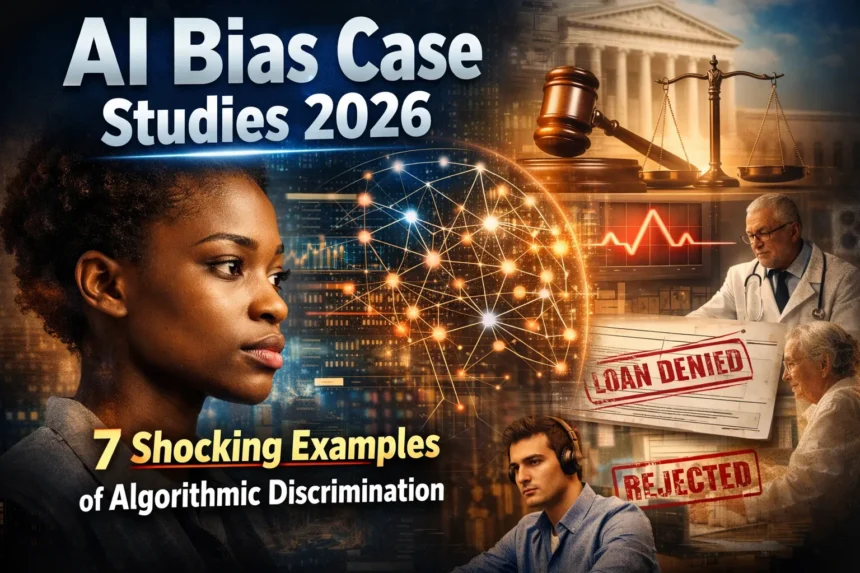
Algorithmic systems now make decisions that once required human judgment, approving mortgages, triaging medical care, and screening job applicants. The efficiency gains appear substantial, but the documented failures reveal a troubling pattern. From employment screening tools that systematically reject qualified candidates to healthcare algorithms that deny critical treatment, AI bias case studies 2026 demonstrate how automated decision-making can encode and amplify historical inequities at scale.
- Workday AI Discrimination Lawsuit – The Employment Screening Wake-Up Call
- UnitedHealthcare’s nH Predict Algorithm – When AI Denies Critical Care
- Apple Card Gender Discrimination – The Credit Algorithm That Exposed Systemic Flaws
- Gemma LLM Healthcare Summaries – Gender Bias in AI Care Assessments (2025)
- AI Hairstyle Bias Against Black Women – The Professional Image Scoring Scandal
- iTutorGroup Age Discrimination Settlement – Automated Rejection of Older Applicants
- What Common Patterns Emerge From These AI Bias Case Studies?
- Conclusion
The legal and regulatory consequences have arrived. Courts certified collective action lawsuits against major technology vendors. Federal agencies launched investigations into discriminatory algorithms. Settlements now reach hundreds of thousands of dollars, and regulatory frameworks mandate bias audits with significant financial penalties. These cases matter because they establish precedent, reveal technical vulnerabilities, and force transparency in systems that previously operated as black boxes. Understanding what went wrong and why positions organizations to build fairer systems and avoid similar failures.
This analysis examines seven documented AI bias case studies from 2019 through 2026, focusing on employment, healthcare, financial services, and education sectors. Each case demonstrates specific failure modes, legal outcomes, and structural lessons for anyone building or deploying algorithmic systems.
Workday AI Discrimination Lawsuit – The Employment Screening Wake-Up Call
Workday, a major enterprise HR software provider, faces ongoing litigation over its AI-powered hiring tools. The case represents one of the most significant legal challenges to algorithmic employment screening systems and reveals how bias can emerge even in systems designed to increase hiring efficiency.
What Did Derek Mobley’s Case Reveal About AI Hiring Tools?
Derek Mobley, a Black man with an MBA and over a decade of experience in sales and account management, applied for hundreds of positions through Workday’s applicant tracking system. Despite his qualifications, he received consistent rejections. The lawsuit alleges that Workday’s AI screening tools systematically filtered out qualified candidates based on protected characteristics, creating what amounts to digital redlining in employment decisions.
The technical mechanism involved Workday’s integration with HiredScore, an AI-powered candidate matching system. According to court filings, these tools analyzed historical hiring data to predict candidate success. The problem emerged when those historical patterns reflected existing biases, fewer women in technical roles, and fewer minorities in senior positions. The algorithm learned to replicate those patterns rather than correct them.
What makes this case particularly significant is the precedent-setting collective action certification granted by courts in May 2025. This decision allows potentially thousands of job seekers who were screened by Workday’s AI tools to join the litigation, transforming it from an individual complaint into a systemic challenge to algorithmic hiring practices.
May 2025 Collective Action Certification and Industry Impact
The court’s decision to certify Mobley v. Workday as a collective action represents a structural shift in how AI discrimination lawsuits proceed. Previous cases typically required individual plaintiffs to prove individual harm. This certification allows class members to argue that the algorithm itself created systematic discrimination, shifting the burden of proof toward the vendor to demonstrate fairness.
In July 2025, the court expanded the scope of the discrimination claims to include HiredScore’s AI features specifically. Workday was ordered to provide a list of employers who enabled these screening tools, potentially expanding the plaintiff pool significantly. This matters because it establishes that AI vendors, not just the companies using their tools, can be held liable for discriminatory outcomes.
The broader implication centers on transparency requirements. Companies can no longer treat AI hiring tools as proprietary black boxes when those tools make consequential decisions about people’s livelihoods. The case establishes that algorithmic systems used in employment decisions must be auditable, explainable, and demonstrably fair across protected classes.
How Does Workday’s AI Actually Screen Candidates?
Workday’s screening systems analyze resumes and application data against job requirements, historical hiring patterns, and success metrics. The AI assigns scores to candidates based on keyword matching, experience alignment, and predicted job performance. Candidates below a certain threshold score face automatic rejection before human recruiters review their applications.
The bias emerges in several ways. First, historical training data reflects existing workplace inequities. If a company historically hired fewer women for engineering roles, the algorithm learns to downweight female candidates. Second, proxy variables introduce indirect discrimination. Attending certain universities, living in specific neighborhoods, or having gaps in employment history correlate with protected characteristics but appear neutral. Third, natural language processing systems trained on biased text corpora can associate gendered or racialized language patterns with competence or leadership.
Understanding what AI ethics is becomes critical here. The technical accuracy of an algorithm, its ability to predict which candidates will succeed, differs fundamentally from its fairness. An AI system can be highly predictive while still perpetuating discrimination if it optimizes for historical patterns rather than equitable outcomes.
UnitedHealthcare’s nH Predict Algorithm – When AI Denies Critical Care
Healthcare represents one of the highest-stakes domains for algorithmic decision-making. UnitedHealthcare’s deployment of the nH Predict algorithm demonstrates how AI bias in medical systems can deny necessary treatment to vulnerable populations, leading to federal investigations and significant legal challenges.
The 90% Error Rate That Sparked Federal Investigations
The nH Predict algorithm assessed whether Medicare Advantage patients still required post-acute care in nursing facilities or rehabilitation centers. The AI analyzed patient records and predicted when individuals could safely transition to home-based care. According to federal administrative law judges, approximately 90 percent of denials were overturned on appeal, revealing systematic over-prediction of patient recovery.
This error rate matters because appealing denials requires time, knowledge, and resources that many elderly patients lack. The algorithm effectively shifted the burden onto patients and their families to prove medical necessity after the AI had already denied care. Most patients never appealed, accepting the denial as final even when medically inappropriate.
The technical mechanism involved training the algorithm on historical discharge data. The system learned patterns from previous cases where patients transitioned out of care facilities. However, those historical patterns reflected financial pressures and administrative decisions rather than optimal medical outcomes. The AI essentially learned to replicate cost-cutting patterns rather than clinically appropriate care timelines.
Federal investigations revealed that the algorithm lacked proper medical oversight. Clinical staff did not review the AI’s recommendations before issuing denials. The system operated with minimal human intervention, creating what amounts to automated medical decision-making without physician judgment.
How Medicare Advantage Denials Escalated From 2020 to 2022
The implementation timeline reveals how algorithmic systems can rapidly scale problematic patterns. According to regulatory data, UnitedHealthcare’s denial rates more than doubled after AI implementation, increasing from 10.9% in 2020 to 22.7% in 2022. This dramatic escalation occurred precisely as the nH Predict algorithm became more widely deployed across the Medicare Advantage patient population.
What makes this pattern particularly concerning is the structural incentive alignment. Medicare Advantage plans receive fixed payments per enrollee, creating financial motivation to minimize care costs. An AI system that systematically under-predicts necessary care duration directly improves profitability while appearing clinically neutral. The algorithm becomes a tool for cost reduction disguised as an objective medical assessment.
The connection to broader AI ethics in healthcare issues centers on accountability and transparency. When an algorithm denies care, who bears responsibility the AI vendor, the insurance company, or the clinical staff? The UnitedHealthcare case demonstrates that legal liability ultimately falls on the organization deploying the system, not the algorithm itself.
What Are the Legal Consequences for Healthcare AI Bias?
The legal outcomes extend beyond individual patient harm. Class action lawsuits consolidate thousands of denied claims into systematic challenges to the algorithm’s validity. Federal investigations examine whether the denial patterns violate Medicare regulations and patient protection laws. State insurance regulators review whether algorithmic decision-making complies with medical necessity standards.
UnitedHealthcare faces both financial and operational consequences. Settlements could reach hundreds of millions of dollars across consolidated cases. Regulatory penalties may include fines, corrective action plans, and enhanced oversight requirements. Most significantly, the company must implement human review processes for AI-generated denials, effectively limiting the automation’s cost-saving potential.
The broader regulatory implication establishes that healthcare algorithms cannot replace clinical judgment without demonstrating equivalent or superior accuracy. Future AI systems in medical decision-making will face higher evidentiary standards, mandatory bias testing, and ongoing performance monitoring across patient demographics.
Apple Card Gender Discrimination – The Credit Algorithm That Exposed Systemic Flaws
Financial services rely heavily on algorithmic credit scoring, making them particularly vulnerable to bias claims. The Apple Card case, which emerged in 2019 and concluded with regulatory findings in 2021, reveals how even sophisticated algorithms from major technology companies can produce discriminatory outcomes in lending decisions.
Why Did Goldman Sachs Offer Men 20x Higher Credit Limits?
The controversy began when tech entrepreneur David Heinemeier Hansson reported that he received a credit limit 20 times higher than his wife’s, despite filing joint tax returns and her having a higher credit score. Similar reports flooded social media from couples experiencing identical disparities. The pattern suggested systematic gender discrimination in credit allocation.
Goldman Sachs, which underwrote the Apple Card, insisted the algorithm considered only legally permissible factors—income, credit history, and debt-to-income ratios. The system never directly accessed gender information. However, the outcomes revealed substantial gender disparities that indicated proxy discrimination.
The technical explanation centers on what researchers call “fairness through unawareness”—the assumption that excluding protected characteristics from an algorithm prevents discrimination. This approach fails because gender-blind algorithms can still produce discriminatory outcomes when they rely on correlated features. Zip codes, employer types, spending patterns, and credit utilization all correlate with gender while appearing neutral.
Women historically have different financial profiles than men, not because of creditworthiness differences but because of wage gaps, career interruptions for caregiving, and different spending patterns. An algorithm trained on historical data learns these correlations and replicates gendered outcomes even without explicit gender inputs.
New York DFS Investigation Outcome and Key Findings
The New York Department of Financial Services conducted a comprehensive investigation into the Apple Card’s credit allocation algorithm. The March 2021 report found no unlawful bias but systemic concerns that prompted regulatory recommendations and reputational consequences for Goldman Sachs.
The investigation revealed several key findings. First, the algorithm did not explicitly consider gender in credit decisions. Second, the underwriting model produced statistically significant disparities in credit limits between male and female applicants with similar credit profiles. Third, Goldman Sachs lacked robust fairness testing and bias monitoring systems when launching the product. Fourth, the company could not adequately explain why certain applicants received specific credit limits.
The regulatory outcome established new transparency requirements. Goldman Sachs agreed to implement enhanced monitoring for disparate outcomes across demographic groups. The company is committed to improving customer communication about credit decisions. Most significantly, the investigation established precedent that financial institutions must proactively test algorithmic systems for fairness before deployment, not merely react to complaints after discrimination occurs.
The reputational damage exceeded the regulatory penalties. Apple and Goldman Sachs faced significant public criticism that damaged both brands’ reputations for innovation and fairness. The case demonstrates that legal compliance alone does not shield organizations from market consequences when algorithmic systems produce inequitable outcomes.
What Does “Fairness Through Unawareness” Actually Mean?
This concept represents a common but flawed approach to algorithmic fairness. The logic suggests that if an AI system never sees protected characteristics like gender, race, or age, it cannot discriminate based on those characteristics. The Apple Card case decisively disproved this assumption.
Proxy variables create indirect discrimination paths. An algorithm might learn that people who shop at certain retailers, live in specific neighborhoods, or have particular employment histories default less frequently. These patterns correlate with demographic characteristics even though the algorithm never directly considers them. The system effectively learns to discriminate through correlated features while maintaining the appearance of neutrality.
The alternative approach requires active fairness testing and bias mitigation. Organizations must analyze algorithmic outcomes across demographic groups, identify disparate impacts, and adjust systems to achieve equitable results. This means sometimes treating similar inputs differently to produce fair outcomes—a concept that challenges traditional notions of algorithmic objectivity but aligns with legal and ethical requirements for non-discrimination.
Gemma LLM Healthcare Summaries – Gender Bias in AI Care Assessments (2025)
Large language models increasingly generate clinical documentation and care summaries. Research from the London School of Economics in 2025 revealed that Google’s Gemma model introduced systematic gender bias when summarizing patient health records, with implications for resource allocation and treatment planning.
LSE Study Findings on Long-Term Care Language Disparities
Researchers at LSE tested Gemma’s ability to generate care summaries for elderly patients requiring long-term support. The study design presented identical health profiles to the model, varying only the patient’s gender. The results showed that Gemma described men’s health needs using terms like “disabled” and “impaired” significantly more frequently than women’s profiles, despite identical medical conditions.
This gender-related AI bias in healthcare summaries matters because clinical language influences resource allocation. Care coordinators, insurance reviewers, and administrators who read AI-generated summaries make decisions based on the severity language used. Describing male patients as “disabled” while describing female patients with identical conditions using less severe terminology creates systematic under-allocation of resources to women.
The technical explanation involves training data bias. Large language models learn from existing medical literature, clinical notes, and healthcare documentation. Those source materials reflect historical biases in how medical professionals describe male versus female patients. Research consistently shows that medical professionals take men’s pain complaints more seriously, diagnose certain conditions more readily in men, and document male patients’ symptoms with greater urgency.
Gemma learned these patterns from training data and reproduced them in generated summaries. The model had no explicit instruction to treat genders differently. The bias emerged from statistical patterns in how healthcare providers historically documented patient conditions.
Real-World Impact on Resource Allocation for Female Patients
The practical consequences extend beyond language differences. Healthcare systems increasingly use AI-generated summaries to prioritize cases, allocate home health aides, approve medical equipment, and determine eligibility for specialized care programs. When those summaries systematically downplay women’s health needs relative to men’s identical conditions, resource allocation patterns follow.
A female patient with severe arthritis might receive a summary emphasizing “mobility challenges,” while a male patient with identical symptoms receives documentation noting “significant disability requiring support.” The care coordinator reading these summaries assigns priority accordingly, potentially delaying or denying resources the female patient needs.
The LSE research also revealed that correcting this bias requires more than simple prompting instructions. Telling the model to “be fair” or “avoid bias” proved ineffective because the bias exists in learned statistical patterns rather than explicit rules. Meaningful correction requires retraining with debiased datasets, implementing fairness constraints during generation, or using adversarial testing to identify and mitigate gendered language patterns.
This case demonstrates how AI bias extends beyond obvious discrimination into subtle language choices that shape human decisions downstream. The algorithm never explicitly denied care to women, but its language patterns created conditions where human decision-makers allocated fewer resources to female patients with equivalent needs.
AI Hairstyle Bias Against Black Women – The Professional Image Scoring Scandal
Facial recognition and image analysis systems increasingly evaluate professional appearance in hiring, performance reviews, and customer service contexts. Research published in August 2025 documented systematic bias against Black women with natural hairstyles, revealing how AI systems encode and perpetuate racial and gender stereotypes.
August 2025 Study Results on Natural Hair vs. Straight Hair Ratings
Researchers tested multiple AI image analysis systems by submitting identical photos of Black women, varying only the hairstyle between natural styles (afros, locs, braids) and straightened hair. The results showed that AI image systems perpetuate racial stereotypes, consistently rating Black women with natural hairstyles as less intelligent, less professional, and less suitable for customer-facing roles compared to individuals with straightened hair.
The magnitude of the bias proved substantial. Natural hairstyles received professionalism scores averaging 15-20% lower than straightened styles in the same systems. Attributes like “intelligent,” “competent,” and “trustworthy” showed similar disparities. The AI systems essentially encoded the same discriminatory beauty standards that civil rights legislation prohibits in human decision-making.
The technical mechanism involves training data composition. Image recognition systems learn from massive datasets of labeled photos. Those datasets reflect societal biases about professional appearance. Historical photos of “professional settings” disproportionately show people with Eurocentric features and hairstyles because workplace discrimination historically excluded natural Black hairstyles.
The algorithm learns these visual correlations and reproduces them as objective assessments. When deployed in hiring systems, performance evaluation tools, or customer service quality monitoring, the bias systematically disadvantages Black women who wear natural hairstyles, creating modern digital enforcement of racist beauty standards.
How Does This Bias Affect Hiring and Professional Opportunities?
Several companies use AI-powered video interviewing platforms that analyze facial expressions, speech patterns, and appearance as part of candidate assessment. When those systems incorporate professional image scoring, the hairstyle bias directly impacts hiring outcomes. Black women with natural styles receive lower scores, reducing their likelihood of advancing through automated screening stages.
The bias extends beyond hiring. Customer service monitoring systems that evaluate employee professionalism based on video analysis may flag Black employees with natural hairstyles more frequently. Performance management systems that incorporate AI-generated assessments may systematically underrate Black women. Promotional decisions influenced by algorithmic evaluations inherit the same biases.
Legal frameworks increasingly recognize this discrimination. The CROWN Act (Creating a Respectful and Open World for Natural Hair) prohibits race-based hair discrimination in employment, housing, and education in multiple U.S. states. However, enforcement becomes complex when the discrimination occurs through algorithmic systems rather than explicit human decisions.
The remedy requires technical intervention. Organizations deploying image analysis systems in employment contexts must audit those systems for bias across hairstyles, skin tones, and facial features. Training data must be diversified to include equitable representation. Fairness metrics should explicitly measure outcomes across protected characteristics. Without these interventions, AI systems will continue enforcing discriminatory beauty standards at scale.
iTutorGroup Age Discrimination Settlement – Automated Rejection of Older Applicants
Age discrimination represents one of the less-discussed but equally consequential forms of algorithmic bias. The iTutorGroup case, which resulted in a $365,000 settlement with the Equal Employment Opportunity Commission, demonstrates how AI hiring systems can systematically exclude older workers.
The $365,000 EEOC Settlement and What It Means
iTutorGroup, an online education company, configured its applicant tracking system to automatically reject female applicants over 55 and male applicants over 60. The system never presented these candidates to human recruiters, creating a digital barrier that operated silently and systematically. The algorithmic age discrimination settlement represents the first major enforcement action specifically targeting automated age-based filtering in hiring.
The EEOC investigation revealed that the company deliberately programmed these age thresholds into its recruitment software. Unlike cases where bias emerges from training data patterns, this represented explicit discrimination encoded in selection rules. The automation simply made the discrimination more efficient and less visible than traditional screening methods.
The settlement amount of $365,000 may appear modest compared to other discrimination cases, but the precedent matters significantly. The EEOC established that automated screening systems must comply with age discrimination laws just as human hiring decisions do. Companies cannot use automation to circumvent civil rights protections. The settlement requires iTutorGroup to implement corrective measures, monitor hiring outcomes by age group, and train staff on age discrimination laws.
The broader implication establishes clear legal liability for algorithmic discrimination. Organizations deploying hiring AI cannot claim ignorance of the system’s filtering criteria. They bear responsibility for ensuring their tools comply with employment law, regardless of vendor claims or technical complexity.
How AI Systems Learn Age-Based Discrimination
While iTutorGroup’s case involved explicit age thresholds, many systems learn age discrimination through more subtle mechanisms. Resume parsing algorithms extract graduation dates, employment history length, and technology familiarity indicators that correlate with age. The system learns that candidates with certain profiles perform better or stay longer, often because those patterns reflect existing workforce demographics rather than inherent capability.
Natural language processing in cover letters and applications can identify age markers—references to older technologies, writing styles characteristic of different generations, or career trajectories that indicate longer work histories. These seemingly neutral patterns create proxy variables for age discrimination.
Video interviewing systems that analyze speech patterns and facial features can infer age from visual and vocal characteristics. When combined with training data showing historical hiring patterns (which often favor younger candidates), the algorithm learns to downweight older applicants.
The technical solution requires active debiasing. Organizations must identify potential age proxies in their data, test algorithmic outcomes across age groups, and implement fairness constraints that prevent age-based disparities. This often means accepting that an “optimized” algorithm that maximizes historical hiring pattern replication will perpetuate age discrimination and must be constrained to achieve equitable outcomes.
What Common Patterns Emerge From These AI Bias Case Studies?
Examining these seven cases reveals systematic failure modes that extend across industries and use cases. Understanding these patterns positions organizations to identify and prevent similar biases in their own AI deployments.
Historical Bias Encoded in Training Data
Every case examined involved algorithms learning from historical data that reflected existing inequities. Workday’s hiring tools learned from companies’ previous hiring patterns. UnitedHealthcare’s algorithm learned from historical discharge decisions influenced by cost pressures. Apple Card’s model learned from gendered financial behaviors created by wage gaps and systemic discrimination. Gemma absorbed bias from medical literature that documented patients differently by gender.
The technical implication is that optimizing for historical accuracy inherently perpetuates historical discrimination. An algorithm that perfectly predicts outcomes based on past patterns will replicate whatever biases existed in those patterns. Organizations that want fair AI systems must explicitly define fairness constraints separate from historical optimization and accept that this may reduce certain performance metrics.
This connects directly to understanding how to become AI literate in the modern context. AI literacy increasingly means recognizing that “accurate” predictions can still be discriminatory and that technical optimization does not equal ethical deployment.
Lack of Transparency in Algorithmic Decision-Making
Multiple cases involved systems that operated as black boxes, making consequential decisions without explanation or human oversight. UnitedHealthcare denied care without physician review. Workday rejected candidates before human recruiters saw applications. iTutorGroup filtered applicants automatically based on hidden criteria.
This opacity creates accountability gaps. When discrimination occurs through algorithmic systems, affected individuals cannot understand why they were rejected, making it nearly impossible to challenge the decision. Organizations deploying the systems can claim ignorance of the technical mechanisms. Vendors who built the algorithms assert proprietary protections.
The regulatory response across jurisdictions increasingly demands explainability. The European Union’s AI Act requires high-risk systems to provide meaningful information about decision logic. Regulatory frameworks now require bias audits with significant financial penalties for non-compliance. South Korea’s AI Framework Act, effective January 2026, mandates fairness audits with fines reaching $21,000 for violations.
The practical implication is that organizations can no longer treat AI decision systems as proprietary black boxes when those systems affect people’s employment, healthcare, credit, or other fundamental opportunities. Transparency becomes both a legal requirement and a practical necessity for identifying and correcting bias.
Low Appeal Rates Enable Systematic Discrimination
The UnitedHealthcare case revealed that 90% of AI-generated denials were overturned on appeal, yet most patients never appealed. The Workday case showed that rejected applicants rarely learned their applications were filtered by AI rather than reviewed by humans. The Apple Card controversy emerged only because a vocal tech entrepreneur publicized the disparity on social media.
This pattern demonstrates how automated discrimination can operate at scale while remaining largely invisible. The burden falls on affected individuals to recognize discrimination, understand that an algorithm made the decision, possess resources to challenge the decision, and navigate appeal processes. Most people lack the time, knowledge, or energy to pursue these challenges, allowing discriminatory systems to continue operating.
The structural solution requires mandatory disclosure and accessible remedy processes. When AI systems make consequential decisions, affected individuals should receive a clear explanation that an algorithmic system was involved, what factors influenced the decision, and how to seek review. Organizations should monitor appeal rates and overturn patterns as indicators of potential algorithmic bias rather than waiting for complaints.
The cases examined establish that algorithmic discrimination is not a theoretical concern but a documented reality with significant legal, financial, and reputational consequences. As organizations increasingly deploy AI systems in high-stakes domains, understanding these failure modes and implementing robust fairness testing, transparency measures, and accountability frameworks becomes essential.
Conclusion
The seven AI bias case studies examined reveal a consistent pattern: algorithmic systems trained on historical data inevitably encode historical discrimination. Workday’s hiring tools replicated biased employment patterns. UnitedHealthcare’s algorithm learned cost-cutting over appropriate care. Apple Card’s credit model perpetuated gendered financial disparities. Each case demonstrates that technical accuracy does not equal fairness and that optimization for historical patterns inherently perpetuates historical inequities.
The legal and regulatory landscape has responded decisively. Collective action lawsuits now consolidate thousands of affected individuals. Settlements reach hundreds of thousands or millions of dollars. Regulatory frameworks mandate bias audits and transparency requirements. Organizations can no longer treat algorithmic decision-making as a technical implementation detail disconnected from civil rights obligations.
For anyone building, deploying, or working with AI systems, these cases establish clear imperatives. Test algorithms for fairness across protected characteristics before deployment. Implement human oversight for consequential decisions. Create accessible appeal mechanisms for affected individuals. Monitor outcomes continuously rather than assuming initial testing guarantees ongoing fairness. Recognize that what is AI ethics represents is not a philosophical abstraction but a practical necessity with direct legal consequences.
The significance extends beyond compliance. As algorithmic systems increasingly mediate access to employment, healthcare, credit, and education, the responsibility for ensuring those systems operate fairly falls on the organizations deploying them. The cases examined demonstrate that failure carries substantial consequences—legal liability, regulatory penalties, and reputational damage. More fundamentally, these failures perpetuate the very inequities that civil rights frameworks were designed to eliminate.
Understanding these AI bias case studies positions professionals entering entry-level AI jobs in 2025 and beyond to build systems that serve all users equitably. The technical capability to deploy AI at scale must be matched by the ethical commitment to deploy it fairly. These cases provide the evidence base for why that commitment matters and the costly consequences of failing to uphold it.