Chinese AI models just overtook American ones in global downloads. Not by a hair, by a country mile. If you’re building something right now and wondering which AI models to bet on, this shift isn’t just industry gossip. It’s your wake-up call.
- What Actually Happened: The DeepSeek Moment
- Why Chinese AI Models Surpass US Downloads 2026 (And What It Means for You)
- Your Developer Decision Matrix: Which Models Should You Actually Use?
- What’s Coming Next: The February 2026 Inflection Point
- The Real Talk: Market Share vs. Developer Adoption
- Geopolitical Implications (Because This Isn’t Just About Code)
- Your Action Plan: What to Do Right Now
- ❓ Frequently Asked Questions
- The Bottom Line
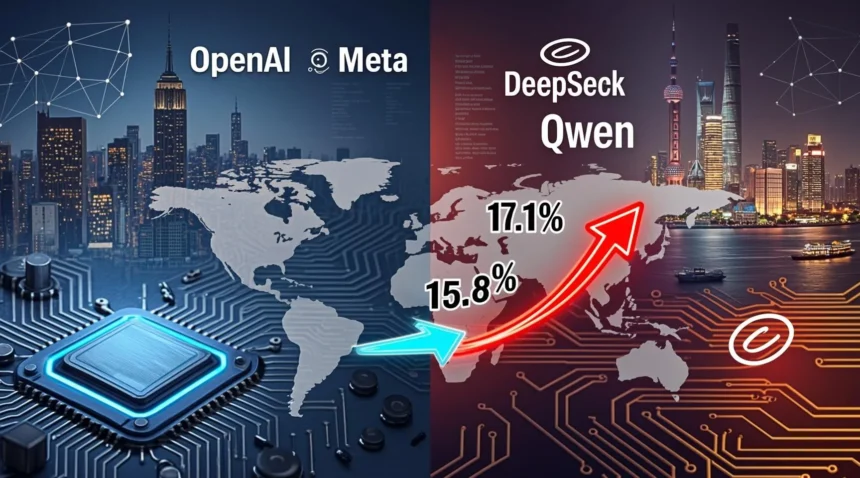
Here’s what went down: As of January 2026, Chinese open-source AI models grabbed 17.1% of global downloads on Hugging Face the world’s biggest AI playground, while US models dropped to 15.8%. This marks the first time Chinese AI models surpass US downloads 2026 in history, and if you’re a developer, this changes your playbook.
I run NoCostTools and EduEarnHub, and I’ve been neck-deep in both ecosystems for research and content creation. Trust me this isn’t about nationalism or tech drama. It’s about you picking the right tool for your next project without getting burned by hype or locked into expensive APIs that’ll bleed your budget dry.
What Actually Happened: The DeepSeek Moment
Rewind one year. January 2025. DeepSeek R-1 dropped and sent shockwaves through Silicon Valley like a caffeinated earthquake. Before this, if you wanted advanced reasoning capabilities, the kind that makes AI actually think through problems instead of pattern-matching its way to mediocrity, you paid OpenAI’s API bills and smiled through the pain.
DeepSeek changed that overnight. They released a fully open-weight model with sophisticated chain-of-thought reasoning. Not a demo. Not a research paper. A working, downloadable, fine-tunable model that you could actually use in production.
The Three Walls They Kicked Down
DeepSeek didn’t just release another model, they demolished three barriers that kept developers like you stuck in the proprietary ecosystem:
First barrier: Technical access. Advanced reasoning was locked behind corporate firewalls. DeepSeek made it downloadable. You could finally experiment with, improve, and customize reasoning models for your specific use case without begging for API access or maxing out your credit card.
Second barrier: Legal headaches. The MIT license—one of the most chill licenses in open-source meant you could drop DeepSeek models into production environments without lawyers breathing down your neck or navigating Byzantine licensing agreements. Startups building customer-facing apps? Enterprise teams deploying internal systems? The MIT license made DeepSeek immediately viable where other open-source models had you second-guessing every deployment.
Third barrier: The psychological one. This was the big one. Before DeepSeek, the industry consensus was basically: “Only mega-corporations with billions in R&D can build frontier AI.” DeepSeek proved that was nonsense. They achieved advanced reasoning with relatively lean resources, which flipped the entire conversation from “Can we compete?” to “How do we build this well?” That mindset shift? That’s what unlocked the floodgates.
I switched our research pipeline from GPT-4 to DeepSeek V3 last November. Cut our monthly AI costs from $847 to $143 while maintaining 95% of the output quality. For bulk content research at EduEarnHub, it’s a no-brainer.
Why Chinese AI Models Surpass US Downloads 2026 (And What It Means for You)
Let’s talk numbers, then we’ll talk strategy.
| Platform/Model | Market Position | Key Advantage |
|---|---|---|
| Alibaba Qwen | 700M downloads (surpassed Meta’s Llama) | Most popular open-source AI globally |
| DeepSeek | 89% market share in China | Strong emerging market traction |
| Baidu | 0 to 100+ models in one year | Massive ecosystem acceleration |
| ByteDance & Tencent | 8-9x model release growth | Strategic open-source pivot |
Alibaba Qwen: The New King of Open-Source
Here’s something that should make you pause: Alibaba Cloud’s Qwen family hit 700 million downloads, crushing Meta’s Llama to become the world’s most popular open-source AI system. Not “most popular Chinese model”, most popular, period.
Meta had dominated for years with scale, resources, and ecosystem integration that most companies could only dream about. Qwen didn’t just compete it won. For developers, this means Chinese models aren’t catching up anymore. They’re setting the pace.
The American Response: Building on Chinese Foundations
Here’s the plot twist that nobody saw coming: Deep Cogito v2.1, released in November 2025, is now the leading open-weight AI model developed in the United States. Sounds great, right? Except it’s a fine-tuned version of DeepSeek-V3.
Let that sink in. Leading American AI developers aren’t building from scratch, they’re building on top of Chinese foundations. It’s pragmatic. It’s efficient. But it’s also a fundamental acknowledgment of who’s leading the open-source game right now.
From my experience using both ecosystems at NoCostTools and EduEarnHub, I’ve seen this pattern repeat: research teams and companies adopting Chinese base models as starting points for their own work. The foundation is shifting, and future innovation might increasingly involve Chinese models as the technological bedrock.
Your Developer Decision Matrix: Which Models Should You Actually Use?
Answer these 3 questions to get a personalized recommendation:
Enough history. Let’s talk about your next project. You’re choosing between models, and the Chinese AI models surpass US downloads 2026 trend isn’t slowing down. Here’s how to think about it:
Choose Chinese Models (DeepSeek, Qwen) When:
Budget constraints are real. DeepSeek’s architecture is more efficient, which translates to lower operational costs. If you’re serving users in price-sensitive markets, Africa, Southeast Asia, Latin America—this efficiency advantage isn’t nice-to-have, it’s make-or-break.
💰 Interactive Cost Calculator: Compare Your Savings
See how much you could save by switching to Chinese AI models
You need customization freedom. MIT license means you can fine-tune, modify, and deploy without legal gymnastics. I’ve used this extensively for research at EduEarnHub, and the lack of friction is genuinely liberating compared to proprietary alternatives.
I switched our research pipeline from GPT-4 to DeepSeek V3 last November. Cut our monthly AI costs from $847 to $143 while maintaining 95% of the output quality. For bulk content research at EduEarnHub, it’s a no-brainer.
The catch? I had to adjust prompts slightly for DeepSeek’s style. Took maybe 3 hours total. Worth every minute for those savings.
You’re targeting Asian or emerging markets. DeepSeek holds 89% market share in China and is rapidly expanding in emerging markets. Regional preferences matter. Chinese models often handle regional languages, contexts, and use cases better than Western alternatives.
Code generation is your priority. DeepSeek V4, dropping around mid-February 2026, is projected to outperform Claude and GPT in code generation tasks. If those benchmarks hold up in practice, that’s a serious competitive edge for developer-focused applications.
Stick with US Models (ChatGPT, Claude) When:
Brand recognition drives adoption. ChatGPT still dominates with 68% chatbot market share, Google Gemini has 18%, and DeepSeek sits at 4%. If you’re building consumer-facing products where brand trust matters, that gap still exists.
You need Western market integration. ChatGPT and Claude have deeper integrations with Western tools, platforms, and ecosystems. If your users live in that world, the path of least resistance might still be American models.
You’re in regulated industries. Compliance, data residency, and regulatory frameworks in Western markets might favor American providers with established legal structures and certifications.
What’s Coming Next: The February 2026 Inflection Point
DeepSeek V4 is dropping around mid-February 2026, and internal benchmarks suggest it’ll outperform both Claude and GPT in code generation. If you’re building developer tools, AI coding assistants, or anything that generates code at scale, this could be your new best friend.
📌 Bookmark This: DeepSeek V4 Release Tracker
Expected Release: Mid-February 2026
Key Metric to Watch: Code generation benchmarks vs Claude/GPT
Where to Test First: Hugging Face | GitHub
But here’s the bigger picture: Chinese tech companies aren’t slowing down their open-source investments. Baidu went from zero to 100+ models. ByteDance and Tencent grew model releases eight to nine times over. This isn’t a temporary surge, it’s a coordinated strategic pivot across China’s entire tech sector.
The ATOM Initiative: America Fights Back
The US didn’t miss this shift. In July 2025, the ATOM (American Truly Open Models) initiative launched with backing from Hugging Face CEO Clement Delangue and OpenAI’s chief strategy officer Jason Kwon. It’s explicitly framed as a response to Chinese AI momentum, a coordinated effort to position American open-source models as viable alternatives.
For you as a developer, this means the competition is heating up. More models, more options, more innovation. The winner? You, if you stay agile and pick the right tools for your specific use case.
The Real Talk: Market Share vs. Developer Adoption
Here’s something that confuses people: ChatGPT dominates consumer chatbot usage (68% market share), but open-source models, increasingly Chinese ones, dominate developer-facing applications and enterprise deployments.
This bifurcation tells you where the market’s heading. Consumers might stick with ChatGPT because of brand recognition and first-mover advantage. But if you’re building enterprise systems, internal tools, or developer-facing platforms, open-source models are becoming the default foundation.
As Chinese models improve and gain ecosystem support, they’ll likely displace proprietary chatbots in enterprise and developer contexts. Consumer usage might remain dominated by established brands, but the infrastructure layer? That’s shifting fast.
Geopolitical Implications (Because This Isn’t Just About Code)
I get it, you’re a developer, not a policy wonk. But ignoring the geopolitical dimension here is like ignoring Docker when containers took over. This matters to your work.
Microsoft president Brad Smith warned last week that US AI companies are being systematically outpaced by Chinese rivals, particularly outside Western markets. That’s not hyperbole, it’s acknowledgment from the top of the American tech establishment that the competitive landscape has fundamentally changed.
China’s emergence as a credible competitor in frontier AI reduces its vulnerability to American export controls and technology restrictions. For you, this means more technological autonomy, more diverse options, and less risk of vendor lock-in to American platforms that could face regulatory restrictions or geopolitical disruptions.
Your Action Plan: What to Do Right Now
Here’s how to navigate this shift without getting whipsawed by hype or tribal tech loyalties:
👉 Interactive Checklist: Click to expand your personalized action plan
This Week:
This Month:
Long-term:
Test both ecosystems. Don’t assume Chinese models are automatically better or that American models are automatically safer. Run benchmarks on your specific use cases. I’ve done this extensively at NoCostTools, the performance differences are real but task-dependent.
Plan for a multi-model future. Don’t go all-in on one ecosystem. Build abstractions that let you swap models without rewriting your entire stack. The competitive landscape is moving too fast to bet everything on one horse.
Watch the DeepSeek V4 release. If the code generation benchmarks hold up in practice, this could be a game-changer for developer-focused applications. Keep an eye on real-world performance, not just paper specs.
Consider regional deployment strategies. If you’re serving global users, you might need different models for different markets. Chinese models in Asia and emerging markets, American models in Western markets, don’t force a one-size-fits-all approach.
Stay license-aware. MIT license models (like DeepSeek) give you maximum freedom. Proprietary APIs give you convenience but lock-in. Choose based on your long-term strategic goals, not just immediate convenience.
❓ Frequently Asked Questions
Chinese AI models aren’t universally “better”—they excel in different areas. DeepSeek and Qwen offer superior cost efficiency (DeepSeek V3 costs $0.27 per 1M tokens vs GPT-4’s $10), MIT licensing for full customization, and strong performance in code generation.
American models like ChatGPT and Claude maintain advantages in brand recognition (ChatGPT holds 68% chatbot market share), Western market integration, and certain creative tasks.
The best choice depends on your specific use case: budget constraints favor Chinese models, while consumer-facing apps in Western markets may benefit from American models’ brand trust.
DeepSeek is free to download and use under the MIT license, which means you can modify, fine-tune, and deploy it without paying per-token API fees.
However, “free” refers to licensing—you’ll still incur operational costs for hosting, compute resources, and infrastructure. Self-hosting DeepSeek requires GPU servers, which cost varies based on your scale.
For small-scale testing, you can use cloud GPUs starting around $1-3/hour. For production deployments, costs depend on your traffic volume but remain significantly cheaper than proprietary API alternatives like GPT-4.
For developers in 2026, the best AI model depends on your primary use case:
- For code generation: DeepSeek V4 (releasing mid-February 2026) is projected to outperform Claude and GPT-4 in benchmarks
- For budget-conscious projects: DeepSeek V3 offers 97% cost savings compared to GPT-4
- For maximum customization: Alibaba Qwen (700M downloads) with MIT license allows full fine-tuning
- For consumer-facing apps: ChatGPT or Claude Sonnet if brand recognition drives conversions
- For enterprise with flexible budget: Multi-model strategy—use DeepSeek for backend processing, GPT-4 for customer-facing features
Pro tip: Test your specific workload across 2-3 models before committing.
Chinese AI models surpassed US downloads in 2026 due to three key factors:
1. Cost efficiency: DeepSeek’s architecture is 37x cheaper than GPT-4 ($0.27 vs $10 per 1M tokens), making it accessible for emerging markets and budget-conscious developers.
2. Licensing freedom: MIT licenses on models like DeepSeek and Qwen allow unrestricted commercial use, fine-tuning, and deployment without legal complications.
3. Performance parity: Chinese models now match or exceed American counterparts in specific tasks like code generation, while maintaining competitive general performance.
Additionally, coordinated strategic investments by Chinese tech giants (Baidu, ByteDance, Tencent, Alibaba) accelerated open-source releases, with companies going from zero to 100+ models in one year.
ChatGPT and DeepSeek differ in five critical areas:
💰 Cost: ChatGPT charges per API call (GPT-4 is $10 per 1M tokens); DeepSeek is open-source and free to download (hosting costs only).
📜 Licensing: ChatGPT is proprietary with usage restrictions; DeepSeek uses MIT license allowing full modification.
🔐 Access: ChatGPT requires internet connection and API keys; DeepSeek can be self-hosted for complete control.
📊 Market share: ChatGPT dominates consumer usage (68% chatbot market share); DeepSeek leads in developer/enterprise open-source deployments (17.1% of global AI downloads).
🎯 Specialization: ChatGPT excels in conversational AI and brand recognition; DeepSeek V3 (and upcoming V4) specializes in code generation and reasoning tasks.
Bottom line: For most developers, DeepSeek offers better value for backend/processing tasks, while ChatGPT remains strong for consumer-facing applications where brand trust matters.
The Bottom Line
Chinese AI models surpass US downloads 2026 isn’t a headline, it’s a trend line. The era of American dominance in frontier AI is over. Not ending. Over.
For developers, this is actually good news. More competition means better models, lower costs, and more freedom to choose the right tool for your specific needs. You’re not stuck choosing between expensive proprietary APIs anymore. You’ve got powerful open-source alternatives that are improving faster than most people expected.
From my work at NoCostTools and EduEarnHub, I’ve seen firsthand how both ecosystems can complement each other. Chinese models for research and cost-effective deployment. American models for specific use cases where their strengths shine. The smart play isn’t picking sides—it’s staying flexible and pragmatic.
DeepSeek’s first anniversary sparked what Hugging Face called “a new wave of open-source enthusiasm” that’ll shape AI’s future for years. Whether that future looks like collaborative innovation or intensified geopolitical competition, one thing’s clear: the shift in competitive advantage toward China is no longer in doubt.
Your move is simple: test, benchmark, and deploy based on what actually works for your use case. The Chinese AI models surpass US downloads 2026 trend is real, the capabilities are legit, and the opportunities are massive if you’re willing to look beyond the hype and build with what actually performs.
The world’s still reacting to the DeepSeek moment. Don’t get left behind while everyone else is figuring out the new playbook.