TL;DR: A digital marketing strategy certification teaches you to think at the planning level, not just the execution level. In 2026, certified marketing managers earn $113,500 on average, compared to $79,500 for non-certified peers in equivalent roles. This guide covers the best certifications for each career stage, a 4-step roadmap to earning one, and how to present it to employers or freelance clients.
- What Is a Digital Marketing Strategy Certification (And Why It’s Not the Same as a Basic Course)?
- Which Digital Marketing Strategy Certification Is Actually Worth It in 2026?
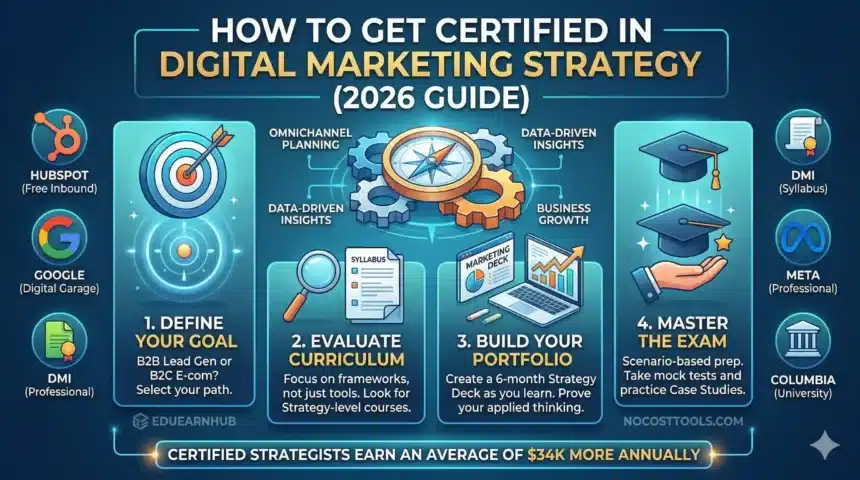
- The 4-Step Roadmap to Getting Certified
- What a High-Quality Strategy Curriculum Must Cover
- How to Build a Real Portfolio While You Study
- Does a Digital Marketing Strategy Certification Actually Increase Your Salary?
- How to Showcase Your Certification So the Right People See It
- The Strategic Mindset Is the Real Credential
- Frequently Asked Questions
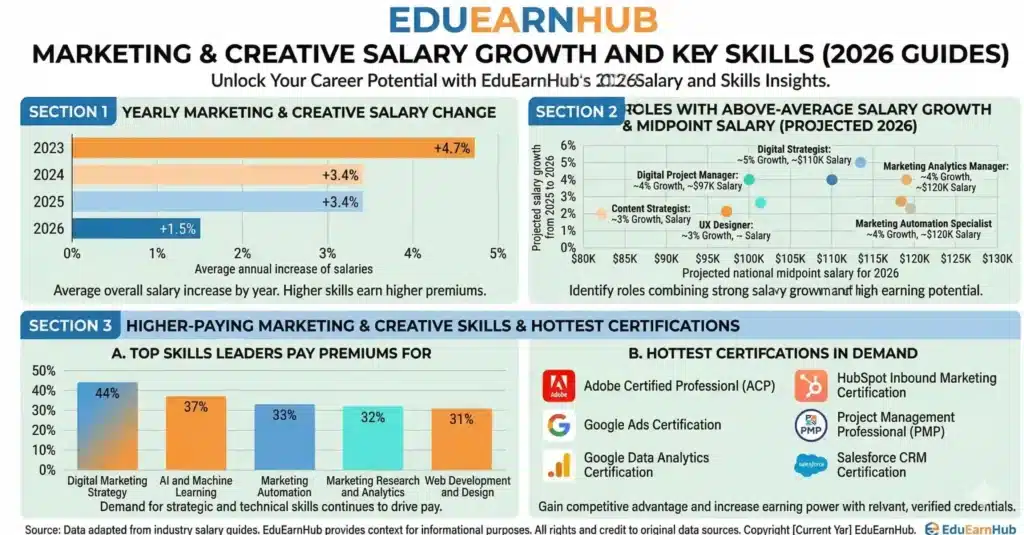
The gap between a digital marketing executor and a digital marketing strategist is one of the most consequential career divides in the profession right now. According to Robert Half’s 2026 Salary Guide, 44% of marketing leaders actively pay more for digital strategy skills than for any other marketing competency. That premium exists because strategy-level work carries accountability for business outcomes, not just task completion.
A digital marketing strategy certification is one of the most direct ways to build that accountability on paper and in practice. The right program teaches you how to select channels for specific business goals, allocate budget across a full funnel, and turn analytics into decisions that drive growth. This guide maps out which certifications are worth your time, what the data says about salary outcomes, and how to build a portfolio alongside your coursework so the credential does more than sit on your LinkedIn profile.
What Is a Digital Marketing Strategy Certification (And Why It’s Not the Same as a Basic Course)?
A digital marketing strategy certification is a credential that validates your ability to design, evaluate, and manage marketing systems across channels. It’s structurally different from a basic digital marketing course, which teaches you how to use tools. Strategy programs teach you which tools to use, why, and in what order.
This matters because employers and clients aren’t looking for someone to run campaigns that someone else designed. They’re looking for someone who can build the plan from the start. The specific skills that separate strategy-level credentials from general marketing training include:
- Platform selection: matching channels to specific business objectives rather than defaulting to what’s popular
- Budget allocation: distributing spend across the funnel based on attribution data, not intuition
- Competitive analysis: identifying market gaps through structured frameworks rather than ad hoc observation
- KPI design: measuring success with indicators tied to revenue outcomes, not vanity metrics
The reason this works at a salary level is that strategic accountability is harder to replace than task execution. A professional who can walk into a business situation and produce a defensible growth plan commands a different rate than one who can execute inside a plan someone else built.
Which Digital Marketing Strategy Certification Is Actually Worth It in 2026?
The certifications worth targeting share three traits: employer recognition, curriculum depth in strategy rather than platform navigation, and outcome data showing real career impact. The strongest options at each price point are listed below.
HubSpot Academy: Digital Marketing Certification Free. Best suited for professionals focused on inbound marketing, content-led growth, and CRM integration. HubSpot’s credential is widely recognized by startups and agencies. It’s a credible starting point, but it skews toward inbound methodology rather than full-channel strategy.
Google Digital Garage: Fundamentals of Digital Marketing Free. Covers 26 modules including business strategy and data analytics. The curriculum addresses search, analytics, and e-commerce fundamentals in a sequence that builds toward applied decision-making. Google’s name carries weight with employers, particularly for roles involving paid search and analytics.
Digital Marketing Institute (DMI): Certified Digital Marketing Professional Paid (approximately $1,000 to $1,500). The DMI credential is widely cited as the gold standard in the field. According to Coursera’s program overview, DMI-trained professionals have taken roles at Google, Meta, Amazon, Disney, TikTok, and Fitbit. For professionals whose goal is global employer recognition, DMI produces it.
Meta Social Media Marketing or Google Digital Marketing & E-Commerce (via Coursera/edX) Paid, with financial aid available. These university-partnered programs are heavier on applied projects and well-suited for professionals targeting B2C growth roles. The capstone project structure is especially useful for building portfolio evidence.
Columbia Business School: Digital Marketing Strategy Certificate Paid. Columbia’s program covers digital strategy frameworks, consumer behavior analytics, and multi-channel planning. It’s positioned toward senior professionals and managers who need both business strategy depth and digital channel fluency.
The right choice depends on where you are in your career. Career-switchers and early-stage professionals benefit most from starting with HubSpot or Google, which provide solid foundational credentials at no cost. Professionals targeting senior roles or Fortune 500 hiring pipelines should look at DMI and Columbia, where employer recognition carries more weight at that level.
The 4-Step Roadmap to Getting Certified
Choosing a certification program and completing it are two different challenges. This roadmap addresses both.
Step 1: Define your career direction before choosing a program
The most important variable isn’t which certification ranks highest. It’s which certification matches where you’re going. B2B lead generation and B2C e-commerce scaling require different strategic fluencies. A professional targeting enterprise SaaS clients needs different credentials than someone building a direct-to-consumer brand. Decide on your direction first, then filter programs against that context.
Step 2: Evaluate the curriculum against strategy-level criteria
A program worth completing will cover buyer persona development tied to funnel stages, KPI frameworks beyond traffic and follower counts, and omnichannel integration that connects SEO, email, paid media, and content into a single measurement system. If the curriculum focuses primarily on platform navigation rather than cross-channel planning, it’s a tools course, not a strategy course.
It’s worth noting that over 70% of marketing roles now require AI tools and analytics experience. Any program completed in 2026 should include at least one module on AI-assisted analysis, audience segmentation, or campaign optimization. To build this foundation before enrolling, the guide to becoming AI literate covers the core competencies worth developing first.
Step 3: Build alongside the coursework
The fastest way to convert a certification into career results is to apply each module to a real or simulated project as you go. Building a 6-month digital strategy deck for a real or fictional brand during the course produces three outcomes at once: it reinforces learning, creates a portfolio asset, and demonstrates applied thinking to future employers or clients.
Step 4: Prepare for the exam with case-study practice
Most strategy-level exams are scenario-based, not definition-based. They test whether you can evaluate a situation and prescribe a course of action, not whether you can recall terminology. Preparation resources from Think with Google and the program’s own practice materials are the most relevant inputs for this format.
What a High-Quality Strategy Curriculum Must Cover
A strategy certification curriculum is worth completing when it teaches you to make defensible decisions, not just follow platform best practices. The core areas a strong program must address are: buyer persona frameworks tied to acquisition channels, KPI systems that connect marketing activity to revenue, and omnichannel integration models that show how SEO, email, paid media, and social work together as a system.
Three additional indicators separate a strategy-level curriculum from a general marketing course.
First, the program should address budget allocation methodology. Knowing how to distribute spend across channels based on attribution data rather than platform defaults is one of the most financially valuable skills a strategist can hold. Clients and employers pay for this judgment directly.
Second, the curriculum should include competitive analysis frameworks. Gap identification, share-of-voice measurement, and competitor content analysis are the tools that allow a strategist to find uncontested positioning rather than compete on the same ground as everyone else.
Third, AI integration should appear in the curriculum. Industry data shows more than 70% of marketing roles now require applied AI skills. A certification program that omits this component is already behind where the market is heading. Digital marketing strategy is increasingly inseparable from data literacy and AI tool fluency, and the best programs treat both as foundational, not optional.
How to Build a Real Portfolio While You Study
A certificate tells an employer or client what you’ve learned. A portfolio tells them what you can do. The most effective approach to certification study is to build both at the same time.
The method is straightforward. Take a real business or a well-researched fictional brand and build a complete 6-month digital strategy around it as you progress through the course. Each module introduces a framework. Apply that framework to your chosen brand before moving to the next module. By the time you finish the course, you have a complete, multi-channel strategy deck that demonstrates applied thinking.
The strategic layer is what produces the result. When Neemesh built NoCostTools, every content and tool page was structured around a deliberate plan: keyword clusters targeting utility search intent, structured data for rich snippet capture, and cross-tool internal linking to increase session depth. The outcome was a 150% organic traffic increase in three months, with no paid advertising. The growth came entirely from planning decisions made before a single piece of content was published. That is precisely the kind of documented, outcome-linked result a portfolio needs to show.
For professionals planning to use their certification in a freelance context, the guide on how to start freelancing in 2026 covers how to position a strategy credential when approaching clients for the first time.
Does a Digital Marketing Strategy Certification Actually Increase Your Salary?
Yes, and the salary gap is measurable. Certified marketing managers earn an average of $113,500 annually, compared to $79,500 for non-certified peers in comparable roles. That’s a $34,000 difference for the same title, produced by credential-level differentiation rather than years of experience alone.
The broader salary picture reinforces this. Robert Half’s 2026 Salary Guide reports that 78% of marketing leaders are willing to pay a premium for specialized credentials, with digital strategy listed as the top skill driving that premium. The guide to high-paying online careers in 2026 places the digital marketing strategist median salary at $115,000 based on BLS and Robert Half data, with 8% job growth forecast for marketing analyst and strategy roles through 2033.
The pattern across this data is consistent. The salary premium is not incidental. It reflects the structural difference between strategy-level accountability and execution-level accountability. A strategist is responsible for whether the plan works. An executor is responsible for whether the task was completed. Employers price that distinction directly into compensation.
For professionals considering the freelance path alongside full-time roles, a strategy certification also raises the floor on what clients will pay. The guide to setting freelance rates covers how to price strategy-level work compared to execution-level services. And for context on where digital marketing strategy sits across the full landscape of high-paying freelance skills, the rate benchmarks by specialization are worth reviewing before setting client expectations.
How to Showcase Your Certification So the Right People See It
Earning a certification is only half the work. The second half is placing it in front of the people who can act on it.
LinkedIn is the highest-priority channel for credential visibility. Add the certification to your “Licenses and Certifications” section with the issuing organization and date. Then publish a post summarizing two or three strategic takeaways from the program. This signals not just that you completed a course, but that you extracted transferable insight from it. That distinction registers with recruiters and hiring managers who read dozens of certification announcements each week.
Portfolio is where credentials gain weight. Attach the strategy deck from Step 3 of the roadmap as a PDF or presentation. Recruiters and clients evaluating strategy-level candidates are looking for evidence of structured thinking. A finished deck provides that. A certificate alone doesn’t.
Resume placement matters as well. List “Digital Strategic Planning” in your skills section rather than just the certification name. This matches the language hiring managers use in job descriptions and improves visibility in applicant tracking systems.
For those building toward the highest-paying digital skills over the next 12 to 24 months, aligning how you present your credentials with the specific language of the roles you’re targeting is a strategy in itself, not just an administrative task.
The Strategic Mindset Is the Real Credential
A digital marketing strategy certification changes how you approach every problem in the profession. The certificate marks the completion of a learning path. The mindset it builds is what actually changes career outcomes.
The data on salary premiums, employer preferences, and job growth all point in the same direction. Strategy-level skills command higher compensation because they carry accountability for business results, not just task delivery. The roadmap is clear: define your career direction, choose a program with real strategic depth, build a portfolio alongside the coursework, and place your credentials where the right people can find them.
This transition from executor to strategist doesn’t happen at the moment you receive the certificate. It happens when you start building the plan before the campaign starts. If you’re mapping where this fits within a broader career move toward high-income remote work, the full breakdown of high-paying online careers in 2026 shows exactly where digital marketing strategy sits relative to data science, cybersecurity, and project management in terms of salary and growth trajectory.
Which certification is closest to the career direction you’re already building toward, and what’s the one step you’d need to take this week to start?
Frequently Asked Questions
How long does it take to get a digital marketing strategy certification?
Timeline varies by program. Free certifications like Google Digital Garage and HubSpot typically take 20 to 40 hours and can be completed in two to four weeks of focused study. Paid programs like DMI’s Certified Digital Marketing Professional are structured over 30 hours of content, typically spread across six to twelve weeks. University-partnered programs via Coursera or edX often run six months with a capstone project included. The right timeline depends on how much time you can allocate weekly and whether you’re building a portfolio project alongside the coursework.
Is a free certification (like Google or HubSpot) taken seriously by employers?
Yes, for roles at the execution and mid-level strategy range. Google and HubSpot certifications carry real employer recognition, particularly among startups, agencies, and digital-first companies. For senior strategy roles at large enterprises or Fortune 500 companies, paid credentials from DMI or university-level programs carry more weight. The right certification depends on the type of role you’re targeting. A free credential paired with a strong portfolio case study often outperforms a paid credential with no applied work to show.
What is the best digital marketing certification for freelancers in 2026?
HubSpot and Google certifications are strong starting points because they’re free, widely recognized, and fast to complete. They provide a credible baseline for early client conversations. For freelancers targeting retainer-based strategic consulting roles, the DMI certification or a university-partnered program provides the credential depth that justifies higher rates. Pairing any certification with a documented portfolio case study is more important than which specific credential you hold.
Do I need work experience before pursuing a strategy certification?
No prior marketing experience is required for most programs, including HubSpot, Google, and the entry-level Coursera paths. That said, professionals with six to twelve months of execution-level experience will extract more value from strategy programs because they have real-world context to map the frameworks against. Experience isn’t a prerequisite for enrolling, but it accelerates how much you retain and apply.
How is a digital marketing strategy certification different from an MBA in marketing?
A digital marketing strategy certification focuses specifically on digital channel planning, analytics, and execution frameworks. An MBA in marketing covers a broader range of topics, including brand management, financial analysis, organizational behavior, and market research. The two credentials serve different purposes. A certification signals channel-specific strategic competency. An MBA signals cross-functional business leadership capability. For professionals targeting CMO-level or general management roles, an MBA carries additional weight. For professionals building deep digital strategy expertise on a faster timeline, a focused certification is more directly applicable.