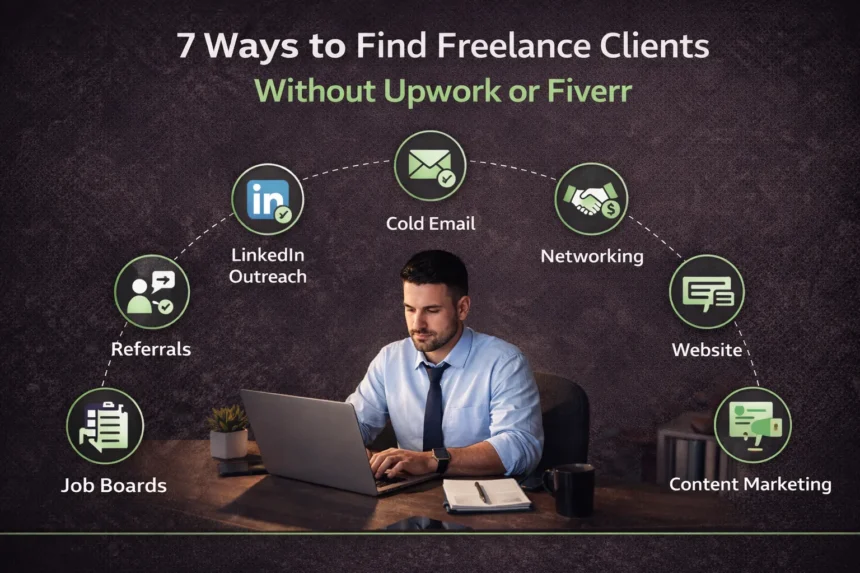
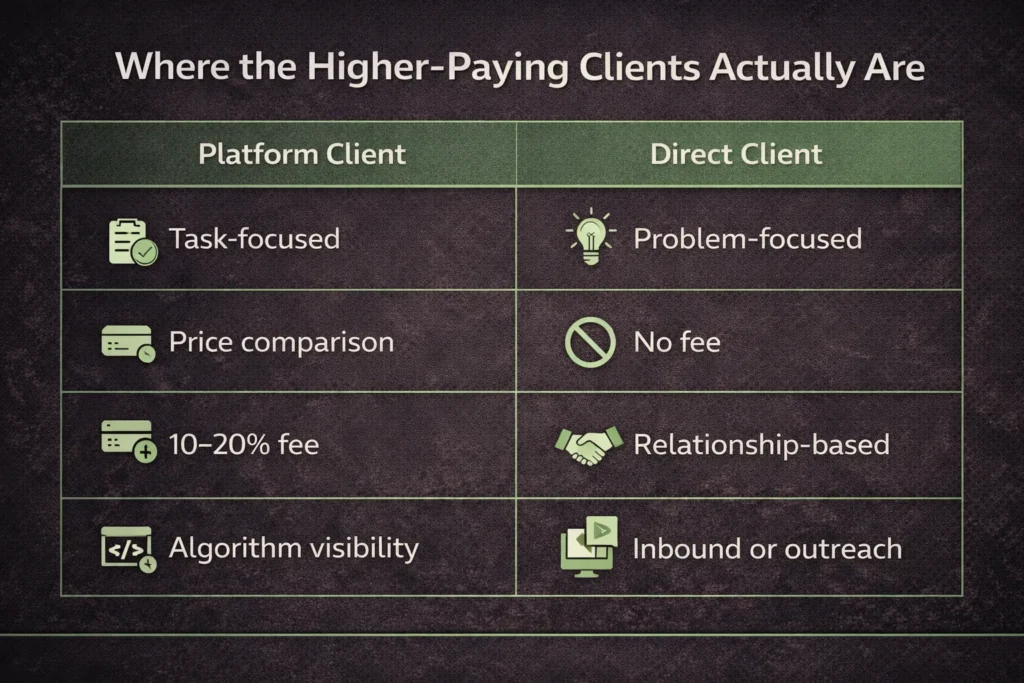
Upwork and Fiverr solve one problem well: they put you in front of clients who are already looking for freelancers. The tradeoff is that those clients are also comparing you against 50 other profiles, the platform takes 10–20% of every payment, and the algorithm, not your reputation, decides how visible you are on any given week. Off-platform clients work differently. They are not comparing you against a marketplace. They found you through a referral, a cold email, or a piece of content, and by the time they respond, you are already the person being considered, not one option among many. The foundation of any client acquisition strategy is understanding which channel reaches which type of client, and why direct clients consistently pay more than platform clients for the same deliverable.
- Why the Highest-Paying Freelance Clients Are Not on Upwork or Fiverr
- Method 1- LinkedIn Cold Outreach
- Method 2 – Cold Email Outreach
- Method 3 – The Referral System (Most Underused Method)
- Method 4 – Niche Job Boards
- Method 5 – Building a Freelance Website That Generates Inbound Leads
- Method 6 – Content Marketing on LinkedIn, X, or Substack
- Method 7 – In-Person Networking at Local Business Events
- Which Method Should You Start With?
- Frequently Asked Questions
- Conclusion
This guide covers 7 specific methods for finding freelance clients without Upwork or Fiverr, with message templates, email structures, job board lists by niche, and a decision framework for which method to use based on where you are in your freelance career.
Why the Highest-Paying Freelance Clients Are Not on Upwork or Fiverr
Before covering the methods, the economics explain why the shift matters.
The Platform Fee Problem, and What It Costs Per Year
Upwork charges freelancers 10% on earnings above $500 with a single client, and 20% on all earnings below that threshold. Fiverr charges a flat 20% on every transaction. On $50,000 in annual freelance revenue, platform fees alone represent $5,000 to $10,000 in lost income, before factoring in payment processing fees, withdrawal delays, or the time cost of competing for jobs in a crowded marketplace.
Off-platform clients pay the same rate with none of that overhead. The $75/hour rate you charge on Upwork produces $60 in actual income after fees. The same rate charged directly produces $75. Across a full year, that difference funds a significant portion of the income growth most freelancers are working toward. Knowing your rate before you reach out to any direct client is the prerequisite, underselling in a direct engagement without the safety net of a platform’s pricing structure costs more than the platform fee itself.
How Direct Clients Think vs. Platform Clients
Platform clients start their search with a task and a budget. They browse profiles until someone looks capable enough at a price they are comfortable with. The relationship is transactional by design.
Direct clients, whether reached through LinkedIn, referral, or cold email, start with a problem. They are not comparing your profile to a competitor’s. They are evaluating whether you understand their specific situation and can solve it. This changes the entire acquisition conversation: it moves from “here is my rate and portfolio” to “here is what I noticed about your business and here is what I would do about it.” That shift in framing is why direct clients spend more, stay longer, and refer more consistently than platform clients. The skills that command direct client rates are the same skills that underperform on platforms because platforms compress pricing, not because the work is worth less.
Method 1- LinkedIn Cold Outreach
LinkedIn is the only professional network where decision-makers actively maintain public profiles showing their company, role, and the problems they are currently thinking about. A post about struggling to scale content output, a job listing for a full-time copywriter, or a comment thread about a marketing challenge are all visible signals that a company has an active need, before any competitor freelancer sees it.
How to Find the Right Decision-Makers
The goal is not to reach the CEO of every company in a niche. It is to reach the person who feels the pain of the problem being solved. For a freelance content writer, that is typically a Head of Content, Content Marketing Manager, or Founder at a company with 10–50 employees, large enough to have a content need, small enough that there is no full team handling it.
The search filters that make this precise:
- People search on LinkedIn → filter by Job Title + Company size (11–50 or 51–200 employees) + Location (if relevant)
- Search for companies posting jobs for the role being targeted, a company hiring a full-time content manager has a content need that a senior freelancer can often fill faster and cheaper
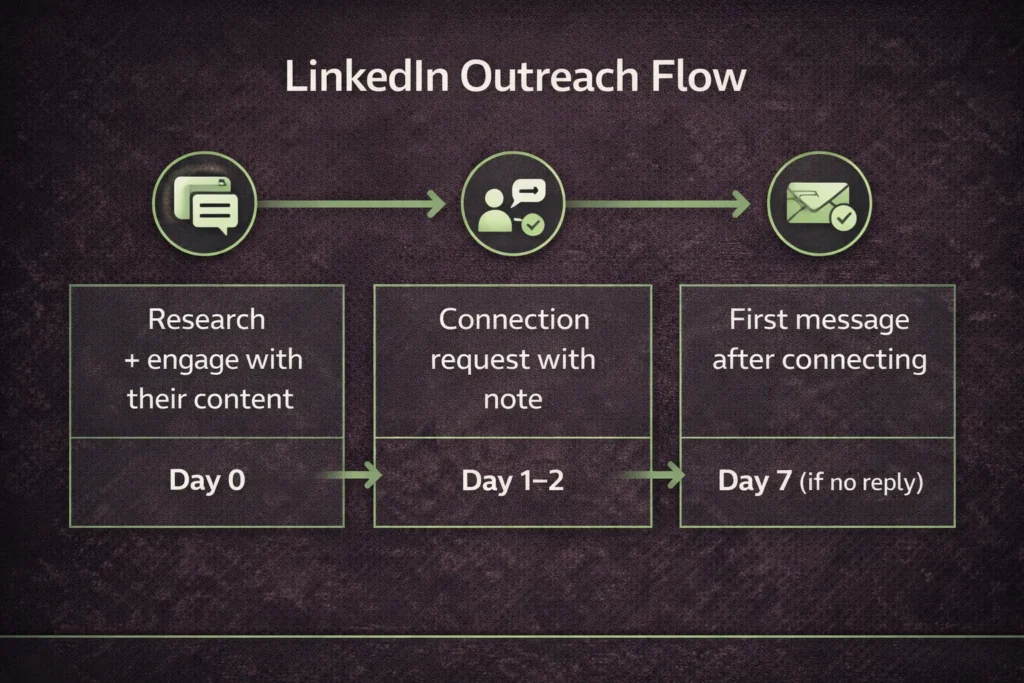
- Follow target prospects before connecting, engage with one piece of their content before sending a connection request
Personalized outreach produces significantly higher response rates than generic connection requests. The research step, reading one recent post or article from the target before writing, is what makes personalization possible and is what separates responses from silence.
The Message Structure That Gets Responses
Connection requests have a 300-character note limit. Every word carries weight.
Connection request note:
“Hi [Name] — I help [specific type of company] with [specific outcome]. Saw your post on [topic] — thought it was worth connecting.”
Keep the note observational, not promotional. The goal is a connection, not a sale.
First message after connecting (send within 48 hours):
“Thanks for connecting, [Name]. I work with [niche] companies on [specific problem]. Noticed [one specific thing about their business, content, or recent activity]. I have a relevant example of what I did for [comparable company type] — happy to send it over, no call needed. Just something concrete to look at when you have five minutes.”
The structure that generates replies has three properties: it references something specific to them, it offers proof before asking for time, and it uses a low-friction CTA that does not require calendar coordination. Writing a proposal that wins the project once they respond follows a different structure from the outreach itself, the outreach opens the door, the proposal closes it.
What to Do When They Reply vs. When They Don’t
A reply, even a “thanks, not right now”, gets a short follow-up in 3–4 weeks: one new piece of relevant content, one new data point, or a brief mention of a result from a recent project. No pitch, no pressure. The goal is to stay visible until the timing is right.
No reply after the first message: follow up once, seven days later, with a single new line, a different angle, a specific result, or a question about a challenge relevant to their role. After two messages with no response, move on. Re-engage in 60 days if the prospect still looks like a strong fit.
Method 2 – Cold Email Outreach
Cold email reaches decision-makers who are not active on LinkedIn, works across every niche, and scales in a way that one-to-one LinkedIn outreach does not. The tradeoff is lower reply rates, 3 to 5% is a realistic benchmark for a well-structured campaign, but that translates to 3 to 5 conversations per 100 emails, which is enough to build a consistent pipeline when run weekly.
How to Build a Prospect List Without Paid Tools
A targeted list starts with defining one specific company type and one specific role title, then finding companies that match both.
Free methods that produce qualified lists:
- Google search:
"[job title]" "[city or remote]" site:linkedin.com/in, finds individual decision-makers with public profiles - Company blog/about pages: Companies that publish content consistently have a content need, find the editor or marketing lead directly
- Job board cross-reference: A company posting a full-time role for the skill being offered is a warm signal, find the hiring manager, not HR
- LinkedIn Sales Navigator free trial: Allows 90 days of filtered search before requiring payment, worth using to build a 300–500 person list before the trial ends
Email addresses can often be found using Hunter.io (free tier covers 25 searches/month) or the [first].[last]@[company].com pattern, which works for the majority of companies with a professional domain.
The Cold Email Structure That Avoids the Spam Folder
Four lines. No attachments on the first email. No PDF portfolio links in the opening message.
Line 1 – One specific observation (not a compliment):
“Noticed your last three blog posts were all bottom-of-funnel – nothing driving top-of-funnel awareness.”
Line 2 – One comparable result:
“I helped a B2B SaaS company in a similar position increase organic traffic by 40% in four months by shifting their content mix.”
Line 3 – One specific offer:
“I could put together a quick content gap analysis for [Company] – takes me about an hour and gives you something actionable regardless of whether we work together.”
Line 4 – One low-friction CTA:
“Worth a 15-minute call this week?”
The subject line should be specific to them, not generic: "Content gap I noticed on [Company]" outperforms "Freelance writer available" at roughly 3× the open rate. Avoid subject lines with words like “partnership,” “collaboration,” or “opportunity”, these trigger spam filters and signal a pitch before the email is opened.
Follow-Up Timing and What a Realistic Reply Rate Looks Like
Send 100–200 cold emails per week to a targeted list and expect 3–10 replies at a 3–5% response rate for a well-personalized campaign. Generic emails produce below 1%. The difference is entirely in Line 1, the specific observation that signals the email was written for this person, not copied from a template.
Follow up once, five to seven days after the original email, with a single new line: one new observation, one new result, or a brief question. Three emails total per prospect maximum, original, one follow-up, one final close. After that, remove from the active sequence and revisit in 90 days.
Method 3 – The Referral System (Most Underused Method)
Most freelancers receive referrals occasionally and treat them as a pleasant surprise. The freelancers with the most stable client pipelines treat referrals as a system, something that runs on a schedule, not on luck.
Why Most Freelancers Get Referrals by Accident
The gap between “I’d recommend you” and “I just recommended you to someone” is almost always the absence of an ask. Satisfied clients do not think to recommend a freelancer unless prompted, not because they would not, but because it does not occur to them unless the moment presents itself. Creating that moment deliberately is what converts passive goodwill into active referrals.
Research consistently shows that referred clients close faster, require less education about the value being offered, and stay longer than cold-acquired clients. The referral itself carries a pre-built trust signal that no cold email or LinkedIn message can replicate.
How to Ask for a Referral Without It Being Awkward
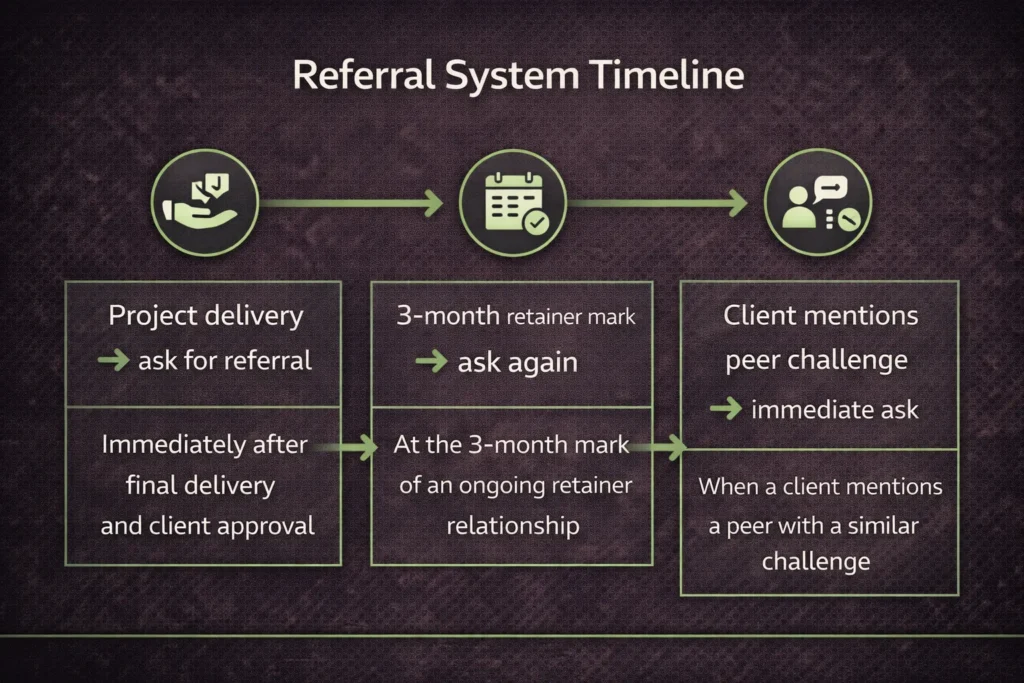
The best moment to ask is immediately after a project milestone or final delivery — when the client has just received the result and satisfaction is highest.
Referral ask script (message or email):
“Really glad the [project] landed well. Quick question, do you know one or two people in your network who might benefit from the same kind of work? No pressure at all, just thought I’d ask while it’s fresh. Even a quick intro email would go a long way.”
Three things make this work: it is specific (“one or two people,” not “anyone”), it is low-pressure (“no pressure at all”), and it gives them an easy action (“a quick intro email”). Systematically collecting testimonials after the same project milestone turns one successful delivery into two client acquisition assets, a referral and a social proof piece.
When and How Often to Run a Referral Ask
Three natural moments to ask:
- Immediately after final delivery and client approval
- At the three-month mark of an ongoing retainer relationship
- When a client mentions a peer who is facing a similar challenge (the spontaneous referral opening, act on it immediately)
Running a referral sequence once per quarter to the full client list, a brief check-in email that ends with a referral ask, adds a consistent source of warm introductions without requiring new outreach.
Method 4 – Niche Job Boards
General job boards aggregate everything and produce high competition. Niche job boards attract clients who are already looking for a specific type of freelancer, which means less competition and a higher signal-to-noise ratio per application. Applying on a niche board also positions the submission differently: there is no algorithmic ranking, no profile score, and no competing bids visible to the client.
The Best Job Boards by Niche
| Niche | Job Board | What It’s Best For |
|---|---|---|
| Writers & content | ProBlogger Jobs, Contena | Blog posts, copywriting, editorial, journalism |
| Designers | Dribbble Jobs, Behance Job List | UI/UX, branding, illustration, motion |
| Developers | We Work Remotely, Remote OK, Gun.io | Full-stack, front-end, back-end, mobile |
| Marketers | Growth Collective, Marketing Hire | SEO, paid ads, email, growth strategy |
| All niches | Wellfound (AngelList), Working Nomads | Remote-first startup and scale-up clients |
| Copywriters | CopyHackers Job Board, Smart Blogger | Conversion copy, SaaS, B2B content |
The most productive use of niche job boards is a daily 20-minute scan, not a full application process for every listing. Apply only to roles where the brief is specific enough to write a targeted response and where the company’s existing work can be referenced in the application.
How to Apply Differently on Job Boards vs. Platforms
Platform applications compete on profile metrics and pricing. Job board applications compete on relevance. The difference in approach:
- Lead with the specific problem they described, not with credentials
- Reference something from their existing work – a content gap, a design pattern, a technical issue visible from their public product
- Propose a small, specific first step rather than pitching a full engagement, “I’d start with a content audit of the top 10 pages” closes more discovery calls than “I’m available for full content strategy work”
- Keep it under 150 words – hiring managers reading job board applications are scanning, not reading
- A portfolio clients can actually review is the asset most job board applications link to. The application creates interest; the portfolio converts it.
Method 5 – Building a Freelance Website That Generates Inbound Leads
A freelance website is the only client acquisition asset that works without active effort, once it ranks for relevant searches, it generates inquiries passively. Neemesh’s experience building NoCostTools demonstrates exactly this dynamic: SEO-driven landing pages targeting specific utility searches generate consistent inbound traffic and leads without requiring ongoing outreach. The same architecture, specific page per specific service, targeted at specific search terms, applies directly to a freelance services website.
The Five Pages Every Freelance Website Needs
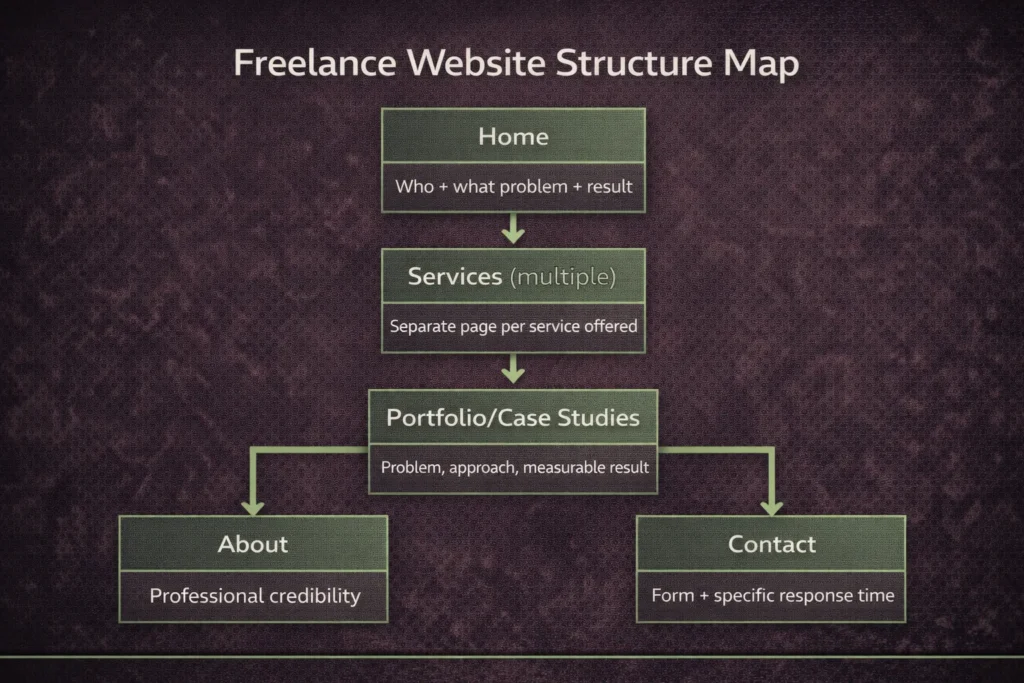
A freelance website that generates leads needs exactly five pages, no more are required to convert a visitor into an inquiry:
- Home page: One clear headline stating who is served, what problem is solved, and what result is produced. Not a biography.
- Services page: One page per service offered, each page targets a specific search term (e.g., “freelance B2B content writer for SaaS companies”) and describes the deliverable, process, and outcome
- Portfolio/Work page: Three to five case studies with a before/after structure, problem, approach, measurable result
- About page: Professional credibility, not personal history, focused on why the background is relevant to the client’s problem
- Contact page: One form, one email address, and a specific response time commitment (“I respond within 24 hours on weekdays”)
What Makes a Freelance Website Generate Leads vs. Just Sit There
Most freelance websites describe the freelancer. Lead-generating freelance websites describe the client’s problem. The shift is structural: every headline, every services description, and every case study is written from the perspective of what the client gains, not what the freelancer does.
The two technical elements that determine whether a website ranks and generates inbound traffic are a fast load time (under 2 seconds) and service pages written around the specific terms clients search, “freelance UX designer for fintech” outranks “freelance designer” because it matches a narrower, higher-intent query with less competition.
Method 6 – Content Marketing on LinkedIn, X, or Substack
Content marketing is the slowest method on this list to produce results and the most durable once it does. A freelancer who consistently publishes useful content in their niche for six months builds an audience of potential clients who already trust the expertise before they ever send a message. The inquiry arrives pre-sold.
Which Platform Fits Which Niche
The platform choice determines the audience reached, and not every platform reaches the same type of client:
- LinkedIn works for B2B niches: content writers serving SaaS companies, developers serving startups, designers serving corporate clients, marketers serving funded companies. Decision-makers with budgets are most concentrated here.
- X (formerly Twitter) works for tech-adjacent niches: developers, product designers, growth marketers, and technical writers. The audience is smaller than LinkedIn but has a high concentration of founders and early-stage startup decision-makers.
- Substack works for expertise-driven niches where depth is the differentiator: strategic consultants, researchers, senior writers, and specialists whose primary asset is a specific analytical point of view. A Substack with 500 engaged subscribers in a tight niche outperforms a LinkedIn page with 5,000 passive followers for high-value client acquisition.
What to Publish and How Often
The content types that attract clients are not promotional, they are analytical. Posts that break down a specific problem in the niche, explain why a common approach fails, or demonstrate a method through a real example attract the attention of people who have that problem. Posts about freelancing, personal milestones, or general career advice attract other freelancers, not clients.
A realistic content schedule that produces results without burning out:
- LinkedIn: 3 posts per week, one observation, one breakdown, one short case result
- X: 5 short posts per week, one thread of substance per week is sufficient
- Substack: One newsletter per week or two per month, depth over frequency
How Long Before Content Marketing Produces Results
Six months is the realistic minimum before content marketing generates consistent inbound inquiries. The first three months build the archive; the second three months build the audience. Most freelancers who try content marketing stop at month two, which is exactly when consistency starts to compound. The freelancers who stay past month three are the ones still receiving inbound inquiries from posts written eight months ago.
Method 7 – In-Person Networking at Local Business Events
Every other method on this list reaches clients through a screen. In-person networking is the only method where a conversation, a handshake, and a follow-up email the same evening can produce a client relationship inside a week. The conversion rate from a genuine in-person conversation to a discovery call is significantly higher than any digital outreach channel, because the trust signal is immediate rather than accumulated.
Where to Find Events Worth Attending
The events that produce client relationships are not freelancer meetups, those produce peer connections, not clients. The events worth attending are the ones clients go to:
- Chamber of Commerce monthly meetings – local business owners with operational needs and budgets
- Industry-specific conferences in the niche being targeted, a content writer attending a SaaS marketing conference meets potential clients, not competitors
- BNI (Business Network International) chapters – structured referral groups where members actively refer business to each other
- Local startup and founder events – Eventbrite, Meetup.com, and YCombinator’s local community boards list these by city
- Trade association events in the target industry, a designer targeting healthcare clients attends healthcare industry events, not design conferences
How to Introduce Yourself and What to Say
The introduction that opens conversations is not “I’m a freelance [job title].” That framing makes the next question “oh, are you looking for work?” which is a dead end.
The framing that produces curiosity: “I help [specific type of company] with [specific problem].”
- “I help e-commerce brands reduce cart abandonment through email sequences.”
- “I help early-stage SaaS companies turn their documentation into a sales asset.”
- “I help marketing teams create content that ranks without adding headcount.”
Each of these opens a conversation because the person hearing it either has that problem, knows someone who does, or is curious how it works. All three outcomes are useful.
The Follow-Up That Converts a Conversation Into a Discovery Call
The follow-up email sent the same evening, while the conversation is fresh, is what separates event attendance from event ROI.
Follow-up email structure:
Subject: “Great meeting you at [event name]”
“Hi [Name] — really enjoyed our conversation about [specific thing they mentioned]. As I mentioned, I help [their company type] with [specific problem]. I put together a quick resource on [relevant topic] that might be useful given what you described — happy to send it over. And if it ever makes sense to talk through [their specific challenge], I’m easy to reach.”
The resource mentioned does not need to be elaborate, a one-page PDF, a relevant article, or a short case study all work. The goal is a reason to follow up that provides value before asking for anything.
Which Method Should You Start With?
The right starting point depends on where the freelance practice currently is, not on which method sounds most appealing.
| Freelancer Stage | Best First Method | Why |
|---|---|---|
| New, no clients yet | Referral system + LinkedIn outreach | Warm network is fastest path to first paid work |
| Has 1–2 clients | Referral system | Lowest effort, highest conversion rate |
| Has portfolio, wants growth | Cold email + niche job boards | Scales faster than one-to-one outreach |
| Has consistent income | Freelance website + content marketing | Builds passive inbound over 6–12 months |
| Wants premium clients | LinkedIn outreach + in-person networking | Highest conversion rate for high-ticket work |
Running two methods simultaneously, one active (outreach) and one passive (content or website), is the structure that produces the most consistent pipeline. The active method pays now. The passive method pays later, without additional effort.
Whichever method is chosen, protecting the engagement with a contract before work begins is the step that converts a verbal agreement into a professional relationship, and the step that most freelancers skip until they learn why it matters from experience.
If building a direct client pipeline is the goal but platforms are still part of the current income mix, a comparison of which platforms are still worth using while the direct pipeline develops helps clarify when to lean on each channel.
Frequently Asked Questions
How do I find freelance clients without Upwork or Fiverr as a beginner?
The fastest path for a beginner with no existing client base is LinkedIn outreach combined with a referral ask to anyone who has seen the work, former colleagues, managers, or professors. Both methods require no paid tools, no established portfolio, and no platform profile. The first paid engagement almost always comes from a warm contact, not a cold one. Once that first client delivers a result, building a portfolio around that result gives every subsequent outreach effort a proof point.
What is the best free method to get freelance clients?
LinkedIn outreach and referral requests are both completely free and consistently produce the highest response rates of any client acquisition channel. Niche job boards are also free to browse and apply to. Cold email requires a free email tool like Hunter.io for prospect research but no paid subscription to run at a small scale. A freelance website requires hosting (typically $5–$15/month) but generates leads passively once established.
How long does it take to get clients through cold email or LinkedIn?
With a targeted list and a personalized message structure, the first response from cold outreach typically arrives within one to two weeks. Converting a response to a paid project adds another one to three weeks depending on the client’s decision timeline. Most freelancers running cold outreach consistently, 50 to 100 messages per week, land one to two new clients within the first 30 days. Content marketing and a freelance website take three to six months before producing consistent inbound inquiries.
Do I need a freelance website to get clients without platforms?
No. Many freelancers build a full client base through LinkedIn, referrals, and cold email without a website. A website becomes useful when the goal is inbound leads from search, clients who find you through Google rather than through outreach. For most freelancers in their first year, direct outreach produces clients faster than building and ranking a website. The website becomes a higher-leverage asset as the client base and portfolio grow.
Which niche job boards pay the best rates?
Growth Collective and Gun.io both vet freelancers before listing them, which filters the client pool toward companies willing to pay above-market rates. Wellfound (AngelList) lists primarily funded startups, which tend to have allocated budgets for freelance work. Dribbble Jobs and We Work Remotely attract design and development clients who are accustomed to professional rates rather than platform pricing.
Conclusion
The shift from platform-dependent to direct client acquisition is not a single action, it is a system built over several months. LinkedIn outreach, cold email, and the referral system produce clients now. A freelance website and content marketing produce clients later, without additional outreach effort. Niche job boards and in-person networking fill the gaps for specific niches and deal sizes.
The freelancers who build the most durable off-platform pipelines do not rely on one method. They run one active outreach channel and one passive content channel simultaneously, generating short-term income from outreach while building long-term inbound from content. Running both is not twice the work. It is the same work, structured across two different time horizons.