This is the portfolio paradox every beginner freelancer faces. You need work samples to land clients, yet you need clients to create work samples. The frustration is real, and it stops thousands of capable people from ever launching their freelance careers.
Here’s what most beginners don’t understand: the paradox isn’t real. The global freelancing workforce reached 1.57 billion people in 2025, and the vast majority started exactly where you are, with zero paid experience. US freelancers contributed $1.2 trillion to the economy in 2025, proving that breaking into this market is not only possible but increasingly accessible.
Who This Guide Is For
- Complete beginners with zero clients
- Students building their first portfolio
- Professionals switching to freelancing
- Side hustlers testing demand
This guide shows you exactly how to build a freelance portfolio with no experience through spec projects, strategic platform selection, and presentation frameworks that demonstrate capability regardless of your employment history. You’ll learn which portfolio components matter, where to host your work, and how to position yourself to land your first client within weeks.
Why You Actually Don’t Need Experience to Build a Portfolio
The Portfolio Paradox (And Why It’s Not Real)
The belief that you need client work before getting client work is a mental trap, not a market reality. Clients focus less on employment history and more on the ability to solve their current problems. This matters because hiring decisions are based on perceived capability, not resume credentials.
Think about how clients evaluate freelancers. They ask: “Can this person deliver what I need?” They rarely ask: “Who has this person worked for?” The distinction is critical. Your portfolio exists to answer the capability question, and capability can be demonstrated through projects you create independently.
Consider how freelancing has evolved. Traditional employment credentialing carried weight when freelancing was a niche activity. Now that nearly half the global workforce operates independently, the market has adapted. Platforms, clients, and algorithms prioritize demonstrated skill over pedigree.
What Clients Really Care About (Spoiler: It’s Not Your Resume)
Clients evaluate three factors when reviewing portfolios: relevance, quality, and results. Relevance means your samples align with their project needs. Quality reflects your execution standards and attention to detail. Results demonstrate that your work creates measurable outcomes, whether that’s increased engagement, improved conversion rates, or cleaner code architecture.
None of these factors requires paid client work. A spec project for a fictional brand can demonstrate relevance if it targets the same industry. A personal website rebuilt with modern design principles demonstrates quality. A case study explaining how your redesign improved loading speed by 40% demonstrates results.
The significance lies in understanding that portfolios function as proof-of-concept, not proof-of-employment. What you prove is your process, your standards, and your ability to deliver valuable work. The context in which you created that work becomes secondary.
What Should a Beginner Freelance Portfolio Include?
Your portfolio needs strategic focus, not volume. Beginners often assume that more samples create better impressions, but the opposite proves true. Three strong, relevant projects outperform twenty mediocre ones because quality signals professionalism while quantity signals desperation.
Here’s what a beginner freelance portfolio should contain:
| Element | Required? | Why It Matters |
|---|---|---|
| 3 Strong Samples | Yes | Demonstrates capability across different scenarios while maintaining quality standards |
| Case Study Format | Strongly Recommended | Transforms samples into strategic narratives that explain your process and problem-solving approach |
| Results Section | Strongly Recommended | Differentiates you from beginners who only show final deliverables without context or impact |
| Testimonials | Optional (Initially) | Adds social proof but isn’t expected from beginners; can be obtained from volunteer work or spec projects with feedback |
| About/Bio Section | Yes | Positions your expertise and target market clearly, helping clients self-qualify fit |
| Contact Information | Yes | Obvious but often neglected; make it effortless for interested clients to reach you |
Understanding which freelance skills command higher rates helps you choose which capabilities to showcase. Specialized technical skills, strategic consulting abilities, and creative execution that demonstrates business thinking all position you for better opportunities than generic service offerings.
Essential Portfolio Components for Zero-Experience Freelancers
Each portfolio piece should include specific elements that transform basic samples into professional presentations. Start with a clear project title that describes what you created. Follow with a brief context section explaining the challenge or opportunity the project addresses.
Next, outline your process. This separates professionals from amateurs. Describe your research, planning, execution phases, and the reasoning behind key decisions. Clients value process transparency because it predicts how you’ll handle their projects.
Finally, present outcomes. Even for spec projects, you can identify what the work achieves. “This redesign reduces navigation clicks by 50%” or “This content strategy targets three high-intent keywords with low competition” demonstrates analytical thinking that clients seek.
Quality vs. Quantity (Why 3 Strong Projects Beat 20 Mediocre Ones)
Portfolio curation reflects judgment. Including weak sample signals that make it hard to distinguish your best from your worst work, which undermines client confidence. Every piece you include should represent work you’re proud to claim and confident that will generate positive impressions.
This creates a practical constraint: if you have only one strong sample, present it. Building a third mediocre project to hit an arbitrary number degrades your portfolio quality. Instead, invest time creating a second high-quality piece that meets your standards.
The strategic implication is that portfolio development becomes an ongoing process, not a one-time task. As your skills improve, older samples get replaced with stronger work. This maintains portfolio quality while documenting your progression.
How Can You Create Portfolio Projects Without Clients?
Mock projects enable freelancers to move from theory to practical application by building mental muscles for creating deliverables. The transition from “I could do this work” to “I have done this work” happens through deliberate practice, and spec projects provide that practice environment.
Strategy 1: Create Spec Projects for Dream Brands
Identify brands you’d like to work with and create unsolicited projects for them. If you’re a copywriter, write three email sequences for a company whose marketing you admire. If you’re a designer, redesign their product page. If you’re a developer, build a feature you think they need.
This approach offers multiple benefits. First, it demonstrates initiative and strategic thinking. Second, it creates relevant samples if those brands or similar companies become future clients. Third, it occasionally leads to actual opportunities when companies discover your spec work and reach out.
The key is choosing realistic projects. Don’t redesign Apple’s entire website—that signals lack of judgment. Instead, solve a specific problem you’ve identified: improve their checkout flow, create a better onboarding sequence, or optimize a landing page for conversion.
Strategy 2: Reimagine Real-World Campaigns
Study successful campaigns in your target industry and create your own version. This isn’t copying—it’s demonstrating that you understand what makes effective work in your field. If a competitor’s email campaign drove impressive results, analyze why it worked and create your own campaign addressing similar objectives with different execution.
This method accelerates learning while building portfolio content. You’re essentially reverse-engineering professional standards and proving you can meet them. The research required to understand why campaigns succeed also builds expertise that differentiates you from beginners who only know execution mechanics.
Strategy 3: Turn Personal Projects Into Professional Case Studies
Building your own project and documenting the results creates compelling portfolio content. A small utility site grew organic traffic by 150% in 3 months after implementing a modular micro-tools architecture combined with SEO-driven landing pages targeting utility search intent. The lesson: personal projects become proof assets when executed with a measurable strategy.
The significance lies in treating self-initiated projects with the same rigor you’d apply to client work. Set objectives, execute professionally, measure outcomes, and document the entire process. The fact that you initiated the project becomes irrelevant when the results and execution quality meet professional standards.
This approach works across disciplines. Developers can build open-source tools, writers can launch niche blogs with an SEO strategy, and designers can create comprehensive brand systems for fictional companies. What transforms these from hobbies into portfolio pieces is strategic execution and results documentation.
Strategy 4: Volunteer Work That Builds Credibility
Nonprofits, local businesses, and community organizations often need freelance services but lack budgets. Offering your skills to these groups creates real client relationships, actual deliverables, and potential testimonials—all while contributing to causes you care about.
The strategic advantage of volunteer work over pure spec projects is authenticity. You’re solving real problems for real stakeholders, which creates natural pressure to deliver quality work. The constraints and feedback you encounter mirror paid client relationships, making volunteer projects valuable learning experiences beyond portfolio building.
Approach volunteer work strategically. Choose projects that align with your target market and allow you to demonstrate skills you want to commercialize. One high-quality nonprofit website redesign proves more valuable than five random volunteer projects that don’t connect to your freelance positioning.
What Makes a Portfolio “Hire-Worthy” on Platforms Like Upwork and Fiverr?
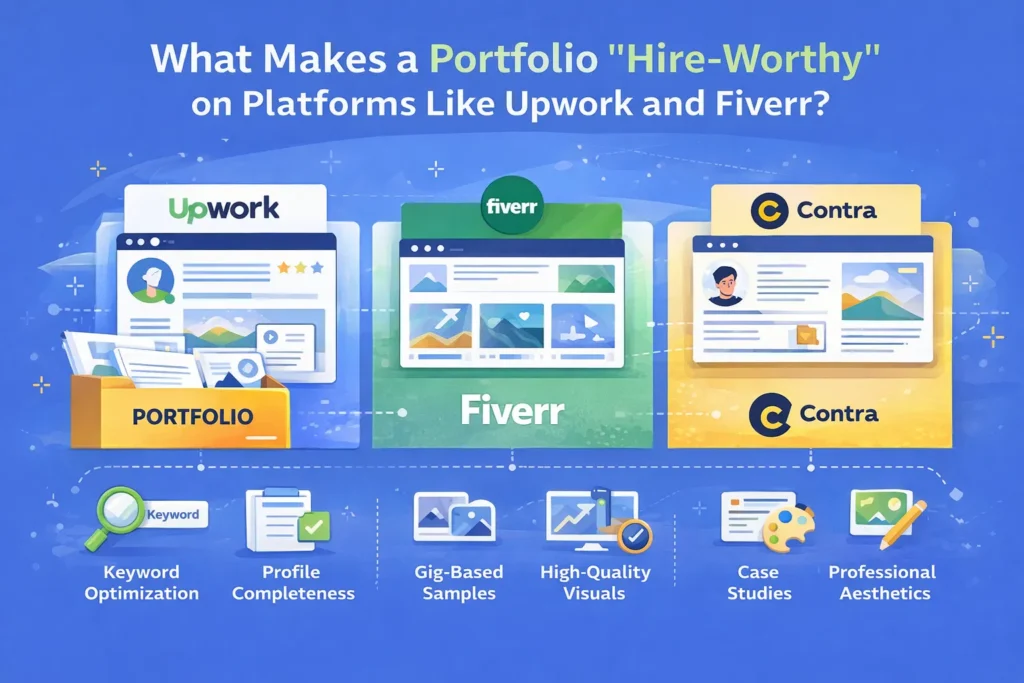
Platform algorithms and client decision-making patterns differ from traditional portfolio review processes. Understanding these mechanics helps you optimize portfolio presentation for marketplace success.
The three dominant freelance platforms, Upwork, Fiverr, and Contra each evaluate portfolios differently, requiring tailored approaches for maximum visibility and conversion.
Upwork operates on a comprehensive profile model where freelancers who’ve published a portfolio get hired nine times more frequently. Once you’ve built 2-3 strong samples, applying our beginner acquisition strategy helps you convert that portfolio into actual interviews and contracts. The platform format that succeeds emphasizes clarity, relevance, and quick-scan evaluation because clients review dozens of profiles rapidly. Upwork’s algorithm evaluates profile completeness, keyword relevance, and engagement metrics optimize these elements systematically to maximize your portfolio’s visibility in client searches. Your portfolio samples contribute to all three factors. Each sample should include targeted keywords in titles and descriptions, demonstrate relevant expertise for your target niche, and present work that encourages profile visitors to continue exploring.
Fiverr operates differently, emphasizing gig-specific portfolios rather than comprehensive profile portfolios. Understanding these platform differences helps you tailor portfolio strategy to each marketplace’s discovery mechanics. Each service you offer should include 2-3 samples directly relevant to that specific offering. Generic samples reduce conversion because they don’t answer the client’s primary question: “Can you deliver exactly what I need?” Fiverr’s algorithm prioritizes gig image quality, title clarity, and delivery speed promises, making portfolio presentation more transactional and service-specific.
Contra targets creative and tech professionals with portfolio-first discovery mechanics. The platform emphasizes visual presentation quality and case study narratives, positioning freelancers through work quality rather than ratings or reviews. This makes Contra ideal for designers, developers, and writers who want portfolio aesthetics to drive client interest.
The platform-specific optimization principle is simple: match portfolio presentation to platform evaluation mechanics. Research how your target platform’s algorithm weights different signals, then structure your portfolio to maximize those signals.
Where Should You Host Your Freelance Portfolio?
Portfolio hosting decisions impact discoverability, credibility, and conversion rates. The optimal approach often involves multiple platforms serving different purposes within your client acquisition strategy.
Here’s how different hosting options compare:
| Option | Best For | Cost | Setup Difficulty | Control Level |
|---|---|---|---|---|
| Upwork / Fiverr | Beginners seeking immediate client access | Free | Easy | Low |
| B2B freelancers and consultants | Free | Easy | Medium | |
| WordPress | Long-term brand building and SEO | $50-200/year | Medium | High |
| Behance | Designers and visual creatives | Free | Easy | Medium |
| Wix / Squarespace | Quick professional presence | $144-312/year | Easy | Medium |
Understanding these tradeoffs helps you choose the right starting point based on your goals, timeline, and target market.
Custom Website Platforms (WordPress, Wix, Squarespace)
Self-hosted portfolios offer maximum control over presentation, branding, and user experience. WordPress provides extensive customization through themes and plugins, making it ideal for freelancers who want specific functionality. Wix and Squarespace prioritize ease of use with drag-and-drop builders that create professional results without technical skills.
The strategic advantage of custom websites is ownership and SEO potential. You control your domain, optimize for search visibility, and create portfolio experiences tailored to your target market. For freelancers building long-term independent businesses, custom websites function as credibility infrastructure.
The constraint is that custom websites require active traffic generation. Unlike platform portfolios that benefit from marketplace traffic, self-hosted sites need SEO strategy, social media promotion, or paid advertising to attract visitors.
Portfolio-Specific Platforms (Behance, Dribbble, Clippings.me)
Industry-specific portfolio platforms provide built-in communities and discovery features. Behance enables freelancers to offer services, send client proposals, and sell assets directly through their platform, creating an integrated ecosystem for creative professionals.
Dribbble serves designers with high-quality presentation standards and a community of potential clients and collaborators. The platform’s selective admission process creates credibility by association having a Dribbble portfolio signals you meet community standards.
These platforms work best as supplementary portfolio locations rather than primary ones. They increase discoverability within specific creative communities but shouldn’t replace comprehensive portfolio websites or platform profiles where most client acquisition occurs.
Freelance Marketplace Portfolios (Upwork, Fiverr, Contra)
Marketplace portfolios integrate directly with client search and hiring flows. When potential clients search for services, they evaluate portfolios within the platform rather than clicking external links. This positions your work at the decision-making moment.
Understanding which platforms match your service offerings helps you choose where to invest portfolio development time. Upwork favors hourly and project-based professional services, Fiverr emphasizes productized services with clear deliverables, and emerging platforms like Contra target creative and tech professionals with portfolio-first discovery.
The practical strategy is building comprehensive portfolios on platforms where you actively seek clients while maintaining a lighter portfolio presence on supplementary platforms that support your broader positioning.
Can You Get Clients Without a Website?
Yes. Many successful freelancers operate entirely through platform profiles without independent websites. The question isn’t whether websites are necessary but whether they’re optimal for your specific strategy and target market.
Platform-only strategies work when your target clients actively search marketplaces like Upwork and Fiverr. These platforms handle discovery, trust-building through reviews and ratings, payment processing, and dispute resolution. For beginners, this infrastructure reduces barriers to securing initial clients.
LinkedIn functions as a professional portfolio platform without requiring technical setup. Your profile becomes your portfolio through featured work samples, recommendations, and strategic content sharing. Many B2B freelancers generate consistent client flow exclusively through LinkedIn positioning and outreach.
Choosing Your Portfolio Strategy: Three Common Scenarios
Scenario 1: Still Testing Whether Freelancing Works for You
If you’re uncertain about long-term freelancing commitment, start with Upwork or Fiverr exclusively. These platforms require zero upfront investment, provide immediate client access, and help you validate whether your services have market demand. Build your profile portfolio, test pricing, and secure your first 5-10 clients before investing in independent infrastructure. This approach minimizes risk while providing real market feedback.
Scenario 2: Targeting B2B Clients and High-Ticket Projects
If you’re pursuing consulting, strategy work, or premium services for businesses, combine LinkedIn with a custom website. B2B decision-makers research freelancers extensively before engaging, expecting a professional web presence that demonstrates expertise. Your LinkedIn profile drives discovery and initial credibility, while your website provides comprehensive portfolio depth, case studies, and thought leadership content. This combination positions you as a strategic partner rather than a task executor, supporting premium pricing.
Scenario 3: Creative Work Requiring Visual Showcase
If you’re a designer, photographer, or visual creative, build your primary presence on Behance or Dribbble while maintaining supporting profiles on client platforms. Portfolio-specific platforms provide community visibility, peer recognition, and client discovery within creative industries. Supplement with Upwork or Fiverr profiles for transactional client access, but lead with platforms that showcase visual work optimally.
The Strategic Trade-Off
The strategic consideration is reach versus control. Platforms provide reach through existing traffic but limit control over presentation and capture competitor attention. Independent websites offer complete control but require traffic generation. Most successful freelancers eventually operate hybrid strategies, using platforms for discovery while directing high-value prospects to comprehensive portfolio websites.
How Do You Present Your Work to Look Professional?
Portfolio presentation quality signals your standards and attention to detail before clients evaluate actual work samples. Professional presentation transforms basic samples into compelling portfolio pieces through structure, context, and visual design.
Writing Compelling Project Descriptions
Project descriptions should follow a problem-solution-outcome framework. Start by explaining the challenge or opportunity the project addressed. This context helps clients understand your strategic thinking beyond execution mechanics.
Next, describe your approach. What research informed your strategy? What alternatives did you consider? Why did you choose your specific execution path? This reveals how you think through problems and make decisions. When explaining your approach, avoid undervaluing your work. Calculate rates that reflect both skill and strategic thinking, not just execution time.
Finally, present outcomes with specific metrics when possible. “Increased engagement” becomes “Increased average session duration by 45% and reduced bounce rate by 23%.” Specificity demonstrates analytical rigor and results orientation that clients value.
Creating Case Studies That Demonstrate Results
Case studies transform portfolio samples into strategic narratives. The format positions you as a problem-solver rather than a task-executor, which commands higher rates and attracts better clients.
Structure case studies with these sections: Challenge (what problem needed solving), Process (how you approached it), Solution (what you delivered), and Results (what outcomes were achieved). Include visuals showing before/after comparisons, wireframes demonstrating your thinking, or data visualizations presenting performance improvements.
The strategic benefit of case study formats is that they demonstrate capabilities beyond the specific work shown. Clients see how you analyze problems, develop strategies, and measure success—all predictors of how you’ll handle their projects.
Using Mockups and Visuals to Elevate Your Presentation
Visual presentation quality impacts perceived work quality even when the underlying work is identical. Professional mockups, consistent typography, thoughtful spacing, and cohesive color schemes all contribute to portfolio polish that differentiates you from beginners.
For designers and developers, mockups showing work in realistic contexts (phone screens, browser windows, physical products) help clients visualize implementation. For writers, formatting samples with clear hierarchy, readable fonts, and appropriate spacing improves accessibility and perceived professionalism.
Free tools like Figma, Canva, and various online mockup generators enable professional presentations without design expertise or budget investment. The time invested in presentation quality returns multiples through improved conversion rates and premium positioning.
What Are the Biggest Mistakes Beginners Make With Portfolios?
Understanding common portfolio mistakes helps you avoid them while differentiating yourself from typical beginner presentations.
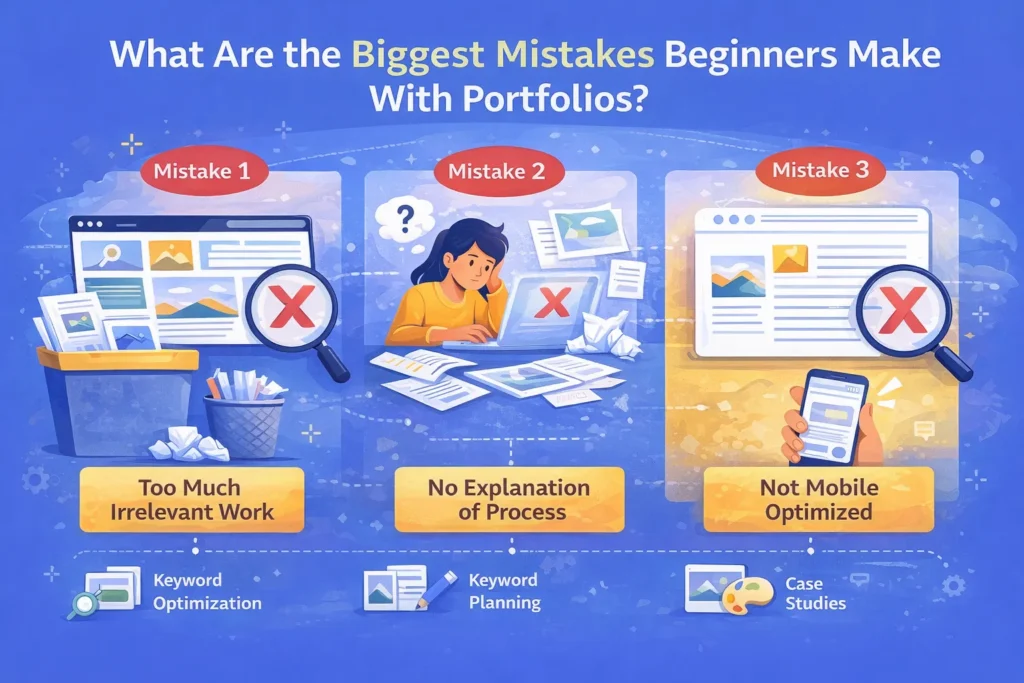
Mistake 1: Including Too Much Irrelevant Work
Beginners often include every project they’ve completed to demonstrate range, but relevance matters more than quantity. A graphic designer applying for logo work doesn’t need to showcase their interior design sketches. A content writer targeting B2B SaaS companies shouldn’t include their travel blog posts.
Each portfolio piece should support your positioning for specific target markets. Ask: “Does this sample help my ideal client see that I can solve their specific problem?” If not, remove it. Portfolio curation demonstrates judgment and strategic thinking that clients value.
Mistake 2: Forgetting to Explain Your Process
Showing finished work without explaining how you arrived there misses the opportunity to demonstrate strategic value. Clients hire freelancers for their thinking process as much as their execution skills.
Every portfolio piece should include some process documentation: research conducted, decisions made, problems solved, or iterations completed. This transforms static samples into stories that reveal how you work and what clients can expect when hiring you.
Mistake 3: Neglecting Mobile Optimization
Significant portions of portfolio traffic and client review happens on mobile devices. Portfolios that break layouts, use tiny fonts, or require excessive scrolling on phones create friction that costs opportunities.
Test your portfolio across different screen sizes and devices. Ensure images load quickly, text remains readable, navigation stays functional, and contact forms work properly. Mobile optimization isn’t optional—it’s a baseline professional standard.
How Can You Use Your Portfolio to Land Your First Client?
Building a strong portfolio creates the foundation, but strategic deployment converts that foundation into client relationships. Pair your portfolio with proposal writing that connects your samples to specific client needs, demonstrating exactly how your proven capabilities solve their current problem.
Positioning Your Portfolio for Your Target Market
Generic portfolios appeal to no one. Effective portfolios speak directly to specific client types through relevant samples, industry-appropriate language, and demonstrated understanding of target market problems.
If you’re targeting e-commerce brands, your portfolio should showcase product pages, email sequences, or ad campaigns relevant to online retail. If you’re pursuing healthcare clients, your samples should demonstrate understanding of compliance requirements, patient communication, and medical terminology.
This specificity reduces your addressable market while increasing conversion rates within that market. Five highly relevant portfolio pieces convert target clients better than twenty generic samples.
Leveraging Your Portfolio on LinkedIn and Social Media
Portfolio value extends beyond passive review, strategic sharing generates active engagement and client inquiries. Share portfolio pieces on LinkedIn with context explaining the problem solved, the approach taken, and the results achieved.
This content strategy serves dual purposes: it demonstrates your expertise to your network while creating shareable assets that extend your reach. When contacts share your work, you access their networks with credibility already established.
The frequency and format matter. Weekly portfolio piece breakdowns maintain visibility without overwhelming followers. Mix formats between static images, short videos, and text posts to match different consumption preferences.
Following Up With Portfolio Links in Proposals
Strong proposal writing integrates portfolio links strategically rather than generically. Instead of saying “Here’s my portfolio,” reference specific samples: “I’ve included a link to a similar email campaign I created for a fintech startup that increased trial signups by 34%.”
This targeted referencing demonstrates that you’ve thoughtfully matched your experience to their needs. It also directs attention to your most relevant work rather than expecting clients to identify relevant samples themselves.
Your 7-Day Portfolio Launch Plan
Strategic execution transforms portfolio building from an overwhelming project to a manageable weekly sprint.
Day 1 – Choose Your Niche
Identify your target market and service focus. Research what these clients need, what portfolios in this space look like, and what differentiates successful freelancers. Clear positioning informs every subsequent decision.
Day 2 – Plan Your First Two Spec Projects
Select realistic projects that demonstrate valuable skills for your target market. Outline what you’ll create, what problems they’ll solve, and what outcomes you’ll measure. Document your planning process for portfolio case studies.
Day 3-5 – Build Your Samples
Execute your spec projects with the same rigor you’d apply to paid client work. Focus on quality over speed. Document your process, track decisions, and capture metrics you can present as results.
Day 6 – Write Your Case Study Descriptions
Transform your samples into professional portfolio pieces. Write problem-solution-outcome narratives, create visual presentations, and develop compelling project titles. This step separates professional portfolios from amateur sample collections.
Day 7 – Upload and Send Your First 10 Proposals
Choose your platform—Upwork and Fiverr offer the fastest paths to first clients for beginners—and build your profile. Understanding which platform matches your service type and pricing strategy helps you focus efforts where they’ll generate the best results. Upload your portfolio pieces, optimize your profile with relevant keywords, and send 10 targeted proposals that reference specific portfolio samples. This activates your portfolio by putting it in front of actual clients.
Understanding how to set competitive freelance rates before sending proposals ensures you position yourself appropriately, while learning comprehensive freelancing fundamentals sets realistic expectations for your journey.
Frequently Asked Questions
How many portfolio pieces do I need to start freelancing?
Three strong, relevant portfolio pieces are sufficient to begin securing clients. Quality and relevance matter significantly more than quantity. Each piece should demonstrate capability for the specific services you’re offering. As you gain experience, you can expand your portfolio, but starting with 3-5 well-executed samples provides adequate proof of competence.
Can I use fake brands in my spec projects?
Yes, creating spec work for fictional or real brands is standard practice for portfolio building. Many successful freelancers showcase redesigns of existing brand materials or mock campaigns for companies they admire. The key is ensuring your spec work demonstrates professional-quality execution and strategic thinking. Avoid explicitly claiming you worked for these brands—instead, present the work as a portfolio exercise or concept project.
Should I work for free to build my portfolio?
Strategic volunteer work for nonprofits or community organizations can build valuable portfolio pieces while contributing to meaningful causes. However, avoid working for free for commercial businesses that have budgets—this devalues your work and establishes poor pricing precedent. The distinction matters: volunteering for a local charity builds portfolio credibility; creating free work for a profitable startup does not.
How long should a portfolio case study be?
Portfolio case studies should be 300-500 words with a clear problem-solution-outcome structure. Include enough detail to demonstrate your strategic thinking and process, but respect that clients review portfolios quickly. Use visuals, metrics, and formatting to make case studies scannable. The goal is to provide sufficient depth to establish credibility without overwhelming readers with excessive detail.
Can Google Docs be used as a portfolio?
While not ideal for long-term branding, Google Docs can function as a temporary portfolio solution when you’re starting immediately. Create a well-organized document with samples, descriptions, and links to live work. However, transition to a proper portfolio platform or website within your first month. Google Docs lacks professional presentation features and SEO benefits that proper portfolio platforms provide.
Conclusion
Building a freelance portfolio with no experience requires strategic project selection, professional presentation, and platform optimization. The portfolio paradox dissolves when you recognize that capability demonstration matters more than employment credentials.
Your next seven days determine whether you remain stuck in research mode or begin building the portfolio that launches your freelance career. The market continues growing, platforms increasingly favor quality over pedigree, and clients actively seek freelancers who demonstrate relevant skills regardless of their work history.
The question isn’t whether you can build a portfolio without experience—it’s whether you’ll invest the week required to create one.
Related Resources
- How to Start Freelancing in 2026: Complete Beginner’s Guide
- How to Write Freelance Proposals That Win Clients (With Examples)
- How to Set Freelance Rates in 2026 (Complete Pricing Guide + Calculator)
- Best Freelancing Platforms for Beginners in 2026 (Upwork vs Fiverr vs Freelancer)
- 15 High-Paying Freelance Skills in 2026 (Earn $50–$250/Hour)