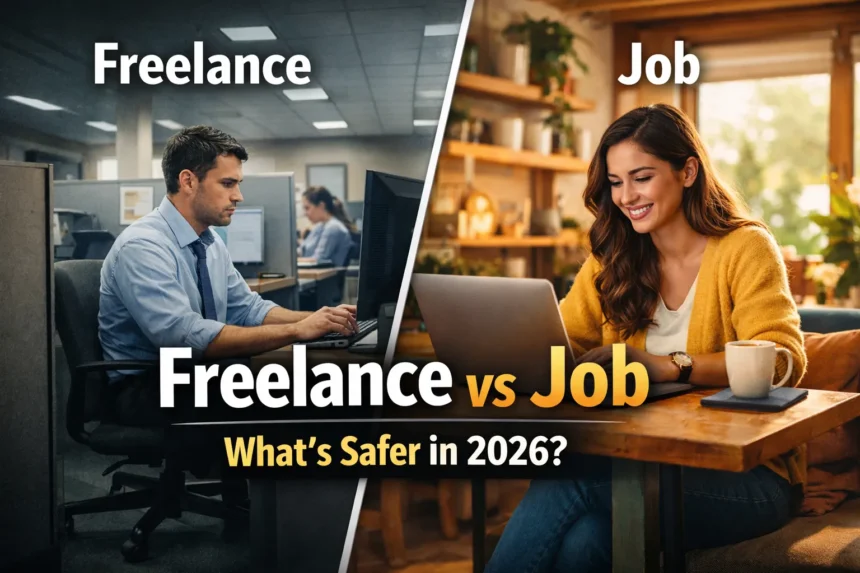
A 32-year-old product manager in Austin lost his job after 8 years of loyalty. Stellar performance reviews didn’t matter when the layoffs came. A freelance UX designer in Pune doubled her income in 18 months but spent six months anxious about client flow, wondering if next month would bring projects or silence. Both thought they had chosen the “safer” path.
Layoffs are rising. Over 127,000 tech workers were laid off in 2025, with another 39,000 affected in early 2026. Remote work, once promised as the new normal, is under assault as major corporations enforce return-to-office mandates. Meanwhile, salaries are stagnating while inflation continues to pressure. The traditional “stable job” feels less stable than ever.
Yet freelancing isn’t a magic solution either. Income volatility creates anxiety. Client acquisition demands constant effort. Health insurance becomes a personal burden. The freedom everyone celebrates comes with trade-offs that silence conveniently ignores.
This analysis examines the freelance vs full-time job decision through 2026’s economic reality, using current data, psychological research, and strategic frameworks. The goal: help you determine which path aligns with your personality, financial situation, and risk tolerance, because the answer depends entirely on who you are.
2026 Work Landscape Snapshot
- 127,000+ tech layoffs in 2025 alone
- Return-to-office mandates tightening at major corporations
- 73 million Americans now freelancing (45% of workforce)
- 85% of workers prioritize remote flexibility over salary
- Health insurance costs up 7% year-over-year for individuals
Quick Comparison: Freelancing vs Full-Time Job (2026 Reality Check)
Understanding what freelancing actually means requires looking beyond surface-level pros and cons. Here’s how these paths compare across critical dimensions:
| Factor | Freelancing | Full-Time Job |
|---|---|---|
| Income Stability | Variable month-to-month | Predictable bi-weekly |
| Income Potential | Unlimited ceiling | Capped by role/industry |
| Job Security | Client-dependent | Company-dependent |
| Work Flexibility | Complete schedule control | Limited to employer policy |
| Benefits | Self-managed (insurance, retirement) | Company-provided package |
| Stress Type | Income uncertainty, self-discipline | Office politics, lack of autonomy |
| Tax Complexity | High (quarterly estimates, deductions) | Low (W-2 withholding) |
| Career Growth | Portfolio and reputation-based | Promotion and credential-based |
This table represents the structural realities, not subjective preferences. Neither path is universally superior—they solve for different variables.
The Income Reality Check: What You’ll Actually Earn
Income conversations around the freelance vs full-time job debate often veer into fantasy. The data tells a more nuanced story.
US Income Perspective
Full-time freelancers reported a median income of $85,000 in recent surveys, positioning them competitively with traditional employment. However, this figure masks significant variance. Entry-level freelancers often earn $30,000-$50,000 during their first two years as they build client bases and reputation capital. Experienced specialists in technical fields, software development, data analysis, UX design command $100,000-$200,000 annually.
Full-time employment offers more predictable ranges. Mid-level professionals in corporate roles earn $60,000-$90,000 depending on industry and geography. Senior positions reach $120,000-$180,000, though progression slows after a certain point. The ceiling exists because compensation ties to organizational hierarchies rather than market value.
Tax implications create another layer. Freelancers pay self-employment tax (15.3% on top of income tax) but gain deduction opportunities for home office, equipment, and business expenses. W-2 employees have simpler tax filing but fewer optimization strategies. The net difference typically ranges from 3-7% effective rate advantage for freelancers who maintain proper records.
Health insurance represents a major cost differential. Employer-sponsored plans cost employees $1,500-$3,000 annually for family coverage. Freelancers purchasing individual marketplace plans pay $8,000-$15,000 for comparable coverage, though subsidies reduce this for lower earners.
Indian Market Perspective
Corporate salaries in India’s tier-1 cities (Bangalore, Mumbai, Delhi) range from ₹6-12 lakhs annually for mid-level professionals, reaching ₹15-25 lakhs for senior roles. Freelancers with international clients earn $20-80 per hour (₹1,650-6,600), translating to ₹8-30 lakhs yearly depending on workload consistency.
The cost-of-living advantage shifts calculations. A freelancer earning ₹15 lakhs in Pune experiences better purchasing power than a corporate employee making ₹18 lakhs in Mumbai, where rent consumes 40-50% of income. Geographic flexibility represents one of freelancing’s structural advantages in emerging markets.
Payment currency matters significantly. Freelancers receiving USD or EUR payments benefit from rupee depreciation, while corporate salaries denominated in INR lose purchasing power relative to imported goods and international services.
The Volatility Nobody Talks About
The majority of freelancers earn comparable income to full-time workers, but income distribution patterns differ dramatically. Full-time employees experience predictable variance, typically within 5-10% year-over-year based on raises, bonuses, and performance reviews.
Freelancers face a coefficient of variation exceeding 40% in their first five years. A month generating $12,000 might follow one producing $3,000. This volatility decreases as client diversification and recurring retainer arrangements develop, but never fully disappears. The psychological impact of income unpredictability exceeds what static annual figures suggest.
Salary caps in traditional employment create different constraints. Most corporate structures limit individual contributors to 2-3x salary progression over 15 years unless they transition to management. Performance excellence yields marginal improvements, perhaps 5-15% above peer averages, but structural limits persist regardless of value creation.
Freedom vs Stability: The Psychological Trade-Off
The freelance vs full-time job decision represents fundamentally different stress profiles. Understanding which stress type you tolerate better matters more than comparing abstract benefit lists.
The Mental Load of Freelancing
Client acquisition creates persistent background anxiety even during busy periods. The question “where will next month’s work come from?” never fully resolves. Successful freelancers develop pipeline management systems, but uncertainty remains structural to the model.
Income unpredictability generates planning challenges. Mortgage applications become more complex. Large purchases require more conservative timing. Budgeting demands discipline most people lack, separating business revenue from personal income, maintaining reserves for tax obligations, and building emergency funds covering 6-12 months rather than 3-6.
Isolation affects mental health more than anticipated. 85% of workers prioritize remote work flexibility, but working alone daily eliminates spontaneous collaboration, casual mentorship, and social infrastructure that offices provide passively. This matters more for extroverted personalities and early-career professionals still developing professional networks.
Self-discipline requirements are non-negotiable. No external structure enforces daily productivity. Procrastination directly reduces income. Time management becomes a developed skill rather than an inherited workplace norm.
Corporate Burnout Is Real
Office politics represent emotional labor that corporate employees rarely account for when comparing paths. Navigating manager relationships, performance review politics, competing priorities from different stakeholders, and organizational change initiatives consumes energy that could be directed toward productive work.
Lack of control over time allocation creates frustration that compounds over the years. Mandatory meetings interrupt deep work. Performance expectations disconnect from actual job requirements. Tech layoffs affecting over 127,000 workers demonstrate that loyalty and performance provide less security than corporate narratives suggest.
Performance pressure in traditional employment differs from freelance stress but carries equal weight. Annual reviews determine compensation and career trajectory based on subjective assessments. Peer comparison creates competitive rather than collaborative environments. The “always-on” culture in knowledge work blurs boundaries between work time and personal time despite physical office presence.
Which Stress Type Fits Your Personality?
Personality assessments provide directional guidance. High conscientiousness and self-motivation predict freelance success better than technical skills alone. Individuals requiring external accountability structures perform better in traditional employment where managers provide oversight and deadline enforcement.
Risk tolerance isn’t binary, it exists on a spectrum influenced by financial obligations, age, family situation, and psychological makeup. A 26-year-old single professional can absorb income volatility differently than a 38-year-old supporting a family with a mortgage.
The decision framework centers on honest self-assessment: Which makes you more anxious, income uncertainty or lack of autonomy? Neither answer is wrong, but misalignment between choice and temperament creates chronic dissatisfaction.
Career Growth: Two Different Trajectories
Professional development follows a different logic in freelance vs full-time job contexts. Both paths offer advancement, but the mechanisms diverge entirely.
How Freelancers Build Expertise
Market-driven learning characterizes freelance career development. Skills acquire value based on the client’s willingness to pay rather than organizational credentials. This creates efficient feedback loops. Investing time in high-paying freelance skills in 2026 yields immediate income returns, while skills facing declining demand signal themselves through reduced project opportunities.
Personal branding becomes career capital in freelancing. Reputation, portfolio quality, client testimonials, and professional network determine earning potential more than resume credentials. Learn the right way to collect them. See our guide on how to ask clients for testimonials with 8 copy-paste email templates. This shifts investment from formal education toward demonstrated capability and relationship development.
Portfolio-based progression rewards specialists over generalists in most markets. Build one today, our guide shows exactly how to build a freelance portfolio with no experience, even without a single client. Deep expertise in narrow domains, e.g., Shopify conversion optimization, rather than generic web design, commands premium rates and reduces competition. The progression path emphasizes differentiation rather than climbing organizational hierarchies.
How Full-Time Employees Advance
Structured mentorship represents traditional employment’s strongest development advantage. Access to senior professionals, formalized training programs, and observational learning from experienced colleagues accelerates skill acquisition in ways independent learning cannot replicate.
The corporate ladder provides clear progression milestones. Junior → Mid-level → Senior → Lead → Principal roles create visible advancement paths with defined expectations. This structure benefits individuals who perform better with explicit goals rather than self-directed exploration.
Credential accumulation matters more in corporate contexts. Certifications, graduate degrees, and specialized training programs carry weight in promotion decisions because they signal commitment and capability within organizational frameworks. Freelancers gain limited ROI from formal credentials unless they increase client willingness to pay.
Risk Analysis: What Can Actually Go Wrong?
Honest risk assessment requires examining failure modes specific to each path rather than generic worst-case scenarios.
Freelancing Risks You Must Prepare For
Client drought periods occur even for established freelancers. Seasonal business cycles, economic downturns, or simple bad luck can create 2-3 month gaps with minimal income. Financial reserves covering 6-12 months of expenses represent mandatory rather than optional preparation.
Payment delays and disputes materialize more frequently than expected. The fix: always send a written freelance contract before starting any project, it gives you legal recourse when clients delay or refuse to pay. Clients extending payment terms from 30 to 60-90 days strains cash flow. Occasional non-payment requires legal recourse or write-offs. Contract protections and payment terms become essential operational knowledge rather than legal formalities.
Health insurance gaps create serious vulnerability in the US market. Losing individual coverage due to administrative errors, experiencing medical emergencies during policy transitions, or facing premium increases that force plan changes all represent risks that employer-sponsored insurance eliminates.
Self-discipline failures have direct financial consequences. Procrastination doesn’t just reduce productivity, it reduces income immediately. No safety net exists between effort and earnings. This reality motivates some people but paralyzes others.
Full-Time Job Risks (Yes, They Exist)
Layoff vulnerability reached historic levels in recent years. Over 127,000 tech workers were laid off in 2025, with many holding strong performance reviews and years of tenure. Company performance, economic conditions, and strategic pivots determine job security more than individual contribution.
Salary ceiling constraints limit upward mobility regardless of performance. Moving from $120,000 to $180,000 often requires switching companies, changing roles, or accepting management responsibilities that remove you from work you enjoy. Internal promotions rarely generate salary increases exceeding 15-20%, even for exceptional performers.
A single point of failure represents an underappreciated risk. Total income dependence on one employer creates vulnerability that mirrors freelancers depending on one client, yet receives less attention in risk discussions. Diversification through side income or investment reduces this exposure but requiresthe initiative most employees never take.
The Hybrid Model: Best of Both Worlds?
Before transitioning, understand freelance taxes for beginners self-employment tax (15.3%) is the #1 financial surprise new freelancers miss. Strategic career transitions rarely occur through sudden leaps. The hybrid approach, maintaining employment while building freelance income, mitigates risk while validating assumptions.
Starting Freelance While Employed
Side hustle strategy provides risk-free experimentation. Evenings and weekends allow testing service offerings, setting competitive freelance rates, and learning client acquisition without income pressure. This validation phase reveals whether freelancing matches expectations or exists primarily as escapist fantasy.
Building an income cushion before transition changes the psychological equation. Entering freelancing with 3-6 months of expenses saved plus $2,000-5,000 in monthly recurring revenue, creates stability that full cold starts lack. The pressure to accept poor-fit clients decreases, allowing selectivity that improves long-term outcomes.
Skill validation occurs through market feedback rather than hypothetical planning. If clients readily pay $75-100/hour for your services while employed, you’ve validated market demand. If acquisition requires excessive effort or rates stay at $25-35/hour, perhaps full-time freelancing isn’t optimal timing.
The Strategic Transition Path
Timeline recommendations vary by financial obligations and skill marketability, but 12-24 month transition periods prove most sustainable. This provides adequate time to build client relationships, develop operational systems, and establish income stability before losing employer benefits.
Writing proposals that win clients becomes a developed skill rather than an instinctive talent. Experimentation during evenings determines what messaging resonates, which client types provide a good fit, and how to differentiate against competitors.
Financial milestones should guide transition decisions. Recommended thresholds include:
(1) freelance income equaling 50% of salary for 3+ consecutive months,
(2) 6 months’ expenses in the emergency fund,
(3) health insurance plan identified with premium costs factored,
(4) Quarterly tax payment system established.
Risk mitigation tactics matter more than optimism. Securing your first 2-3 retainer clients before resigning, maintaining strong employer relationships for potential return, and keeping skill certifications current all create safety margins that pure enthusiasm overlooks.
Thinking About Testing Freelancing?
Before quitting your job, build your foundation:
- How to Start Freelancing in 2026 – Complete roadmap from zero to first client
- Best Freelancing Platforms for Beginners in 2026 – Where to find your first projects
- How to Write Freelance Proposals That Win Clients – Proven templates and strategies
- 15 High-Paying Freelance Skills in 2026 – Which skills earn $50-$250/hour
Start with side income. Test the model. Then decide.
Who Should Choose Freelancing in 2026?
Freelancing suits specific personality profiles and life situations better than others. Honest self-assessment prevents costly misalignment. Once you decide, the next step is choosing your platform. Read our Upwork vs Fiverr comparison to pick the right one for your skill.
Self-starters who generate internal motivation perform better in unstructured environments. If you’ve consistently pursued side projects, learned skills independently, or built things without external pressure, freelancing likely matches your temperament. Conversely, if you struggle with self-directed work and perform better with accountability structures, traditional employment might serve you better.
High-skill professionals in markets with established freelance economies, software development, design, writing, marketing, and consulting find viable client bases more readily. Entry-level generalists face harder paths. Specialization creates a market position that supports sustainable rates.
Risk-tolerant individuals who can absorb income variability without psychological damage represent better freelance fits. Financial stability matters, but emotional response to uncertainty matters equally. Some people energize from unpredictability; others experience chronic anxiety.
Location freedom seekers gain maximum value from freelancing’s structural flexibility. Half of the U.S. workforce works at flexible companies, but true geographic independence, living in Bali while serving US clients, remains exclusive to freelancers and remote-first roles.
Who Should Choose a Full-Time Job?
Traditional employment serves different priorities equally valid as freelancing preferences.
Stability-seekers who value predictable income and comprehensive benefits packages find traditional employment superior. Comprehensive benefits packages remain exclusive to full-time roles, providing healthcare, retirement matching, paid time off, and disability insurance that freelancers purchase separately or forgo entirely.
Beginners without established skills benefit from workplace learning environments. Observing experienced professionals, receiving mentorship, and developing expertise while earning a stable income accelerates development more efficiently than independent learning for most people.
Individuals valuing separation between work and personal life often prefer employment boundaries. Clocking out at 5 pm and fully disconnecting, while increasingly rare, remains more achievable in traditional roles than freelancing, where client demands blur boundaries.
Risk-averse personalities, uncomfortable with uncertainty, perform better in structured environments. If financial volatility creates anxiety that reduces quality of life, accepting salary ceilings in exchange for stability represents rational optimization rather than limited ambition.
How Much Does Remote Work Matter in This Decision?
Remote work availability complicates the freelance vs full-time job equation because it addresses freelancing’s primary appeal, location flexibility, while maintaining employment stability.
85% of workers prioritize remote work flexibility over salary increases, demonstrating that autonomy matters more than compensation for most knowledge workers. Yet return-to-office mandates from major corporations create uncertainty about remote work in traditional employment.
Remote freelancing advantages persist beyond location flexibility. Client relationships built through global platforms mean New York rates apply to professionals living in lower-cost geographies. This arbitrage, high-income currency earning combined with low-cost living expenses, creates financial leverage impossible in local employment.
Hybrid job availability creates middle-ground options. 2-3 days in the office preserves some workplace culture benefits while reducing commute burden and allowing partial geographic flexibility. For some professionals, hybrid employment plus evening freelance side income provides an optimal balance.
Final Verdict: Your Decision Framework
No universal answer exists to the freelance vs full-time job question. The right choice depends on your specific circumstances, personality, and priorities.
Choose freelancing if:
- Income uncertainty motivates rather than paralyzes you
- You possess in-demand skills with established freelance markets
- Geographic freedom matters more than predictable paychecks
- Self-motivation and discipline come naturally
- You can maintain 6-12 months’ expense reserves
- Learning how to start freelancing in 2026 interests you more than climbing corporate ladders
Choose full-time employment if:
- Predictable income reduces stress and enables better planning
- You value comprehensive benefits packages and employer-sponsored healthcare
- Structured learning environments accelerate your development
- Office social interaction improves your mental health and productivity
- You’re building foundational skills that workplace exposure provides faster
- Managing business operations (taxes, invoicing, marketing) feels burdensome
Consider hybrid approaches if:
- You want to test freelancing without risking a stable income
- Building a side income provides a financial cushion and optionality
- Career transitions feel less risky with gradual progression
- Multiple income streams reduce dependence on any single source
The real mistake isn’t choosing freelancing or employment. The real mistake is drifting into one without understanding its trade-offs.
The significance lies not in which path you choose, but in alignment between choice and reality. Freelancing, romanticized as escape from corporate politics, often disappoints when income stress replaces political stress. Employment chosen purely for stability can create regret if autonomy matters more than you realized.
Start with an honest self-assessment. Experiment when possible. Make reversible choices early in a career when the stakes are lower. And recognize that optimal paths change as life circumstances evolve—the answer today may differ from the answer in five years.
Conclusion
The freelance vs full-time job debate lacks a universal resolution because it optimizes for different variables. Income potential, schedule control, stress tolerance, benefit priorities, and personality all factor into which path serves you better.
Current economic conditions, including layoffs in traditional sectors, remote work policy uncertainty, and growing freelance market acceptance, make this decision more complex than previous generations faced. Yet this complexity creates opportunity. More paths exist now than ever before.
Your move: If employed and curious about freelancing, test assumptions through evening side projects. If freelancing and craving stability, explore part-time or contract roles that provide a middle ground. Either way, make active choices rather than defaulting to inertia.
The professional world in 2026 rewards intentionality over convention. Choose the path aligned with who you are, not who others expect you to be.