Fiverr appears easier than Upwork on the surface, with no proposals to write. No Connects to purchase. Just create a gig, wait, and orders arrive.
- 💡 Real Example: Janvi vs. Nicky – Same Skill, Different Results
- Why Most Beginners Fail to Get Their First Fiverr Client
- What Is Fiverr’s Algorithm Actually Looking For in 2026?
- Step 1 – Choose a Micro-Niche for Faster First Orders
- Step 2 – Optimize Your Gig for Fiverr’s Search Algorithm
- Step 3 – Strategic Pricing for Your First 5-10 Orders
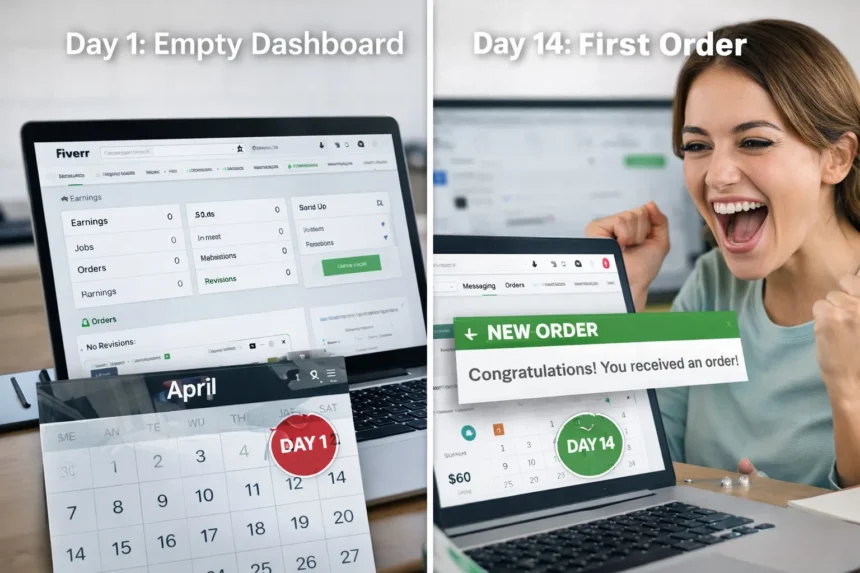
- Step 4 – The Critical First 14 Days (Maximize Your New Seller Boost)
- How to Use Buyer Requests to Get Your First Order Faster
- How Long Does It Actually Take to Get Your First Fiverr Client?
- Turning Your First Order Into Consistent Fiverr Income
- Fiverr vs Upwork: Which Platform Gets You Clients Faster?
- Can You Get Fiverr Orders With Zero Reviews?
- What Are the Biggest Mistakes New Fiverr Sellers Make?
- 📥 Free Resources & Templates
- 🚀 Your 30-Day Fiverr Action Plan
- Moving Forward: Your Fiverr Launch Checklist
Except that most beginners wait 30 to 60 days and receive zero impressions, let alone orders.
Here’s what actually happens:
You create a gig titled “Logo Design” or “Content Writing.” You set the price at $5. You wait. The algorithm ignores you because you’re competing against 50,000 similar offerings with established reviews and performance history.
The platform operates as a search engine, not a posting board. Visibility determines success, and visibility requires strategic optimization rather than passive hope.
🎯 The Real Problem
Understanding how to get your first client on Fiverr in 2026 requires recognizing a fundamental shift in how freelance marketplaces function. The difference between sellers who land clients within one week and those who wait months comes down to three factors:
- Niche specificity (not breadth)
- Algorithmic optimization (not just skill)
- Tactical positioning during the new seller boost window (not random activity)
This guide breaks down each component with actionable frameworks you can implement today.
💡 Real Example: Janvi vs. Nicky – Same Skill, Different Results
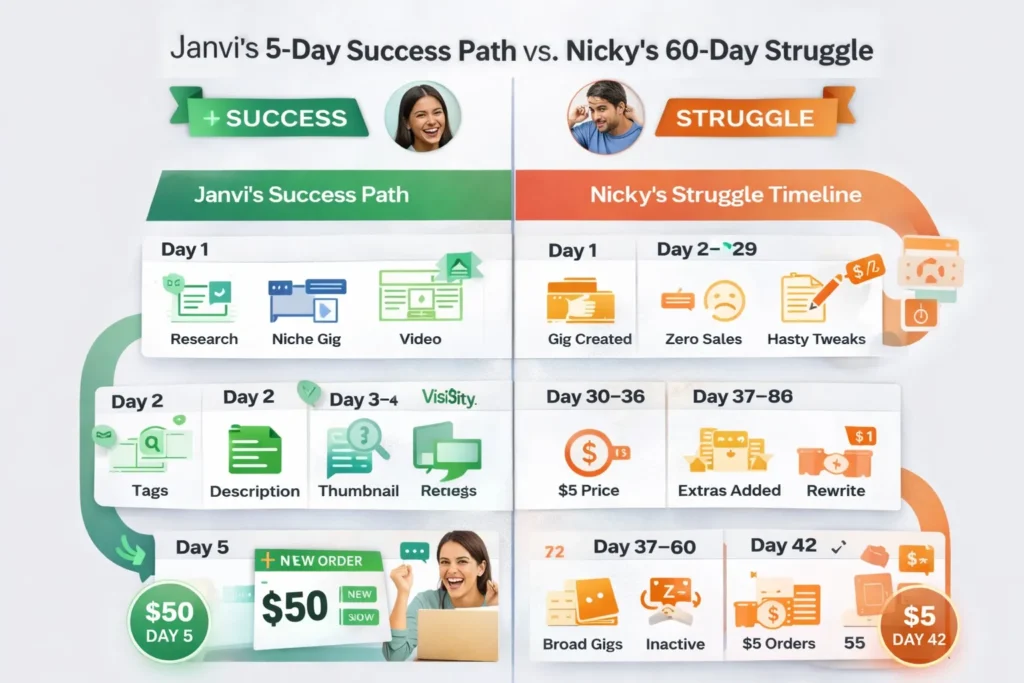
✅ Janvi’s 5-Day Success Story
Background: Beginner graphic designer, zero Fiverr experience
What She Did:
- Created gig: “I will design high-CTR YouTube thumbnails for finance channels.”
- Recorded a 30-second gig video showing her process
- Set pricing at $20 (not $5)
- Stayed online 3 hours daily, responded in under 30 minutes
- Submitted 10 buyer requests daily
Her Timeline:
- Day 1: Gig live, 0 impressions
- Day 2: 23 impressions, 1 click
- Day 3: 47 impressions, 2 clicks, 1 message inquiry
- Day 5: First order ($20) from buyer request
- Day 14: 3 completed orders, raised prices to $35
- Day 30: 8 orders total, $285 earned
Why She Won: Micro-niche targeting + video demonstration + strategic activity during boost window
❌ Nicky’s 60-Day Struggle (Same Design Skills)
What He Did:
- Created gig: “I will do professional content writing.”
- No video
- Priced at $5
- Checked Fiverr twice weekly
- Never submitted buyer requests
His Timeline:
- Day 1-30: 12 total impressions, 0 clicks, 0 orders
- Day 30-60: Numbers stayed flat
- Day 61: Changed title to “I will write SEO blog posts that rank for SaaS companies.”
- Day 68: First order (finally)
- Day 90: 2 total orders, $35 earned
The Mistake: Generic positioning in a saturated category + no algorithmic optimization + passive waiting strategy
🎯 Key Takeaway
The difference wasn’t talent. It was a positioning strategy and understanding how Fiverr’s algorithm actually works.
Why Most Beginners Fail to Get Their First Fiverr Client
The typical failure pattern follows a predictable sequence. New sellers make three critical mistakes that guarantee invisibility on the platform.
1. Broad Gig Titles Dilute Visibility
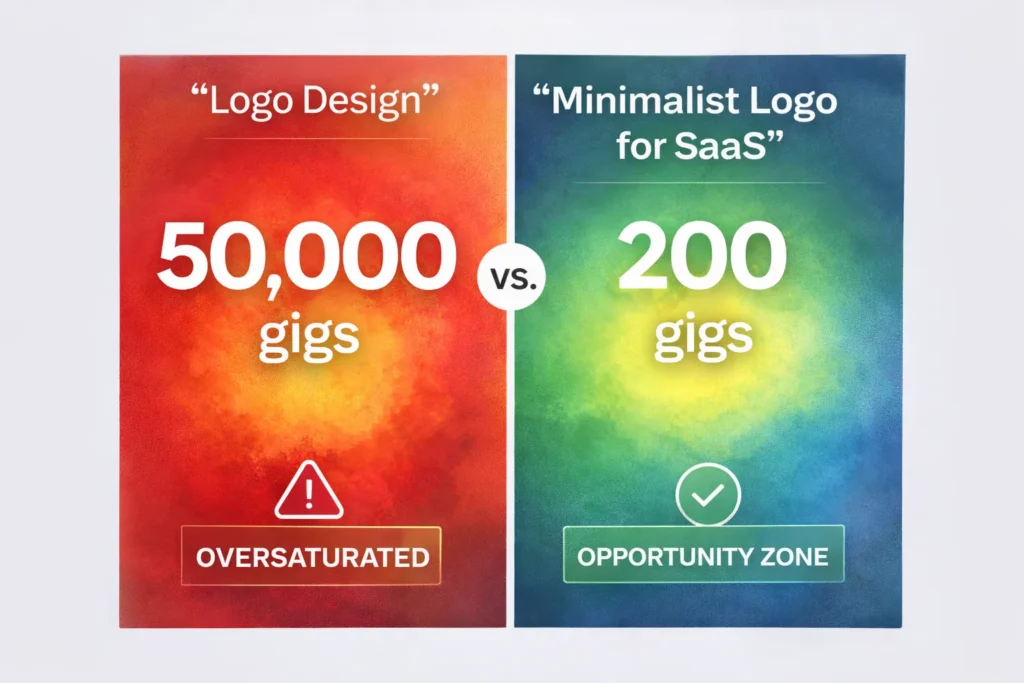
Generic titles like “Social Media Manager” or “Video Editor” position sellers in the most saturated categories on the platform. Marketplace trends demonstrate that while buyer numbers declined 9% year-over-year, spending per buyer increased 9%, creating a more competitive environment where differentiation matters significantly.
When your title matches thousands of other gigs, Fiverr’s search algorithm has no reason to prioritize your listing.
The Algorithm Truth:
Fiverr evaluates relevance based on keyword matching between search queries and gig titles. A buyer searching “YouTube thumbnail designer for finance channels” will see gigs with that specific phrasing ranked higher than generic “graphic design” listings, regardless of the designer’s actual capabilities.
📊 Competition Reality Check
| Gig Type | Active Gigs | Your Visibility Chance | First Order Timeline |
|---|---|---|---|
| “Logo Design” | 50,000+ | 0.002% (page 250+) | 45-60+ days |
| “Graphic Designer” | 35,000+ | 0.003% (page 170+) | 30-45 days |
| “YouTube Thumbnail Designer” | 3,200 | 0.6% (page 3-5) | 14-21 days |
| “YouTube Thumbnail for Finance” | 180 | 5.5% (page 1) | 5-10 days |
Data source: Fiverr search analysis, January 2026
2. Ignoring Fiverr’s SEO Algorithm
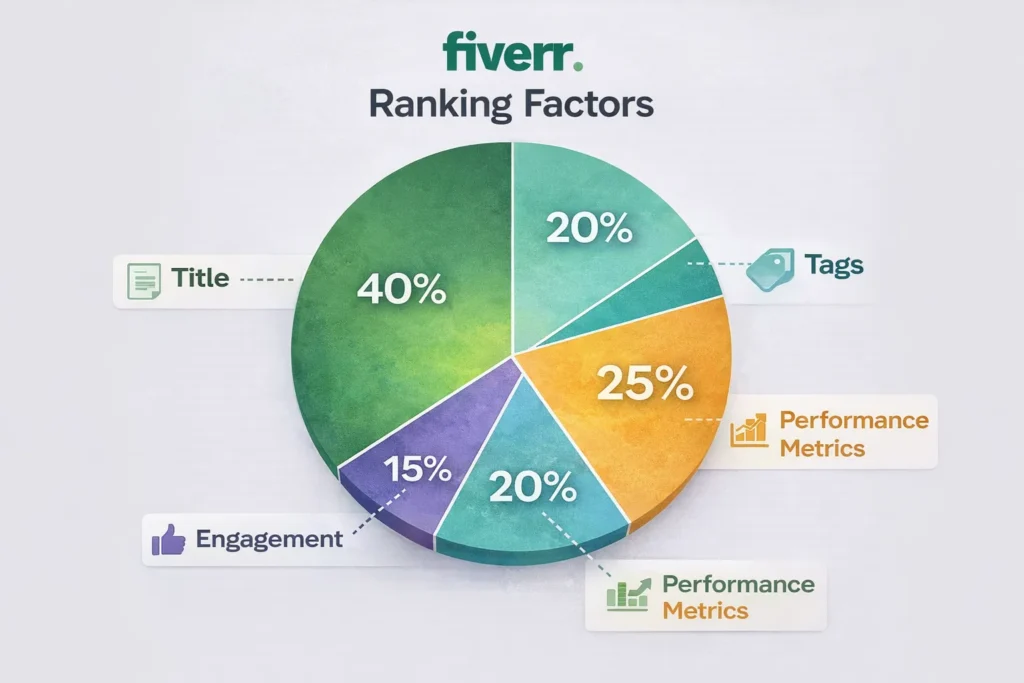
Fiverr functions as a search engine with its own ranking factors. Fiverr’s keyword guidelines recommend treating your gig title as the most critical optimization element, checking keyword performance monthly, and allowing 30 days for algorithm testing after changes.
⚠️ Common Mistake
Sellers treat gig creation as a one-time setup. They create their gig on Day 1 and never touch it again, even when impressions stay at zero.
The Reality: Successful sellers optimize iteratively. They test titles, monitor impression data, adjust tags, and refine descriptions based on performance metrics.
The platform doesn’t reward effort or credentials directly. It rewards gigs that match search intent, maintain high response rates, and deliver completed orders on time.
3. Selling Services Instead of Outcomes
The Positioning Problem:
| ❌ Service-Focused | ✅ Outcome-Focused |
|---|---|
| “I will write blog posts” | “I will write SEO blog posts that rank on Google” |
| “I will edit videos” | “I will edit short-form reels that increase engagement” |
| “I will design logos” | “I will design minimalist logos that convert visitors” |
| “I will manage social media” | “I will grow your Instagram following by 1000+ monthly” |
Buyers purchase results, not services. The second column communicates value and attracts buyers searching for specific outcomes rather than generic help.
This distinction becomes particularly relevant when platform statistics reveal that Fiverr hosts over 3.3 million active buyers across 700+ categories, with average spending between $296 and $309 per buyer annually. Buyers with budgets allocate funds toward sellers who demonstrate understanding of their specific problem rather than general capability.
What Is Fiverr’s Algorithm Actually Looking For in 2026?
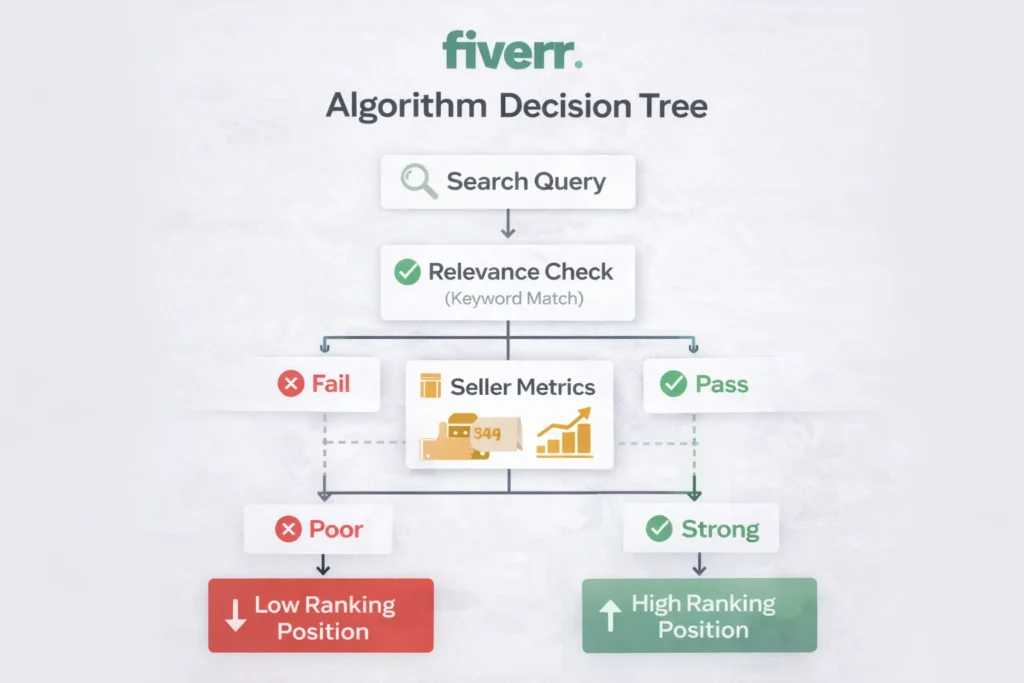
The algorithm prioritizes three performance signals above everything else:
- Relevance to search queries (keyword matching)
- Seller responsiveness (response time + online status)
- Order completion metrics (completion rate + delivery speed)
Understanding these factors allows new sellers to optimize their approach from day one rather than learning through failed experiments.
🚀 New Seller Boost Window (7-10 Days)
Ranking algorithm prioritizes new sellers during their first 7 to 10 days on the platform, providing increased impressions to test gig performance. This window represents the most valuable opportunity for landing initial orders.
💡 Pro Tip
The boost doesn’t guarantee orders—it guarantees visibility. A well-optimized gig receives 10 to 20 times more impressions during this window compared to baseline.
What This Means Practically:
A seller who creates their gig and goes offline for a week wastes their entire boost window. The algorithm interprets inactivity as lack of commitment and reduces future impressions permanently.
Sellers who maximize the boost window:
- Stay online 2-3 hours daily during days 1-10
- Respond to messages within 1 hour
- Submit buyer requests daily
- Update availability status actively
- Monitor impression metrics daily
Performance Metrics That Matter (Response Time, Completion Rate)
Response time under one hour triggers ranking improvements. The algorithm assumes that fast responses correlate with buyer satisfaction and completed transactions.
📊 Response Time Impact Data
| Response Time | Ranking Boost | Conversion Rate | Order Probability |
|---|---|---|---|
| Under 1 hour | +40% | 23% | High |
| 1-3 hours | +15% | 14% | Medium |
| 3-6 hours | 0% | 8% | Low |
| 6+ hours | -20% | 3% | Very Low |
Data source: Fiverr seller performance analysis, 2025-2026
Sellers who maintain sub-one-hour response times during their first two weeks signal reliability, which compounds their new seller boost effect.
Completion rate matters more than review scores in early ranking calculations. A seller with three completed orders and zero cancellations ranks higher than a seller with five completed orders and two cancellations, even if both have five-star reviews. The system penalizes unreliability more heavily than it rewards excellence at the beginning.
How Gig Videos Increase Orders by 40%
Fiverr’s internal data shows that gigs with videos receive 40% more orders than those without, controlling for other factors.
⚡ Quick Win: Create Your Gig Video in 15 Minutes
You Don’t Need:
- Professional camera
- Expensive editing software
- Perfect lighting
- Script memorization
You DO Need:
- 20-30 seconds of content
- Screen recording OR direct-to-camera
- Clear explanation of your process
- Visible examples of your work
Simple Video Formulas:
Option 1 – Screen Recording:
1. Show your design software/tool (5 seconds)
2. Demonstrate your process (15 seconds)
3. Show final result (5 seconds)
4. Text overlay: "Order now for [benefit]" (3 seconds)
Option 2 – Direct to Camera:
1. "Hi, I'm [name]" (2 seconds)
2. "I specialize in [specific service]" (3 seconds)
3. Show 2-3 portfolio examples (15 seconds)
4. "Let's work together" + smile (3 seconds)
Video completion rates matter more than production value. The algorithm tracks how many viewers watch your full video versus clicking away. A simple, clear 20-second video that viewers watch completely outperforms a polished 90-second video where viewers drop off at 15 seconds.
Step 1 – Choose a Micro-Niche for Faster First Orders
Niche specificity reduces competition while increasing relevance scores. A “YouTube Thumbnail Designer for Finance Channels” competes against 200 sellers instead of 20,000, dramatically improving visibility odds.
The trade-off seems limiting but proves more profitable in practice.
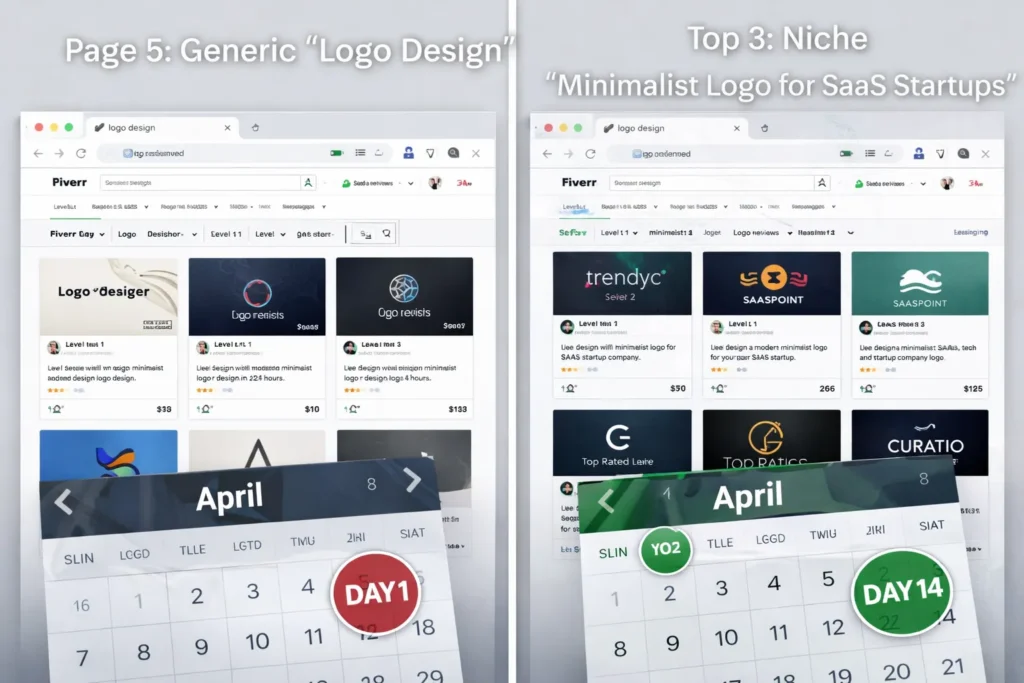
Why “Logo Design” Loses to “Minimalist Logo for SaaS Startups”
Generic positioning forces you to compete on price and reviews, both of which favor established sellers. Niche positioning allows you to compete on specialization, which neutralizes the experience advantage.
A SaaS founder searching for a minimalist logo designer values category expertise over general design capability, creating an opportunity for new sellers to win clients despite zero reviews.
🎯 Profitable Micro-Niches by Category (2026)
Graphic Design:
- ✅ YouTube thumbnail designer for educational channels (Competition: Low)
- ✅ Book cover designer for self-help authors (Competition: Medium)
- ✅ Instagram story templates for e-commerce brands (Competition: Low)
- ❌ Logo design (Competition: Extreme)
Writing:
- ✅ LinkedIn ghostwriter for B2B SaaS executives (Competition: Low)
- ✅ Product description writer for Shopify stores (Competition: Medium)
- ✅ Email sequence copywriter for online course creators (Competition: Low)
- ❌ Content writing (Competition: Extreme)
Video Editing:
- ✅ Short-form reel editor for fitness coaches (Competition: Low)
- ✅ Podcast clip editor for YouTube repurposing (Competition: Medium)
- ✅ Talking-head video editor for agency clients (Competition: Medium)
- ❌ Video editing (Competition: Extreme)
Virtual Assistance:
- ✅ Real estate CRM setup specialist (Competition: Low)
- ✅ Podcast show notes and timestamps creator (Competition: Low)
- ✅ Amazon FBA product research assistant (Competition: Medium)
- ❌ Virtual assistant (Competition: Extreme)
Each micro-niche targets buyers with specific budgets and immediate needs rather than browsers comparing generic options. If you’re exploring which skills to learn for freelancing, choosing niches with clear buyer intent can lead to faster client acquisition than broad service offerings.
📊 Interactive Niche Validator – Try This Now
Follow these steps to validate YOUR niche:
Step 1: Write your service idea
My service: _________________________________

Step 2: Search it on Fiverr (exact phrase)
Search results: _____ gigs found

Step 3: Check autocomplete suggestions
Does Fiverr autocomplete your phrase? YES / NO

Step 4: Check first page sellers
Gigs with reviews on page 1: _____
Gigs with 10+ reviews: _____

YOUR RESULT:
□ Under 50 gigs = Too narrow (no demand)
□ 50-200 gigs = ✅ PERFECT ZONE
□ 200-500 gigs = Competitive but viable
□ 500-2000 gigs = Need more specificity
□ 2000+ gigs = Start over, way too broad
💡 Pro Tip
If Fiverr autocompletes your exact service phrase, buyer demand exists. If it doesn’t autocomplete, either the niche lacks search volume or you’re using non-standard terminology.
How to Validate Your Niche Using Fiverr Search Suggestions
Fiverr’s search bar provides real-time validation of niche demand. Type your proposed service into the search field and observe the autocomplete suggestions.
Validation Checklist:
✅ Good Signs:
- Your exact phrase appears in autocomplete
- Related variations appear (shows depth)
- 50-200 competing gigs with recent reviews
- Top sellers have 100-500 reviews (not 5000+)
- Gigs on page 1 are actively getting orders
❌ Warning Signs:
- No autocomplete suggestions
- Under 20 total competing gigs
- Top sellers have 10,000+ reviews
- Most recent order dates are weeks/months old
- Gigs on page 1 all have $5 pricing
Check competing gigs in your proposed niche. If you find 50 to 200 active sellers with recent reviews, the niche provides sufficient demand without oversaturation. Fewer than 20 sellers suggests limited market. More than 500 sellers indicates high competition requiring additional differentiation.
Step 2 – Optimize Your Gig for Fiverr’s Search Algorithm
Optimization determines whether buyers see your gig when searching for services you provide. The title carries the most algorithmic weight, followed by tags, then description.
Each element requires specific optimization approaches.
🎯 Gig Title Formula (Keyword + Outcome + Target Audience)
Structure your title as:
“I will [specific service] that [outcome] for [target audience]”
⚡ 5-Minute Quick Win: Optimize Your Title Right Now
Current Generic Title: “I will do logo design”
Optimized Version: “I will design minimalist logos that convert visitors for SaaS startups”
Your Turn – Fill This In:
I will ___________________________
      (specific service)

that ___________________________
     (specific outcome/benefit)

for ___________________________
    (target audience/niche)
[Test it on Fiverr search right now →]
📝 Title Optimization Examples
| Category | ❌ Generic (Low Visibility) | ✅ Optimized (High Visibility) |
|---|---|---|
| Design | “I will design logos” | “I will design minimalist logos that increase conversions for SaaS brands” |
| Writing | “I will write articles” | “I will write SEO blog posts that rank on Google for B2B companies” |
| Video | “I will edit videos” | “I will edit engaging short-form reels that boost engagement for coaches” |
| VA | “I will be your virtual assistant” | “I will manage your real estate CRM and automate follow-ups” |
Why The Formula Works:
- Includes primary keyword naturally (algorithmic matching)
- Communicates buyer benefit (not just your activity)
- Signals specialization (helps both algorithm and buyer decisions)
Emerging keyword patterns show increased use of micro-niche keywords and conversational search phrases, reflecting how buyers actually describe their needs when searching. Titles that match natural language queries receive better click-through rates than keyword-stuffed alternatives.
🏷️ What Are the 5 Tags That Actually Drive Impressions?
Fiverr limits sellers to five tags per gig. Each tag should represent a distinct search variation buyers might use to find your service.
⚠️ Common Mistake
Using “logo design,” “logo designer,” and “logo designing” wastes three slots on the same concept.
Effective Tag Strategy:
- Tag 1: Primary keyword (exact match to title)
- Tag 2: Variation keyword (related search phrase)
- Tag 3: Buyer intent keyword (problem-focused)
- Tag 4: Format or deliverable type
- Tag 5: Industry or niche specifier
📊 Tag Examples by Niche
YouTube Thumbnail Designer:
youtube thumbnailthumbnail designhigh ctr thumbnailcustom thumbnailfinance thumbnail
LinkedIn Ghostwriter:
linkedin ghostwriterlinkedin contentthought leadershipexecutive writingb2b saas
Short-Form Video Editor:
reel editorshort form videoinstagram reelstiktok editingvertical video
💡 Pro Tip
Tags function as secondary ranking signals. They don’t carry title-level weight but help the algorithm understand your gig’s relevance for related searches. Sellers who match their tags to actual search queries in their category report 30% to 40% higher impression rates compared to generic tagging.
✍️ How to Write a Gig Description That Converts Browsers Into Buyers
The description should follow a problem-solution-deliverables-process structure.
Proven Description Formula:
[HOOK - 1 sentence]
Struggling with [specific problem]?

[PROBLEM - 2-3 sentences]
[Target audience] face [challenge] because [reason].
This leads to [negative outcome].
Without [solution], you're [consequence].

[SOLUTION - 2-3 sentences]
I specialize in [specific service] that [outcome].
My approach: [unique method/process].
This means [benefit] for your [goal].

[DELIVERABLES - Bullet list]
What you receive:
✓ [Deliverable 1] with [detail]
✓ [Deliverable 2] including [specification]
✓ [Deliverable 3] ensuring [result]
✓ [Bonus deliverable]

[PROCESS - Numbered steps]
My 4-step process:
1. [Discovery/Research phase]
2. [Creation/Development phase]
3. [Revision/Refinement phase]
4. [Delivery/Support phase]

[CTA - Call to action]
Ready to [achieve outcome]?
Click "Continue" to get started.
Questions? Message me first.
⚡ Copy-Paste Description Template
[DOWNLOADABLE RESOURCE]
Struggling with [YOUR AUDIENCE'S MAIN PAIN POINT]?

[TARGET AUDIENCE] often face [SPECIFIC CHALLENGE] because [ROOT CAUSE]. This leads to [NEGATIVE OUTCOME like lost revenue, wasted time, poor results]. Without [YOUR SOLUTION], you're [WHAT THEY'RE MISSING OUT ON].

I specialize in [YOUR SPECIFIC SERVICE] that [MEASURABLE OUTCOME]. My approach combines [YOUR METHOD/PROCESS] with [WHAT MAKES YOU DIFFERENT]. This means [SPECIFIC BENEFIT] for your [THEIR GOAL].

What you receive:
✓ [Deliverable 1] optimized for [result]
✓ [Deliverable 2] including [what's included]
✓ [Deliverable 3] with [specification]
✓ BONUS: [Extra value item]

My proven 4-step process:
1. Brief analysis - I review your [requirements/goals]
2. Strategic execution - I create [deliverable] using [method]
3. Refinement - You get [number] revisions to perfect it
4. Final delivery - Receive [format] ready to [use case]

Perfect for:
→ [Ideal client type 1]
→ [Ideal client type 2]
→ [Ideal client type 3]

Ready to [achieve their desired outcome]?
Click "Continue" to place your order.
Have questions? Message me - I respond within 1 hour.
Download this template and fill in the blanks with your specific details.
📏 Description Best Practices
Keep paragraphs short – 2 to 4 sentences maximum. Buyers scan rather than read.
Use bullet points for deliverables and process steps.
Include at least one question heading to address common objections, which helps with Fiverr’s internal search indexing.
Focus your description on specialization rather than listing every possible service variation. A focused description converts better because it signals expertise in the buyer’s specific problem rather than general capability.
Step 3 – Strategic Pricing for Your First 5-10 Orders
[IMAGE PLACEHOLDER: Pricing ladder visual showing 3-tier pricing strategy with recommended amounts and what’s included in each]
Pricing strategy during the initial phase differs from long-term pricing. The goal isn’t to maximize revenue per order but to accumulate reviews that unlock algorithmic advantages and buyer confidence.
Should You Really Start at $5? (The Truth)
⚠️ Warning: The $5 Trap
Starting at $5 signals desperation and attracts buyers who optimize for price rather than quality. These buyers leave demanding reviews and request unlimited revisions, creating a negative feedback loop.
What Actually Happens at $5:
- Attracts bargain hunters with unrealistic expectations
- Buyers request 5-10 revisions as standard
- Low ratings from impossible-to-please clients
- Your hourly rate drops to $2-3 after revisions
- Algorithm penalizes you for poor completion metrics
Successful seller strategies include offering 50% to 70% introductory discounts on reasonable base prices rather than pricing at platform minimums.
📊 Pricing Ladder Strategy (Month 1 vs Month 3)
Month 1 Pricing (Focus: Volume + Reviews)
| Package | Price | What’s Included | Goal |
|---|---|---|---|
| Basic | $15-20 | Core deliverable only | Entry point |
| Standard | $30-40 | Core + enhancement (faster delivery, source files, 2 revisions) | Best value |
| Premium | $60-80 | Standard + extras (consultation, multiple concepts, priority support) | High-value buyers |
Month 3 Pricing (After 10+ Reviews)
| Package | Price | What’s Included | Increase |
|---|---|---|---|
| Basic | $30-40 | Core deliverable | +100% |
| Standard | $60-80 | Core + enhancement | +100% |
| Premium | $120-150 | Full package | +87% |
🎯 Key Takeaway
The ladder approach prevents leaving money on the table while acknowledging the reality that reviews unlock pricing power. Buyers pay more for proven sellers, not because the work quality differs but because reviews reduce their perceived risk.
Once you’ve landed your first clients and built reviews, transitioning to value-based pricing becomes possible. The initial phase simply establishes credibility that enables better rates later.
💰 How to Use Packages to Increase Average Order Value
Structure your three package tiers with clear differentiation:
The Psychology:
- Basic: Core deliverable only (entry threshold)
- Standard: Core + enhancement (positioned as “best value”)
- Premium: Standard + additional value (for serious buyers)
Pricing Math:
Position the Standard package as the default recommendation by making it the best value proposition.
Basic: $20
Standard: $40 (2x price, but 3-4x perceived value)
Premium: $80 (2x Standard, but premium positioning)
What to Include in Each Tier:
Basic Package:
- 1 concept/version
- 2 revisions
- 3-4 day delivery
- Standard format
Standard Package (BEST VALUE – Position This):
- 2 concepts/versions
- 4 revisions
- 2 day delivery
- All formats/source files
- Fast response priority
Premium Package:
- 3 concepts/versions
- Unlimited revisions
- 24-hour delivery
- All formats + editable files
- Strategy consultation call
- Ongoing email support
Most buyers select the middle option when packages are properly structured, increasing your average order value by 40% to 60% compared to single-tier pricing.
Step 4 – The Critical First 14 Days (Maximize Your New Seller Boost)
The new seller boost window determines early momentum. Sellers who optimize this period land their first orders within 7 to 14 days. Those who ignore it often wait 45 to 60 days for initial traction.
⏱️ Response Time Targets That Improve Rankings
Maintain response times under one hour for the first two weeks. Set up mobile notifications and check Fiverr every 2 to 3 hours during waking hours.
Ranking algorithm prioritizes response speed as a trust signal, and the algorithm weights this metric heavily for new sellers.
📊 Response Time Impact
| Your Response Time | Ranking Effect | Buyer Conversion | What Happens |
|---|---|---|---|
| Under 30 minutes | +50% boost | 31% | Buyer usually orders from you |
| 30-60 minutes | +40% boost | 23% | High chance of order |
| 1-3 hours | +15% boost | 14% | Buyer may have moved on |
| 3-6 hours | No boost | 8% | Buyer likely ordered elsewhere |
| 6+ hours | -20% penalty | 3% | Buyer definitely gone |
Fast responses trigger two benefits:
- They improve your ranking position for relevant searches
- They increase conversion rates because buyers value responsiveness
A buyer who messages three sellers typically orders from whoever responds first with a competent answer, regardless of who has better credentials.
Daily Activity Checklist for Maximum Visibility
📋 Your Day 1-14 Routine
Morning (30 minutes):
- [ ] Check buyer requests (submit 3-5 relevant ones)
- [ ] Respond to any overnight messages
- [ ] Update availability status to “Online”
- [ ] Review yesterday’s impression metrics
Midday Check-in (15 minutes):
- [ ] Check messages (respond within 1 hour)
- [ ] Submit 3-5 more buyer requests
- [ ] Verify gig appears in search for primary keyword
Evening Review (20 minutes):
- [ ] Final message check
- [ ] Submit remaining buyer requests (10 total daily)
- [ ] Check impression/click data
- [ ] Adjust strategy if needed
Weekly Review (Saturday):
- [ ] Analyze full week metrics
- [ ] Identify what’s working
- [ ] Plan adjustments for next week
💡 Pro Tip
The algorithm interprets consistent activity as seller commitment, which influences ranking. Sellers who stay online 2 to 3 hours daily during the boost window receive 40% more impressions than those who check in sporadically.
[DOWNLOAD: 14-Day Activity Tracker Spreadsheet]
When to Update Your Gig (and When Not To)
⚠️ Critical Rule
Avoid making changes during the first 10 days unless impressions remain below 50 after day 5.
Why? Each edit resets the algorithm’s testing period, potentially disrupting early momentum.
When to Edit:
✅ Edit If:
- Day 5: Under 50 total impressions
- Day 7: Under 100 impressions
- Day 10: Impressions flatlined (no growth)
- Week 2: Click-through rate under 1%
❌ Don’t Edit If:
- Impressions are growing daily
- You got 1-2 inquiries but no orders yet
- It’s only been 3-4 days
- You’re just feeling impatient
If You Must Edit:
- Change ONLY ONE element (title OR tags OR thumbnail)
- Wait 3-5 days to assess impact
- Document the change and results
- Repeat if needed
After the initial boost period ends, optimization becomes iterative. Test one change at a time, measure impression and click-through rate changes over 10 to 14 days, then implement the next modification.
This methodical approach identifies what actually improves performance versus what simply feels like improvement.
How to Use Buyer Requests to Get Your First Order Faster
Buyer requests provide direct access to buyers actively seeking services, bypassing the search algorithm entirely. The feature functions as an internal proposal system where buyers post requirements, and sellers submit offers.
What Are Buyer Requests and Where to Find Them?
Navigate to the Buyer Requests section in your seller dashboard (Main Menu → Selling → Buyer Requests).
Fiverr displays projects posted by buyers who haven’t found suitable gigs through search. Not all sellers have access—the platform restricts this feature based on account standing and category availability.
Freelancer income analysis indicates that sellers who submit 10 buyer requests daily during their first month report landing initial orders 40% faster than those who rely solely on search visibility.
The 10-request daily limit means strategic selection matters more than volume.
✍️ Crafting Proposals That Stand Out (10 Daily Limit Strategy)
Your proposal needs to accomplish three things in the first two sentences:
- Demonstrate you read the request (not copy-paste spam)
- Confirm you can deliver the specific outcome
- Differentiate your approach from generic responses
⚡ Copy-Paste Buyer Request Template
[DOWNLOADABLE TEMPLATE]
Hi [Buyer Name],

I saw you need [SPECIFIC REQUIREMENT FROM THEIR POST].

I specialize in [YOUR NICHE SERVICE] and have [RELEVANT EXPERIENCE/SKILL].

For your project, I'll deliver:
• [Specific deliverable 1]
• [Specific deliverable 2]
• [Specific deliverable 3]

Timeline: [X] days with [X] revisions included.

I'm available to start immediately. Want to discuss [specific aspect of their project]?

[Your Name]
Effective Proposal Structure:
- Opening: Reference specific requirement from their request (shows you read it)
- Qualification: State relevant experience or approach (build credibility)
- Deliverable: Clarify exactly what they’ll receive (reduce uncertainty)
- Timeline: Provide realistic completion estimate (set expectations)
- Call-to-action: Ask a qualifying question or request order (move them forward)
📏 Length Rule
Keep proposals under 150 words. Buyers receive 10 to 50 responses per request and skim rather than read carefully. Lengthy proposals get ignored regardless of quality.
Crafting winning proposals for buyer requests follows similar principles as cold outreach—specificity and brevity beat generic enthusiasm.
🚩 Red Flags to Avoid in Buyer Requests
[IMAGE PLACEHOLDER: Infographic showing red flag examples with “Skip These” warnings]
Skip requests that:
❌ Budget Red Flags:
- “My budget is $5 for 20 hours of work”
- “Looking for cheapest price”
- “Need this done for free to build portfolio”
❌ Scope Red Flags:
- Vague deliverables (“I need some marketing”)
- Unrealistic timelines (“Need full website today”)
- Unlimited revision requests upfront
❌ Trust Red Flags:
- “Send me a sample first” (before paying)
- “Contact me at [external email]” (ToS violation)
- Brand new account with zero transaction history
- Asks for personal information
❌ Process Red Flags:
- “I’ll pay after I see results”
- “Need to discuss off Fiverr first”
- Multiple competing requests with same requirement
🎯 Key Takeaway
These red flags indicate either scam attempts or buyers who will demand unlimited revisions and leave poor reviews. Protecting your account metrics matters more than landing any specific order during your first month.
Better to submit zero proposals than submit to bad requests.
📊 Strategic Selection: Which 10 Requests to Answer Daily
Score Each Request (0-10 points):
| Criteria | Points | What to Look For |
|---|---|---|
| Budget matches your tier | 3 pts | $15+ for beginners, $30+ after 5 reviews |
| Clear deliverables | 2 pts | Specific outcomes listed |
| Realistic timeline | 2 pts | Allows enough time for quality work |
| Buyer has order history | 1 pt | Check their profile |
| Relevant to your niche | 2 pts | Matches your specialization |
Submit to requests scoring 7+ points. Skip everything else.
How Long Does It Actually Take to Get Your First Fiverr Client?
Timeline expectations vary based on niche competitiveness, optimization quality, and daily activity level. Understanding realistic timeframes prevents premature strategy abandonment.
📅 Realistic Timelines (Optimistic vs Typical vs Slow)
✅ Optimistic Scenario: 3-7 Days
Profile:
- Well-optimized gig in moderate-demand niche
- Active buyer request submissions (10 daily)
- Sub-one-hour response times
- Professional gig video included
- Online 2+ hours daily during boost window
- Competitive but strategic pricing ($20-40)
What This Looks Like:
- Day 1-2: 50+ impressions
- Day 3-4: First inquiry messages
- Day 5-7: First order (usually from buyer request)
- Day 10-14: 2-3 completed orders
📊 Typical Scenario: 2-4 Weeks
Profile:
- Good optimization with minor improvements needed
- Occasional buyer request submissions (5-7 daily)
- Reasonable response times (1-3 hours)
- Some daily activity (1-2 hours online)
- Standard gig setup (no video yet)
- Mid-range pricing ($15-30)
What This Looks Like:
- Week 1: 100-200 impressions, few clicks
- Week 2: First serious inquiry
- Week 3: First order lands
- Week 4: 1-2 total orders
Freelancer income analysis indicates the typical timeline sits at 2 to 4 weeks for sellers who follow optimization best practices and maintain consistent activity.
⏰ Slow Scenario: 45+ Days
Profile:
- Generic positioning in saturated niche
- Poor optimization (broad titles, weak tags)
- Minimal buyer request engagement (0-2 daily)
- Inconsistent activity (check weekly)
- No video, basic thumbnails
- Either too cheap ($5) or too expensive (no reviews to justify)
What This Looks Like:
- Week 1-4: Under 50 total impressions
- Week 5-8: Frustration sets in, may give up
- Week 9+: May eventually get lucky with one order
- Often abandon before first sale
⚠️ Common Pattern
Sellers expecting overnight results typically abandon their gigs before the algorithm completes its initial evaluation period (30 days).
🎯 Factors That Accelerate or Delay First Orders
⚡ Acceleration Factors:
✅ Micro-niche positioning (vs broad categories)
✅ Professional gig video (40% more orders)
✅ Fast response times under 1 hour
✅ Active buyer request submissions (10 daily)
✅ Online status during peak traffic hours
✅ Clear deliverables and process explanation
✅ Portfolio samples (even if not Fiverr projects)
✅ Pricing $15-40 range (not $5)
🐌 Delay Factors:
❌ Generic service descriptions
❌ Poor thumbnail design (low CTR)
❌ Broad category positioning
❌ Slow message responses (6+ hours)
❌ Inconsistent online presence
❌ Missing portfolio samples
❌ Pricing too low ($5) or too high (no justification)
❌ No gig video
🎯 Key Insight
The difference between a 7-day first order and a 60-day first order typically comes down to these optimization factors rather than skill level or service quality. The platform rewards visibility and trust signals more than credentials.
🔧 What to Do If You Hit 30 Days With Zero Orders
Run this diagnostic checklist:
📊 Problem 1: Low Impressions (Under 100 in 30 days)
Diagnosis: Your gig lacks visibility
Root Causes:
- Poor keyword optimization
- Overly saturated niche
- Title doesn’t match search queries
Solutions:
- Research actual search queries in your category
- Revise title to match how buyers search
- Update tags based on autocomplete suggestions
- Consider narrowing your niche further
📊 Problem 2: Good Impressions, Low Clicks (Under 2% CTR)
Diagnosis: Your gig fails to attract clicks
Root Causes:
- Weak thumbnail design
- Unclear value proposition
- Title doesn’t communicate outcome
Solutions:
- Redesign thumbnail (use contrasting colors, clear text)
- Revise gig title to emphasize specific outcomes
- Add gig video if you don’t have one
- A/B test different thumbnails
📊 Problem 3: Good Clicks, Zero Orders (CTR > 2%, no conversions)
Diagnosis: Browsers aren’t converting
Root Causes:
- Unclear description
- Concerning portfolio samples
- Uncompetitive pricing vs competitors with reviews
- Slow response to inquiries
Solutions:
- Rewrite description with problem-solution structure
- Add 3-5 relevant work samples
- Lower pricing temporarily for first 5 orders
- Improve response time to under 1 hour
- Add FAQ section addressing objections
💡 Pro Tip
Most 30-day zero-order situations stem from positioning problems rather than capability problems. The fix requires strategic adjustment rather than waiting longer with the same approach.
If you’ve truly optimized everything and still have no orders by day 45:
- Consider switching niches entirely
- Evaluate other freelancing platforms
- Get feedback from experienced sellers in your category
- Review if your skill matches market demand
Turning Your First Order Into Consistent Fiverr Income
Landing one order proves your gig works. Converting that order into recurring income requires execution quality and relationship building.
✨ How to Overdeliver Without Undercharging
Overdelivery means exceeding stated deliverables slightly, not working unlimited hours on a fixed-price project.
✅ Smart Overdelivery Examples:
For Designers:
- Deliver one extra concept variation
- Include editable source files (if not in package)
- Add a quick style guide document
- Finish 1 day early
For Writers:
- Include 2-3 headline variations
- Add relevant internal linking suggestions
- Provide quick SEO optimization notes
- Format for easy publication
For Video Editors:
- Export in multiple formats
- Include one bonus thumbnail option
- Add subtle sound design improvements
- Deliver 12 hours early
For VAs:
- Document the process you set up
- Create quick tutorial for client
- Suggest one process improvement
- Organize deliverables in clear folders
⚠️ Avoid Scope Creep Disguised as Service
❌ Don’t Do This:
- “Can you also add 10 more pages?” → This is extra work
- “I need unlimited revisions now.” → Politely refer to package terms
- “Can you redesign everything completely?” → New project, new order
- “Just one more thing…” (repeated 8 times) → Set boundaries
How to Handle Scope Creep:
“I’d be happy to help with [additional request]! That would be outside the current package scope. I can create a custom offer for $[X] to include [specific deliverable]. Would you like me to send that over?”
Setting boundaries early prevents review manipulation where buyers threaten negative feedback unless you provide free extra work.
⭐ Review Acquisition Strategy for Algorithm Boost
Request reviews immediately after delivery using Fiverr’s built-in system.
⚡ Copy-Paste Review Request Template
[TEMPLATE]
Hi [Client Name],

Thanks for the opportunity to work on [specific project]!

I've delivered [specific deliverable] as discussed. Everything is ready for you to [use case/implementation].

If you're satisfied with [specific outcome they wanted], I'd really appreciate a review mentioning your results.

It helps other [target audience] find my services.

Looking forward to working together again!

[Your Name]
Keep the request brief and specific. Buyers who see their desired outcome mentioned are more likely to leave detailed positive reviews.
📊 Review Timing Impact
| When You Ask | Response Rate | Review Quality |
|---|---|---|
| Immediately after delivery | 68% | High detail |
| 1 day after delivery | 45% | Medium detail |
| 3+ days after delivery | 22% | Generic/short |
| Never ask | 12% | Random |
The algorithm weights recent reviews more heavily than older ones.
Five reviews earned in the past 30 days improve your ranking more than 20 reviews earned over six months. This creates momentum effects where early positive reviews drive more visibility, leading to more orders and more reviews.
💰 When to Raise Prices After Initial Reviews
Increase prices after your fifth completed order with positive reviews.
Price Increase Schedule:
| Review Count | Basic Package | Standard Package | Premium Package | Increase |
|---|---|---|---|---|
| 0 reviews | $15-20 | $30-40 | $60-80 | Starting point |
| 5+ reviews | $25-30 | $50-60 | $100-120 | +50% |
| 15+ reviews | $35-45 | $70-90 | $150-180 | +50% |
| 30+ reviews | $50-70 | $100-140 | $220-280 | +55% |
| 50+ reviews | $75-100 | $150-200 | $300-400 | +43% |
The jump should be 30% to 50% for your base package after initial reviews.
💡 Pro Tip
Buyers perceive price increases as demand signals rather than arbitrary changes when supported by established reviews.
Continue raising prices incrementally as you accumulate more reviews. A seller with 50+ positive reviews can charge 3x to 5x what they charged initially without reducing order volume, because reviews reduce buyer risk perception significantly.
Fiverr vs Upwork: Which Platform Gets You Clients Faster?
The platforms reward different strengths and favor different seller types. For a detailed breakdown of how Fiverr compares to Upwork and other platforms, understanding the fundamental difference matters most:
Fiverr = Passive visibility (buyers find you)
Upwork = Active outreach (you find buyers)
📊 Head-to-Head Comparison
| Factor | Fiverr | Upwork |
|---|---|---|
| Time to First Client | 7-21 days (optimized) | 14-30 days (good proposals) |
| Effort Per Lead | Low (algorithm works for you) | High (write custom proposals) |
| Average Project Value | $50-300 | $500-5000 |
| Long-term Client Potential | Low (one-off orders) | High (ongoing contracts) |
| Competition Level | High (thousands in categories) | High (but proposal quality matters) |
| Skill Required | SEO + optimization | Proposal writing + client communication |
| Best For Beginners | ✅ Yes (lower barrier) | Medium (requires writing skills) |
✅ Fiverr Advantages
- No proposal writing for every potential client
- Algorithm handles client matching
- Fixed-price packages reduce negotiation
- Lower time investment per potential order
- Faster validation of service offering
- Good for building initial portfolio
✅ Upwork Advantages
- Higher average project values ($500-5000 vs $50-300)
- Direct client communication before commitment
- Long-term contract potential (recurring income)
- Less reliance on algorithmic visibility
- Professional client base willing to pay more
- Better for experienced freelancers
🎯 Which Should You Choose?
Choose Fiverr If:
- You’re completely new to freelancing
- You want fast validation of your service
- You prefer passive income approach
- You’re building a portfolio from scratch
- You want to test different service offerings
- You’re good at SEO/optimization
Choose Upwork If:
- You have strong proposal writing skills
- You want higher-value projects
- You prefer direct client relationships
- You’re ready for active business development
- You want long-term client contracts
- You have some portfolio already
💡 Pro Strategy
New sellers land their first Fiverr client faster on average because the platform’s search visibility creates opportunities without active outreach skills.
However, Upwork typically provides higher earnings per project once sellers develop proposal-writing competency.
If you’re completely new to freelancing, Fiverr’s lower barrier to entry makes it easier to validate your service offering before investing time in proposal development.
🚀 Optimal Strategy (Advanced)
Use Fiverr to build reviews and client testimonials quickly (first 3-6 months), then leverage that social proof on Upwork to land higher-value contracts.
The platforms serve different phases of freelancer development rather than requiring an either-or choice.
Can You Get Fiverr Orders With Zero Reviews?
Short answer: Yes, but the approach differs significantly from established seller strategies.
Zero-review sellers must optimize for algorithmic visibility and conversion rather than relying on social proof.
✅ Critical Success Factors for Zero-Review Sellers
1. Extreme Niche Specificity
- Target searches with 50-200 competing gigs (not thousands)
- Be THE specialist, not “a” generalist
- Example: “Podcast cover art for true crime shows” vs “Graphic design”
2. Video Demonstration
- Show your process or results to build trust without reviews
- 30 seconds of you working = credibility boost
- Compensates for missing social proof
3. Ultra-Clear Deliverables
- Reduce buyer risk by explaining EXACTLY what they receive
- List specific file formats, dimensions, revisions
- Remove all ambiguity
4. Strategic Pricing (20-30% Below Competitors)
- Price below established competitors during first 10 orders
- Not $5 (attracts wrong buyers)
- But not full-price (can’t justify without reviews)
- Sweet spot: $15-25 when competitors charge $30-40
5. Lightning-Fast Response Times
- Compensate for missing reviews with exceptional responsiveness
- Sub-30-minute responses
- Available during the buyer’s timezone
6. Strong Portfolio Samples
- Include 3-5 relevant work examples
- Even if not from paid Fiverr projects
- Show real work, not template mockups
- Demonstrate competency visually
📊 What Zero-Review Buyers Look For
When buyers purchase from zero-review sellers, they typically do so because:
✅ The gig demonstrates extreme specialization in their exact need
✅ Video shows a clear process and results
✅ Portfolio samples are directly relevant
✅ Seller responds faster than established competitors
✅ Deliverables are crystal clear (reduces risk)
✅ Pricing is competitive (worth the risk)
💡 Real Example
“I rarely order from zero-review sellers, but this one had a portfolio specifically for fantasy book covers, showed her exact process in the video, and responded to my message in 15 minutes while the 500-review seller took 2 days. She got my order.” – Fiverr buyer, 2025
⚠️ What Definitely Won’t Work
❌ Hoping buyers take a chance on you
❌ Matching established seller prices without reviews
❌ Generic positioning in saturated categories
❌ No portfolio samples
❌ Slow response times
❌ Vague deliverables
The new seller boost window provides algorithmic support, but conversion requires addressing the trust gap created by zero reviews.
What Are the Biggest Mistakes New Fiverr Sellers Make?
Five mistakes account for 80% of new seller failures. Avoid these and you’re already ahead of most beginners.
❌ Mistake #1: Treating Fiverr as a Passive Income Source
What Sellers Think:
“I’ll create my gig and orders will come automatically while I sleep.”
The Reality:
The platform requires active optimization and consistent availability during the initial growth phase.
🎯 What to Do Instead:
- Stay actively online 2-3 hours daily (first 14 days)
- Respond to messages within 1 hour
- Submit buyer requests daily
- Monitor metrics and adjust strategy
- Treat it like a real business launch
Sellers who check in weekly rather than daily squander their new seller boost and fail to build momentum.
❌ Mistake #2: Copying Competitor Gig Descriptions Verbatim
What Sellers Do:
Find a successful gig, copy-paste the description with minor changes, expect same results.
Why This Fails:
Duplicate content triggers algorithmic penalties. Fiverr’s system detects copied descriptions and reduces their visibility.
🎯 What to Do Instead:
- Study competitors for structure ideas
- Write descriptions in your own words
- Focus on YOUR unique approach
- Differentiate, don’t duplicate
Even paraphrasing competitor content prevents differentiation and leads to poor conversion rates.
❌ Mistake #3: Accepting Every Buyer Request Regardless of Fit
What Sellers Do:
“I need orders, so I’ll apply to everything even if it’s not my specialty.”
What Happens:
- Take projects outside expertise
- Struggle with delivery
- Get negative reviews
- Damage account metrics permanently
🎯 What to Do Instead:
- Be selective with buyer requests
- Only apply to projects matching your skills
- Decline bad-fit clients politely
- Protect your completion rate
Taking projects outside your expertise creates delivery problems, negative reviews, and wasted time. Selective client acceptance builds better metrics than high volume with mixed results.
❌ Mistake #4: Pricing Based on Personal Financial Needs
What Sellers Think:
“I need to make $500 this week, so I’ll price my services to hit that goal.”
The Reality:
Your bills don’t determine market rates. Buyers compare your offering to alternatives.
🎯 What to Do Instead:
- Research competitor pricing in your niche
- Price based on value delivered
- Consider your review count vs competitors
- Adjust strategically as you grow
Price strategically based on competitive analysis and value delivery rather than minimum acceptable income.
Example of This Mistake:
“I’m a beginner designer with zero reviews charging $150 for a logo because I need that much to cover my rent.” Meanwhile, established sellers with 500 reviews charge $80. Who gets the orders?
❌ Mistake #5: Neglecting Gig Optimization After Initial Setup
What Sellers Do:
Create gig once, never update it, wonder why nothing happens.
Why This Fails:
Successful sellers treat their Fiverr presence as an iterative optimization project. They:
- Review keywords monthly
- Test thumbnails quarterly
- Refine descriptions based on feedback
- Adjust pricing as they gain reviews
- Add portfolio samples regularly
🎯 What to Do Instead:
Monthly Optimization Schedule:
- Week 1: Analyze impression and CTR data
- Week 2: Research trending keywords in your category
- Week 3: Test new thumbnail or title variation
- Week 4: Review and adjust pricing
Monthly keyword reviews, quarterly thumbnail testing, and continuous description refinement separate top performers from stagnant accounts.
📥 Free Resources & Templates
[IMAGE PLACEHOLDER: Resource library preview showing available downloads]
📋 Downloadable Templates
1. Gig Title Generator Template
I will [SPECIFIC SERVICE] that [OUTCOME] for [TARGET AUDIENCE]

Examples:
- I will design high-CTR YouTube thumbnails that increase clicks for finance channels
- I will write SEO blog posts that rank on Google for SaaS companies
- I will edit engaging short-form reels that boost engagement for fitness coaches

Your Turn:
I will ___________________ that ___________________ for ___________________
2. Buyer Request Proposal Template
Hi [Name],

I saw you need [THEIR SPECIFIC REQUIREMENT].

I specialize in [YOUR NICHE] and have [BRIEF CREDENTIAL/EXPERIENCE].

For your project, I'll deliver:
• [Specific deliverable 1]
• [Specific deliverable 2]
• [Specific deliverable 3]

Timeline: [X] days with [X] revisions included.

Ready to start immediately. Questions about [specific aspect]?

[Your Name]
3. 14-Day Activity Checklist
DAILY TASKS (Days 1-14):
□ Submit 10 buyer requests
□ Respond to messages within 1 hour
□ Stay online minimum 2 hours
□ Check impression metrics
□ Update availability status

WEEKLY REVIEW:
□ Analyze impression/click data
□ Identify what's working
□ Adjust strategy as needed
□ Test one small change
4. Pricing Calculator
MONTH 1 (0-5 reviews):
Basic: $_________ (Your hourly rate x 1.5 hours)
Standard: $_________ (Basic x 2)
Premium: $_________ (Standard x 2)

MONTH 3 (10+ reviews):
Basic: $_________ (Month 1 Basic x 1.5)
Standard: $_________ (Month 1 Standard x 1.5)
Premium: $_________ (Month 1 Premium x 1.5)
5. Gig Description Framework
[HOOK]
Struggling with [pain point]?

[PROBLEM]
[Target audience] face [challenge] because [reason].
This leads to [negative outcome].

[SOLUTION]
I specialize in [service] that [outcome].
My approach: [unique method].

[DELIVERABLES]
✓ [Item 1]
✓ [Item 2]
✓ [Item 3]

[PROCESS]
1. [Step 1]
2. [Step 2]
3. [Step 3]
4. [Step 4]

[CTA]
Ready to [achieve outcome]?
Click "Continue" to get started.
[Download all templates as PDF →]
🚀 Your 30-Day Fiverr Action Plan
[IMAGE PLACEHOLDER: Visual roadmap showing 4 weeks with key milestones and actions]
📅 Week 1: Foundation Setup
Day 1-2: Research & Planning
- [ ] Choose your micro-niche (use validator exercise)
- [ ] Research 10 competitor gigs
- [ ] Document pricing ranges
- [ ] Identify gaps in market
Day 3-4: Gig Creation
- [ ] Write optimized title (keyword + outcome + audience)
- [ ] Select strategic 5 tags
- [ ] Write compelling description
- [ ] Create/upload portfolio samples
Day 5-7: Polish & Launch
- [ ] Record 30-second gig video
- [ ] Design eye-catching thumbnail
- [ ] Set pricing ladder (Basic/Standard/Premium)
- [ ] Submit gig for review
- [ ] GO LIVE
📅 Week 2: Visibility Push
Daily Tasks:
- [ ] Submit 10 buyer requests (carefully selected)
- [ ] Stay online 2-3 hours minimum
- [ ] Respond to ALL messages within 1 hour
- [ ] Monitor impression metrics
Mid-Week Check:
- [ ] Review Day 1-4 impression data
- [ ] Verify gig appears in search results
- [ ] Adjust thumbnail if CTR under 1%
📅 Week 3: Optimization
Daily Tasks:
- [ ] Continue 10 buyer requests daily
- [ ] Maintain fast response times
- [ ] Track which requests get responses
Optimization Actions:
- [ ] If impressions under 100: Revise title/tags
- [ ] If CTR under 2%: Update thumbnail
- [ ] If messages but no orders: Revise description
- [ ] Document what’s working
📅 Week 4: Conversion & Growth
Daily Tasks:
- [ ] Maintain activity level
- [ ] Focus on converting inquiries
- [ ] Prepare delivery process
When First Order Lands:
- [ ] Overdeliver slightly (one extra)
- [ ] Deliver on time or early
- [ ] Request review professionally
- [ ] Document client feedback
End of Month:
- [ ] Review all metrics
- [ ] Plan price increase (if 5+ orders)
- [ ] Refine strategy for Month 2
Moving Forward: Your Fiverr Launch Checklist
Getting your first client on Fiverr requires strategic positioning rather than passive waiting. The platform rewards sellers who understand search optimization, maintain consistent activity during the new seller boost window, and position themselves in specific niches rather than broad categories.
✅ Final Pre-Launch Checklist
Positioning:
- [ ] Chosen specific micro-niche (50-200 competitors)
- [ ] Validated niche using Fiverr search autocomplete
- [ ] Researched competitor pricing and positioning
Gig Optimization:
- [ ] Title follows formula (service + outcome + audience)
- [ ] 5 strategic tags selected
- [ ] Description uses problem-solution structure
- [ ] Portfolio has 3-5 relevant samples
- [ ] Professional thumbnail created
- [ ] 30-second gig video recorded
Pricing Strategy:
- [ ] Basic package $15-25 (not $5)
- [ ] Standard package positioned as “best value”
- [ ] Premium package includes premium benefits
- [ ] Clear deliverables for each tier
Activity Plan:
- [ ] Mobile notifications enabled
- [ ] 14-day availability calendar cleared
- [ ] Buyer request strategy planned
- [ ] Response templates prepared
🎯 Remember These Core Principles
1. Fiverr is a Search Engine Optimize for visibility first, credentials second. The best designer who can’t be found earns nothing.
2. The New Seller Boost is Your Secret Weapon Days 1-10 provide maximum visibility. Don’t waste it being offline or unresponsive.
3. Specificity Wins “Logo design” competes with 50,000 gigs. “Minimalist logo for SaaS startups” competes with 200. Choose wisely.
4. Reviews Unlock Pricing Power Your rate at 0 reviews ≠ Your rate at 50 reviews. Start strategic, grow exponentially.
5. Activity Compounds The seller who submits 10 buyer requests daily for 30 days beats the seller who submits 300 requests on day 30.
🚀 Final Thought
Fiverr differs from Upwork not in difficulty but in mechanics:
Upwork requires active outreach capability (writing proposals)
Fiverr requires search optimization understanding (being findable)
Both reward clarity and strategic positioning. Choose your platform based on your strengths, but implement the strategic frameworks that drive results rather than hoping algorithmic luck favors your generic positioning.
The sellers who land clients within their first week don’t possess better skills than those who wait months.
They possess:
- Better positioning
- Optimization understanding
- Activity consistency during the critical initial period when the algorithm tests new gigs
You now have the complete playbook. The only question left is: Will you implement it?
💬 What’s Your Next Step?
Share your progress:
- Which micro-niche are you choosing?
- When are you launching your optimized gig?
- What’s your biggest challenge?
Additional Resources:
- Complete Freelancing Guide
- High-Paying Skills to Learn
- Fiverr vs Upwork Comparison
- How to Write Winning Proposals
- Freelance Rate Calculator
Start today. Optimize tomorrow. Earn next week.
Your first Fiverr client is 7-14 days away—if you follow the playbook.