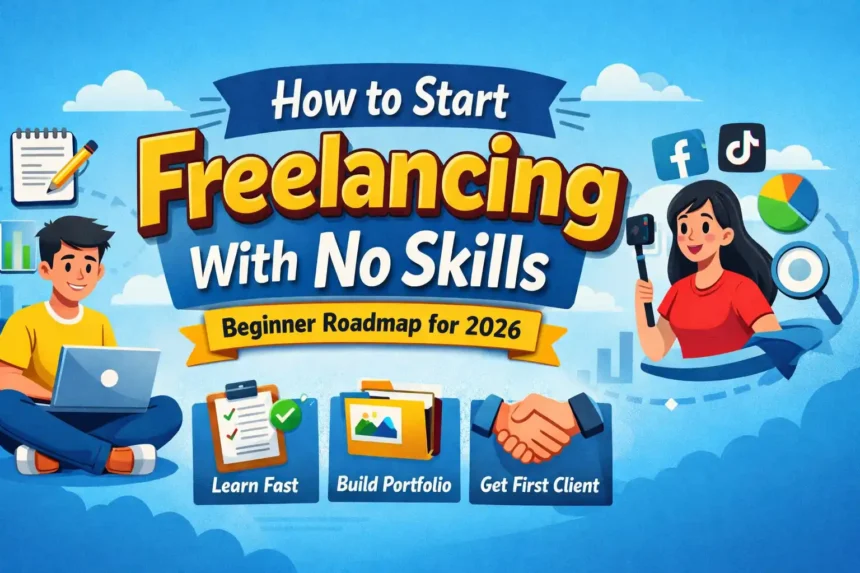
- TL;DR: “No skills” rarely means what people think it means. Most beginners already have something, writing ability, basic design sense, Excel familiarity, and social media comfort, which someone will pay for right now. For those who genuinely need to learn from scratch, five freelance skills can be job-ready in under 30 days using free tools and free courses. The path from zero to first paid project takes most beginners six weeks when they follow a structured approach. This guide covers the honest skill audit, the five fastest skills to learn, a week-by-week roadmap, and how to land the first client before you feel “ready.”
Every freelancer you see earning $500 a month started with the same thought you have right now: “I don’t have anything to offer.” That feeling is real. It’s also almost always wrong. The actual problem isn’t a lack of skills. It’s a lack of clarity about what skills you already have. Learning how to start freelancing without any skills is mostly about recognising what “no skills” actually means, because for most people it means “no awareness of transferable skills.” The global freelance market is now valued at $1.4 trillion, with demand for entry-level talent growing faster than supply. There has never been a better time to start with exactly what you have right now.
- What “No Skills” Really Means When Starting Freelancing
- 5 Freelance Skills You Can Learn in Under 30 Days (With Free Resources)
- The Honest Skill Audit: How to Find What You Already Have
- 6-Week Freelancing Roadmap for Beginners With No Experience
- How Beginners Get Their First Freelance Client With No Experience
- What’s the One Mistake That Kills Most No-Skill Freelancers Before They Start?
- Conclusion
- Frequently Asked Questions
What “No Skills” Really Means When Starting Freelancing
Most beginners who say they have “no skills” are wrong. They have skills they don’t recognise as marketable, which is a different problem entirely, and a much easier one to solve.
There are three categories of hidden skills that most people overlook. The first is daily life skills: writing clearly, organising information, creating simple graphics, or managing a calendar. These feel ordinary because you do them without thinking. The second category is academic skills: research, summarising complex topics, data entry, or subject expertise from school or a previous job. The third is digital habits: social media familiarity, making short videos on a phone, or using tools like Google Sheets and Canva. According to Upwork’s resources on beginner freelance jobs, many entry-level positions don’t require a degree or previous professional experience. The most in-demand entry-level skills, data entry, transcription, and social media management, require nothing more than practice and basic digital literacy.
This matters because the starting point for most beginners is not a learning problem. It’s a recognition problem. Before you spend a single hour on a new course, complete the skill audit in the next section.
5 Freelance Skills You Can Learn in Under 30 Days (With Free Resources)
For those who genuinely need to build from scratch, the good news is that several high-demand freelance skills have short, realistic learning curves. These five are the fastest entry points available in 2026.
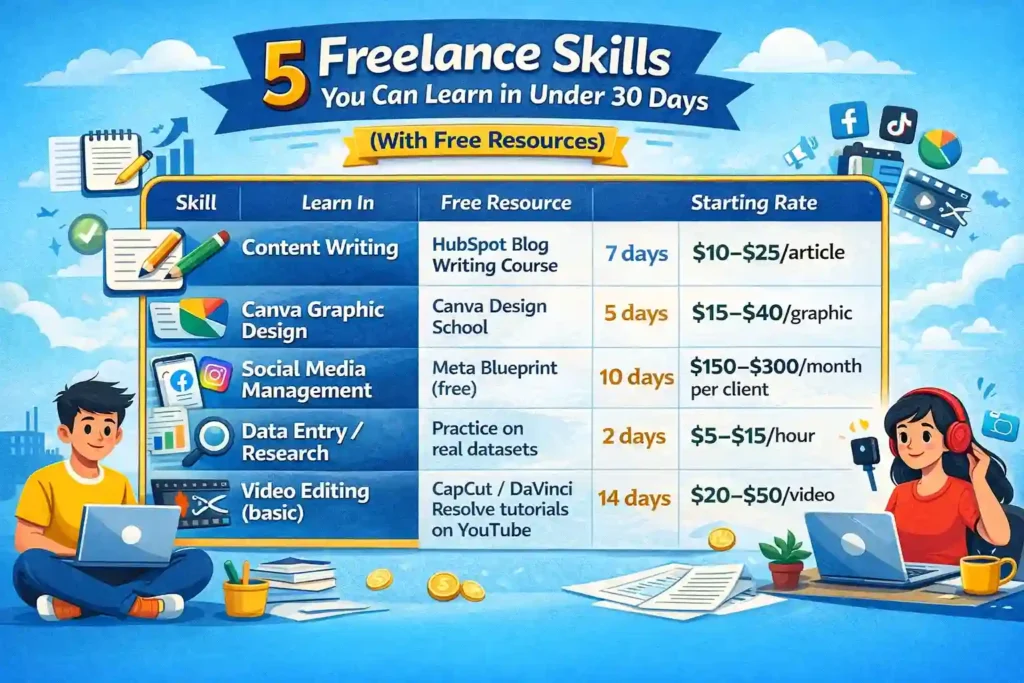
| Skill | Learn In | Free Resource | Starting Rate |
|---|---|---|---|
| Content Writing | 7 days | HubSpot Blog Writing Course | $10–$25/article |
| Canva Graphic Design | 5 days | Canva Design School | $15–$40/graphic |
| Social Media Management | 10 days | Meta Blueprint (free) | $150–$300/month per client |
| Data Entry / Research | 2 days | Practice on real datasets | $5–$15/hour |
| Video Editing (basic) | 14 days | CapCut / DaVinci Resolve tutorials on YouTube | $20–$50/video |
Content writing is the fastest skill to turn into paid work. If you can write clearly in English, you’re closer to job-ready than you think. Upwork’s freelance writing guide for 2026 is clear: you don’t need a writing degree, but you do need clear samples and a focused niche. HubSpot’s free blog writing course gives both foundations in under a week.
Social media management requires no formal training. As noted by experienced freelancers on the platform, if you already know how Facebook, Instagram, LinkedIn, and TikTok work from personal use, you have the core foundation. The skill gap between “personal user” and “professional manager” is smaller than most beginners assume.
Data entry and basic research are the simplest entry points for absolute beginners. These roles pay less than writing or design, but they require almost no ramp-up time and teach you how freelance platforms work in practice. That education is worth more than the hourly rate at this stage.
Canva graphic design has become genuinely learnable in recent days. Canva’s Design School is free, structured, and practical. Clients for simple graphics are everywhere: small business owners, bloggers, and social media managers all need basic visual assets regularly.
Basic video editing using CapCut or DaVinci Resolve takes two weeks of consistent practice to reach a serviceable level. AI-related skills on Upwork grew 109% year over year in 2025, which includes AI-assisted video editing. Learning even basic editing positions you in a high-growth area. Neemesh recommends content writing or social media management for most beginners because the feedback loop is fast. You can see results in days and iterate quickly, which builds confidence alongside skill.
For a full comparison of which of these leads to the high-paying freelance skills as you develop, the detailed breakdown covers rates from $50 to $250 per hour.
The Honest Skill Audit: How to Find What You Already Have
Before learning anything new, you need to know what you already have. The skill audit is a three-question process, and the answers almost always reveal something freelanceable.
Question 1: What do people ask you for help with? If friends, family, or colleagues regularly come to you for writing, tech help, design input, or advice on a specific subject, that’s a signal. The things others seek your help with are rarely things you consider skills, because they feel easy to you.
Question 2: What tasks at school or work come easily to you that others find hard? This is where academic and professional skills hide. Summarising long documents, researching a topic quickly, formatting spreadsheets, or editing someone else’s writing are all common answers that translate directly into freelance services.
Question 3: What have you done in the last six months that someone could have paid for? Think about projects, side tasks, or unpaid help you’ve given. A school project on social media marketing, a graphic you made for a friend’s event, or a report you wrote at work all count as evidence of a freelanceable skill.
This matters because of a pattern Neemesh has observed consistently across 15 years of teaching STEM and computer science subjects: students who struggle to identify their own skills almost always undervalue what they know. The audit works because it externalises the evaluation. Instead of asking “Do I have skills?”, it asks “What have I done?” The answers to those two questions are very different. Research by career development platforms consistently shows that natural abilities and transferable skills from any context can become the foundation of a freelance career. You don’t need to acquire something new. You need to name what you already have.
6-Week Freelancing Roadmap for Beginners With No Experience
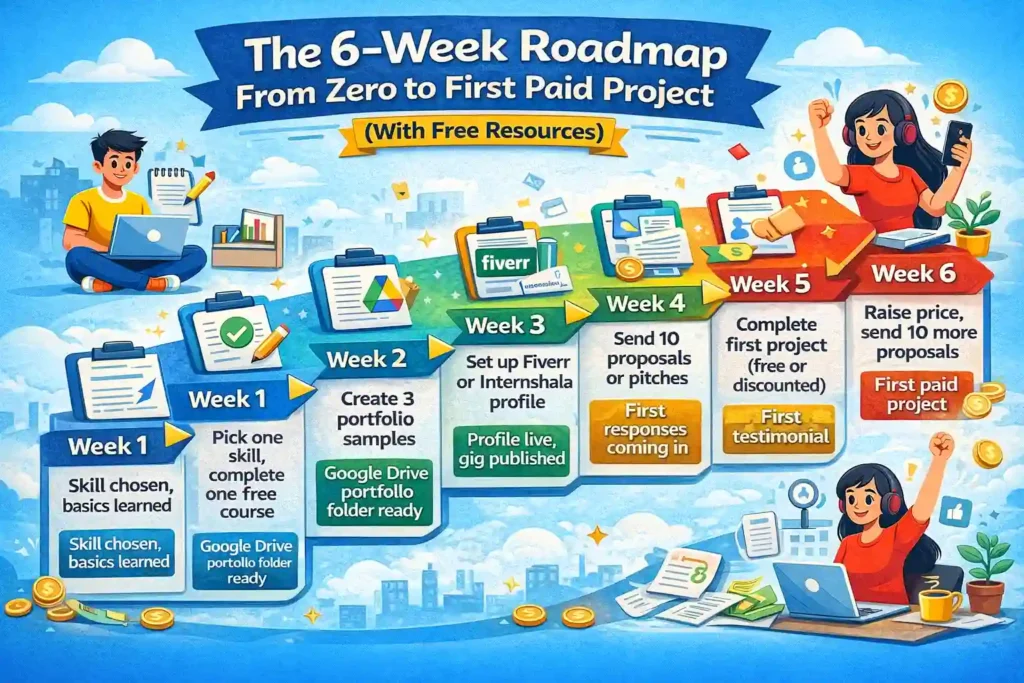
This is the most direct path from no profile and no portfolio to a first paid project. Each week has one priority and one output. Nothing more.
| Week | Focus | Output |
|---|---|---|
| Week 1 | Pick one skill, complete one free course | Skill chosen, basics learned |
| Week 2 | Create 3 portfolio samples | Google Drive portfolio folder ready |
| Week 3 | Set up Fiverr or Internshala profile | Profile live, gig published |
| Week 4 | Send 10 proposals or pitches | First responses coming in |
| Week 5 | Complete first project (free or discounted) | First testimonial earned |
| Week 6 | Raise price, send 10 more proposals | First paid project |
Week 1 is about commitment, not mastery. You’re not finishing a course to become an expert. You’re finishing it to have enough foundation to create samples in Week 2. Choose the skill from the table above that fits what you already know best.
Week 2 is where most beginners stall. Creating portfolio samples from nothing feels impossible, but it’s straightforward in practice. Write three blog posts on topics you know. Design three social media graphics for a fictional brand. Create a sample spreadsheet. These are real demonstrations of real ability. To build a portfolio with no experience, mock projects, and personal work are entirely valid. Clients want to see how you work, not just where you worked.
Week 3 is about choosing the right platform. Fiverr rewards clear, packaged service offerings with a visible price. Internshala and Freelancer.com have “beginner-friendly” filters that explicitly surface clients open to working with newcomers. The best platform for beginners depends on your skill, but for most of the five skills above, Fiverr is the fastest path to a first gig.
Week 4 is about volume, not perfection. Send ten proposals this week. Not two. Ten. Each proposal should be short, specific, and address the client’s actual brief. Learning to write a winning proposal is one skill that pays for itself on every project that follows.
Week 5 is deliberately free or discounted. The goal is not income. The goal is a testimonial and a real portfolio sample from a real client. According to research on how 100 freelancers won their first clients, the hardest part of early freelancing is getting started without social proof. A single testimonial from a real project breaks that cycle. Price this first project 20 to 30 percent below market rate. That discount is an investment in the evidence you need for every client after.
Week 6 is when it becomes a business. You have a testimonial. You have a portfolio sample. Now set your freelance rates at or above market, send ten more proposals, and close your first paid project.
How Beginners Get Their First Freelance Client With No Experience
The most common reason beginners never start is that they wait until they feel confident enough. This is the trap.
Most freelancers land their first client while they’re still learning. The act of working with a real client accelerates skill development faster than any course, because a real brief exposes exactly what you don’t know yet. Waiting to feel “ready” delays both the income and the learning. Upwork’s own guidance to beginners is direct on this point: start with what you can do now, deliver it well, and build from there. You’ll never feel ready before the first client. You’ll feel ready after.
Three strategies work reliably for getting a first client without a track record:
Offer one free project to a local business or personal contact. A local restaurant, a friend’s new business, or a school club all need writing, graphics, or social media help. This gets you a real brief, a real deliverable, and a testimonial from someone willing to vouch for you. Offering services to organisations with limited budgets is one of the most consistent paths to a first real-world case study.
Price your first Fiverr gig 30 to 40 percent below market to earn reviews. The reviews are the asset. A $7 data entry gig with five five-star reviews is worth more for your profile than a $20 gig with none. Early pricing strategy should prioritise reputation over revenue.
Respond to beginner-friendly posts on Internshala and Freelancer.com that mention “no experience required.” These posts are there precisely because the client expects to train someone. They are the lowest-competition entry point on any platform.
What’s the One Mistake That Kills Most No-Skill Freelancers Before They Start?
The answer is straightforward: trying to learn three skills at the same time.
The temptation is real. Content writing looks good, but so does graphic design, and social media management is also interesting. Every week spent deciding is a week not earning. The research on skill development consistently shows that focused learners outperform scattered ones. This is exactly the pattern Neemesh sees in teaching: students who focus on one subject at a time with consistent daily effort outperform students who study three subjects at once and make surface-level progress on all of them. The principle transfers directly to freelancing.
Neemesh recommends a hard rule: pick one skill on day one, commit to it for 60 days, and only evaluate switching after 60 days of consistent effort. The first skill is rarely the final skill. It is the skill that teaches you how freelancing works in practice: how to write proposals, how to communicate with clients, how to price work, and how to ask for a testimonial. All of that knowledge transfers to the next skill you learn. None of it transfers if you never finish picking the first one. For those who want the full picture from the first project to consistent income, the complete freelancing roadmap covers the entire path in detail.
Conclusion
Starting freelancing without a traditional skill set is not the obstacle it appears to be. Three ideas from this guide are worth holding onto.
First, “no skills” almost always means “unrecognised skills.” The three-question audit in this guide has a very high conversion rate from “I have nothing to offer” to “I have something concrete to start with.” Second, if you do need to build from scratch, five skills can take you to job-ready in under 30 days with free resources. Content writing and social media management are the fastest paths to a real feedback loop. Third, the six-week roadmap works because it is specific. Week 5 is free on purpose. The testimonial you earn there is worth more than any course you could take that week.
The only move that doesn’t work is waiting. Freelancing teaches you how freelancing works, and no amount of preparation replaces that. Start the skill audit today, pick one skill, and follow the roadmap. The first client is closer than you think.
What is the one skill you already have that you’ve been dismissing as “not good enough”? Write it in the comments, you might be surprised what others think.
Frequently Asked Questions
Can I really start freelancing with zero skills? You can start freelancing with very little formal training, but you do need something useful to offer. Most people have more than they think in the form of daily skills like writing, basic design sense, or social media familiarity. According to Upwork’s beginner guides, many entry-level freelance jobs require no degree and no prior work experience. The honest answer is: use the skill audit in this guide before deciding you have nothing to offer.
Which freelance skill is easiest to learn for a complete beginner? Data entry and basic research are the easiest to start within days. Social media management and content writing have a slightly longer learning curve but offer a faster path to consistent income. Experienced freelancers consistently identify social media management as one of the most accessible entry points because the baseline knowledge most people already have from personal use is directly applicable.
How long does it take to earn the first $100 from freelancing? For most beginners who follow a structured approach, the first $100 comes within four to six weeks. The six-week roadmap in this guide is built around that timeline. Week 5 is deliberately free or heavily discounted, so the first actual payment typically comes in Week 6. The timeline shortens significantly if you already have a recognisable skill and go straight to building a portfolio and submitting proposals.
Do I need a degree or certification to start freelancing? No. Freelancing is skills-based, not credential-based. Clients pay for results, not qualifications. That said, free certifications from platforms like HubSpot and Meta Blueprint do add credibility to a new profile when you have no client reviews yet. They signal to potential clients that you’ve completed structured training, which reduces the perceived risk of hiring a newcomer.
Should I work for free to build experience? One or two free or heavily discounted projects, done deliberately to earn a testimonial and a portfolio sample, is a sound strategy. Research on first-client acquisition shows that offering services to organisations with limited budgets is one of the most consistent paths to a first case study. The key distinction is intentionality: working for free as an investment in evidence is different from working for free indefinitely out of a lack of confidence in your own rates.