Most employed professionals who want to start freelancing while working full time are not stopped by a lack of skills or time. Three specific fears stop them: getting fired if their employer finds out, not understanding how a second income affects their taxes, and not knowing whether they are financially ready to eventually go full-time.
- What Is Freelancing While Working Full Time?
- The Six-Step Framework at a Glance
- Step 1: Read Your Employment Contract Before You Do Anything Else
- Step 2: Choose Freelance Work That Creates Zero Contract Risk
- How Does Freelancing Affect Your Taxes When You Have a Full-Time Job?
- Step 3: How to Find Time Without Burning Out
- How Much Should You Earn Before Quitting Your Full Time Job?
- The Fastest Way to Get Your First Freelance Clients While Employed
- Frequently Asked Questions
- Conclusion
None of those fears is unfounded. Each one represents a real decision with real consequences. According to the 2024 State of Independence research, 37% of Americans with a traditional full-time job also maintain a side gig — meaning part-time freelancing alongside employment is not a fringe calculation but a mainstream income strategy that most people navigate without a clear framework. The difference between professionals who successfully build freelance side income and those who stay stuck at the intention stage is not motivation, it is a structured approach to navigating each decision in the right order.
This guide covers that sequence: what to check in your employment contract before taking a single client, how to set up your tax position correctly from the first payment, how to manage time without letting freelance work erode your primary job performance, and how to identify the financial threshold that makes going full-time a rational decision rather than a leap of faith. If you are still at the earlier stage of understanding the mechanics of independent work, how to start freelancing in 2026 covers the foundational layer before this guide picks up.
What Is Freelancing While Working Full Time?
Freelancing while working full-time means earning income from independent clients outside a primary salaried job. Most professionals complete freelance work during evenings or weekends, building a freelance side income stream while maintaining the stability of regular employment. The arrangement is sometimes called part-time freelancing, a freelance side hustle, or freelancing after office hours, depending on how much time is dedicated and how formally the work is structured.
The core distinction from traditional employment: freelance clients pay per project or per hour, with no taxes withheld. The freelancer operates as a self-employed contractor, invoices clients directly, and manages their own tax obligations alongside the W2 income from the primary job.
The Six-Step Framework at a Glance
Before going deep on each component, this table maps the full sequence. Every section below connects to one of these steps.
| Step | What It Addresses | When to Do It |
|---|---|---|
| Read your employment contract | Legal risk | Before anything else |
| Choose a conflict-free niche | Contract protection | Week 1 |
| Set up tax structure | Financial compliance | Before first payment |
| Block freelance hours | Burnout prevention | Before first client |
| Build a portfolio and get clients | Income generation | Weeks 2–4 |
| Track income vs. salary | Exit planning | Month 3 onward |
Step 1: Read Your Employment Contract Before You Do Anything Else
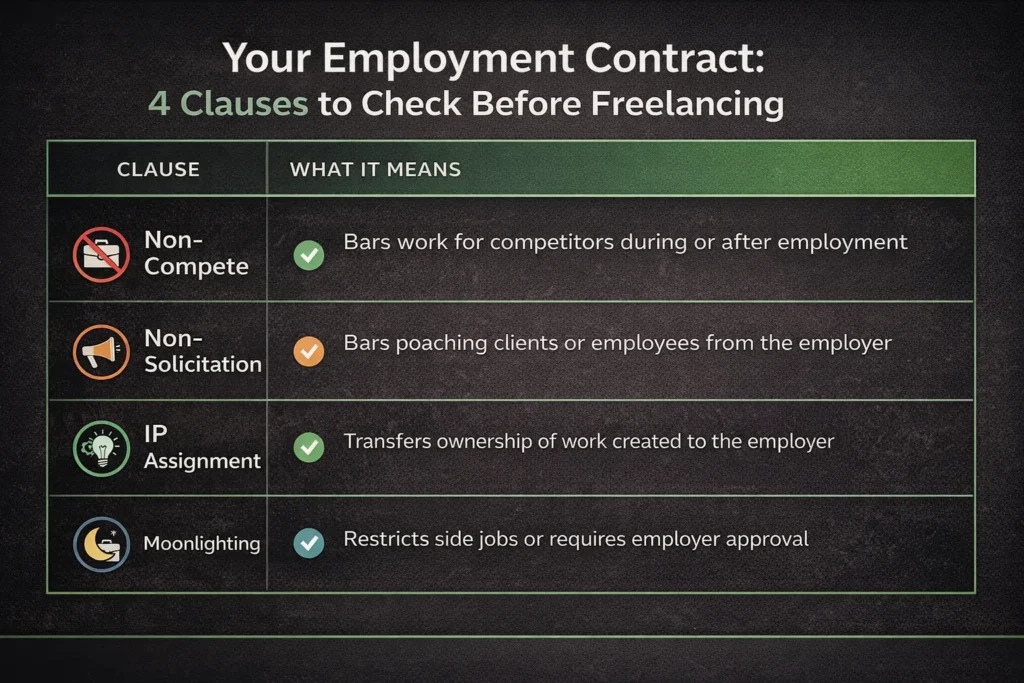
The single most overlooked step when starting part-time freelancing alongside a job is reading the employment agreement that governs the current role. Most people sign these documents during onboarding and never look at them again. Four specific clauses determine whether freelancing creates legal risk, and only one of them is the one most people know about.
The Four Clauses That Determine What You Can and Cannot Do
- Non-compete clauses restrict working for competitors within a defined geography and timeframe. Most non-competes are unenforceable in their broadest form, US courts require geographic and time limits to be reasonable, but they create legal uncertainty that is worth avoiding rather than testing.
- Non-solicitation clauses prohibit approaching the employer’s clients or employees after leaving. These are often more enforceable than non-competes. Selling services to a client already on your employer’s customer list, even independently and after hours, can trigger this clause.
- Intellectual property assignment clauses are the most commonly overlooked. Many agreements state that any work created during the employment period, including work done on personal time using personal equipment, belongs to the employer if it relates to the employer’s business. A software engineer who builds a freelance app in the same technical domain as their employer’s product may be assigning those IP rights without realizing it.
- Moonlighting or outside employment clauses directly address whether the employer permits any outside work at all. Some contracts require written approval before taking on any secondary income-generating activity. Others prohibit work that creates a conflict of interest without defining what that means.
How to Identify a Genuine Conflict of Interest vs. an Overly Broad Clause
A genuine conflict of interest exists when freelance work competes directly with the employer’s business, uses proprietary information developed at the employer, or requires time and attention during contracted working hours. These are legitimate restrictions. An overly broad clause attempts to prohibit any outside work regardless of relevance, a marketing manager barred from doing freelance photography for wedding clients, for instance, creates no realistic conflict with their employer’s interests.
The operative test is whether the freelance work affects the employer’s competitive position, uses their resources, or consumes the capacity they are paying for. If the answer to all three is no, the clause is likely unenforceable even if its language is broad.
What to Do If Your Contract Has a Restrictive Clause
The most direct resolution is to ask. Requesting written clarification from HR about what outside work the employer permits costs nothing, creates a paper trail of good faith, and often produces more permissive guidance than the contract language alone suggests. Employers rarely object to a marketing professional doing freelance content work for clients in unrelated industries. They do object to discovering the arrangement after the fact.
If the contract restriction is genuine and narrow, working directly for competitors, the solution is niche selection, covered in the next section. A standard freelance contract for the client side of the arrangement is a separate document entirely, and having one in place before the first project protects both parties regardless of what the employment agreement says.
Do You Need to Tell Your Employer You Are Freelancing?
The legal obligation depends entirely on the contract. If the moonlighting clause requires written approval, disclosure is mandatory before the first project. If the contract is silent on outside work, disclosure is a strategic choice rather than a legal requirement.
The practical case for voluntary disclosure: framing freelance work around skill development, showing how side projects build capabilities that benefit the primary role, converts a potential objection into a shared interest. Employers who learn about an arrangement independently tend to view the situation as concealment regardless of whether any contractual term was violated. A disclosure conversation framed around professional development and clear schedule separation typically receives approval.
The practical case for privacy: if the contract is silent, the freelance work is in an unrelated industry, and primary job performance is unaffected, many employed freelancers operate without disclosure indefinitely. The deciding factor is a realistic assessment of how the specific manager would respond to learning about the arrangement, before or after the fact.
Step 2: Choose Freelance Work That Creates Zero Contract Risk
The cleanest structural protection against contract risk is selecting freelance work in a different industry than the employer’s, using skills that exist in the current job but are not proprietary to it.
The Safe Niche Rule: Adjacent Skills, Different Industries
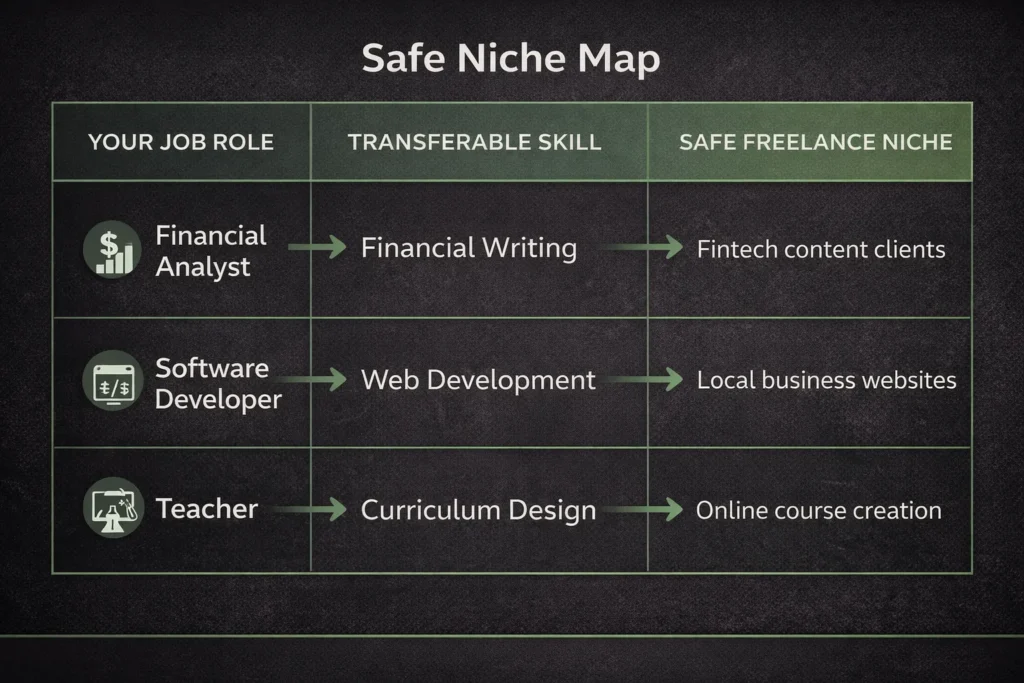
Many professionals start a freelance side hustle by applying existing skills in a completely different industry, keeping the expertise but removing the competitive overlap. A few examples:
- A financial analyst at a healthcare company → freelance financial content writer for fintech brands
- A software developer at a retail company → website builder for local restaurants and small businesses
- A teacher running a STEM program → private tutor or digital study material creator for general audiences
In each case, the core skill transfers, but the client base creates no competitive conflict with the employer.
This approach resolves IP assignment concerns simultaneously. Work produced for clients in unrelated industries, using general professional skills rather than employer-specific knowledge, sits outside the scope of most IP assignment clauses. Identifying which of your skills commands the highest market rate before committing to a niche prevents the common mistake of building a side practice in a skill category that underprices the time it consumes.
Should You Set Up an LLC Before Taking Your First Client?
No legal registration is required to begin accepting freelance payments, but forming a single-member LLC before the first client engagement creates a meaningful layer of structural protection. An LLC places a legal firewall between freelance liability and personal assets. It also makes the separation of work argument cleaner: freelance invoices come from a distinct business entity rather than from the individual employee, which reduces the surface area for employer conflict-of-interest claims if the arrangement ever faces scrutiny.
For most US states, LLC formation costs between $50 and $150 in state filing fees and takes under two weeks. Opening a dedicated business bank account immediately after establishment keeps freelance income completely separated from the primary salary from day one, which also simplifies the tax filing position covered in the next section.
Platforms That Work Best for Employed Freelancers
The platform choice for someone building a side hustle freelancing income carries different considerations than for someone going full-time. Fiverr packages work at fixed prices and do not require ongoing availability negotiation with clients. This suits employed freelancers who need a predictable scope and cannot commit to open-ended hourly arrangements. Upwork involves project contracts with more client communication overhead, which works better once a weekly routine is established. A full comparison of which platform suits which profile covers the tradeoffs in detail rather than defaulting to the most popular option.
What Separation of Work Means in Practice
Separation of work means keeping every freelance activity on personal infrastructure, not employer-provided tools. In practice:
- Use personal devices, email, and accounts for all freelance communication
- Never store freelance files on work computers, cloud accounts, or company drives
- Take no freelance calls during contracted working hours
- Invoice and receive payments into a personal or business account separate from employer payroll
The cleaner this separation, the easier it is to demonstrate that freelance work did not use employer resources, which matters significantly if the arrangement ever faces scrutiny.
How Does Freelancing Affect Your Taxes When You Have a Full-Time Job?
Freelancing while working full time means filing two income streams on a single tax return: W2 income with employer withholding already applied, and 1099 freelance income with no withholding and a 15.3% self-employment tax applied on top. The practical impact on take-home pay depends on freelance income volume, but the structural filing requirement is the same for every employed freelancer, regardless of how much they earn.
The W2 + 1099 Reality: What You Will Actually Owe
A full-time employee receives a W2 form showing income that has already had federal and state taxes withheld by the employer. Freelance income arrives as 1099 forms with no withholding, the full amount lands in the bank, and the tax liability accumulates separately. Filing combines both income streams on Form 1040, with freelance income reported on Schedule C (profit or loss from business) and Schedule SE (self-employment tax).
The critical number: self-employment tax is 15.3% on net freelance earnings, covering Social Security and Medicare. As a W2 employee, this is split with the employer, each pays 7.65%. As a freelancer, both halves are the individual’s responsibility. The table below shows what this looks like at common freelance side hustle income levels:
| Annual Freelance Income | SE Tax (15.3%) | Approximate Monthly Tax Owed |
|---|---|---|
| $5,000 | $765 | $64 |
| $10,000 | $1,530 | $128 |
| $20,000 | $3,060 | $255 |
| $50,000 | $7,650 | $638 |
These figures cover self-employment tax only, federal and state income tax on the same earnings is additional. The full breakdown of freelance taxes including US and India filing structures covers the complete liability picture, including the deductions that reduce the net amount owed.
For freelancers based in India working alongside a salaried position: salaried income is reported under “Income from Salary” and freelance income under “Profits and Gains from Business or Profession,” both combined in the ITR-3 filing. The 44ADA presumptive taxation scheme allows freelancers in specified professions earning under ₹75 lakh annually to declare 50% of gross receipts as taxable income without detailed expense tracking, a significant administrative simplification for freelancing after office hours at moderate income levels.
Quarterly Estimated Payments
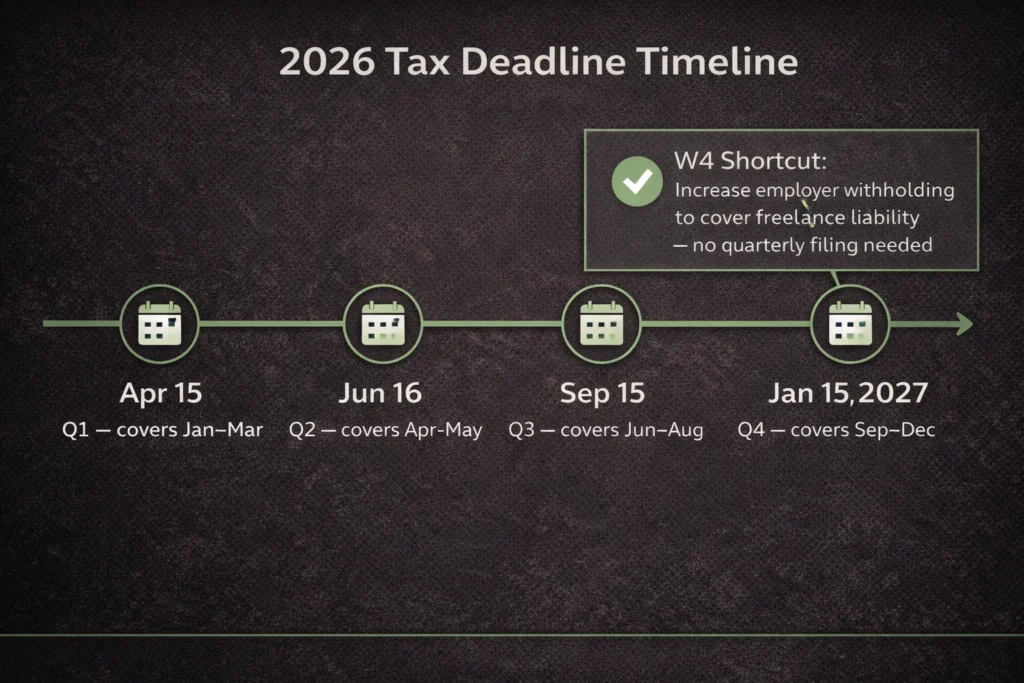
The IRS requires freelancers to pay estimated taxes quarterly rather than annually when the expected tax liability exceeds $1,000 for the year. Missing these triggers underpayment penalties even if the full amount is paid at year-end filing. The four 2026 deadlines are:
- April 15 — covers January through March earnings
- June 16 — covers April and May earnings
- September 15 — covers June through August earnings
- January 15, 2027 — covers September through December earnings
The shortcut that most W2 earners overlook: adjusting W4 withholding at the primary job to cover the freelance tax liability. By increasing withholding on the W4, the additional tax due on freelance income is covered through the existing payroll process, eliminating the need to track and remit quarterly payments separately. This works cleanly when freelance income is predictable. For variable income, the quarterly system remains the more precise approach.
The safe harbor rule removes guesswork entirely: paying 100% of the prior year’s total tax liability, or 90% of the current year’s actual liability, through withholding or quarterly payments avoids underpayment penalties regardless of what the final bill turns out to be.
Step 3: How to Find Time Without Burning Out
The time management challenge for freelancing after office hours is not finding hours, it is protecting primary job performance while building a parallel income stream. The professional reputation built at the full-time job is the financial floor. Nothing in the freelance practice should put that floor at risk.
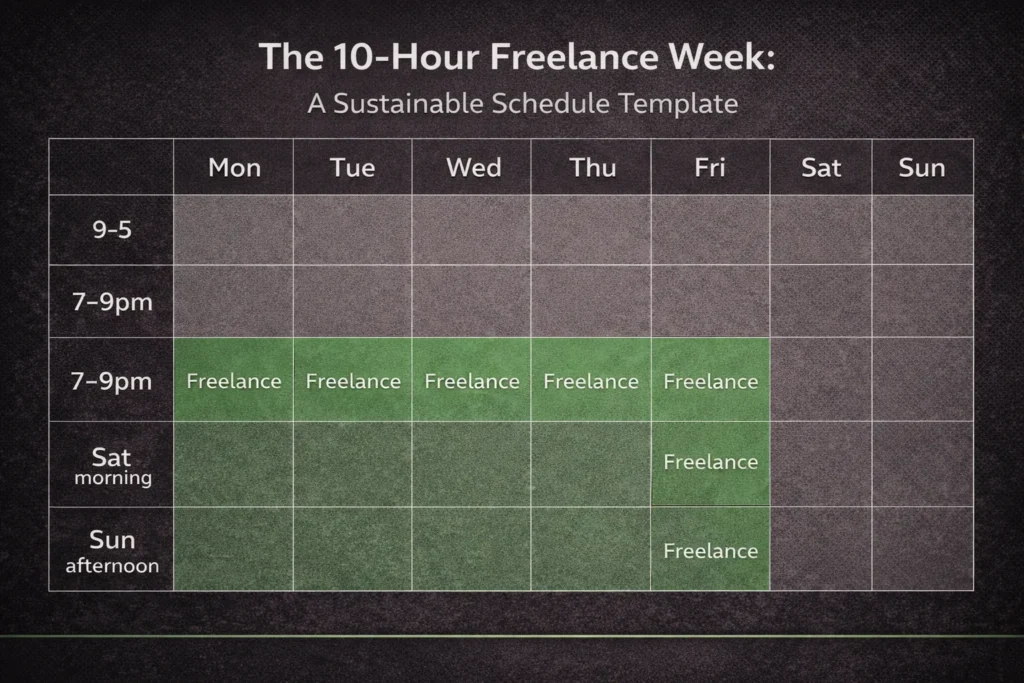
The 10-Hour Week Model
Ten to fifteen hours per week is the realistic working capacity for most employed professionals with standard schedules and personal commitments. This translates to roughly one hour on weekday evenings and five hours across the weekend. At that pace, a freelancer charging rates aligned with their skill level and market can generate $800 to $2,500 per month, depending on niche and delivery model, consistent with the IRS data showing US freelancers earn an average of $47.71 per hour across skill categories.
Building systems that reduce non-billable time matters more here than in any other freelance context. A reusable proposal template eliminates the hours most freelancers spend writing pitches from scratch for every opportunity. A standard contract eliminates the negotiation overhead that turns a 30-minute project discussion into a three-day back-and-forth. Every hour saved on administration is an hour available for billable work or recovery.
When to Work and How to Protect Primary Job Performance
The most sustainable pattern is to treat freelance hours as fixed rather than flexible. Scheduled blocks, specific evenings, and specific weekend windows prevent freelance work from expanding to fill available time. The risk of an unscheduled approach is that a demanding client or an overrunning project pulls time from recovery hours, and degraded performance at the primary job creates the exact outcome the entire arrangement was designed to avoid.
Saying no to projects that fall outside scheduled capacity is a higher-leverage skill in this context than client acquisition itself. Undercommitting and delivering consistently builds a client reputation faster than overcommitting and occasionally delivering late.
How Much Should You Earn Before Quitting Your Full Time Job?
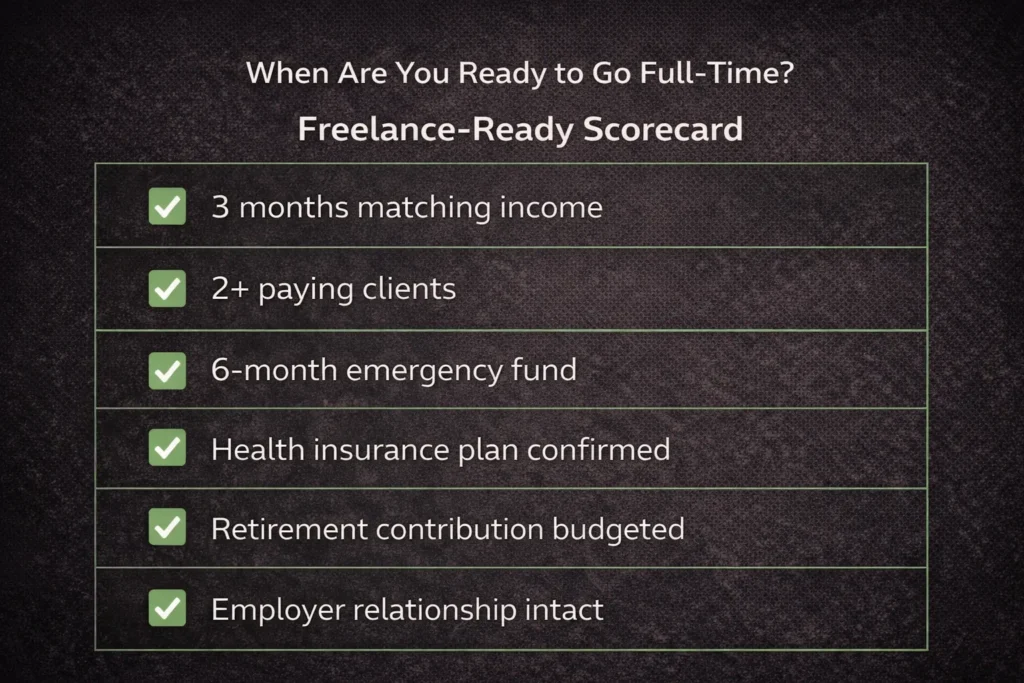
The standard threshold is three consecutive months of freelance income matching or exceeding take-home salary, not total compensation. Most employed professionals who leave full-time work prematurely do so because they hit the income number once without confirming it is repeatable, and the unpredictability that follows is the most common reason for a return to employment.
The Three-Month Income Replacement Rule
Three consecutive months filter out single-month revenue spikes and confirm that client demand is repeatable rather than accidental. A strong month followed by a dry month signals client dependency on a single project or source, not a sustainable income base. Three months of consistent replacement income also provides the psychological baseline to make the transition without constant financial anxiety. Most freelancers who leave prematurely report that the income level was not the problem, the volatility was.
The Non-Income Factors That Matter as Much as the Number
Health insurance, retirement contributions, and paid leave do not appear in take-home pay calculations but represent 20 to 35% of total employment compensation for most US professionals. The income replacement target should include the cost of replicating these independently: individual health insurance premiums, a SEP-IRA or solo 401k contribution budget, and a cash reserve equivalent to the paid leave no longer accruing.
| Factor | Minimum Threshold Before Quitting |
|---|---|
| Monthly freelance income | 3 consecutive months ≥ take-home salary |
| Client base | At least 2 paying clients (reduces single-source dependency) |
| Emergency fund | 6 months of living expenses in liquid savings |
| Health insurance | Replacement plan identified and monthly cost confirmed |
| Retirement | SEP-IRA or solo 401k contribution budget modelled |
| Professional relationship | Full notice given, employer relationship intact |
How to Time the Exit
The cleanest exit involves completing the full-time vs. freelance financial comparison before resigning, giving standard notice regardless of how ready the departure feels, and leaving with the professional relationship intact. Former employers are often the first source of freelance contracts, particularly in consulting and technical fields where domain knowledge is the primary asset. An exit that preserves that relationship preserves a potential client relationship simultaneously.
The Fastest Way to Get Your First Freelance Clients While Employed
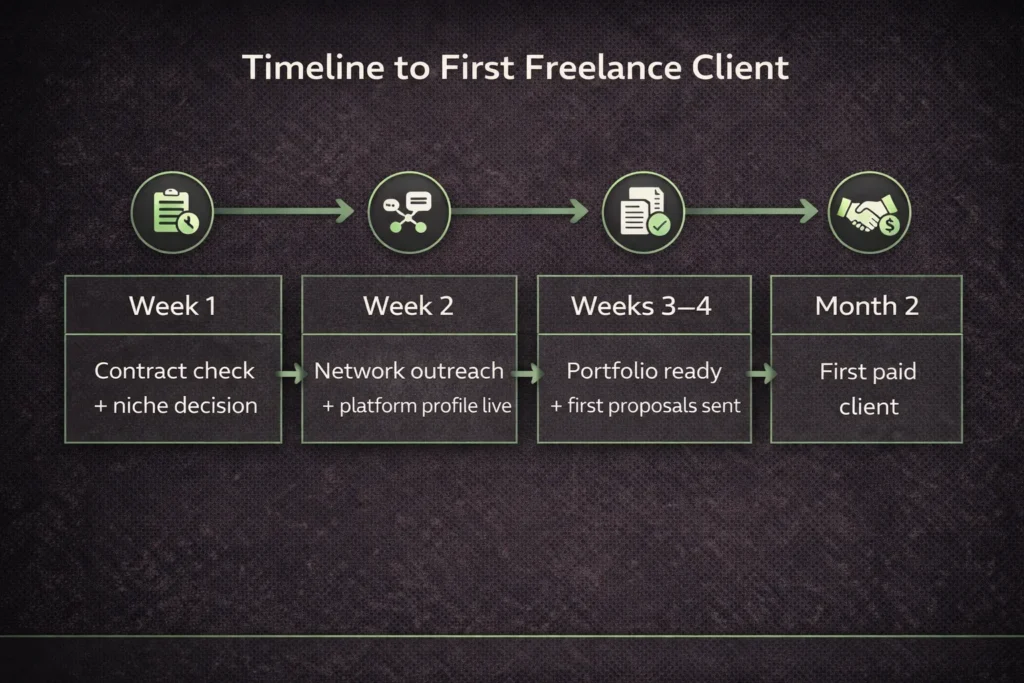
The first client is the hardest acquisition in any side hustle freelancing practice. For employed professionals, an existing professional network shortens this timeline considerably, and the warm audience that network represents costs nothing to reach.
Starting With Your Existing Network Before Any Platform
Colleagues, former employers, vendors, and professional contacts represent a warm audience that already understands the skill set. To make the most of this network:
- Send a direct message describing the services now available, the type of client being targeted, and the problem being solved. Keep it specific, skip the hard pitch
- Contact former managers who respected the work, they are often willing to hire directly or make a referral
- Reach out to vendors and contractors from the current role who work in adjacent industries
- Post a brief professional update on LinkedIn describing the new availability
This approach requires no platform profile, no portfolio, and no formal proposal, only clarity about what is being offered and to whom.
Building a Portfolio Before the First Client Asks for One
The most common objection from first-time clients is the absence of a portfolio. Building a freelance portfolio without existing clients is a solved problem, spec work, pro bono projects for local organizations, and personal projects that demonstrate the skill in a real-world context all serve as portfolio evidence before paid client work exists. For employed professionals, work completed at the full-time job (with employer permission to use non-confidential examples) often constitutes the strongest available portfolio evidence without requiring any additional effort.
Frequently Asked Questions
Can my employer fire me for freelancing on the side?
Only if the freelance work violates a specific clause in the employment contract, a non-compete, non-solicitation, IP assignment, or moonlighting provision. Employers cannot terminate employment solely because an employee earns additional freelance side income from unrelated work performed in personal time, unless a contractual provision expressly prohibits it. The contract review in Step 1 identifies whether any such provision exists before any freelance work begins.
Do I need to register a business to freelance while employed?
No legal registration is required to begin accepting freelance payments. However, forming a single-member LLC before the first client engagement creates liability separation, simplifies tax filing, and makes the separation of work argument cleaner, freelance invoices come from a business entity rather than from the individual employee.
How do I avoid a large tax bill from freelance income?
Freelance income is taxed once, not twice, but at a higher effective rate than W2 income because the full 15.3% self-employment tax applies. The two main offsets are legitimate business expense deductions through Schedule C, which reduce taxable net income, and the W4 withholding adjustment at the primary job, which spreads the freelance tax liability across every paycheck rather than creating a single large bill at filing.
How many hours per week is realistic for freelancing after office hours?
Ten to fifteen hours per week is the sustainable baseline for most employed professionals. Structured as scheduled blocks, weekday evenings and weekend windows, this pace is sufficient to generate $800 to $2,500 per month at competitive rates in most skill categories, without creating the schedule pressure that degrades primary job performance.
Is it better to tell my employer I’m freelancing?
If the employment contract includes a moonlighting or outside employment clause requiring approval, disclosure is a legal obligation before the first project. If the contract is silent, disclosure is a strategic decision based on the expected response. The strongest framing for a voluntary disclosure conversation is skill development: side projects that build capabilities relevant to the primary role convert a potential objection into shared professional interest.
Conclusion
Starting a freelance practice while employed is a sequenced process, not a leap. The sequence is contract review first, niche selection second, tax structure third, time blocking fourth, client acquisition fifth, and exit threshold planning last. Skipping any step creates the specific problems, legal exposure, surprise tax bills, burnout, and income instability that cause most employed professionals to abandon the attempt before it produces meaningful income.
The professionals who build stable freelancing while working full time treat the two activities as parallel systems rather than competing obligations. The full-time job provides stability during the building phase. The freelance side income practice builds the client base and revenue that eventually fund independence. Running both simultaneously, with a clear framework for each component, is exactly how that transition happens without the financial risk most people assume is unavoidable.