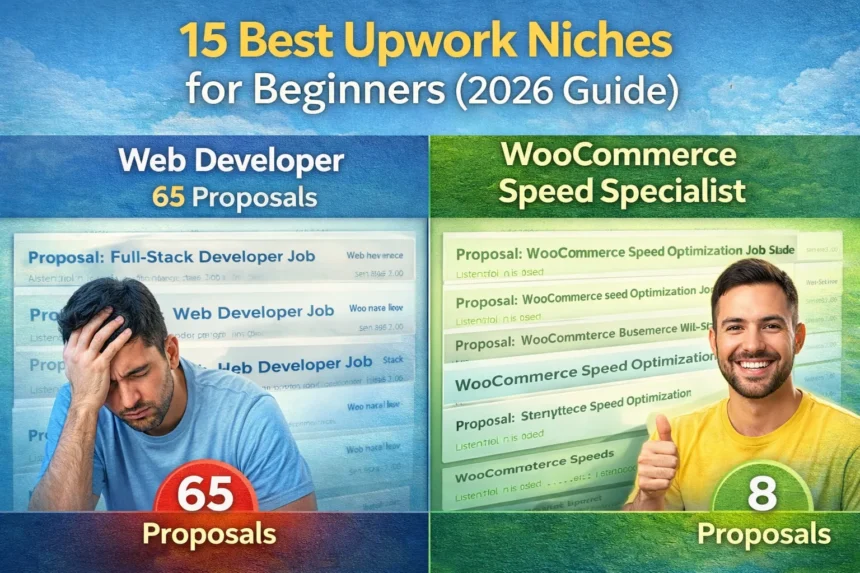
Most beginners fail on Upwork, not because of competition, but because they choose broad categories. The difference between “Web Developer” and “Shopify Speed Optimization for DTC Brands” determines whether proposals generate interviews or disappear into client inboxes unread. Upwork operates as a proposal-driven marketplace, fundamentally different from search-algorithm platforms like Fiverr. This structural difference means positioning affects proposal win rate more than raw skill level.
This guide breaks down 15 validated Upwork niches for beginners, the competition logic behind each, pricing ranges, and why specific niches work on Upwork’s platform architecture. Understanding these distinctions enables beginners to secure their first client within 2–4 weeks rather than submitting hundreds of ignored proposals.
📌 Key Takeaways
- Platform Logic: Upwork operates on proposal competition, not search algorithms like Fiverr
- The Formula: Skill + Business Outcome + Client Type = winning niche positioning
- Sweet Spot: Target jobs with 5–15 proposals, not 50+ proposals per posting
- Pricing Range: $50–$1,000+ per project, depending on niche specialization
- Timeline: 2–4 weeks to first client with proper positioning and proposal strategy
- Validation Time: 10 minutes to assess niche viability using Upwork’s search filters
What Makes a Good Upwork Niche for Beginners?
The Upwork Advantage vs Fiverr (Why Niche Logic Is Different)
Upwork and Fiverr operate on fundamentally different models. Fiverr functions as a search algorithm where buyers discover sellers through keyword searches and gig rankings. Upwork functions as a proposal system where buyers post job requirements, and sellers compete through written applications. This matters because platform-specific positioning strategies determine visibility differently across marketplaces.
On Upwork, buyers post jobs with specific requirements. Freelancers browse these postings and submit proposals. The client reviews proposals, conducts interviews, and selects a freelancer. This means niche selection on Upwork follows a different logic: lower proposal competition combined with clearer outcome specifications equals higher win rates. Visibility depends on proposal relevance and application timing, not search engine optimization.
Platform Comparison:
| Feature | Upwork | Fiverr |
|---|---|---|
| Discovery Method | Client posts job, freelancers apply | Buyers search, algorithm ranks gigs |
| Competition Metric | Proposals per job posting | Search ranking position |
| Pricing Control | Freelancer sets per-project rates | Seller creates tiered packages |
| Niche Strategy | Reduce proposal density | Optimize for search keywords |
| Win Factor | Proposal quality + timing | Gig SEO + reviews |
The 3-Part Upwork Niche Formula (Skill + Business Outcome + Client Type)
The most successful Upwork niches follow a three-part formula: specific skill plus measurable business outcome plus defined client type. This formula creates positioning clarity that generic job titles lack.
Generic positioning fails because it triggers higher proposal density. “Graphic Designer” attracts 50+ proposals per posting. “YouTube Thumbnail Designer for Finance Channels” attracts 8–15 proposals because the specificity filters out generalists. The formula works by combining technical capability with business context and target market.
The Niche Formula in Action:
❌ Generic Positioning          ✅ Niche Positioning
━━━━━━━━━━━━━━━━━━━━━━━━━━━━━━━━━━━━━━━━━━━━━━━━━━━━━━━━
WordPress Developer      →      WooCommerce Speed Optimization Specialist
Content Writer          →      SEO Blog Writer for SaaS Companies
Video Editor            →      Short-Form Video Editor for Coaches
Virtual Assistant       →      LinkedIn Ghostwriter for Founders
Graphic Designer        →      YouTube Thumbnail Designer for Finance Channels
The specificity signals expertise in a domain rather than general capability in a tool. Clients seeking specialized outcomes pay premium rates and face less competition among qualified applicants.
What Is the Proposal Competition Sweet Spot on Upwork?
Ideal Upwork niches for beginners exhibit specific proposal density patterns. Proposal density patterns reveal that average job postings receive 20–50 proposals, while highly competitive postings receive 50–100+ proposals. The sweet spot exists where jobs post weekly, proposal counts remain between 5–15, clients show verified payment history, and scope appears clearly defined rather than vague.
On Upwork, success metrics differ from traditional freelancing platforms. Rather than counting total available gigs, beginners should count proposal density per posting. A niche with 20 jobs posted weekly, averaging 8 proposals each, outperforms a niche with 200 jobs posted weekly, averaging 60 proposals each. The first scenario provides 20 opportunities with 12.5% theoretical visibility; the second provides 200 opportunities with 1.7% theoretical visibility.
Competition Sweet Spot Indicators:
✅ Good Niche Signals:
- 10–30 jobs posted per week
- 5–15 average proposals per posting
- 60%+ jobs from verified payment clients
- Clear scope definitions
- Specific deliverable requirements
- Budget transparency ($100+ minimum)
❌ Avoid These Signals:
- 100+ jobs posted per week
- 50+ average proposals per posting
- Many unverified client accounts
- Vague job descriptions
- “Budget TBD” or very low budgets
- Excessive skill requirements for low pay
Client verification status signals genuine hiring intent. Jobs posted by clients with verified payment methods and a history of hire convert at higher rates than jobs posted by unverified accounts. Beginners should filter search results by “Payment Verified” to focus applications on serious buyers.
15 Best Upwork Niches for Beginners in 2026
Niche Comparison Overview:
| Niche | Competition Level | Pricing Range | Skill Barrier | Recurring Potential |
|---|---|---|---|---|
| WooCommerce Speed Optimization | Medium | $100–$400 | Medium | High |
| Short-Form Video Editor (Coaches) | Low-Medium | $20–$60/reel | Low | Very High |
| SEO Blog Writer (SaaS) | Medium | $50–$150/article | Low-Medium | Very High |
| LinkedIn Ghostwriter | Low | $100–$300/batch | Low | Very High |
| Shopify Product Descriptions | Low-Medium | $15–$50/product | Low | High |
| Email Copywriter (Launches) | Medium | $500–$2,000 | Medium | Medium |
| Webflow Landing Pages | Medium | $200–$800 | Medium | High |
| AI Automation (Zapier/Make) | Low | $200–$800 | Medium | High |
| Podcast Show Notes | Low | $30–$80/episode | Low | High |
| Notion Workspace Setup | Low | $100–$400 | Low | Medium |
| Google Ads Setup (Local) | Medium | $300–$1,500 | Medium-High | High |
| Resume Writer (Tech) | Low-Medium | $75–$250 | Low | Medium |
| CRM Setup (HubSpot/Zoho) | Medium | $400–$1,200 | Medium | Medium |
| Pinterest Manager (Bloggers) | Low | $200–$600/month | Low | Very High |
| Amazon Listing Optimization | Medium | $50–$200/listing | Low-Medium | High |
WooCommerce Speed Optimization Specialist
WooCommerce speed optimization represents a high-demand technical niche with clear deliverables. E-commerce store owners understand that site speed directly impacts conversion rates and search rankings. This creates demand for specialists who can diagnose performance bottlenecks, optimize database queries, implement caching strategies, and reduce page load times.
The niche works on Upwork because outcomes are measurable. Clients can verify results through tools like Google PageSpeed Insights and GTmetrix. Projects typically range from $100–$400 and require 5–15 hours of work. The technical specificity reduces competition for proposals while maintaining consistent demand from WooCommerce site owners.
Example Job Title Clients Post:
“Need WooCommerce expert to reduce page load time from 6s to under 2s.”
Example Positioning Headline:
“WooCommerce Speed Optimization | 50+ Stores Optimized | Average 4.2s Load Reduction”
Short-Form Video Editor for Coaches
Online coaches and course creators generate constant demand for short-form video content. Instagram Reels, YouTube Shorts, and TikTok videos require fast turnaround editing with platform-specific formatting. Coaches recognize video content as essential for audience growth, but lack the time or expertise to edit content themselves.
This niche succeeds because it offers recurring work. A coach producing daily content requires ongoing editing support, converting single projects into long-term retainers. Pricing typically ranges from $20–$60 per reel, depending on complexity. The quick turnaround nature means beginners can build portfolios rapidly while establishing client relationships.
Example Job Title Clients Post:
“Looking for an editor to create 15 Instagram Reels per week from raw coaching footage.”
Example Positioning Headline:
“Short-Form Video Editor for Coaches | 500+ Reels Created | Fast 24-48hr Turnaround”
SEO Blog Writer for SaaS Companies
SaaS companies maintain consistent content marketing budgets to drive organic traffic and product awareness. Businesses actively seeking AI automation support and software solutions search for writers who understand technical topics, search intent, and conversion-focused content.
The positioning works because SaaS founders actively hire content specialists on Upwork rather than agencies. This creates direct client relationships and clearer communication. Pricing ranges from $50–$150 per article, depending on research depth and word count. The niche allows beginners to develop expertise in high-value industries while building authority through published portfolio pieces.
Example Job Title Clients Post:
“Need SEO blog writer who understands SaaS products for 8 articles/month on project management.”
Example Positioning Headline:
“SEO Blog Writer for SaaS | 200+ Tech Articles Published | ROI-Focused Content Strategy”
LinkedIn Ghostwriter for Founders
B2B founders recognize LinkedIn as critical for personal branding and business development. However, consistent content creation requires time and strategic thinking that busy executives lack. This creates demand for ghostwriters who can capture founder voice, understand industry dynamics, and produce engagement-optimized posts.
The niche functions well on Upwork because clients seek ongoing relationships rather than one-off projects. A founder posting three times weekly needs consistent content support, creating predictable monthly revenue. Pricing typically ranges from $100–$300 per batch of posts. The personal nature of ghostwriting means clients value trust and consistency, leading to long-term contracts.
Example Job Title Clients Post:
“Seeking LinkedIn ghostwriter for fintech CEO – 12 posts per month on industry trends.”
Example Positioning Headline:
“LinkedIn Ghostwriter for B2B Founders | 50+ Executives Served | Thought Leadership Content”
Shopify Product Description Writer
E-commerce stores launching new products or scaling catalogs require professional product descriptions that convert browsers into buyers. Shopify store owners understand that product copy directly affects conversion rates and search visibility. This creates demand for writers who understand e-commerce psychology, keyword integration, and benefit-focused copywriting.
The recurring nature drives niche viability. Stores adding inventory monthly need ongoing description writing. Projects typically pay $15–$50 per product description, depending on complexity and research requirements. The clear deliverable format allows beginners to develop templates and workflows that increase efficiency over time.
Example Job Title Clients Post:
“Need product description writer for 50 skincare products – SEO optimized, conversion-focused.”
Example Positioning Headline:
“Shopify Product Description Writer | 1,000+ Products Written | Average 3.2% Conversion Lift”
Email Copywriter for Course Launches
Course creators and digital product sellers rely on email sequences to convert leads into customers. Launch sequences, nurture campaigns, and promotional emails require persuasive copywriting that understands customer psychology and conversion frameworks. This creates demand for email specialists who can write sequences that generate measurable revenue.
The high-value outcome justifies premium pricing. Email sequences that generate five or six figures in course sales command $500–$2,000 per project. Beginners can start with smaller creators and build case studies demonstrating conversion rates. The measurable results create strong portfolio pieces and referral opportunities.
Example Job Title Clients Post:
“Need email sequence for $1,997 course launch – 7 emails converting cold leads to buyers”
Example Positioning Headline:
“Email Copywriter for Course Launches | $2.3M in Client Revenue Generated | Launch Specialist.”
Webflow Landing Page Builder
Webflow enables designers to build custom websites without writing code, creating demand for specialists who can transform design concepts into functional landing pages. Startups and agencies hiring Webflow specialists value clean code output, responsive design, and fast turnaround over full-stack development capabilities.
The specific tool positioning reduces competition compared to generic “web developer” categories. Projects range from $200–$800 depending on page complexity. The visual nature of deliverables creates strong portfolio opportunities, and the recurring need for new landing pages generates ongoing project flow.
Example Job Title Clients Post:
“Looking for a Webflow expert to build 3 landing pages for a SaaS product launch in 2 weeks.”
Example Positioning Headline:
“Webflow Landing Page Builder | 100+ Pages Built | CRO-Focused Design + Development”
AI Automation Setup (Zapier / Make)
Platform data confirms that generative AI job posts surged over 1000% while related searches increased by more than 1500% from Q2 2023 to Q4 2024. This trend extends to workflow automation as businesses seek to automate repetitive tasks through no-code tools like Zapier and Make. Automation specialists demonstrate capabilities including Voice AI Agents, AI-enhanced Customer Support, and intelligent sales processes.
This represents a 2026 hot niche with currently low saturation. Small businesses and startups understand automation value but lack the technical expertise to implement workflows connecting CRMs, email platforms, project management tools, and payment processors. Projects range from $200–$800 depending on workflow complexity. The technical barrier to entry remains low enough for beginners, while the business value justification supports professional pricing.
Example Job Title Clients Post:
“Need Zapier expert to automate lead capture from Facebook Ads → CRM → email sequence.”
Example Positioning Headline:
“AI Automation Specialist | Zapier & Make Expert | 200+ Workflows Automated | Time Saved: 15hrs/week Average”
Case Study Reference:
Similar to how specialized positioning produces measurable outcomes, freelancers focusing on automation niches can demonstrate concrete metrics around time saved, error reduction, and process efficiency. A freelancer implementing modular automation architectures combined with outcome-driven workflow design targeting specific business pain points can achieve significant client retention and referral rates within the first quarter.
Podcast Show Notes Writer
Podcast producers require show notes for every episode to improve SEO, provide episode summaries, and create shareable content. This consistent demand creates recurring work opportunities. Show notes typically include episode summary, key timestamps, guest information, and resource links.
The low barrier to entry makes this ideal for beginners. Projects pay $30–$80 per episode, depending on length and detail requirements. Podcasters publishing weekly or daily episodes need ongoing support, converting single episodes into monthly retainers.
Example Job Title Clients Post:
“Looking for a show notes writer for a weekly business podcast – 1-hour episodes”
Example Positioning Headline:
“Podcast Show Notes Specialist | 500+ Episodes Documented | SEO-Optimized Summaries”
Notion Workspace Setup for Startups
Startups and small teams adopting Notion for project management need workspace configuration, template creation, and team training. The rise of remote work increased demand for productivity system specialists who can structure databases, create automated workflows, and design team dashboards.
Projects typically range from $100–$400 depending on workspace complexity. The consultative nature often leads to ongoing optimization work as teams scale. The visual deliverables create portfolio pieces that demonstrate organizational thinking.
Example Job Title Clients Post:
“Need Notion expert to set up CRM, project tracker, and knowledge base for 10-person team.”
Example Positioning Headline:
“Notion Workspace Setup Specialist | 75+ Teams Organized | Custom Databases & Automation”
Google Ads Setup for Local Businesses
Local businesses entering digital advertising need Google Ads specialists who can set up campaigns, define targeting, write ad copy, and optimize for local conversions. The technical complexity, combined with direct ROI measurement, creates premium pricing opportunities.
Projects range from $300–$1,500 for initial setup plus ongoing management retainers. The measurable results (calls, form fills, store visits) create clear success metrics. Beginners can start with single-location businesses and scale to multi-location clients.
Example Job Title Clients Post:
“Need Google Ads expert for local plumbing company – setup + first month optimization.”
Example Positioning Headline:
“Google Ads Specialist for Local Businesses | 40+ Campaigns Launched | Average 4.2x ROAS”
Resume Writer for Tech Professionals
Tech professionals switching jobs or entering new roles seek resume writers who understand industry terminology, ATS optimization, and technical skill presentation. The specialized knowledge required for tech resumes creates niche positioning opportunities.
Pricing ranges from $75–$250 per resume, depending on seniority level and revision rounds. The project-based nature allows high-volume throughput. Success stories (client landinga job at FAANG companies) create powerful testimonials and referrals.
Example Job Title Clients Post:
“Looking for a resume writer who understands software engineering roles for a senior dev position.”
Example Positioning Headline:
“Tech Resume Writer | 200+ Engineers Placed | ATS-Optimized | FAANG Success Stories”
CRM Setup Specialist (HubSpot / Zoho)
Growing businesses implementing CRM systems need specialists who can configure platforms, migrate data, create automated workflows, and train teams. The technical knowledge combined with strategic consulting creates mid-to-high ticket pricing.
Projects range from $400–$1,200 for setup plus potential ongoing optimization work. The business-critical nature means clients value expertise and pay accordingly. Platform certifications (HubSpot, Zoho) enhance credibility and proposal win rates.
Example Job Title Clients Post:
“Need HubSpot expert to migrate 5,000 contacts from spreadsheets and set up sales pipeline.”
Example Positioning Headline:
“HubSpot CRM Setup Specialist | Certified Partner | 50+ Implementations | Data Migration Expert”
Pinterest Manager for Bloggers
Bloggers and content creators recognize Pinterest as a traffic driver but lack time for consistent pinning, design, and strategy. Pinterest managers create pins, schedule content, optimize boards, and analyze performance metrics.
Monthly retainers typically range from $200–$600 depending on pin volume and strategy depth. The recurring nature provides a predictable income. The visual portfolio nature makes client acquisition easier through before/after traffic growth screenshots.
Example Job Title Clients Post:
“Looking for Pinterest manager for food blog – create 20 pins weekly + optimize strategy.”
Example Positioning Headline:
“Pinterest Manager for Bloggers | 30+ Blogs Grown | Average 180% Traffic Increase in 90 Days”
Amazon Listing Optimization Specialist
Amazon sellers require listing optimization to improve search rankings, conversion rates, and sales velocity. Specialists optimize titles, bullet points, descriptions, backend keywords, and A+ content using Amazon’s ranking algorithms.
Projects pay $50–$200 per listing, depending on research depth and content volume. The measurable outcomes (ranking improvements, conversion rate increases) create clear success metrics. Sellers with multiple products need ongoing optimization as algorithms and competition evolve.
Example Job Title Clients Post:
“Need Amazon listing optimization for 15 products – keyword research + A+ content creation.”
Example Positioning Headline:
“Amazon Listing Optimization Specialist | 500+ Listings Optimized | Average 35% Conversion Improvement”
Which Upwork Niches Pay the Most for Beginners?
Understanding pricing tiers helps beginners select niches aligned with income goals and skill development trajectories. Category-specific win rate data shows that Content & SEO niches maintain 10–18% win rates while Web Dev niches maintain 8–14% win rates, suggesting that pricing alone doesn’t determine proposal success.
Pricing Tier Breakdown:
| Tier | Price Range | Examples | Projects/Month Needed for $2K |
|---|---|---|---|
| Low-Ticket | $50–$200 | Show notes, product descriptions, social captions | 10–40 projects |
| Mid-Ticket | $200–$1,000 | Landing pages, ghostwriting, email sequences | 2–10 projects |
| High-Ticket | $1,000+ | CRM setup, Google Ads, comprehensive audits | 1–2 projects |
Low-Ticket Niches ($50–$200 Per Project)
Low-ticket niches include podcast show notes writing, Pinterest pin design, product description writing, and social media caption creation. These niches work for beginners building portfolios and establishing platform credibility. The lower price points mean faster client decision-making and more frequent project opportunities.
The volume-based approach requires efficient workflows and template systems. Writers producing podcast show notes at $50 per episode need streamlined processes to maintain hourly rates above $25. The advantage lies in quick portfolio building and positive review accumulation that supports higher-priced niche transitions.
Typical Volume Economics:
- 10 projects @ $150 each = $1,500/month
- 20 projects @ $100 each = $2,000/month
- 40 projects @ $75 each = $3,000/month
Mid-Ticket Niches ($200–$1,000 Per Project)
Mid-ticket niches include email copywriting, Webflow landing pages, LinkedIn ghostwriting batches, and WooCommerce optimization. These represent the sweet spot for beginners establishing sustainable freelance income. Projects at this level typically require 8–20 hours of work, creating a manageable scope while supporting professional rates.
Success in mid-ticket niches depends on outcome clarity and client communication. Clients paying $500 for a landing page expect professional deliverables and strategic thinking beyond template application. Determining competitive freelance rates requires understanding market positioning, skill level, and deliverable complexity.
Typical Project Economics:
- 3 projects @ $600 each = $1,800/month
- 5 projects @ $500 each = $2,500/month
- 4 projects @ $800 each = $3,200/month
High-Ticket Niches ($1,000+ Per Project)
High-ticket niches include CRM implementation, Google Ads campaign management, comprehensive SEO audits, and custom automation systems. These niches typically require specialized expertise or certification. However, beginners can access these markets by starting with smaller implementations and building case studies demonstrating measurable results.
The strategic implication of high-ticket positioning centers on value-based pricing rather than hourly rates. A Google Ads specialist charging $1,500 for campaign setup and optimization focuses the client’s attention on ROI potential rather than hourly cost. This shift enables premium positioning for specialists who demonstrate business outcome expertise.
Typical Income Economics:
- 2 projects @ $1,500 each = $3,000/month
- 1 project @ $2,500 = $2,500/month
- 3 projects @ $1,200 each = $3,600/month
Upwork Niches Beginners Should Avoid in 2026
Why “Full-Stack Web Developer” Kills Your Win Rate
Generic positioning like “full-stack web developer” triggers maximum proposal competition while providing minimal differentiation. Competition dynamics require personalized proposals when clients face choices from 18 million+ registered freelancers. Broad categories make proposal differentiation nearly impossible.
Full-stack positioning suggests general capability rather than specialized expertise. Clients posting projects seeking WordPress customization, React development, or Node.js APIs prefer specialists who demonstrate deep knowledge in specific technologies over generalists claiming competence across entire stacks. The proposal density for generic developer roles regularly exceeds 50–100 applications per posting.
Why Generic Positioning Fails:
| Generic Title | Average Proposals | Win Rate | Niche Alternative | Average Proposals | Win Rate |
|---|---|---|---|---|---|
| Web Developer | 65+ | 3–5% | Webflow Specialist | 12–18 | 15–22% |
| Graphic Designer | 80+ | 2–4% | YouTube Thumbnail Designer | 8–15 | 18–25% |
| Virtual Assistant | 100+ | 1–3% | LinkedIn Ghostwriter | 10–20 | 12–18% |
| Content Writer | 70+ | 4–6% | SEO Blog Writer (SaaS) | 15–25 | 14–20% |
The Data Entry Trap (High Volume, Low Visibility)
Data entry represents Upwork’s highest-volume, lowest-barrier category. Jobs are posted constantly, but attract enormous proposal counts, often 100+ applications for simple spreadsheet tasks. The combination of low skill requirements and global competition drives rates below sustainable levels for most freelancers.
The visibility problem compounds as proposal counts increase. When clients review 150 applications for a $50 data entry task, individual proposals receive seconds of attention. This makes differentiation nearly impossible regardless of proposal quality.
Data Entry Economics (Unsustainable):
- Average project: $30–$75
- Average proposals: 120+
- Win rate: <1%
- Hourly rate: $5–$12
- Client quality: Often one-time, low-budget
Generic Virtual Assistant Roles
Virtual assistant positions suffer from scope ambiguity and rate compression. Unlike specialized niches with clear deliverables, VA roles often expand beyond initial job descriptions without corresponding rate adjustments. The broad positioning attracts high proposal density while clients frequently expect comprehensive service coverage at entry-level pricing.
The category serves clients better suited to full-time employees rather than project-based freelancing. Tasks requiring 40+ hours weekly across multiple business functions indicate an employment need, not a freelance project. Beginners seeking sustainable Upwork careers should target project-based niches with defined scopes and deliverables.
Why VA Positioning Underperforms:
- Scope creep (tasks expand without a rate increase)
- Low hourly rates ($8–$15 typical)
- High proposal competition (60–100+ per job)
- Unclear success metrics
- Limited portfolio building opportunities
How Do You Validate an Upwork Niche in 10 Minutes?
Step 1: Search Job Keywords and Filter by Last 7 Days
Upwork’s search functionality enables rapid niche validation. Begin by searching potential niche keywords like “WooCommerce speed optimization” or “LinkedIn ghostwriter.” Apply the “Last 7 Days” filter to assess current demand rather than historical data. Active job posting volume indicates sustained market need rather than seasonal fluctuation.
Examine job descriptions for scope clarity and budget transparency. Vague postings requesting “help with marketing” indicate clients who haven’t defined project requirements. Specific postings requesting “5 LinkedIn posts per week on B2B SaaS topics with conversion tracking” indicate clients ready to hire immediately.
Validation Search Checklist:
- [ ] Search your niche keyword in Upwork job search
- [ ] Filter: “Posted: Last 7 Days”
- [ ] Filter: “Payment Verified: Yes”
- [ ] Count total jobs found
- [ ] Note: Are jobs specific or vague?
- [ ] Check: Budget transparency (fixed price or hourly range)
Ideal Results:
- 10–30 jobs in the last 7 days
- 70%+ with clear scope
- 60%+ with visible budgets
- Specific deliverable requests
Step 2: Check Average Proposal Count
Click into 8–10 recent job postings and note proposal counts. Calculate the average across sampled jobs. Ideal niches show 5–15 proposals per posting. Higher counts indicate excessive competition; lower counts may signal insufficient demand or problematic client requirements.
Client expectations demonstrate that 80% of clients value communication skills just as highly as technical skills in 2026. This means proposal quality matters as much as technical capability. However, proposal quality becomes irrelevant when clients review 100+ applications.
Proposal Density Formula:
Niche Viability Score = (Jobs Posted Weekly × Win Rate Target) / Average Proposals

Example 1: Strong Niche
(20 jobs × 15% target) / 10 proposals = 0.30 (Good)

Example 2: Weak Niche
(100 jobs × 15% target) / 60 proposals = 0.25 (Marginal)

Example 3: Saturated Niche
(200 jobs × 15% target) / 120 proposals = 0.025 (Avoid)
Proposal Count Interpretation:
- 5–15 proposals: Excellent (low competition, clear positioning advantage)
- 15–30 proposals: Good (moderate competition, strong proposals still win)
- 30–50 proposals: Marginal (high competition, requires exceptional proposals)
- 50+ proposals: Avoid (saturated, minimal visibility regardless of quality)
Step 3: Look for Verified Payment and Hire Rate
Client verification status signals serious hiring intent. Filter search results by “Payment Method Verified” to focus on clients who have connected payment sources. Review client profiles for hire rate statistics and previous job posts. Clients with 80%+ hire rates demonstrate consistent hiring behavior rather than window shopping.
Examine spending history to assess budget alignment. Clients who have spent $10,000+ on Upwork demonstrate platform commitment and professional expectations. This creates more sustainable client relationships than accounts testing platforms with single projects.
Client Quality Indicators:
✅ High-Quality Client Signals:
- Payment method verified ✓
- $1,000+ total spent on Upwork
- 75%+ hire rate
- 4.5+ average review given to freelancers
- Multiple jobs posted (not first-time poster)
- Specific industry/company profile filled out
❌ Low-Quality Client Red Flags:
- No payment verification
- $0 spent (brand new account)
- 0–30% hire rate (posts jobs, rarely hires)
- Generic profile, no details
- Budget significantly below market rate
- Vague requirements, no examples
Quick Validation Worksheet:
Niche Being Tested: _________________________

Jobs Found (Last 7 Days): _____
Average Proposals per Job: _____
% Payment Verified Clients: _____%
Average Budget Listed: $_____
Scope Clarity (1-10): _____

✅ PROCEED if:
- 10+ jobs found
- <20 average proposals
- >60% verified clients
- Budget aligns with your target rate
- Scope clarity score >7

❌ AVOID if:
- <5 jobs found (low demand)
- >40 average proposals (saturated)
- <40% verified clients (time wasters)
- Budgets consistently too low
How to Combine Niche Positioning with Proposal Strategy
Niche Improves Search Filter Alignment
Specialized niches enable precise job search filtering. A “Shopify product description writer” can filter jobs by “Shopify” and “product descriptions,” eliminating irrelevant postings and focusing attention on qualified opportunities. This search efficiency increases application volume to relevant positions while reducing time spent reviewing unsuitable projects.
The filtering advantage extends to client perception. When job requirements specify “Shopify experience required” and a proposal headline reads “Shopify Product Description Specialist | 200+ Products Written,” the alignment signals relevant expertise immediately. Generic headlines like “Professional Writer Available” fail to establish this connection.
Search Filter Optimization Strategy:
- Create Saved Searches:
- Your niche keyword + “Posted: Last 3 Days”
- Filter: Payment Verified
- Filter: Budget minimum aligned with your rate
- Check 2-3x daily for new postings
- Notification Setup:
- Enable email alerts for saved searches
- Respond within 2–4 hours of the job posting
- Early applications get higher visibility
- Proposal Template Library:
- Create 3–5 niche-specific templates
- Customize the opening paragraph per job
- Include relevant portfolio samples
- Clear CTA for interview scheduling
Early Application Timing Still Matters
Niche positioning reduces competition but doesn’t eliminate timing importance. Jobs posted within the last 2–4 hours receive fewer proposals than jobs posted 24+ hours ago. Early applications appear higher in client review queues and demonstrate responsiveness.
Accessible freelance opportunities exist across multiple categories, but successful beginners combine niche positioning with proposal timing optimization. This dual-focus approach maximizes visibility advantages while maintaining differentiation from generic applicants.
Timing Impact on Win Rates:
| Application Timing | Proposals at Time | Client Attention | Estimated Win Rate Boost |
|---|---|---|---|
| 0–2 hours after posting | 0–5 proposals | High (top of queue) | +40–60% |
| 2–6 hours after posting | 5–15 proposals | Medium-High | +20–30% |
| 6–24 hours after posting | 15–40 proposals | Medium | Baseline |
| 24+ hours after posting | 40+ proposals | Low (buried) | -30–50% |
Your First Client Timeline (What to Expect)
Beginners following niche positioning strategies typically secure first clients within 2–4 weeks when applying to 10–15 qualified jobs weekly. This timeline assumes appropriate skill level, professional proposal quality, and competitive pricing. Understanding how to build your freelance foundation provides context for reasonable timeline expectations and portfolio development strategies.
The first client serves as proof of concept rather than revenue optimization. Initial projects often pay below long-term rate targets but generate reviews, portfolio pieces, and client testimonials. These assets enable rate increases and niche authority development over subsequent months.
Success in landing that first client depends heavily on crafting proposals that convert interviews into contracts. The proposal acts as the primary differentiation tool in Upwork’s marketplace structure. Beginners should invest time developing proposal templates that address client needs directly while demonstrating relevant expertise through specific examples and case studies.
Realistic First-Month Metrics:
Week 1–2:
- Applications sent: 15–20
- Interview invitations: 2–4
- Proposals conversion: 10–20%
- Focus: Profile optimization, portfolio building, proposal refinement
Week 3–4:
- Applications sent: 20–30 (cumulative)
- Interview invitations: 4–8 (cumulative)
- First client landed: 1–2 projects
- Focus: Deliver exceptional work, request reviews
Month 2–3:
- Applications sent: 30–50 (cumulative)
- Active clients: 2–5
- Reviews earned: 3–8
- Monthly revenue: $500–$2,000
- Focus: Rate increases, recurring client relationships
🛠️ Tools & Resources for Upwork Success
Niche Validation:
- Upwork search filters (built-in)
- Proposal tracker spreadsheet (create your own)
- Competition analysis checklist (use template above)
Pricing Strategy:
- Freelance Rates Calculator
- Market rate research (check 10+ similar profiles)
- Value-based pricing frameworks
Proposal Optimization:
- Proposal Writing Guide
- Template library (create 3–5 niche-specific versions)
- Grammarly or ProWritingAid (error checking)
Portfolio Building:
- Notion or Google Drive (organize samples)
- Loom or CloudApp (video portfolio for technical work)
- GitHub (for code-based niches)
Skill Development:
- Platform-specific certifications (HubSpot, Google Ads)
- YouTube tutorials (free skill learning)
- Udemy or Coursera (structured courses)
- High-Paying Freelance Skills Guide
Conclusion
Upwork isn’t saturated. Broad positioning is saturated. The platform hosts active demand for specialized skills across hundreds of niches. The strategic difference between success and failure lies in positioning specificity rather than raw competition levels. Beginners who position themselves as “WooCommerce Speed Optimization Specialists” face dramatically different proposal dynamics than those positioning as “Web Developers.”
The 15 niches outlined above represent validated opportunities where beginners can establish credibility, build portfolios, and secure clients within realistic timeframes. Each niche combines learnable skills with clear deliverables and measurable outcomes. The selection criteria emphasized proposal competition sweet spots, recurring demand patterns, and outcome clarity over maximum earning potential.
Specific positioning combined with early application timing enables first client acquisition within 2–4 weeks for most beginners. This timeline assumes appropriate skill development, professional proposal execution, and strategic niche selection. High-demand freelance skills align with market needs rather than personal preferences, requiring honest assessment of capabilities and learning curves.
Which Upwork niche aligns with your current skills and three-month learning capacity? The answer to that question determines your positioning strategy and proposal approach for the next 30 days.
Related Resources: