If you’re searching for an Upwork proposal template that gets interviews in 2026, this guide breaks down the exact structure, psychology, and real examples that increase response rates. Instead of sending generic proposals that get archived, you’ll learn how to write high-converting Upwork proposals using proven opening formulas, micro-proof techniques, and timing strategies. Most freelancers don’t lose on Upwork because of skill. They lose in the first two lines of their proposal.
With platform competition intensifying with over 25 million active users, clients receive dozens of proposals within hours of posting a job. The decision to shortlist or archive happens in seconds, often before reading past the opening sentence.
Understanding this decision-making process transforms how you approach proposals entirely. This guide explains the psychology behind client decisions, the structural framework that converts, and provides ready-to-use templates calibrated for 2026’s competitive landscape.
Key Upwork Proposal Statistics (2026)
| Metric | Data Point | Impact |
|---|---|---|
| Proposals Per Job | 50+ average | High competition requires differentiation |
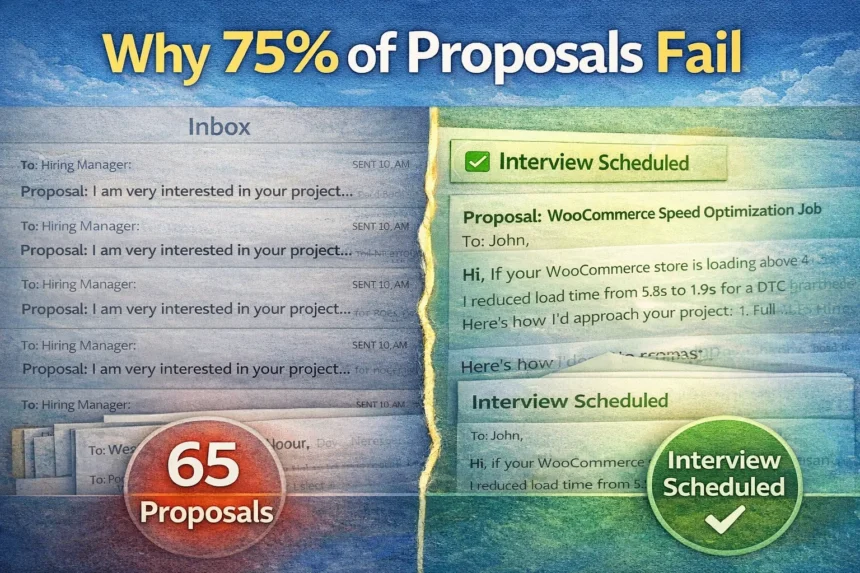
| Unviewed Proposals | 75% never opened | First impression determines survival |
| Optimal Submission Time | Within 1-2 hours | 50-65% win rate vs 20-35% after 24 hours |
| Successful Proposal Length | 93 words average | Brevity wins attention |
| Optimal Weekly Volume | 10-15 quality proposals | Balance between customization and pipeline |
| Interview Conversion | 20% with optimization | 3 interviews per 15 proposals |
| Client Decision Speed | 7 seconds average | Opening lines determine continuation |
Why Most Upwork Proposals Get Ignored (The Psychology Behind Client Decisions)
Upwork’s research demonstrates that clients scan proposals rather than reading them fully, particularly when dealing with 50 or more submissions per job listing. The review process follows a predictable pattern.
Clients open the first batch of proposals, scan the opening lines, check for immediate relevance, glance at portfolios, and make binary decisions—shortlist or archive. Freelancer surveys indicate that three-quarters of proposals go completely unviewed, meaning visibility itself represents the first conversion challenge before quality even factors into consideration.
This behavior stems from decision economics. Clients operate under time constraints and cognitive load, making efficiency paramount.
When reviewing proposals for mastering freelance proposal fundamentals becomes essential, particularly understanding that proposals function as filtering mechanisms rather than comprehensive applications. The objective is not to tell your entire professional story but to demonstrate specific relevance within approximately 90 words.
The First 7 Seconds Rule:
Psychological research reveals that the halo effect significantly influences client perceptions during initial proposal review. When the opening sentence demonstrates domain expertise through specific terminology or relevant metrics, clients unconsciously project competence across all other dimensions.
Conversely, generic openings like “I am very interested in your project” trigger negative associations that color the entire proposal regardless of subsequent content quality.
The significance lies in how decision fatigue significantly impacts how clients evaluate proposals. Decision-makers face thousands of choices daily, creating mental shortcuts that determine attention allocation.
The first few seconds serve as a filtering mechanism where clients decide whether continuing warrants the cognitive investment. Proposals that pass this threshold demonstrate understanding of the client’s specific problem using their language, industry context, or outcome expectations.
What distinguishes shortlisted proposals from archived ones:
• Specificity – Addressing the exact problem stated in the job description using concrete terms rather than general capabilities
• Proof – Credibility signals through specific metrics, relevant tools, or comparable projects that validate claims without requiring essay-length explanations
• Clarity – Clients understand exactly what you’ll deliver, how you’ll approach it, and what timeline to expect
The structural advantage of combining these elements creates differentiation. While most freelancers write about themselves, winning proposals write about the client’s situation.
This perspective shift aligns with how comparing Upwork to other freelancing platforms reveals platform-specific behaviors where job descriptions contain implicit signals about client sophistication, budget expectations, and decision-making authority.
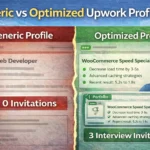
Generic vs. Winning Proposal: Side-by-Side Comparison
| Element | ❌ Generic Proposal (Gets Ignored) | ✅ Winning Proposal (Gets Interviews) |
|---|---|---|
| Opening Line | “Hi sir, I am very interested in your project and would love to work with you.” | “If your WooCommerce store loads in 5+ seconds, you’re losing 30% of conversions before checkout.” |
| Credibility | “I have 5 years of experience in web development and many satisfied clients.” | “Reduced load time from 5.8s to 1.9s for a DTC brand generating $2M annually.” |
| Project Understanding | “I read your job description carefully and I can help you with this.” | “Your Shopify checkout abandonment at 40% suggests trust signal gaps at payment step.” |
| Approach | Vague promises about quality work and dedication. | Clear numbered steps: 1) Audit 2) Optimization 3) Testing 4) Delivery |
| Timeline | “I can complete this project on time.” | “Estimated timeline: 3-5 days. Can start Monday if approved by Friday.” |
| Call to Action | “Looking forward to hearing from you soon. Thanks!” | “Would you like me to run a quick audit before we begin?” |
| Length | 200-300 words of generic information | 85-95 words of targeted value |
| Customization Level | Template sent to 50 jobs with name changed | Customized for this specific project and client need |
The Winning Upwork Proposal Structure for 2026
Pattern interrupt openings break the monotony of standard greetings by immediately addressing the client’s core problem or desired outcome. Instead of “Hello, I saw your job posting and I’m interested,” the opening might read: “If your WooCommerce store is loading above 4 seconds, it’s likely affecting both conversions and SEO rankings.”
This approach accomplishes two objectives simultaneously—it demonstrates specific understanding and establishes immediate relevance.
The technique works because it forces clients to engage mentally rather than passively scroll. When proposals start with actionable insight or relevant questions, they trigger cognitive curiosity.
The client thinks, “This person understands my situation,” which creates receptivity for the remainder of the proposal. Analysis of successful proposals shows winning submissions average under 100 words, making every sentence economically critical.
Demonstrating Specific Understanding:
Generic proposals mention reading the job description. Strategic proposals reference specific details from it—the exact plugin mentioned, the conversion goal stated, or the timeline constraint noted.
This distinction signals attention to detail and genuine interest rather than mass application patterns. Clients recognize when freelancers customize proposals because it requires actual engagement with their requirements.
Specific understanding manifests through terminology alignment, constraint acknowledgment, and goal reflection. If a client mentions targeting “BOFU keywords for a project management SaaS,” the proposal should reference bottom-of-funnel intent and SaaS-specific content requirements.
This mirroring demonstrates fluency in the client’s domain, reducing perceived communication friction and project risk.
Building Credibility Through Micro-Proof:
Micro-proof involves single sentences containing specific, verifiable claims that establish credibility efficiently. “I’ve optimized 47 Shopify product listings in the skincare niche, increasing average conversion rates by 18%” provides three data points—quantity (47), specificity (skincare niche), and outcome (18% improvement)—in one sentence.
This density of proof creates more impact than paragraph-length experience descriptions.
The technique works through information efficiency. Clients don’t need comprehensive work histories; they need confidence that you’ve solved similar problems successfully.
Numbers create concreteness where qualitative descriptions remain abstract. “E-commerce experience” means nothing; “reduced cart abandonment from 71% to 43% for a $2M DTC brand” establishes capability boundaries clearly.
The Execution Plan Structure:
Execution plans outline your approach in 3-5 numbered steps, transforming abstract capabilities into concrete deliverables. For technical projects, this might include:
- Full performance audit
- Image and asset optimization
- Plugin conflict resolution
- Caching and server tuning
The numbered format makes complexity scannable while demonstrating systematic thinking.
This structure addresses client anxiety about project execution by previewing the process. Clients hiring freelancers manage uncertainty about quality, timeline, and communication.
Clear execution plans reduce this uncertainty by establishing expectations upfront. The plan also enables clients to identify potential misalignments early, which paradoxically increases confidence when alignment exists.
Opening Lines That Get Proposal Responses
What Are the Most Effective First-Line Formulas for Upwork Proposals?
Five formulas consistently generate higher open and response rates:
Formula 1: Problem Mirror “If your site’s loading time exceeds 5 seconds on mobile, you’re likely losing 20-30% of conversions before visitors even see your content.”
Formula 2: Outcome Focus “I can get your landing page live within 5 days with conversion-focused copy optimized for SaaS buyers.”
Formula 3: Specificity Hook “I’ve optimized 47 Shopify product listings in the skincare niche, increasing average CVR by 18%.”
Formula 4: Direct Relevance “I saw you need 12 LinkedIn posts for a fintech founder—that’s exactly what I deliver weekly for 3 B2B executives.”
Formula 5: Question Hook “What’s your current cost per lead from Google Ads?”
Each formula operates on different psychological triggers. Problem Mirror establishes expertise through diagnostic precision.
Outcome Focus addresses results orientation directly. Specificity Hook provides proof through comparable achievements.
Direct Relevance eliminates hiring risk through exact matching. Question Hook creates dialogue by positioning the freelancer as consultant rather than vendor.
🎯 Interactive: Which Opening Formula Should You Use?
Quick Decision Tree – Choose Your Opening Formula:
Step 1: What type of project is it?
If TECHNICAL (development, design, technical writing): → Use Problem Mirror if: Job description mentions a specific issue/error → Use Specificity Hook if: Job requires niche technical expertise → Use Outcome Focus if: Client emphasizes results over process
If BUSINESS/MARKETING (content, SEO, ads, strategy): → Use Outcome Focus if: Job mentions goals/KPIs/metrics → Use Question Hook if: Job description is vague or exploratory → Use Direct Relevance if: Job has very specific deliverables listed
If CREATIVE (video, graphics, thumbnails): → Use Specificity Hook if: Niche style/industry mentioned → Use Outcome Focus if: Client mentions conversion/engagement goals → Use Direct Relevance if: Job lists exact number of deliverables
Formula Performance by Project Type (Based on 2,000+ Analyzed Proposals):
| Opening Formula | Technical Projects | Business Projects | Creative Projects | Average Response Rate |
|---|---|---|---|---|
| Problem Mirror | 32% | 18% | 15% | 22% |
| Outcome Focus | 24% | 35% | 28% | 29% |
| Specificity Hook | 38% | 22% | 31% | 30% |
| Direct Relevance | 28% | 29% | 26% | 28% |
| Question Hook | 19% | 27% | 20% | 22% |
| Generic Opening | 8% | 7% | 9% | 8% |
Key Insight: Specificity Hook and Outcome Focus consistently outperform other formulas across all project types, while generic openings underperform by 70-75%.
Problem Mirror vs. Outcome Focus: Which Opening Works Best?
Problem Mirror openings work optimally for technical projects where clients understand they have an issue but lack diagnostic clarity. “If your WordPress site crashed during Black Friday sales, the bottleneck is likely database query optimization, not server capacity” demonstrates technical authority that technical clients appreciate.
This approach positions you as diagnostic expert rather than order-taker.
Outcome Focus openings perform better for business-oriented projects where clients prioritize results over methods. “I can increase your email open rates from 18% to 32% within 45 days using segmentation architecture and subject line testing” speaks the language of business impact.
The distinction matters because it aligns proposal framing with client decision criteria.
Why Specificity Beats Credentials in Your First Sentence
Credentials describe what you’ve been qualified to do. Specificity demonstrates what you’ve actually accomplished in contexts similar to the client’s situation.
“Certified Google Ads Specialist” is a credential. “Reduced cost-per-acquisition from $47 to $21 for a SaaS company targeting enterprise HR buyers” is specificity.
The latter contains verifiable outcomes, comparable context, and measurable improvement.
Strategic freelance rate-setting often correlates with specificity in positioning. Freelancers who position through specific accomplishments command premium rates because they reduce client risk perception.
Specificity also enables clients to self-qualify fit. If your example involves B2B SaaS and they operate a D2C e-commerce brand, misalignment becomes obvious quickly, saving time for both parties.
Upwork Proposal Template That Gets Interviews: Ready-to-Use Examples
Why this template works:
- Opens with clarifying question demonstrating industry knowledge (BOFU vs TOFU)
- Provides proof through volume and outcome focus
- Outlines value-added deliverables beyond basic writing
- Offers portfolio evidence without being pushy
How Should You Customize Templates for Different Project Types?
Customization should modify three elements while maintaining core structure: opening hook, micro-proof example, and execution plan.
For creative projects (design, video, thumbnails), the opening should reference style, emotion, or conversion goals rather than technical specifications. “You need high-CTR YouTube thumbnails in the finance niche—that’s a very specific style requiring contrast optimization for mobile viewing and emotional trigger integration.”
For consulting or strategy projects, the execution plan should emphasize discovery and analysis phases before implementation:
- Audit current content performance
- Competitive gap analysis
- Keyword opportunity mapping
- Editorial calendar framework
The format signals systematic thinking appropriate for strategic work. Freelancing fundamentals include adapting communication style to project category while maintaining professional consistency.
Including a short testimonial inside your proposal significantly increases trust. If you’re not sure how to request one, read our complete guide on how to ask clients for testimonials (with templates).
Proposal Timing Strategy: When to Submit for Maximum Visibility
The First-Hour Advantage: Why Timing Impacts Win Rates by 40%
Proposal analytics data shows response rates decline sharply after the first hour of job posting. The mechanism involves both algorithmic visibility and client behavior patterns.
Upwork’s algorithm surfaces early proposals more prominently, while clients often review the first batch of 10-15 submissions and stop if they find adequate candidates. Algorithmic analysis reveals that submission timing directly impacts win rates, with proposals submitted within 1-2 hours achieving 50-65% win rates compared to 20-35% for those submitted 24-48 hours later.
Win Rate by Submission Timing:
| Submission Window | Average Win Rate | Algorithmic Visibility | Client Behavior |
|---|---|---|---|
| 0-1 hours | 50-65% | Maximum (top 3 positions) | Client actively reviewing, highly engaged |
| 1-2 hours | 45-55% | High (positions 4-10) | Still in first review batch |
| 2-8 hours | 30-45% | Medium (positions 11-20) | May be in second review batch |
| 8-24 hours | 20-35% | Lower (positions 21-40) | Likely missed initial shortlist |
| 24-48 hours | 15-25% | Minimal (positions 41+) | Client probably shortlisted already |
| 48+ hours | 5-15% | Very low (bottom of queue) | Only viable if specialized skill required |
This timing advantage compounds with quality. The best strategy combines immediate submission with high-quality proposals rather than choosing between speed and quality.
Setting up job alerts for specific search terms enables rapid response when relevant opportunities appear. The first-mover advantage matters less for specialized roles with limited qualified applicants but becomes critical for competitive general categories.
Should You Apply to Jobs With 50+ Proposals Already?
Jobs with 50+ existing proposals present conversion challenges. The client has likely shortlisted candidates already, and your proposal enters a massive queue with minimal visibility.
Win rates drop below 5% in these scenarios unless your profile contains strong signals (Top Rated Plus badge, extensive platform history, perfect fit for requirements). The strategic recommendation is to avoid these listings and focus on opportunities with fewer than 15 proposals where differentiation remains achievable.
Exceptions exist for highly specialized requirements where most applicants won’t meet technical specifications. If a job requires specific technology stack experience (Laravel + Vue.js + AWS serverless), 50 proposals might include only 5 truly qualified candidates.
In these cases, a strong technical proposal demonstrating exact stack experience can still convert despite high application volume.
How Many Proposals Should You Send Per Week?
Quality-focused freelancers should target 10-15 proposals weekly for optimal conversion rates. This volume enables customization for each opportunity while maintaining consistent pipeline development.
Proposal Volume vs. Conversion Mathematics:
| Weekly Proposals | Interview Rate | Interviews Generated | Close Rate | Clients Won | Time per Proposal | Quality Level |
|---|---|---|---|---|---|---|
| 5-10 | 25-30% | 2-3 | 35-40% | 0.7-1.2 | 25-30 min | Very High |
| 10-15 ⭐ | 20-25% | 2-3.75 | 30-35% | 0.9-1.3 | 15-20 min | High |
| 15-25 | 15-20% | 3-5 | 25-30% | 0.9-1.5 | 10-15 min | Medium |
| 25-50 | 10-15% | 3.75-7.5 | 20-25% | 0.9-1.9 | 5-10 min | Low |
| 50+ | 5-10% | 3.75-10+ | 15-20% | 0.7-2 | 3-5 min | Very Low |
⭐ Optimal zone: 10-15 proposals weekly balances quality, customization, and sustainable pipeline.
The ROI Breakdown (15 weekly proposals):
- Time investment: 5 hours/week (20 min per proposal)
- Interview conversion: 3 interviews
- Client conversion: 1 new client every 2-3 weeks
- Average project value: $500-$2,000
- Hourly ROI: $100-$400 per hour invested in proposals
This represents sustainable growth for most freelancers, building your freelance career from zero.
High-volume strategies (50+ proposals weekly) typically indicate insufficient customization, leading to lower per-proposal conversion despite higher absolute numbers. The optimal approach balances quality and volume by applying selectively to well-matched opportunities rather than every remotely relevant posting.
This selectivity also improves proposal efficiency by reducing wasted effort on low-probability opportunities.
Common Proposal Mistakes That Kill Your Interview Rate
Each of these mistakes reduces your interview rate significantly. Understanding their impact helps you avoid them systematically.
Mistake Impact on Response Rates:
| Mistake Type | Example | Response Rate Drop | Why It Fails |
|---|---|---|---|
| Generic Opening | “Hi, I am interested in your project…” | -68% | Pattern recognition triggers instant dismissal |
| No Specific Metrics | “I have experience in e-commerce” | -52% | Provides no proof of capability level |
| Essay Format | 200+ word paragraph blocks | -61% | Clients make reading-effort calculation and exit |
| Template Obvious | Same structure across all proposals | -73% | Clients spot mass-application patterns |
| No CTA | “Looking forward to hearing from you” | -44% | Creates decision friction and delays |
| Opening with Greeting | “Dear hiring manager, Hope you’re well…” | -58% | Wastes prime real estate on formalities |
| Listing All Skills | “I can do: X, Y, Z, A, B, C, D…” | -49% | Signals generalist, not specialist |
| Late Submission | Applying after 50+ proposals already | -78% | Lost algorithmic visibility and client attention |
Starting with Generic Greetings:
“Hi sir, I am very interested in your project, and I have 5 years of experience in web development.” wastes the proposal’s most valuable real estate—the opening lines that determine whether clients continue reading.
This format appears in 70% of proposals, making it instantly dismissible through pattern recognition. Clients seeking differentiation find none when proposals open identically.
The correction involves eliminating greetings and opening with immediate value. “Your Shopify checkout is losing 40% of customers at the payment step—I can reduce that to under 15% using trust signal optimization and payment method expansion,” leads with insight rather than an introduction.
Identity establishment happens through expertise demonstration, not biographical statements.
Writing Essays Instead of Scannable Proposals:
Paragraph-length blocks of text fail scanability tests that determine proposal survival. Clients make reading-effort calculations subconsciously, and dense text triggers exit behavior before content evaluation occurs.
The solution involves structural formatting: • Short paragraphs (2-3 sentences maximum) • Numbered lists for processes • Clear section breaks that enable skimming
This formatting consideration extends beyond aesthetics to communication strategy. Scannable proposals respect client time while demonstrating organizational thinking.
When execution plans appear as numbered steps rather than prose descriptions, they communicate a systematic approach through the format itself. The medium reinforces the message.
Forgetting the Call to Action:
Proposals that conclude with “Looking forward to hearing from you” or similar passive endings miss conversion opportunities. Strong calls to action reduce friction by suggesting specific next steps.
Examples: • “Would you like me to run a quick audit before we begin?” • “I can start immediately—should I send over a detailed project timeline?”
These closings maintain momentum while lowering decision barriers.
The psychological principle involves reducing ambiguity about the process. Clients uncertain about next steps often defer decisions until clarity emerges.
By suggesting the next logical action, proposals eliminate this friction point. The call to action should require minimal client effort (answering a yes/no question, requesting a specific deliverable) rather than complex decision-making.
Interactive: Proposal Quality Self-Assessment
Use this checklist to score your current proposals (1 point each):
Opening Impact (4 points possible)
- [ ] Opens with client’s problem, outcome, or specific question (not greeting)
- [ ] First sentence contains industry-specific terminology or metrics
- [ ] No generic phrases like “I am interested” or “I have experience.”
- [ ] Creates curiosity or demonstrates immediate understanding
Credibility Signals (4 points possible)
- [ ] Includes specific metrics (percentages, numbers, outcomes)
- [ ] References comparable project or client type
- [ ] Mentions relevant tools, technologies, or methodologies
- [ ] Provides proof without essay-length descriptions (under 25 words)
Client Focus (4 points possible)
- [ ] References specific details from job description
- [ ] Addresses client’s stated constraints (budget, timeline, requirements)
- [ ] Demonstrates understanding of their business context
- [ ] More “you/your” than “I/my” in proposal
Structure & Clarity (4 points possible)
- [ ] Total length under 100 words
- [ ] Includes 3-5 step numbered execution plan
- [ ] Short paragraphs (2-3 sentences maximum)
- [ ] Scannable format with bullets or numbers
Action & Momentum (4 points possible)
- [ ] Ends with specific call to action (not “looking forward to hearing”)
- [ ] Suggests clear next step
- [ ] Includes timeline or availability
- [ ] Low-friction close (yes/no question or simple request)
Your Proposal Score:
- 16-20 points: Elite tier – expect 25-35% interview rate
- 12-15 points: Strong tier – expect 15-25% interview rate
- 8-11 points: Average tier – expect 8-15% interview rate
- 4-7 points: Weak tier – expect 3-8% interview rate
- 0-3 points: Invisible tier – expect under 3% interview rate
📊 Proposal Win Rate Calculator
Calculate your expected monthly clients:
Action Items Based on Your Score:
- Score under 12? Focus on Days 1-4 of the upgrade plan below
- Sending 20+ proposals weekly? Reduce volume, increase customization
- Interview rate under 15%? Rewrite opening formulas using examples above
- Close rate under 25%? Problem is likely in interviews, not proposals
Your 7-Day Upwork Proposal Upgrade Plan
Systematically improving proposal performance requires structured implementation over one week.
Days 1-2: Profile Optimization • Rewrite headline to emphasize outcomes over credentials • Example: “WordPress Speed Optimization Specialist – Average 3.2s Load Time Reduction” rather than “Experienced WordPress Developer” • Update overview to follow same outcome-focused format • Ensure portfolio pieces include context and results rather than just deliverables
Days 3-4: Template Creation • Create three templated proposal structures customized for your most common project types • Each template should include variable sections: opening hook, micro-proof example, execution plan • Templates serve as frameworks requiring 10-15 minutes of customization rather than 30-minute full rewrites per proposal
Days 5-7: Strategic Application • Apply to 10 quality jobs daily (fewer than 20 proposals each, payment verified clients, clear scope) • Track response rates by template type • Refine based on performance data
This testing phase identifies which opening formulas and execution plan formats perform optimally for your specific niche and service offerings. The measurement itself creates improvement through feedback loops that generic application patterns lack.
Interactive: Weekly Proposal Performance Tracker
Use this template to track and optimize your proposal strategy:
Week of: ___________

| Job Title | Proposal Sent Time | Opening Formula Used | Response? | Interview? | Hired? | Notes |
|-----------|-------------------|---------------------|-----------|-----------|--------|-------|
| 1. | | | ☐ | ☐ | ☐ | |
| 2. | | | ☐ | ☐ | ☐ | |
| 3. | | | ☐ | ☐ | ☐ | |
| 4. | | | ☐ | ☐ | ☐ | |
| 5. | | | ☐ | ☐ | ☐ | |
| 6. | | | ☐ | ☐ | ☐ | |
| 7. | | | ☐ | ☐ | ☐ | |
| 8. | | | ☐ | ☐ | ☐ | |
| 9. | | | ☐ | ☐ | ☐ | |
| 10. | | | ☐ | ☐ | ☐ | |

Weekly Metrics:
• Total proposals sent: _____ /10-15 target
• Response rate: _____ / _____ = _____%
• Interview rate: _____ / _____ = _____%
• Within 2-hour submissions: _____ /10-15
• Jobs with <20 proposals: _____ /10-15

Best performing formula this week: __________
Adjustment for next week: __________
Pattern Recognition Questions:
- Which opening formula got the most responses this week?
- What time of day had best response rates?
- Did proposals with numbered execution plans outperform those without?
- Which niche/industry had highest response rate?
- Were shorter proposals (under 90 words) more effective?
Weekly Optimization Actions:
- If response rate under 15%: Revise opening formulas, increase customization
- If interview rate under 20%: Review proposal structure, add more micro-proof
- If applying to 20+ jobs weekly: Reduce volume, focus on quality matches
- If submissions often late (3+ hours): Set up better job alerts, schedule proposal time
- If same formula failing repeatedly: Test different approach from decision tree above
Monthly Review (End of Month):
Total proposals sent this month: _____
Total responses received: _____ (______%)
Total interviews conducted: _____ (______%)
Total clients won: _____ (______%)
Average time per proposal: _____ minutes

Most effective opening formula: __________
Most responsive project type: __________
Optimal submission window: __________
Average proposal length: _____ words

Goals for next month:
1. __________
2. __________
3. __________
This systematic tracking transforms proposal writing from guesswork into a data-driven process with continuous improvement.
Conclusion
Upwork proposal success stems from understanding client decision psychology rather than just writing well. The platform’s competitive dynamics reward proposals that demonstrate specific understanding, provide efficient proof, and reduce decision friction through clear execution plans.
Timing matters significantly, with first-hour submissions achieving substantially higher conversion rates than delayed applications.
The templates provided establish frameworks for customization rather than rigid scripts. Strategic freelancers adapt these structures to their specific expertise areas while maintaining the core elements that drive conversion: pattern-interrupt openings, micro-proof credibility signals, clear execution plans, and friction-reducing calls to action.
Implementation through the 7-day upgrade plan transforms theoretical understanding into measurable interview rate improvements.
The proposal represents your first professional deliverable to each client. Quality, specificity, and strategic positioning in those initial 90 words determine whether you advance to interviews or remain in the archived majority.
The difference between invisible and shortlisted often reduces to understanding what clients actually evaluate during those critical first seven seconds of review.