
A DDoS Protected VPS (Virtual Private Server) is a virtualized hosting solution with built-in security systems that automatically detect and neutralize Distributed Denial-of-Service attacks. Unlike standard VPS hosting, it includes real-time traffic monitoring, automated filtering through scrubbing centers, and multi-layered defense protocols that keep your website online even when bombarded by millions of malicious requests.
- What Exactly Is a VPS (And Why Should You Care)?
- Understanding DDoS Attacks: The Digital Mob at Your Door
- How DDoS Protection Actually Works
- Why You Actually Need DDoS Protection (The Real Cost)
- Picking the Right DDoS Protected VPS Provider
- What Running Unprotected Actually Costs You
- Real Talk: My Experience Testing VPS Solutions
- FAQ: Your Burning Questions Answered
- Bottom Line: Protection Isn’t Optional Anymore
Running EduEarnHub and NoCostTools while managing multiple social media channels taught me one thing fast: you’re only as good as your uptime. I’ve tested every type of VPS out there budget options that crashed during traffic spikes, premium solutions that held strong under attack, and everything in between. Here’s what I learned about DDoS protected VPS hosting and why it’s non-negotiable in 2026.
What Exactly Is a VPS (And Why Should You Care)?
A Virtual Private Server gives you your own slice of a physical server, dedicated CPU, RAM, storage, and bandwidth that nobody else touches. Unlike shared hosting, where your site fights for resources with hundreds of neighbors, VPS hosting isolates you in your own container.
Think apartment building versus penthouse floor. You get your own space, your own utilities, your own security setup. When another VPS gets hammered with traffic or compromised, your site keeps running smoothly.
The real power? Root access. You can install custom firewalls, set up intrusion detection systems, and configure security exactly how you need it. That’s something shared hosting will never give you.
Understanding DDoS Attacks: The Digital Mob at Your Door
DDoS stands for Distributed Denial-of-Service, basically, a coordinated assault where thousands of compromised devices bombard your server with requests until it crashes.
Here’s the play: attackers infect devices with malware, creating what’s called a botnet. Then they unleash this army to flood your server with simultaneous requests. Your bandwidth gets exhausted, resources max out, and your site goes dark.
The numbers? Brutal. Cloudflare blocked over 20.5 million DDoS attacks in Q1 2025 alone a 358% jump from the year before. By Q2, hyper-volumetric attacks (we’re talking 1+ terabit per second) shot up 592% from the previous quarter.
What’s scary? 82% of attacks are now small-scale but frequent attackers probing defenses, testing systems, looking for weak spots. These evolving threats mirror what we’re seeing across technology sectors in 2026, where blockchain technology and AI systems are also facing sophisticated attack vectors.
The Four Horsemen of DDoS
Volumetric Attacks drown you in traffic. UDP floods spam user datagram protocol packets. ICMP floods (ping floods) overwhelm with echo requests. DNS amplification uses public DNS servers to reflect and multiply traffic toward you.
Protocol Attacks exploit network protocol weaknesses. TCP SYN floods exhaust connection tables with incomplete handshakes. RST floods and ACK floods manipulate TCP mechanics to crash services.
Application-Layer Attacks (Layer 7) target your actual software not just the network. HTTP floods mimic real user requests, making them tough to spot. These attacks hammer your CPU and memory, hitting databases, APIs, and authentication systems with devastating precision despite lower traffic volume.
Multi-Vector Attacks combine all three types simultaneously, testing every defense mechanism you’ve got.
How DDoS Protection Actually Works
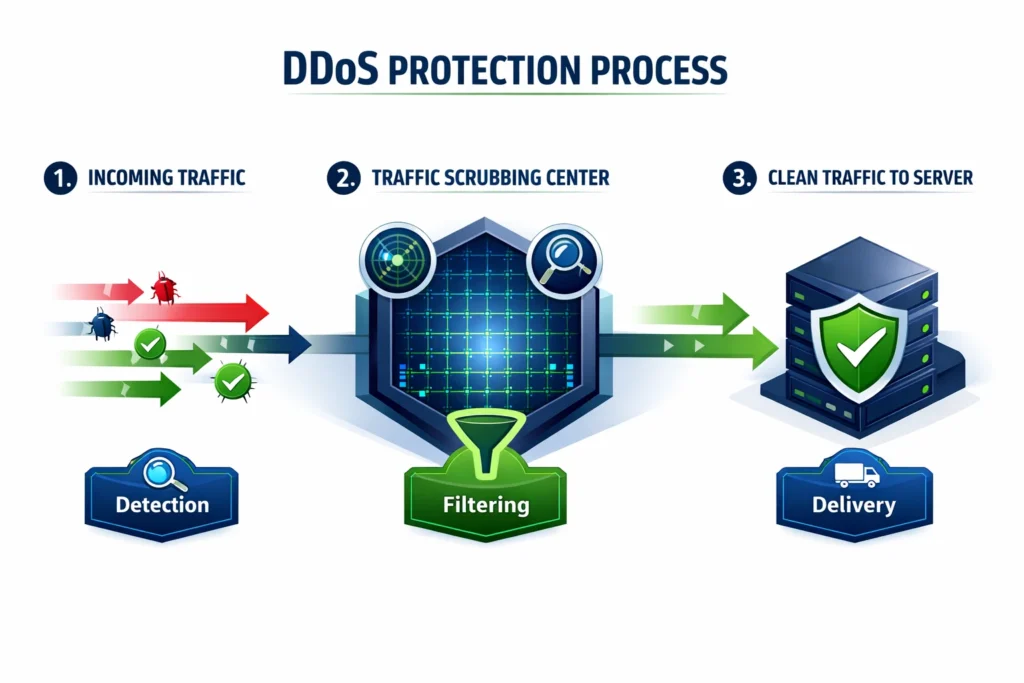
DDoS protected VPS hosting deploys multiple defense layers to stop attacks before they touch your server.
Real-Time Traffic Analysis: The system constantly monitors incoming patterns. Abnormal spikes trigger alerts within seconds, activating mitigation immediately.
Traffic Scrubbing Centers: When an attack hits, your traffic gets rerouted through specialized filtering facilities. These data centers use advanced threat intelligence to distinguish legitimate requests from malicious ones. Attack traffic gets filtered and dumped. Clean traffic flows back to your server.
Automated Filtering: Providers use BGP Flowspec to redirect traffic at network edges, blocking attacks before they consume bandwidth. Rate limiting caps requests from single IPs within specific timeframes. Tools like Fail2Ban identify and block suspicious activity instantly.
Application-Level Defense: For sophisticated Layer 7 attacks, Web Application Firewalls inspect packet content, catching HTTP floods, Slowloris attacks, and malicious API requests through deep packet inspection.
The entire process, detection, rerouting, filtering, and clean traffic return completes in seconds. Your site stays up during even massive attacks.
Why You Actually Need DDoS Protection (The Real Cost)
24/7 Uptime: Your site stays accessible. Revenue flows. Customers get their services. Your reputation stays intact. For e-commerce and SaaS platforms, every offline second equals lost sales.
Cost Protection: Quality DDoS protected VPS plans include mitigation at no extra charge. You’re never billed for malicious bandwidth consumption no surprise invoices after attacks.
Set-It-and-Forget-It Defense: Always-on protection shields you 24/7 without manual intervention. No scrambling to activate defenses. The system monitors and responds in real time, automatically.
Focus on What Matters: Your team builds products and serves customers instead of managing attacks, configuring emergency defenses, and recovering from incidents.
Geographic Redundancy: Professional solutions operate across globally distributed data centers, protecting regardless of the attack origin. Backup systems stand ready if primary defenses get overwhelmed.
Picking the Right DDoS Protected VPS Provider
Protection Capacity: Look for at least 100+ Gbps mitigation capacity, scalable to 1+ Tbps for large attacks. JavaPipe offers 750 Gbps, and KnownHost provides 500+ Gbps.
Complete Attack Coverage: Ensure protection against volumetric (Layer 3/4), protocol, and application-layer (Layer 7) attacks. Layer 7 attacks jumped 38% in mid-2025, you need coverage for all vectors.
Always-On Protection: Some providers activate defenses manually during attacks. That lag kills you. OVHcloud includes automatic 24/7 monitoring without extra cost.
Uptime Guarantees: Look for an SLA of at least 99.95%. Premium providers guarantee 99.99% uptime with financial compensation for misses. KnownHost guarantees 10% money back for every 0.1% drop below 99.9%.
Strategic Location: Choose servers geographically close to your target audience. Low latency ensures better performance while defending against global attacks.
24/7 Expert Support: When attacks happen, you need immediate expert response. Top providers offer round-the-clock chat and phone support.
Transparent Pricing: Compare what’s included in base pricing. DDoS protection extra? Backups included? SSL certificates, monitoring, and control panels? Budget providers like Contabo ($8.49/month) include network-level protection in base pricing. Others charge $10-$20/month as add-ons.
Scalability: Your VPS should grow with your business without migration hassles. Ensure easy resource upgrades with DDoS protection that scales alongside traffic increases.
What Running Unprotected Actually Costs You
I learned this lesson the expensive way. The costs of unprotected servers dwarf the pricing for protective services.
Immediate Revenue Hemorrhage: Network downtime costs $5,600 per minute—$300,000 per hour. One hour offline? Six figures gone. 49% of enterprises face hourly revenue risk of $250,000+. With mitigation taking 45% of enterprises 3-24+ hours, the bleeding becomes catastrophic.
Customer Loss: A 2020 Infrascale survey found 37% of companies lost customers after downtime. These customers don’t come back they stick with competitors. Just a 1-second page delay causes 11% fewer pageviews, 16% customer satisfaction drop, and 7% conversion loss.
SEO Damage: While search rankings typically recover within 1-2 weeks, traffic loss during downtime is immediate and severe. Google uses availability as a ranking factor repeated DDoS outages signal poor reliability.
Operational Paralysis: If your site serves remote employees or business partners, downtime halts productivity across your entire organization. Critical systems become inaccessible, transactions fail, and data access stops.
Regulatory Penalties: Data protection laws like GDPR and PCI-DSS require service availability and information security. DDoS-caused breaches or data exposure trigger significant fines and legal consequences.
Reputation Destruction: Customers perceive vulnerability when your site goes dark. Trust erodes. In financial services, retail, and logistics, digital trust is priceless. Rebuilding after an incident requires months of reputation management.
Real Talk: My Experience Testing VPS Solutions
Running two content sites and managing social channels means I’m constantly testing infrastructure. I’ve run budget VPSs that folded under moderate traffic spikes. I’ve paid premium for enterprise-grade protection that handled everything thrown at it.
The budget solutions? Great until they’re not. You save $15/month but lose thousands when a competitor DDoSes you during a product launch. Been there.
The sweet spot I found: mid-tier providers with included DDoS protection, 99.9%+ uptime guarantees, and transparent pricing. You’re paying $20-50/month more than bare-bones hosting, but you’re buying peace of mind and actual uptime.
For EduEarnHub, uptime directly correlates with ad revenue and affiliate conversions. Every hour down is thousands in lost earnings. For NoCostTools, it’s about user trust people rely on our resources being accessible.
FAQ: Your Burning Questions Answered
Q: Can a VPS be completely DDoS-proof?
A: No solution offers 100% immunity. However, well-implemented DDoS protection services can mitigate the vast majority of attacks by absorbing massive malicious traffic, filtering attack vectors, and maintaining legitimate user access.
Q: Is DDoS protection included or extra?
A: Depends on the provider. Premium hosts like OVHcloud, ServerBasket, and Liquid Web include basic protection at no extra cost. Others charge $10-$20/month or sell tiered levels. Always confirm what’s in base pricing.
Q: How quickly does protection activate?
A: Modern systems detect attacks within seconds and begin filtering within 2-5 seconds. FastNetMon can reduce response times under two seconds. Always-on protection provides immediate response without manual intervention.
Q: What’s the difference between Layer 3/4 and Layer 7 protection?
A: Layer 3/4 (network-layer) defends against volumetric attacks like UDP and ICMP floods using traffic filtering at network edges. Layer 7 (application-layer) uses Web Application Firewalls to detect sophisticated HTTP floods and API attacks by inspecting application content. Quality protection includes both.
Q: Do small sites need DDoS protection?
A: Absolutely. Recent data shows small sites increasingly face probing attacks designed to test defenses. Attackers systematically scan for vulnerable targets before launching larger campaigns. No site is too small to be attacked.
Q: What about hidden costs?
A: Common hidden costs include SSL certificates, backup storage, monitoring tools, and premium support. Some providers charge extra for control panels or per-Gbps of attack traffic. Compare total package value, not just base price.
Q: Can I migrate without downtime?
A: Yes, most providers offer live migration services where your data and configurations transfer while your current site stays online. Confirm this capability before choosing a provider.
Bottom Line: Protection Isn’t Optional Anymore
DDoS protected VPS provides the security foundation every website needs in 2026’s threat environment. With attacks increasing 358% year-over-year and becoming more sophisticated, protection transitioned from luxury to necessity for maintaining uptime, protecting revenue, and preserving customer trust.
By combining VPS isolation with multi-layered DDoS mitigation, you get a secure, scalable hosting solution that keeps your site accessible regardless of attack volume or sophistication. The cost typically $0-$20/month with most providers is negligible compared to six-figure losses a single unprotected downtime event could inflict.
I’ve seen both sides. Running unprotected is gambling with your business. Every day without protection is another day you’re vulnerable to attacks that could wipe out months of growth in hours.
Get protected. Stay online. Keep building.
Running sites like EduEarnHub and NoCostTools while managing multiple channels taught me that uptime isn’t just a metric, it’s your reputation. DDoS protection isn’t about if you’ll be attacked; it’s about when. Be ready.