TL;DR: India is the world’s second-largest freelancer market, and over 60% of Indian freelancers are under 30. A student can realistically earn Rs. 5,000 to Rs. 30,000 per month within the first three months, with zero investment and no need to drop out. The formula is simple: pick one skill you already have, build three portfolio samples, create a profile on Fiverr or Internshala, and deliver a five-star experience on your first orders. This guide covers every step with India-specific context, INR income figures, and a schedule that fits college life.
Some students in your college are waiting for their first internship call. Others are already earning from their laptops, on their own schedule, without asking anyone for permission.
Freelancing for students in India is no longer a side experiment. It’s a real income path, and the numbers back it up. India is now the world’s second-largest freelancer market, with over 15 million independent professionals contributing to a sector that touches every major industry.
The fear is understandable. Parents want stability. Degrees feel safer. And freelancing, from the outside, looks uncertain.
But here’s what the data actually shows: over 60% of Indian freelancers are under 30. This is not a path for people who have already built careers. It’s a path built by students and young professionals, exactly like you.
This guide gives you India-specific income figures in INR, platform recommendations that work for beginners, and a weekly schedule that doesn’t require you to drop out or sacrifice your CGPA.
Why Freelancing Works Specifically for Indian Students in 2026
Freelancing works for Indian students in 2026 because of three structural advantages that most guides don’t spell out clearly: the dollar-rupee income gap, the normalization of remote work globally, and the fact that Indian coursework already builds skills that international clients are actively paying for.
The dollar-rupee advantage is significant. With the USD trading at approximately Rs. 91 in early 2026, a client in the US paying $10 for a piece of content is putting Rs. 910 into a student’s account. For a beginner, that math changes everything. A single short writing project that takes two hours can cover a week’s commute costs. A small web development task that takes a weekend can cover a month’s textbooks.
Remote work has made location irrelevant. A student in Patna or Coimbatore competes on the same screen as a student in Bangalore or Delhi. Clients in the UK, US, and Australia don’t check your city. They check your samples, your reviews, and your communication.
Indian students already have the skills. A BCA student who has built one college project has the foundation for a web development portfolio. A B.Com student who has written case studies knows the structure of business content. India’s freelancer market is projected to reach Rs. 2 lakh crore by 2026, driven in large part by this talent pipeline from Indian colleges.
The question isn’t whether freelancing is possible for Indian students. The question is which skill to start with.
Which Skills Can Indian Students Freelance With Right Now?
The skill you start with should come from what you already know, not from what sounds impressive. The fastest path to a first paying client is the shortest distance between your current knowledge and a client’s current problem.
Here’s a stream-wise breakdown of where to start:
| Stream | Skill to Start | Platform | Realistic First Month |
|---|---|---|---|
| Arts / Commerce | Content writing, social media management | Internshala, Fiverr | Rs. 5,000–12,000 |
| Engineering / BCA | Web development, Python scripting | Upwork, Freelancer | Rs. 8,000–20,000 |
| Design / Media | Canva graphics, video editing | Fiverr, Instagram | Rs. 6,000–15,000 |
| Any stream | Data entry, transcription | Truelancer, Fiverr | Rs. 3,000–8,000 |
A few things worth noting about this table.
Data entry and transcription are not glamorous, but they are the easiest to get started without a portfolio. They build a review record fast, which is the real asset in the first 60 days.
Content writing pays better than most students expect. Internshala lists content writing as one of the most in-demand student skills, with consistent project availability throughout the year, not just during placement season.
Web development has the widest income range because the gap between a basic HTML landing page and a full React application is enormous. Start with what you know. A simple WordPress site for a local business is a legitimate first project.
For students who want to go deeper into which high-paying freelance skills have the strongest long-term earning potential, that comparison covers 15 skills with income benchmarks up to $250 per hour.
Which Freelancing Platform Should Indian Students Start With?
The right starting platform for Indian students is Internshala or Fiverr, not Upwork. Internshala is built for the Indian student context, with domestic clients, INR payments, and a lower rejection barrier for profiles with no prior client history. Fiverr’s gig model means you set up the service once and wait for buyers, which is better for beginners than writing cold proposals.
Platform choice affects your first 90 days more than your skill level does. Here’s what each platform is actually like for a beginner:
Internshala is India-specific and designed for students and freshers. Clients on Internshala expect to hire people with limited experience. The rejection rate for new profiles is lower than on any international platform, and domestic projects mean no currency conversion friction. This is the recommended starting point for students in Arts, Commerce, or any non-technical stream.
Fiverr works best for packaged, repeatable services. A student who can offer “5 Instagram captions for Rs. 500” or “a 500-word blog post in 24 hours” can set up a gig and start receiving orders without writing a single proposal. Fiverr pays in USD through Payoneer or direct bank transfer to Indian accounts.
Upwork pays more per project, but the competition at the entry level is steeper. A profile with zero reviews on Upwork is competing against freelancers from across the world who already have 50+ reviews. Neemesh recommends treating Upwork as a second platform, one to move to after you’ve built 5–10 reviews on Internshala or Fiverr.
Truelancer and WorkIndia serve domestic clients and are useful for students who prefer INR-denominated projects without the complexity of international payments.
For a deeper comparison of each platform’s fee structure and proposal strategies, the best freelancing platforms for beginners in 2026 guide covers Upwork, Fiverr, and Freelancer.com side by side.
How to Build a Portfolio When You Have Zero Clients
The most common objection student freelancers have before sending a single proposal is this: “Why would a client hire me when I have no portfolio?” The answer is that you already have a portfolio. You just haven’t organized it yet.
Three types of work count as portfolio samples for a student with no paid clients:
College assignments and projects. A report you wrote for your Economics class is a writing sample. A database project from your BCA second year is a development sample. A poster you made in Canva for a college event is a design sample. Igauge research confirms that college assignments are valid and accepted portfolio samples for entry-level freelance applications.
Mock projects. Pick a real business in your city, one you can find on Google Maps, and create a sample deliverable for them. Write three social media captions for their Instagram page. Redesign their menu graphic. Write a 300-word “About Us” page. The client doesn’t need to know it exists. The sample proves you can do the work.
One free or discounted project. Ask a family friend, a local shop owner, or a college senior who runs a small side business if they need any help. Do one project at a reduced rate or free in exchange for a written testimonial. One real testimonial is worth more than five mock samples.
Three strong samples, organized in a Google Drive folder with a clear filename structure, is enough to send with your first 10 proposals. A personal website is not required on day one.
When Neemesh worked with students building early freelance profiles, the consistent finding was that students who used their existing college work as the starting point got responses faster than those who spent three weeks building a new portfolio from scratch. The work is already there. The organizing step takes less than an afternoon.
For a full walkthrough on how to structure samples, the guide on how to build a portfolio with no experience covers this in more detail.
How to Balance Freelancing With College: A Realistic Weekly Schedule
This is the section most guides skip, and it’s the section that determines whether freelancing works long-term or burns out in week three.
The structure that works is treating freelancing like a part-time job with fixed hours, not as something you’ll get to “whenever there’s time.” Unstructured time is the reason most student freelancers stop in month one.
Here’s a weekly schedule that students have used successfully:
| Time Block | Activity |
|---|---|
| Mon–Fri, 7–9 PM | Focused freelance work (2 hours/day) |
| Saturday morning | Client communication, proposals, invoicing |
| Sunday | Skill improvement, learning one new thing |
A few ground rules that make this sustainable:
Exams come first. When exam season arrives, pause new project intake two weeks before. Communicate with existing clients in advance. Most clients respect a “I’m available again from [date]” message. Disappearing without notice is the only thing that damages your reputation.
Track time, not tasks. Focusing on two hours of output is more effective than maintaining a task list that never ends. Use Google Calendar to block the hours. Use Notion or a physical notebook to log what you worked on.
One skill at a time. Students who try to offer writing, design, and development simultaneously in month one rarely get traction in any of them. Pick one skill, get your first three reviews, then consider expanding.
The schedule above amounts to about 14 hours per week, roughly equivalent to a part-time job with much more control over when and how you work.
How Much Can Indian Students Realistically Earn From Freelancing?
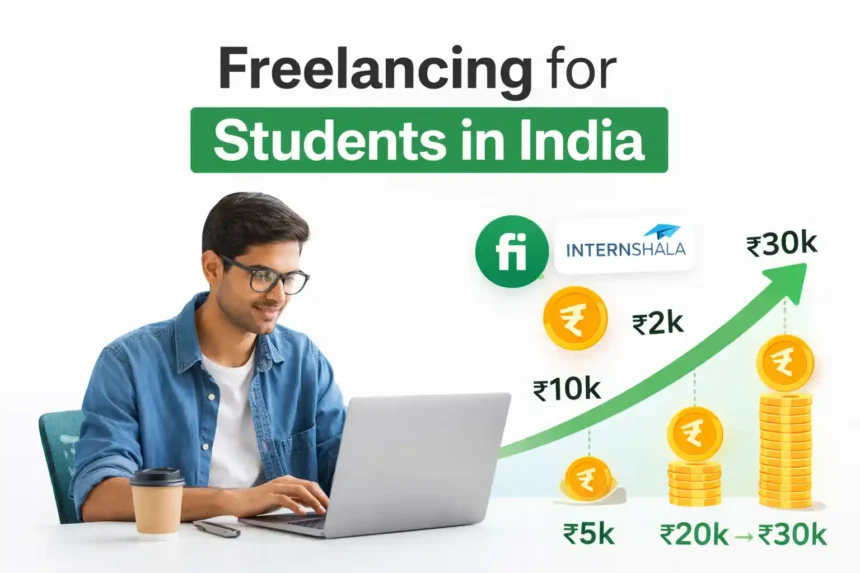
A student starting freelancing in India can realistically earn Rs. 2,000 to Rs. 8,000 in their first two months. By month four, with consistent effort and a few reviews, Rs. 20,000 per month becomes achievable. Rs. 30,000 per month after three to four months is realistic for students who treat freelancing as a structured part-time activity.
Here’s the honest income ladder:
| Stage | Timeline | Monthly Income |
|---|---|---|
| Getting started | Month 1–2 | Rs. 2,000–8,000 |
| First reviews in | Month 3–4 | Rs. 8,000–20,000 |
| Regular clients | Month 5–6+ | Rs. 20,000–50,000+ |
The keyword in that table is “consistent.” Curominds documents cases of Indian students reaching Rs. 30,000 per month within three months of starting, but those cases involve students who send proposals daily, respond to clients within two hours, and improve their samples after every project.
Razorpay’s research on Indian freelancers shows the average income for a beginner freelancer at approximately Rs. 20 lakh per year, but that figure includes people who have been freelancing for two to three years. The starting numbers are lower.
The income also depends heavily on the skill. Content writing at Rs. 0.50 per word is the lower end of the market. Content writing at Rs. 2.50 per word, which is achievable after six months, produces significantly different monthly totals for the same number of hours.
To understand how to set your freelance rates correctly from month one, this guide includes a rate calculator and benchmarks by skill type.
3 Mistakes That Stop Most Student Freelancers Before They Even Start
These three mistakes are the reason most students research freelancing for months and never send a single proposal.
Mistake 1: Searching for the “perfect skill” before starting. This is the most common one. A student spends two to three weeks comparing content writing vs. graphic design vs. video editing, reading about each, and never starting any of them. The right skill is the one you already have some exposure to. You can refine your skill choice after your first client. You cannot refine it from a browser tab.
Mistake 2: Pricing too low to get orders. New freelancers often price at Rs. 50 per blog post or Rs. 100 per logo hoping the low price will make the decision easier for clients. It doesn’t. Low prices signal low confidence and attract clients who will negotiate further down. Neemesh recommends starting 20–30% below the market rate for your skill, not lower. For content writing, that means Rs. 1.50–2 per word, not Rs. 0.30.
Mistake 3: Quitting after the first or second rejection. The average freelancer sends 10 to 15 proposals before landing their first client. That’s not a reflection of skill. That’s how the pipeline works. Track your proposal count. After 15 proposals with no responses, revisit the proposal itself. The guide on how to write better proposals covers exactly how to structure a proposal that gets a reply.
The pattern across all three mistakes is the same: a student treats freelancing as something that should work immediately, and stops before the 10–15 proposal threshold, where results typically begin.
Conclusion
Freelancing for students in India in 2026 is not a theory. It’s a structured activity with a clear starting point, a realistic income timeline, and a schedule that can coexist with a full college workload.
Three things to take from this guide: start with a skill you already have, use Internshala or Fiverr as your first platform, and send proposals consistently before worrying about whether your portfolio is perfect.
For the complete step-by-step path from registration to your first paid client, the complete freelancing roadmap covers the full process in one place.
Freelancing is not a distraction from your degree. When Neemesh observed students who built real freelance projects alongside their coursework, they entered placements with demonstrated skills, client communication experience, and actual income history. That combination consistently set them apart from candidates who had only classroom experience.
What skill do you already use in your college assignments that someone else would pay for? Share it in the comments below.
Frequently Asked Questions
Can Indian students start freelancing with no experience?
Yes. No prior paid experience is required to start. College assignments, mock projects built for practice, and one small project done for a friend or family contact all count as valid portfolio samples. The first goal is to land a client with one to three samples and build a review record from there. Internshala is specifically designed for students and freshers with no professional history.
How does Fiverr payment work for Indian students?
Fiverr pays in USD and offers two withdrawal options for Indian freelancers: Payoneer (which issues an INR bank transfer or a prepaid card) and direct bank transfer. Funds are held for 14 days after an order is marked complete before becoming available for withdrawal. There is no minimum age barrier beyond 13 years old, but students should use a valid bank account in their name to avoid withdrawal complications.
Do Indian students have to pay tax on freelancing income?
Yes, freelancing income is taxable in India. It is classified as income from business or profession under the Income Tax Act. Students earning below Rs. 2.5 lakh per year (the basic exemption limit for individuals under 60) do not need to pay income tax, but filing a return is still advisable once income is consistent. Students who earn in foreign currency may also need to be aware of FEMA (Foreign Exchange Management Act) guidelines. Consulting a CA for annual filing is recommended once income exceeds Rs. 5 lakh.
Which is better for beginners in India, Internshala or Fiverr?
For most Indian students, Internshala is the better starting point. It is India-specific, the clients expect to work with freshers, and the domestic payment process is straightforward. Fiverr is the better second platform, particularly for students who can package their service clearly and are comfortable managing international payments through Payoneer. After five to ten reviews on either platform, moving to Upwork becomes significantly easier.
Will freelancing affect my studies or CGPA?
Only if you let it run without a schedule. Students who set fixed freelance hours (typically two hours per weekday evening) and pause during exam season consistently report no impact on academic performance. The risk is not the activity itself but the absence of boundaries around it. Treating freelancing like a part-time job with firm hours is the same approach that works for students who do internships alongside college. The time is there. The key is protecting study time first and building freelance hours around it.