TL;DR: The answer depends entirely on what kind of freelancer you are. AI has already replaced a significant portion of basic writing, translation, and image creation work. But aggregate freelance demand did not drop after ChatGPT launched; it shifted toward skills that complement AI. Freelancers who do task-based, repeatable work at low price points face the highest risk. Freelancers who specialize, use AI as a tool, and value price are growing. This post covers the data, skill by skill, and the exact moves that separate these two groups.
If you have been freelancing for more than a year, you have probably felt something shift. Proposals that used to close in two days now sit unanswered. Clients who once paid Rs. 3,000 for a blog post are offering Rs. 800. Some clients have disappeared entirely.
Will AI replace freelancers? The question is everywhere, and most answers land in one of two bad places: complete panic or complete denial. Neither helps you.
The data tells a more specific story. AI is not replacing all freelancers. It is replacing specific types of work, done at specific price points, by freelancers who have not adapted. Understanding exactly which category you are in is the most important thing you can do for your freelance career right now.
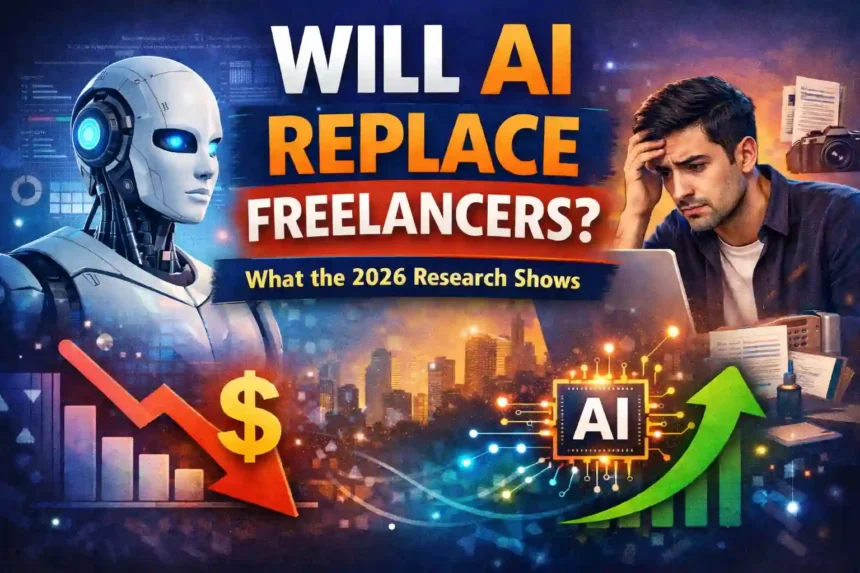
Will AI Replace Freelancers? What the Research Actually Shows
The honest answer is that AI has already caused measurable damage in some skill categories, while demand in others has grown significantly since ChatGPT launched in late 2022.
Three pieces of research make this clear.
First, Ramp’s 2026 spending analysis tracked actual business spending at the firm level. Freelance marketplace spending as a share of total business spend dropped from 0.66% in Q4 2021 to 0.14% in Q3 2025. That is nearly a five-fold decline. More than half of businesses that were using freelancers in 2022 had completely stopped by 2025.
Second, a peer-reviewed study published in ScienceDirect found that aggregate freelance demand did not decrease after the ChatGPT launch. Demand actually increased, but only in skill clusters that complement or are unaffected by AI. Demand for substitutable skills like writing and translation dropped by 20 to 50 percent.
Third, Brookings Institution research found something that surprised most analysts: high-skill freelancers are disproportionately affected, not insulated. Their work in writing, design, and complex creative tasks overlaps most directly with what generative AI does well.
The implication is precise. AI is not replacing freelancing as a category. It is replacing the outputs that AI can now produce at near-zero cost. Freelancers who produce those outputs at those price points are the ones facing real displacement.
Is Freelancing Still Safe from AI?
Freelancing is still viable in 2026, but safety depends entirely on your skill category and pricing model. Freelancing jobs at risk from AI are those priced per output in areas AI can now replicate: basic writing, translation, data entry, and simple design. Freelancing roles structured around judgment, specialization, and client relationships have not lost ground and, in some categories, have grown significantly.
This distinction matters because it reframes the question. The AI impact on freelancing is not uniform. It is concentrated in the lowest-margin, highest-volume, most-repeatable segment of the market. That segment was always the most fragile: it competed on price, not on expertise. AI accelerated a consolidation that was already structurally likely.
The freelancing jobs safest from AI share three consistent characteristics. First, they require domain knowledge that a brief cannot fully capture: knowing why a fintech client needs compliance-specific language, not just that they need content. Second, they involve ongoing client relationships where context accumulates over time. Third, they are priced on outcomes rather than outputs: a retained strategist is not evaluated per deliverable.
Freelancing after AI looks different from freelancing before it. The baseline expectation has shifted. Clients now assume some AI involvement in most deliverables. What they are paying a premium for is the human judgment layer on top: the edit, the strategy, the accountability, and the relationship. That layer is not something AI can replace by definition, because it is built on trust established over time.
Which Freelance Skills Are Most at Risk in 2026?
Research from Cornell University via DesignRush shows demand drops of 20 to 50 percent for substitutable skills on online labor platforms. The table below maps specific risk levels to the data:
| Skill | Risk Level | Data Point |
|---|---|---|
| Basic content writing | Very High | Writing jobs down 33% since ChatGPT |
| Translation | Very High | Translation jobs down 19 to 20% |
| Data entry | Very High | 7.5M admin jobs at risk by 2027 |
| Basic graphic design | High | Image creation work down 17% |
| Simple coding / scripts | High | Software dev jobs down 21% |
| Customer support scripts | High | 80% of support roles at automation risk |
| Video editing (basic) | Medium | AI tools growing; complex editing still human |
| SEO content strategy | Medium | Research and strategy remain human-led |
| Web development (complex) | Low to Medium | Architecture and custom builds still human |
| Consulting and strategy | Low | Judgment, relationships, and context-specific work |
| AI integration specialist | Very Low | Demand tripled post-ChatGPT |
The pattern is consistent across every category. Risk is highest where the task is repeatable, the output is generic, and the price is set per unit. Risk is lowest where the work requires judgment, industry context, or a relationship that spans multiple projects.
Understanding where your current skill set sits on this table is the first step. Everything else follows from that.
If you are building your freelance career from the ground up, follow the step-by-step freelancing roadmap for 2026 before investing time in any skill category. Starting in the wrong direction in 2026 is a more expensive mistake than it was in 2022.
Why Are High-Skill Freelancers Also Getting Hit?
Most freelancers assume that being good at their craft protects them from AI displacement. The data says otherwise.
Research from Washington University in St. Louis, cited by Jobbers.io, found that top-performing freelancers are experiencing the most significant setbacks. For every 1 percent increase in a freelancer’s past earnings, they experience an additional 0.5 percent drop in job opportunities and a 1.7 percent decrease in monthly income following AI introduction.
The reason is structural. High earners were concentrated in exactly the fields AI targets first: content creation, design, and creative work. The skill level was genuinely high. But the underlying task was still repeatable. A 2,000-word product review, a logo for a startup, a translated product description: these require real skill to do well, but they follow predictable patterns that AI can replicate at scale.
When Neemesh analyzed which NoCostTools pages held organic search rankings after AI content tools scaled in 2024, the pattern was consistent: pages producing generic, templated output lost visibility fastest. Pages with specific data, original positioning, and expert analysis held and grew. The same dynamic applies to freelancers. Producing high-quality generic output is no longer a defensible position. Producing output that requires genuine context and judgment still is.
The distinction is between executing a task and solving a problem. Freelancers who built their income on output production face the same pressure regardless of their skill level. Freelancers who built it on problem-solving face much less.
Which Freelancers Are Actually Growing in 2026?
In 2026, clients no longer pay primarily for doing the work. They pay for decisions made with speed, clarity, and reliability. AI has compressed technical effort but expanded the need for judgment, communication, and systems thinking.
Four freelancer profiles are growing:
The AI Operator: Volume Through Speed
The AI Operator uses AI tools to deliver five times the output at the same price. This freelancer wins on speed and throughput. A content writer who used to deliver three articles per day now delivers fifteen, at the same quality standard, using AI drafting and human editorial judgment. The rate per article is lower, but the total income is higher.
The Specialist: Niche So Deep That AI Output Looks Generic
The Specialist niches so specifically that AI output looks generic by comparison. A “fintech compliance content writer” or a “SaaS onboarding UX writer” cannot be replaced by a general AI because the value is in the domain knowledge, not the writing mechanics. If you are choosing your niche, this breakdown of high-paying freelance skills in 2026 shows which specializations carry the strongest rate premiums by category, with hourly rate ranges for each.
The Strategist: Moving From Execution to Direction
The Strategist moves from execution to direction. This freelancer does not write the copy; they decide what the copy needs to accomplish. They do not design the landing page; they determine what the landing page needs to communicate. Strategy requires an understanding of the client’s business context in a way that AI cannot access from a brief.
The AI Integrator: The Fastest-Growing Freelance Category in 2026
The AI Integrator helps businesses implement and manage AI tools. According to 2727Coworking’s analysis, machine learning programming grew 24 percent, and AI chatbot development nearly tripled after ChatGPT’s launch. This is the fastest-growing freelance category in 2026, and demand continues to outpace supply.
The common thread across all four profiles is that none of them are competing on output. They are competing on judgment, context, or capability that AI either cannot replicate or is not yet expected to provide alone.
If your freelance income has dropped in the last 12 months, the likely cause is not a slow market. It is a positioning mismatch. This guide on how to set freelance rates in 2026 walks through exactly how to reprice your services based on value delivered, not hours or word counts. Pricing strategy and positioning strategy are not separate decisions.
The $0.03 Problem: Why Task-Priced Freelancers Cannot Compete on Price
The Ramp study found a number that explains the math of this shift precisely. Firms in the highest AI exposure quartile substituted one dollar of freelance labor for just three cents of AI spending. A business that was spending Rs. 8,00,000 per year on freelance content is now getting comparable output for Rs. 24,000 in AI tool costs.
This is not a pricing negotiation. It is a structural cost shift.
For freelancers priced per task, this math is impossible to compete with directly. If a client was paying Rs. 2,000 for a 500-word article that AI now produces for Rs. 20, no pricing adjustment closes that gap.
The only sustainable response is to move up the value chain. The move is from producing content to strategizing content. From writing code to architecting systems. From translating documents to managing multilingual content strategy. The output that AI produces becomes an input that the freelancer manages, refines, and takes strategic responsibility for.
This shift is not automatic. It requires building different skills, having different conversations with clients, and writing different proposals. Most freelancers lose the positioning battle at the proposal stage, before the client even sees their rates. If that pattern sounds familiar, this guide to writing freelance proposals that win clients shows how to restructure your pitch around value delivered instead of tasks completed.
What I’m Seeing on Freelance Platforms Right Now (March 2026)
Data from studies is important. What is happening on actual platforms right now is more immediate.
Neemesh has been tracking freelance market behavior across Upwork, Fiverr, and Freelancer.com over the past several months, both through direct observation and through conversations with freelancers in his teaching and SEO community. The platform-level patterns are worth knowing.
Client language has changed. Briefs that used to say “write me a blog post” now increasingly say “review and polish this AI draft” or “provide strategic direction for our content calendar.” Clients are not hiding that they use AI. They are openly building it into their workflow and looking for freelancers who fit around it.
Rates for commodity writing have not just dropped; they have restructured. The Rs. 2,000 to 2,500 per article range that was standard for decent blog content two years ago has compressed to Rs. 600 to 900 for basic posts on most platforms. At the same time, rates for content strategy engagements, editorial oversight roles, and AI content auditing have held or increased.
Short-term gig postings are declining; project-based and retainer postings are growing. Clients who have bad experiences with AI output (low accuracy, wrong tone, no industry specificity) come back to freelancers but they come back looking for ongoing relationships, not one-off tasks. This shift rewards freelancers who can position for continuity rather than transaction.
New job categories are appearing that did not exist in 2023. Titles like “AI content reviewer,” “prompt strategy consultant,” “AI workflow auditor,” and “human-in-the-loop editor” are now posted regularly on major platforms. Most freelancers have not updated their profiles to reflect competency in these areas, which means the competition for these postings is lower than it should be.
The picture that emerges from the platform level matches the research: the floor of the market has dropped significantly, and the ceiling has risen. The freelancers doing well are not the ones who adapted fastest. They are the ones who moved in the right direction, toward judgment, specialization, and relationship, before the pressure forced them to.
What Should Freelancers Do Right Now to Survive AI Disruption?
The actions that matter most are specific. “Learn AI” is not an action plan. The table below is:
| Action | Timeline | What It Does |
|---|---|---|
| Audit which of your current tasks AI can now do | This week | Identifies your actual risk level, not your perceived risk level |
| Add one AI tool to your existing workflow | This month | Makes you faster without changing your positioning |
| Niche down by industry, not just skill | 60 days | Generic AI cannot serve specific industries |
| Move at least one service to retainer pricing | 90 days | Shifts value from output to relationship |
| Learn one AI-adjacent skill (prompt engineering, AI QA, AI strategy) | 90 days | Creates a new billable service category |
The audit step is the one most freelancers skip. Before making any positioning changes, it is worth being honest about which parts of your current workflow AI can already replicate and at what quality level. The answer tells you where your risk is concentrated.
Retainer pricing is worth particular attention. A client paying a monthly retainer for strategic guidance is not evaluating you on the cost of each output. They are paying for reliability, judgment, and a relationship that reduces their decision-making burden. AI cannot provide that relationship, regardless of what it can produce.
For freelancers still building their client base, this comparison of the best freelancing platforms for beginners in 2026 shows which platforms still have strong human-freelancer demand and which have seen the sharpest AI-driven contractions. The platform you choose shapes your rate ceiling and your client type. It is not a neutral decision.
The Future of Freelancing with AI in 2026 and Beyond
The AI impact on the freelancing industry is not a one-time disruption. It is a structural reset that continues to move as AI capabilities expand. Understanding the trajectory is as important as understanding the current state.
Three shifts define where the market is heading.
The floor keeps dropping, but the ceiling keeps rising. AI tool quality improves every six to nine months. Tasks that still require human skill today will require less human involvement in 18 months. This does not mean freelancers are running out of time; it means the window for repositioning from execution to strategy is not unlimited. Freelancers who have not moved up the value chain by mid-2026 will face steeper repositioning costs than those who move now.
Clients are becoming more sophisticated buyers. In 2023, many clients did not know what AI could or could not do. By 2026, most medium and large businesses have experimented with AI outputs and understand their limitations: generic tone, factual errors, no industry context, no accountability. They are returning to freelancers not because they gave up on AI, but because they understand where AI stops and human expertise begins. This creates a more educated client pool, which is better for freelancers who can articulate their value clearly.
Freelancing after AI is a hybrid model, not a replacement model. The dominant work pattern in 2026 is not “AI instead of freelancers” or “freelancers instead of AI.” It is freelancers who operate AI tools, take responsibility for output quality, and provide the strategic layer that connects AI capability to client goals. Understanding what AI literacy actually requires is now a prerequisite for any freelancer building a durable practice, not a nice-to-have.
The future of freelancing with AI is not uncertain. The direction is clear: generalist, task-priced, output-measured freelancing contracts. Specialist, relationship-priced, judgment-measured freelancing grows. The only real question is which side of that divide you are building toward.
The data is not comfortable for freelancers doing task-based, commodity work. It is genuinely encouraging for freelancers who specialize, use AI as a tool, and price on value rather than output volume.
Some freelancers have already been displaced. That is real, and pretending otherwise does not help anyone. But the displacement is concentrated and specific: it is hitting repeatable, price-sensitive, output-measured work the hardest.
The freelancers who are building toward a durable position in 2026 share three characteristics. They understand what AI can and cannot replace in their specific skill area. They have moved at least part of their income toward relationship-based or strategy-based services. And they treat AI as a tool that makes them more capable, not a competitor that makes them irrelevant.
The question is not whether AI will replace freelancers. The question is which kind of freelancer you are building toward.
Which of the four freelancer profiles, the AI Operator, the Specialist, the Strategist, or the AI Integrator, best describes where you want to position yourself? Share your thinking in the comments below.
Frequently Asked Questions
Is freelancing dying because of AI in 2026?
Freelancing is not dying, but it is restructuring. According to Ramp’s 2026 spending data, spending on freelance marketplaces dropped significantly, and more than half of businesses that used freelancers in 2022 have stopped by 2025. At the same time, a ScienceDirect study found that overall freelance demand did not decrease after ChatGPT launched; it shifted toward skills that AI cannot easily replicate. Freelancing as a category is not dying. Commodity freelancing is being restructured out of the market.
Which freelance jobs are safest from AI replacement in 2026?
The safest freelance categories are those requiring judgment, industry-specific knowledge, or direct client relationships. According to Cornell University research via DesignRush, demand for AI integration specialists nearly tripled after ChatGPT launched, and machine learning programming grew 24 percent. Strategy consulting, AI integration, complex web architecture, and industry-specific content (fintech, legal, medical) remain the most durable positions. The common factor is that these roles require context AI cannot access from a brief.
Should I stop learning content writing because of AI?
Content writing as a standalone task is under significant pressure; writing jobs dropped 33 percent after ChatGPT launched, according to DesignRush. But content strategy, editorial judgment, and industry-specific writing remain valuable. The better move is not to stop learning writing, but to stop positioning writing as your primary service. Positioning yourself as a content strategist who also produces content is a fundamentally different value proposition, and one that AI cannot yet replicate independently.
How are successful freelancers using AI in 2026?
Successful freelancers are using AI in three ways: to produce first drafts that they then edit and refine with expert judgment; to handle research and data aggregation so they can spend more time on analysis; and to offer AI implementation services to clients who need help integrating AI into their own workflows. The key pattern is that AI handles repetitive, lower-judgment parts of the workflow, while the freelancer focuses on the decisions and context that require real expertise.
Will Fiverr and Upwork survive AI disruption?
Both platforms are actively adapting. Upwork and Fiverr have introduced AI-powered matching tools and are repositioning toward higher-value, longer-term engagements rather than one-off task orders. The platforms most at risk are those built entirely around commodity task completion. The long-term model for both is likely to shift toward managed service relationships and project-based engagements, where the platform provides coordination value that AI alone cannot replace.