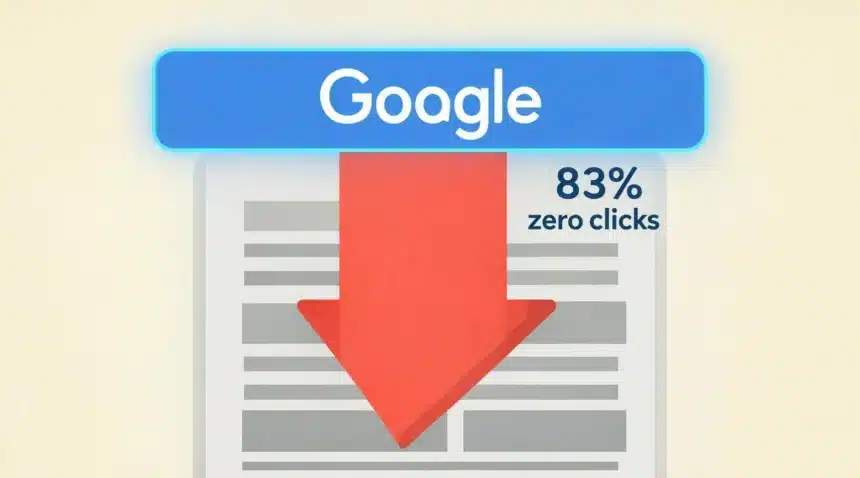
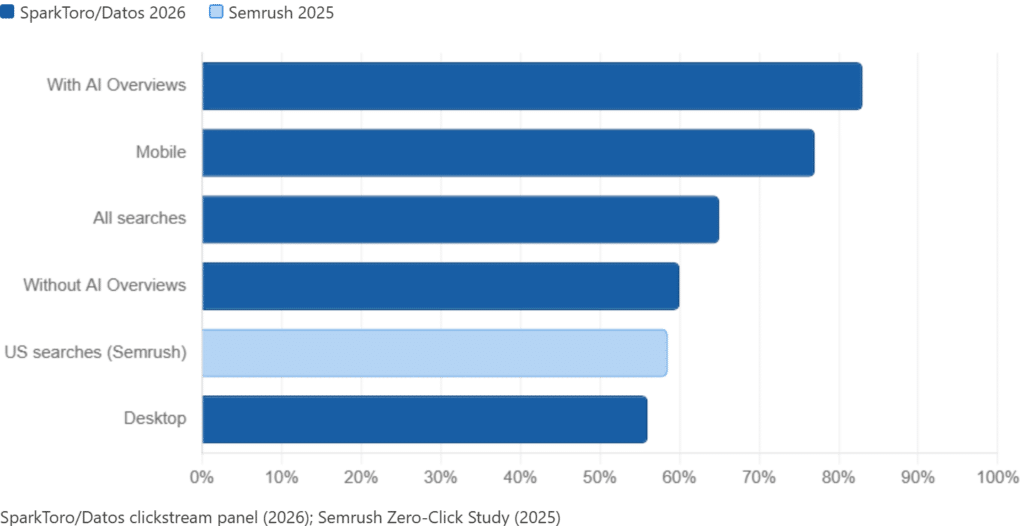
65% of all Google searches now end without a click to any website (SparkToro/Datos, 2026). Organic click-through rates fell 61% for queries where AI Overviews appear (Seer Interactive, Nov 2025). And 83% of searches that trigger an AI Overview end in zero clicks, compared to 60% for searches without one (SparkToro/Datos, Aug 2025). Gartner predicts traditional search volume will drop 25% by 2026 as users shift to AI-powered answer engines.
We aggregated data from Pew Research, SparkToro/Datos, Seer Interactive, Semrush, Ahrefs, Gartner, Bain, Conductor, Amsive, and dozens of other primary sources to compile the most comprehensive AI Overviews and zero-click search statistics available in 2026. Every stat below is sourced, dated, and methodology-checked.
Key Takeaways
- 65% of all Google searches end without a click (SparkToro/Datos, 2026)
- 83% of searches with AI Overviews end in zero clicks vs 60% without (SparkToro/Datos, Aug 2025)
- AI Overviews appear in 13–25% of all US searches overall (Semrush, 2025), but in 99.9% of informational queries (Ahrefs, Nov 2025)
- Position-1 CTR dropped 34.5% when AI Overviews appear (Ahrefs, 300K-keyword study, 2025)
- Overall organic CTR fell 61% for AIO queries: from 1.76% to 0.61% (Seer Interactive, Nov 2025)
- Paid CTR fell 68% on AIO queries: from 19.7% to 6.34% (Seer Interactive, Nov 2025)
- Sites cited in AI Overviews earn 35% more organic CTR and 91% more paid CTR than non-cited sites on the same query (Seer Interactive, Nov 2025)
- Mobile zero-click rate is 77% vs 56% on desktop (SparkToro/Datos, 2026)
- Branded queries with AI Overviews see +18.68% CTR while non-branded fall 19.98% (Amsive, 2025)
- Relationships niche: 54.84% AI Overview trigger rate. E-commerce: just 3.2–4% (SE Ranking, 2025; Ahrefs, Nov 2025)
- Only 8% of users click traditional results when an AI summary appears, vs 15% without (Pew Research, July 2025)
- Gartner predicts a 25% drop in traditional search volume by 2026
1. Zero-Click Search: How Big Is the Problem?
Zero-click search is not a new problem. SparkToro’s clickstream research first documented it in 2019, when roughly 50% of Google searches already ended on the results page. What changed between 2024 and 2026 is the acceleration rate. The arrival of AI Overviews pushed the zero-click share upward faster than any single SERP feature before it.
The most important cut of this data is not the headline number. It’s the gap between AIO and non-AIO queries. 83% of searches that trigger an AI Overview end without a click, compared to 60% for searches without one. That 23-percentage-point gap tells you exactly where the risk is concentrated: any informational content that AI Overviews can summarize is at maximum exposure.
The device split adds another layer. Mobile users hit 77% zero-click, while desktop users sit at 56%. This matters because mobile now accounts for the majority of Google searches globally.
83%
of searches with AI Overviews end without a click (SparkToro/Datos, Aug 2025)
| Metric | Value | Source |
|---|---|---|
| Overall Google zero-click rate (2026) | 65% | SparkToro/Datos, 2026 |
| Zero-click rate: queries with AI Overviews | 83% | SparkToro/Datos, Aug 2025 |
| Zero-click rate: queries without AI Overviews | 60% | SparkToro/Datos, Aug 2025 |
| Mobile zero-click rate | 77% | SparkToro/Datos, 2026 |
| Desktop zero-click rate | 56% | SparkToro/Datos, 2026 |
| US zero-click rate (Semrush measurement) | 58.5% | Semrush, Zero-Click Study, 2025 |
Why do SparkToro (65%) and Semrush (58.5%) give different numbers? Different panels, different sampling. SparkToro’s Datos clickstream panel captures a broader range of query types. Semrush’s study focused on US desktop keywords with over 100 monthly searches. Both are accurate; they measure different slices of the same market.
2. AI Overviews: How Many Searches Actually Trigger Them?
The prevalence numbers for AI Overviews range from 13% to 48% depending on which study you read. This gap is methodology, not error. It matters because bloggers who write informational content are in the highest-exposure category, regardless of what the average looks like.
99.9% of informational queries now trigger an AI Overview (Ahrefs, Nov 2025). That’s the number that should anchor your strategy, not the headline average.
| Metric | Value | Source |
|---|---|---|
| AI Overviews: share of all US searches (Semrush range) | 13–25% | Semrush, AI Overviews Study, 2025 |
| AI Overviews: share of all US searches (Conductor) | 25.11% | Conductor, AEO/GEO Benchmarks, Q1 2026 |
| AI Overviews: informational intent queries | 99.9% | Ahrefs, Nov 2025 |
| AI Overviews: commercial intent queries | 8.69% | Semrush, AI Overviews Study, 2025 |
| AI Overviews: question-format queries | 57.9% | Ahrefs, Nov 2025 |
| AI Overviews: local search queries | 7.9% | Ahrefs, Nov 2025 |
| AI Overviews: monthly users globally | 2 billion | Alphabet, Q2 2025 Earnings Call |
BrightEdge reports AIO prevalence as high as 48%. The reason: their tracking panel is weighted toward the query categories most likely to trigger AI Overviews. It’s not wrong. It reflects the reality for publishers focused on health, science, and education content. Semrush’s 13–25% range reflects a broader, more representative sample.
This matters for EduEarnHub readers. If you publish how-to content, educational explainers, or informational guides, your content lives in the 99.9% zone. The average prevalence figure is almost irrelevant to your actual exposure.
3. The CTR Collapse: What the Data Actually Shows
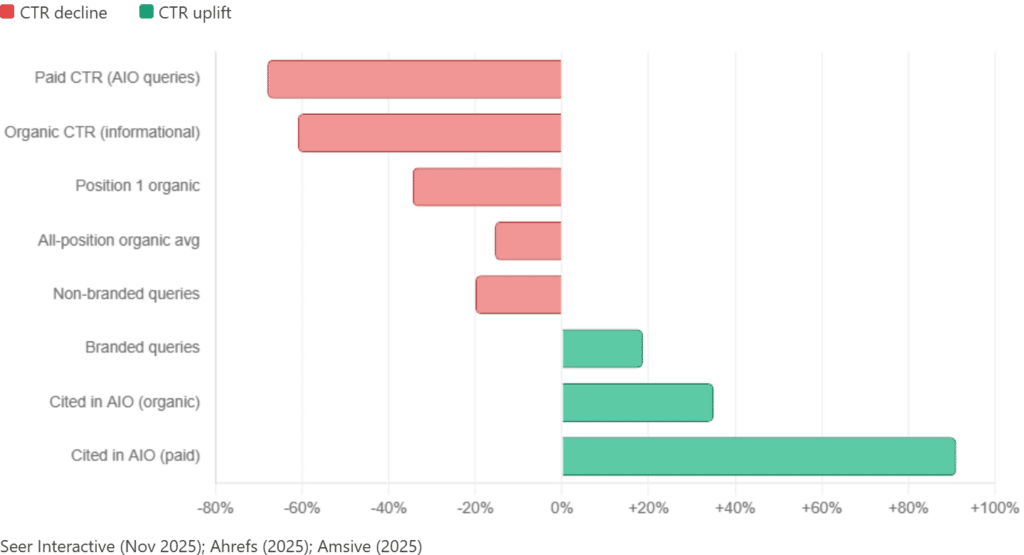
Three major independent studies measured how AI Overviews affect click-through rates. They gave three different answers: 15.49%, 34.5%, and 61%. None of them are wrong. They measured different things.
This matters because the “average” you see cited in most roundups depends entirely on which study the writer picked. The full picture is more useful. Organic CTR fell 61% for informational queries across 3,119 queries and 25.1 million impressions tracked by Seer Interactive over 15 months. That’s the most comprehensive longitudinal dataset available.
The most actionable finding in all three studies is buried: being cited inside an AI Overview reverses the penalty entirely. Sites cited in AIO earn 35% more organic CTR and 91% more paid CTR than non-cited sites competing for the same query.
-61%
organic CTR drop for informational queries with AI Overviews (Seer Interactive, Nov 2025)
| Metric | Value | Source |
|---|---|---|
| Organic CTR decline (AIO queries, all positions avg) | -15.49% | Amsive, 700K-keyword study, 2025 |
| Organic CTR decline (position 1, AIO present) | -34.5% | Ahrefs, 300K-keyword study, 2025 |
| Organic CTR decline (informational queries, overall) | -61% | Seer Interactive, Nov 2025 |
| Paid CTR decline (AIO queries) | -68% | Seer Interactive, Nov 2025 |
| CTR uplift: cited within an AI Overview (organic) | +35% | Seer Interactive, Nov 2025 |
| CTR uplift: cited within an AI Overview (paid) | +91% | Seer Interactive, Nov 2025 |
| Branded queries with AIO: CTR change | +18.68% | Amsive, 2025 |
The Pew Research Center ran the most rigorous controlled behavioral study available. Across 68,879 real searches, users clicked traditional results in only 8% of visits when an AI summary appeared, compared to 15% without one. That’s a 46.7% relative decline in clicks. The reason this study is significant: it tracked actual browser behavior, not keyword rankings or modeling.
Why do the three CTR studies differ?
Amsive’s 15.49% figure spans all query types and positions across 700,000 keywords. Many of those queries weren’t informational. Ahrefs’ 34.5% focused specifically on position-1 rankings. Seer Interactive’s 61% tracked only informational queries over 15 months of longitudinal data. Each is accurate within its sample. Your CTR impact depends on your query type, your ranking position, and whether you’re cited in the AIO.
4. Which Niches Get Hit Hardest (And Which Are Safer)
The “average” AI Overview impact stat tells bloggers almost nothing useful. A recipe blogger and a real estate blogger face completely different realities in 2026. Niche-level data is where strategy actually begins.
The highest-exposure niches are Relationships (54.84%), Healthcare (43–63%), Science (43.6%), and Business (38.84%). These are categories where informational queries dominate and AI Overviews can answer the user’s question without a click. The lowest-exposure niches are Shopping (3.2%) and Real Estate (5.8%), where Google still relies on maps, inventory, and local data that AI can’t summarize effectively.
If you publish content in the technology and AI tools space, the 33.67% trigger rate for the Technology niche means roughly one in three of your informational queries already shows an AI Overview above your content.
Bar chart showing AI Overview trigger rates by content niche in 2025-2026
SE Ranking (2025); Ahrefs Nov 2025; BrightEdge 2025. Healthcare shown as midpoint of 43–63% range.
| Niche | AI Overview Trigger Rate | Source |
|---|---|---|
| Relationships | 54.84% | SE Ranking, 2025 |
| Healthcare | 43–63% | Ahrefs + BrightEdge, Nov 2025 |
| Science | 43.6% | Ahrefs, Nov 2025 |
| Business | 38.84% | SE Ranking, 2025 |
| Food & Beverage | 37.14% | SE Ranking, 2025 |
| Technology | 33.67% | SE Ranking, 2025 |
| Real Estate | 5.8% | Ahrefs, Nov 2025 |
| Shopping / E-commerce | 3.2–4% | Ahrefs + Semrush, Nov 2025 |
The Food & Beverage figure deserves specific attention. Semrush’s 2025 study found that food and recipe sites report 50–70% traffic declines as complete recipes now appear directly in AI Overviews. This is one of the most severe niche-specific impacts documented so far.
Real estate and e-commerce content remain the safest for organic clicks in 2026. Google still needs product pages, local listings, and inventory data to satisfy those queries. AI can’t replace that.
Choose a niche above to see your risk profile
5. How Users Actually Behave with AI Summaries
Survey data on user preferences is interesting. Behavioral data from actual searches is more useful.
The Pew Research Center browsing panel tracked 68,879 real searches in March 2025. It’s the largest controlled behavioral study on AI Overview click patterns available. The findings are more sobering than most CTR studies, because they measure what users actually did, not what rankings would predict.
Only 1% of AI Overview citation links get clicked. That’s the figure most publishers haven’t fully absorbed. Being cited in an AI Overview builds authority and brand exposure. It does not reliably drive direct clicks to your site. The reason this still matters: citation builds brand familiarity, which drives direct traffic and branded searches over time.
The session-ending behavior is the finding that changes content strategy most. 26% of AI-summary sessions end the user’s entire Google session. That’s a visitor who never reached any website at all. They got their answer inside Google and closed the tab.
1%
of AI Overview citation links actually get clicked by users (Pew Research, July 2025)
| Metric | Value | Source |
|---|---|---|
| Users clicking traditional results when AIO present | 8% | Pew Research, July 2025 |
| Users clicking traditional results without AIO | 15% | Pew Research, July 2025 |
| AI Overview citation links that get clicked | 1% | Pew Research, July 2025 |
| Sessions ending entirely after AI summary | 26% | Pew Research, July 2025 |
| US adults who encountered AI summary (March 2025) | 58% | Pew Research, Oct 2025 |
| Users who find AI summaries “extremely/very useful” | 21% | Pew Research, Oct 2025 |
Low trust has not reduced reliance. Only 6% of users say they trust AI summaries “a lot,” yet Bain’s February 2025 research found 80% of search users rely on AI summaries for at least 40% of their queries. Usage and trust are decoupled. Users treat AI summaries as a starting point, not a final authority.
This matters for content creators building authority: the goal in 2026 is not just to rank. It’s to become the source that AI systems cite, so your brand appears in that starting-point layer even when the click doesn’t come.
6. What Still Gets Clicks: The Survival Data
Zero-click dominates informational queries. It does not dominate every query type. Transactional, branded, and local queries still convert to clicks at significant rates. Understanding where clicks still happen is the most practical output of all this data.
Branded queries with AI Overviews see a +18.68% CTR increase, while non-branded queries fall 19.98% (Amsive, 2025). This is one of the most under-reported findings in AI search research. When users already know your brand and search for it, an AI Overview that mentions you reinforces trust and drives the click. For sites with no brand recognition, the AIO absorbs the click instead.
The LLM conversion data adds another dimension. Visitors who arrive from AI platforms like ChatGPT, Perplexity, and Gemini convert at 4.4x the rate of traditional organic search visitors (Semrush, 2025). Fewer clicks, but each click carries significantly more intent.
4.4x
higher conversion rate for visitors arriving from AI platforms vs organic search (Semrush, 2025)
| Metric | Value | Source |
|---|---|---|
| Branded queries with AIO: CTR change | +18.68% | Amsive, 2025 |
| Non-branded queries with AIO: CTR change | -19.98% | Amsive, 2025 |
| LLM visitors: conversion rate vs organic search | 4.4x higher | Semrush, 2025 |
| AI-cited content: organic CTR vs non-cited | +35% | Seer Interactive, Nov 2025 |
| E-commerce queries triggering AI Overviews | 3.2–4% | Ahrefs + Semrush, Nov 2025 |
| Voice search queries ending with zero click | 92% | Backlinko, Voice Search Study |
| Keywords outside top-3 positions with AIO: CTR drop | -27.04% | Amsive, 2025 |
The academic research on GEO (generative engine optimization) adds structural context. The Princeton and IIT Delhi GEO paper (Aggarwal et al., 2024) tested 10,000 queries and found that including citations, quotations, and statistics in content boosts AI citation frequency by over 40%. Structured Q&A formatting and FAQ schema are the two highest-ROI content changes for earning AI Overview citations.
This is directly relevant to bloggers tracking their income from search traffic. Diversifying traffic sources is part of the answer, but so is restructuring existing content to earn citations rather than just rankings. Content that gets cited in AI Overviews earns visibility even when clicks don’t follow immediately.
For bloggers who also work as freelancers, this shift has a parallel in client work. Platforms like Upwork still drive income regardless of Google’s AI changes. Understanding how to use your Upwork Connects strategically is one way to reduce dependence on organic search traffic while rebuilding your content strategy for the citation era.
AI Overviews & Zero-Click Search by the Numbers
| Metric | Value | Source |
|---|---|---|
| Overall Google zero-click rate (2026) | 65% | SparkToro/Datos, 2026 |
| Zero-click rate: queries with AI Overviews | 83% | SparkToro/Datos, Aug 2025 |
| Zero-click rate: queries without AI Overviews | 60% | SparkToro/Datos, Aug 2025 |
| Mobile zero-click rate | 77% | SparkToro/Datos, 2026 |
| Desktop zero-click rate | 56% | SparkToro/Datos, 2026 |
| Organic CTR decline (all positions avg) | -15.49% | Amsive, 700K-keyword study, 2025 |
| Organic CTR decline (position 1) | -34.5% | Ahrefs, 300K-keyword study, 2025 |
| Organic CTR decline (informational queries) | -61% | Seer Interactive, Nov 2025 |
| Paid CTR decline (AIO queries) | -68% | Seer Interactive, Nov 2025 |
| CTR uplift: cited in AI Overview (organic) | +35% | Seer Interactive, Nov 2025 |
| CTR uplift: cited in AI Overview (paid) | +91% | Seer Interactive, Nov 2025 |
| Branded queries with AIO: CTR change | +18.68% | Amsive, 2025 |
| AI Overviews: informational queries | 99.9% | Ahrefs, Nov 2025 |
| Healthcare niche: AIO trigger rate | 43–63% | Ahrefs + BrightEdge, Nov 2025 |
| E-commerce niche: AIO trigger rate | 3.2–4% | Ahrefs + Semrush, Nov 2025 |
| Users clicking results when AIO present | 8% | Pew Research, July 2025 |
| AI-summary sessions ending Google session entirely | 26% | Pew Research, July 2025 |
| LLM visitors: conversion rate vs organic | 4.4x higher | Semrush, 2025 |
| Traditional search volume predicted drop by 2026 | -25% | Gartner, 2025 |
| GEO citation boost from structured content | +40% | Aggarwal et al., Princeton/IIT Delhi, 2024 |
Old SEO vs New GEO Comparison Table
| Strategy | Old SEO (2023) | New Reality (2026) |
|---|---|---|
| Primary goal | Rank #1 on page 1 | Get cited inside AI Overview |
| Content format | Long-form informational prose | Q&A structure + FAQ schema |
| Success metric | Organic CTR and impressions | Brand citations + conversion rate |
| Best query type | Informational (“how to,” “what is”) | Transactional + branded searches |
| Link building focus | Domain authority for rankings | E-E-A-T signals for citation trust |
| Traffic source | Google organic (one channel) | Google + LLMs + email + direct |
| Content update cycle | Yearly refresh | Quarterly (AI trains on fresh data) |
| Keyword research goal | Find high-volume queries | Find low-AIO-exposure queries |
Conclusion
The data points in one direction. Informational content that AI Overviews can summarize is losing clicks at scale. The rate depends on your niche, your query type, and whether your content earns a citation inside the summary.
Three things the data supports as responses:
First, earn citations rather than just rankings. Being cited in an AI Overview on an informational query gives you a 35% CTR uplift over non-cited competitors. This requires structured Q&A formatting, FAQ schema, and content that directly answers specific questions.
Second, build content in lower-AIO niches where clicks still flow. E-commerce, real estate, and local content face 3–6% AIO exposure. Informational content faces 99.9%.
Third, build your brand. Branded queries with AI Overviews see a CTR increase, not a decline. The clearest hedge against zero-click erosion is becoming a brand users search for by name.
The transition from traffic-first to citation-first content is already happening. Sites that understand the difference between ranking and being cited will hold more traffic than those still optimizing for position alone.
Have you checked which of your keywords now trigger AI Overviews? Share what you found in the comments below.
EduEarnHub — 2026 checklist
Your AI Overview survival checklist
16 actions across 4 phases. Check off each item as you complete it — progress saves automatically.
Frequently Asked Questions
What percentage of Google searches end without a click in 2026? 65% of all Google searches end without a click to any external website, according to SparkToro/Datos clickstream data from 2026. When AI Overviews appear, that rate rises to 83%. Without AI Overviews, the zero-click rate is 60%. The gap between these two figures shows how significantly AI Overviews accelerate zero-click behavior beyond what SERP features alone produce.
How much have AI Overviews reduced organic CTR? Three major studies give three different answers. Amsive’s 700,000-keyword study found a 15.49% average CTR decline across all positions. Ahrefs’ 300,000-keyword study found a 34.5% drop at position 1. Seer Interactive’s longitudinal study of 3,119 informational queries found a 61% organic CTR decline over 15 months. The differences reflect different samples and query types. Informational content faces the steepest impact.
Which niches are most affected by AI Overviews? Relationships (54.84% trigger rate), Healthcare (43–63%), Science (43.6%), and Food & Beverage (37.14%) face the highest AI Overview exposure. E-commerce (3.2–4%) and Real Estate (5.8%) face the lowest. The reason: high-exposure niches rely on informational queries that AI can answer directly. Low-exposure niches rely on local data, inventory, or real-time information that AI cannot replace.
Does getting cited in an AI Overview help or hurt your traffic? It helps. Sites cited inside an AI Overview earn 35% more organic CTR and 91% more paid CTR than non-cited competitors on the same query (Seer Interactive, Nov 2025). This inverts the traditional SEO model: the goal is no longer just to rank in position 1. It’s to appear inside the AI Overview itself. Structured content, FAQ schema, and direct-answer formatting increase citation probability.
What types of queries still generate clicks in 2026? Transactional queries, branded searches, and local queries still generate strong click rates. Branded queries with AI Overviews see a +18.68% CTR increase (Amsive, 2025). E-commerce queries trigger AI Overviews just 3.2–4% of the time, leaving product and category pages largely protected. Local queries, where users need maps, hours, and directions, also remain click-heavy because AI cannot satisfy that intent on-page.
Methodology and Sources
All statistics in this report come from primary research studies published between July 2024 and April 2026. Every figure traces to a named study with disclosed methodology.
Primary sources:
- SparkToro/Datos Clickstream Panel (2026): US desktop and mobile search behavior across tens of millions of queries
- Semrush Zero-Click Study (2025): Analysis of US desktop keywords with 100+ monthly searches
- Semrush AI Overviews Study: 10M+ keyword analysis of AIO prevalence and CTR impact, published Dec 2025
- Ahrefs CTR Study: 300,000-keyword Google Search Console analysis comparing March 2024 vs March 2025
- Seer Interactive (Nov 2025): 3,119 informational queries, 25.1 million organic impressions, 1.1 million paid impressions across 42 organizations, June 2024 to September 2025
- Amsive (2025): 700,000-keyword study across 10 websites and 5 industries
- Pew Research Center Browsing Panel (July 2025): 68,879 tracked searches from a 900-person panel, March 2025
- Pew Research Center ATP Consumer Survey (Oct 2025): 5,153 respondents
- Conductor AEO/GEO Benchmarks Report (Q1 2026): Analysis of 21.9 million search queries
- SE Ranking Niche Study (2025): AI Overview trigger rates by content category
- Advanced Web Ranking CTR Report (2025)
- Bain & Company (Feb 2025): Consumer reliance on AI summaries survey
- Gartner (2025): Traditional search volume projection
- Aggarwal et al., “GEO: Generative Engine Optimization,” Princeton University / IIT Delhi, 2024 (KDD 2024). Available at arxiv.org/abs/2311.09735
- Alphabet Q2 2025 Earnings Call: AI Overviews user figures
Recency note: All statistics come from data collected in 2025 or early 2026. No figures older than 18 months are used in this report.
Last updated: April 2026. We update this page quarterly as new primary data becomes available.