Student AI usage jumped from 66% in 2024 to 92% among university students in 2025. That is not gradual adoption. That is a near-complete shift in how an entire generation learns, conducts research, and completes academic work, all compressed into a single school year.
For students, bloggers, and working professionals, understanding these AI in education statistics is not an academic exercise. The data tells you where the job market is moving, which skills are attracting the highest demand, and how AI is changing what it means to learn something well. This post covers it all, with the numbers to back up every claim.
Key AI in Education Statistics at a Glance (2026)
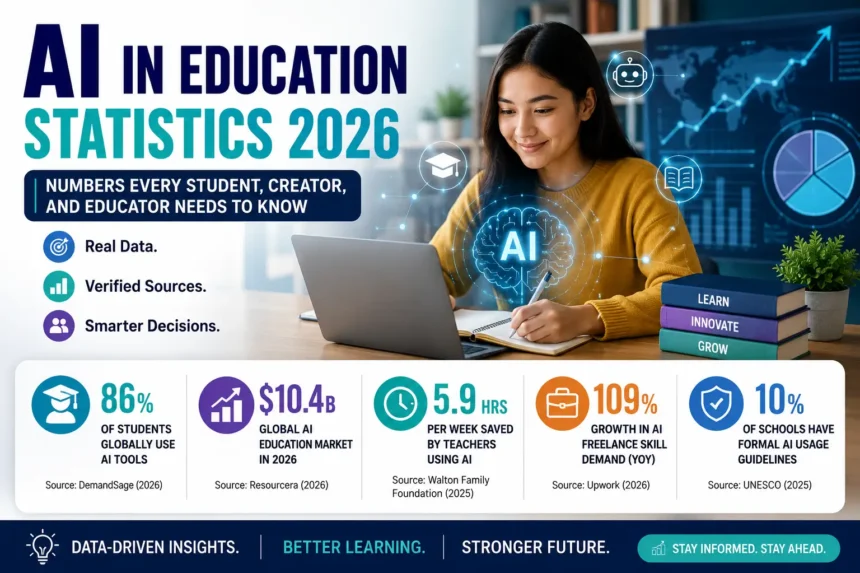
- 86% of students globally use AI tools for their studies
- Global AI education market: $10.4 billion in 2026
- Teachers save 5.9 hours per week using AI, adding up to six weeks annually
- AI freelance skill demand grew 109% year-over-year on Upwork
- Only 10% of schools worldwide have formal AI usage guidelines
How Big Is the AI in Education Market in 2026?
The global AI in education market reached $10.4 billion in 2026, with North America accounting for the largest regional share at 36%. The market is projected to grow at a compound annual growth rate of 31.2% through 2030, reaching $32.27 billion, with long-term forecasts pointing toward $136.79 billion by 2035.
That trajectory reflects more than investor enthusiasm. It reflects the pace at which schools, universities, and online learning platforms are building AI directly into their core infrastructure, from adaptive tutoring systems to automated grading and student performance analytics.
The table below shows the market’s growth path from 2024 through the long-term forecast.
| Year | Market Value | Notes |
|---|---|---|
| 2024 | $5.47 billion | Baseline year |
| 2025 | $7.05–$7.57 billion | Rapid institutional adoption |
| 2026 | $10.4 billion | Current valuation |
| 2030 | $32.27 billion | Projected (31.2% CAGR) |
| 2035 | $136.79 billion | Long-term forecast |
The Middle East and Africa region, currently at $0.56 billion, is projected to grow at 34.3% CAGR through 2030. The fastest-growing segment within the market is machine learning, which accounted for 64% of the total market share in 2025, driven by intelligent tutoring systems and adaptive content delivery.
This matters for anyone building skills in AI or content creation. A $10 billion market with a 31% growth rate does not stay quiet. The tools, the jobs, and the demand for people who understand them are all expanding at the same pace.
How Many Students Use AI for Learning?
Global student AI usage has reached near-universal levels, with 86% of students across 16 countries using AI tools in their studies as of 2026, up from 66% in 2024.
At the university level, adoption is even higher. According to data from the Digital Education Council and HEPI, 92% of university students now use AI tools, and 88% acknowledge using generative AI specifically for assessments, a figure that stood at just 53% in 2024.
The most widely used tool is ChatGPT, with 66% of students reporting regular use. Grammarly and Microsoft Copilot follow at 25% each. On average, students use 2.1 AI tools simultaneously for their coursework.
| AI Tool | Student Usage Rate | Primary Function |
|---|---|---|
| ChatGPT | 66% | Research, writing, problem-solving |
| Grammarly | 25% | Grammar and writing assistance |
| Microsoft Copilot | 25% | Productivity and general assistance |
In the US specifically, 51% of students aged 14 to 22 use generative AI, with this age group representing the most active adopters. Among younger teenagers, 19% use ChatGPT for schoolwork, rising to 24% among 11th and 12th graders.
For students exploring AI tools built specifically for learning, the range of available tools has expanded well beyond general-purpose chatbots into subject-specific tutors, writing coaches, and study planners.
What Are Students Actually Using AI For?
The breakdown of how students use AI reveals a clear pattern: they use it for tasks that require time and mental effort, not tasks that are already quick.
Research from Harvard GSE and the Digital Education Council shows the following use case distribution:
| Use Case | Percentage of Students |
|---|---|
| Getting information / research | 53% |
| Brainstorming ideas | 51% |
| Summarizing content | 38% |
| Generating study guides | 33% |
| Making images or visuals | 31% |
| Creating sound or music | 16% |
| Writing or debugging code | 15% |
Around 50% of students have used an AI writing tool at least once for school. Among teens, 69% say they accept AI-generated content for research purposes, while 20% use it for essays.
The implication here is practical. Students are not just using free AI chatbots for minor convenience tasks. They are integrating AI into the parts of learning that require the most cognitive effort: forming ideas, processing large amounts of information, and structuring written output. Whether this builds or replaces those skills depends entirely on how the tools are used.
Does AI Actually Improve Student Performance?
When used correctly, AI tutoring produces measurable learning gains. But the research also shows a consistent risk: performance during AI-assisted practice does not always transfer to independent performance.
The positive case is strong. A 2025 randomized controlled trial published in Scientific Reports found that AI tutoring outperformed traditional active-learning classrooms, with effect sizes between 0.73 and 1.3 standard deviations. Students in AI-powered learning environments show 54% higher test scores and 30% better learning outcomes compared to students in standard classroom settings.
The completion data tells a similar story. Students on AI-personalized learning platforms complete 91% of lessons, compared to 72% on traditional platforms. AI dropout prevention systems have reduced student dropout rates by 15% in several programs. In Spain, a government-funded AI platform helped 85% of users improve their final math grades.
The risk, however, is real and documented. The PNAS study from the University of Pennsylvania, conducted with nearly 1,000 high school students, found that students solved 48% more problems correctly during AI-assisted practice, but scored 17% worse than non-AI students on an independent test afterward. The gains during practice did not transfer to independent performance.
The pattern across this research is consistent: AI improves outcomes when it scaffolds the learning process. It reduces outcomes when it replaces the cognitive effort that builds lasting knowledge. This distinction matters for anyone building skills, not just for formal academic study.
How Many Teachers Use AI, and What Does It Do for Them?
60% of US teachers used AI during the 2024-25 school year, and those who use it at least weekly save an average of 5.9 hours per week, the equivalent of six full work weeks across a standard school year.
The Gallup-Walton Family Foundation study, conducted with 2,232 US public school teachers, is the most detailed look at where those hours come from. Teachers reclaim time across nine categories of work tasks, with the largest savings concentrated in lesson preparation, worksheet and assessment creation, and administrative communications.
| Task | % of Teachers Who Save Time | Quality Improvement Reported |
|---|---|---|
| Creating worksheets / assessments | 84% | 64% say quality improved |
| Administrative work | 80% | 74% say quality improved |
| Preparing lessons | 80% | Majority report improvement |
| Personalizing student feedback | 74% | 57% say quality improved |
| Grading and feedback | 60% | 57% say quality improved |
The time recovery is not the only outcome. 59% of teachers report that AI has enabled more personalized instruction, and high school teachers are the most active adopters, with 69% reporting generative AI use compared to 42% of elementary teachers.
Neemesh has used AI tools for lesson differentiation and worksheet creation across his STEM classes over 15 years of teaching. The time recovered from administrative task preparation consistently allows for more direct feedback and problem-solving time with students during sessions, which is where the most meaningful learning exchange happens.
This is the pattern the data reflects at scale. When teachers spend fewer hours on routine document creation, more hours go to the work that requires human judgment: reading student confusion, adjusting explanations in real time, and building the relationships that drive long-term engagement.
AI in Education by Country: Who Is Leading?
The gap between countries in AI education enthusiasm and investment is significant, and it has direct implications for where the strongest AI-skilled talent will emerge over the next decade.
According to Stanford HAI research, China leads globally in student enthusiasm for AI in education, with 80% of students expressing excitement. The US sits at 39% and the UK at 38%, a difference that partly reflects different cultural relationships with technology adoption and partly reflects differences in how AI is being framed in schools.
| Country / Region | AI Enthusiasm Among Students | Notable Policy / Investment |
|---|---|---|
| China | 80% | Largest share of EdTech AI deployment |
| Indonesia | 80% | Rapid institutional adoption |
| Thailand | 77% | Growing EdTech market |
| United States | 39% | $109.1B private AI investment overall |
| United Kingdom | 38% | £4M government AI tools investment |
| Canada | 40% | Active policy development |
At the government level, South Korea invested approximately $740 million between 2024 and 2026 specifically to train teachers on AI tools and shift their role from direct instructors to learning facilitators. The UK government invested £4 million in AI tools for lesson planning and homework marking. The US leads in private AI investment overall at $109.1 billion, roughly 12 times China’s private investment figure of $9.3 billion.
Around 70% of institutions in Europe and North America have developed or are actively developing AI usage guidance, compared to just 45% in Latin America and the Caribbean. The policy gap between regions is as significant as the investment gap.
What Do AI in Education Statistics Mean for the Job Market?
AI literacy has shifted from a technical specialty to a baseline hiring requirement. On LinkedIn, jobs listing AI skills grew 6 times in volume, and LinkedIn members adding AI literacy to their profiles increased 177% year-over-year.
The data from the LinkedIn Economic Graph and Upwork’s 2026 In-Demand Skills report tells a consistent story: AI skills are the fastest-growing category in both employment and freelance markets.
The top AI skills students added on LinkedIn were ChatGPT (60%) and prompt engineering (38%). For freelancers, the numbers are sharper. Upwork reports that demand for AI-related freelance work grew 109% year-over-year based on actual client spending data from 2025, not survey responses or projections. The fastest-growing category was AI video generation and editing, followed by AI content creation and AI data analysis.
| Job Market Metric | Data Point |
|---|---|
| LinkedIn jobs listing AI literacy skills | 6x increase YoY |
| LinkedIn members adding AI skills | 177% increase |
| Upwork AI freelance demand growth | 109% YoY |
| Top skill added by students (LinkedIn) | ChatGPT (60%) |
| Second top skill added (LinkedIn) | Prompt engineering (38%) |
| Leaders who won’t hire without AI literacy | 66% |
For anyone looking to build high-paying freelance skills or explore entry-level AI jobs, these numbers frame the window clearly. The demand is not speculative. It is showing up in actual marketplace earnings and job listings right now.
The reason to become AI literate is not about staying current with technology. It is about maintaining access to a labor market where AI fluency is increasingly the threshold requirement, not a bonus.
The Gaps: What the Statistics Don’t Show
The adoption numbers are large. The policy and training infrastructure has not kept pace.
According to UNESCO, only 10% of schools and universities worldwide have established formal guidelines for AI use. The adoption curve has outrun the governance curve by a wide margin.
The training gap for educators is equally significant. 71% of US K-12 teachers have received no AI training, according to the National Education Association’s 2025 report. Around 45% of educators globally have received no AI professional development at all.
Student concerns reflect this gap. 48% of students globally feel unprepared for an AI-enabled workforce, and 58% say they lack sufficient AI knowledge. Only 34% feel their institution actively seeks their feedback on AI integration decisions, and only 36% of UK students report receiving meaningful institutional support for AI skill development.
The PNAS study result sits at the center of this picture. Students are using AI at scale, but without consistent guidance on how to use it in ways that build lasting knowledge rather than bypass it. The 17% post-access performance gap is not a reason to stop using AI. It is a reason to use it with more intention.
For students and creators who want to start building AI-enabled income, the gap between adoption and understanding is actually an opportunity. Most people are using the tools. Far fewer are using them in ways that build durable expertise.
The AI in education statistics for 2026 point in a consistent direction. Adoption is near-universal among students, the market is expanding at pace, and AI literacy is now a concrete requirement in the job market. The significant caveat running through the data is that volume of use does not equal quality of learning. The students and professionals who build frameworks for using AI well, rather than just using it frequently, are the ones who will hold the long-term advantage.
Three things worth taking from this data: the market is large and growing, the skills gap is real and widening, and the window to build genuine AI fluency before it becomes fully commoditized is still open but not indefinite.
What’s the AI in education statistic that surprised you most? Share it in the comments below.
Frequently Asked Questions
What percentage of students use AI in 2026?
As of 2026, 86% of students globally use AI tools for their studies, based on data from the Digital Education Council’s survey across 16 countries. At the university level, the figure is higher: 92% of university students report using AI, up from 66% in 2024. In the US, 51% of students aged 14 to 22 use generative AI tools, with 88% of those students acknowledging use of AI specifically for assessments in 2025.
How big is the AI in education market?
The global AI in education market is valued at $10.4 billion in 2026, according to Resourcera and related market research. It is projected to grow at a compound annual growth rate of 31.2% through 2030, reaching $32.27 billion, with long-term forecasts from Precedence Research pointing toward $136.79 billion by 2035. North America holds the largest regional share at 36%. Machine learning is the largest technology segment, accounting for 64% of the total market in 2025.
How much time do teachers save using AI?
Teachers who use AI tools at least once a week save an average of 5.9 hours per week, according to the 2025 Gallup-Walton Family Foundation study of 2,232 US public school teachers. Over a standard school year, that adds up to approximately six full work weeks. The largest time savings come from creating worksheets and assessments, administrative work, and lesson preparation. 74% of teachers also report that AI improves the quality of their administrative work, not just the speed.
Is AI use in education helping or hurting students?
The research shows both outcomes, depending on how AI is used. A 2025 randomized controlled trial found AI tutoring produced learning gains with effect sizes between 0.73 and 1.3 standard deviations above traditional instruction. Students in AI-supported environments show 54% higher test scores and complete 91% of lessons, versus 72% on traditional platforms. However, the PNAS study from the University of Pennsylvania found that students who relied on AI during practice scored 17% worse on independent tests than students who had never used AI. The consistent finding across studies is that AI builds skills when it scaffolds learning and reduces skills when it replaces the cognitive effort that creates lasting knowledge.
What AI skills are most in demand in the job market right now?
According to LinkedIn’s Economic Graph data, job listings with AI literacy skills grew 6x year-over-year, and LinkedIn members adding AI skills to their profiles increased 177%. The top AI skills students added on LinkedIn were ChatGPT (60%) and prompt engineering (38%). On Upwork, AI-related freelance demand grew 109% year-over-year in 2025, with AI video generation, AI content creation, and AI data analysis as the fastest-growing categories. 66% of hiring leaders say they would not hire candidates who lack AI literacy.