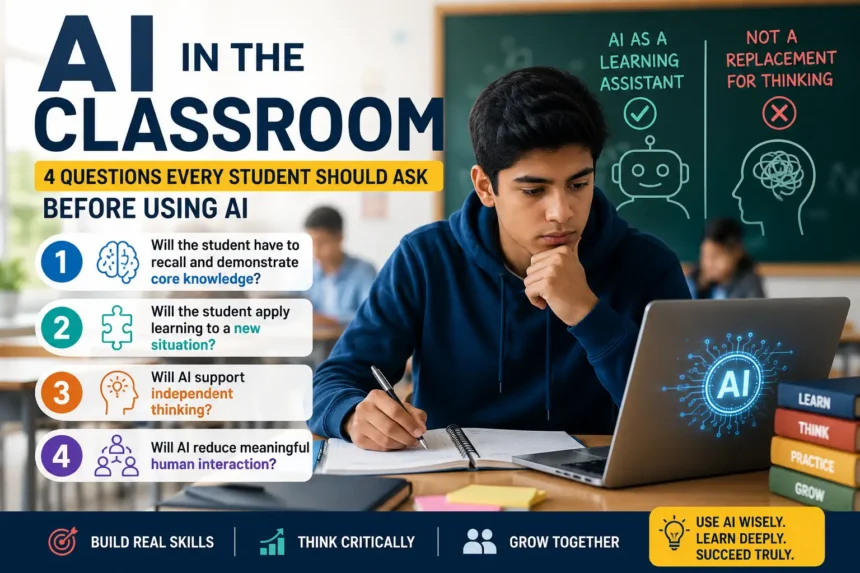
AI in the classroom is no longer a debate about the future. It is happening right now, in most schools, across most grade levels. And for students, bloggers, and digital creators trying to build real skills, the timing of this shift matters more than most people realize.
Here is the problem. Most conversations about AI in education focus on adoption, how fast it is spreading, which tools are best, and how teachers should integrate it. Far fewer conversations focus on the cost of using it wrong. The research on that cost is worth paying attention to before you add another AI tool to your workflow.
Quick Answer: AI in the classroom works best when it supports recall, transfer of knowledge, independent thinking, and meaningful human interaction. Students and creators should use AI as a learning assistant, not a replacement for problem-solving and critical thinking.
Why Is AI Entering Classrooms So Fast?
AI in the classroom has reached near-universal adoption levels in just a few years, driven by a combination of student demand, institutional policy, and significant market investment.
The numbers reflect how quickly this shift has happened. Global student AI usage jumped from 66% in 2024 to 92% in 2025, according to DemandSage. Among educators, 61% of teachers reported using AI in their work in 2025, nearly double the figure from just two years prior. The AI education market reached $7.05 billion in 2025, with projections pointing toward $112 billion by 2034.
At the policy level, 34 U.S. states now have official AI guidance or policies for K-12 schools. The message from most of these frameworks is consistent: the question is no longer whether to use AI, but how.
This matters because the pace of policy adoption is outrunning the pace of evidence. Institutional enthusiasm is not the same thing as pedagogical proof. And for students using AI tools for studying and skill-building, the distinction is critical.
Does AI Actually Help Students Learn?
AI tools improve academic performance when students have access to them. The problem is what happens when access is removed.
A large-scale field experiment published in PNAS, conducted by University of Pennsylvania researchers with nearly 1,000 Turkish high school students in math, found that students using GPT-4 during practice sessions solved 48% more problems correctly. That sounds like a clear win. But when AI access was subsequently removed, and students were tested independently, those same students scored 17% worse than students who had never used AI at all.
A separate version of the experiment gave students access to a GPT-4 model designed to function as a tutor, providing hints without giving away answers. These students solved 127% more practice problems correctly. But on an independent test afterwards, their scores were no better than those of students who had done the work without any AI assistance.
The Stanford University AI Hub for Education confirmed this pattern across a broader set of studies: AI tools frequently boost academic performance while students have access, but those gains weaken or disappear when students are assessed on their own.
The reason this happens is not complicated. Durable learning requires cognitive engagement, productive struggle, and retrieval practice. When a student uses AI to generate an answer, they skip the exact mental process that builds lasting knowledge. The output looks good. The learning did not happen.
This is the crutch problem. And it applies equally to a student writing an essay, a blogger drafting a post, and a creator building a new skill set.
More Read

Question 1: Will the Student Have to Recall and Demonstrate Core Knowledge?
Before any AI tool is added to a learning task, the first question is whether the student will still need to recall and demonstrate foundational knowledge independently.
Higher-order thinking is built on a base of domain knowledge. You cannot analyze an argument without understanding what an argument is. You cannot write a persuasive essay without knowing what a thesis and counterargument look like. You cannot debug code without understanding what the code is supposed to do.
If an AI tool supports that knowledge base, through retrieval practice, targeted feedback, or questions that push students to recall what they know, it may genuinely support learning. If the tool lets students bypass that knowledge entirely, it is almost certainly working against them.
The test is simple. After completing a task with AI assistance, can the student explain the core concepts in their own words, without the AI open? If not, the AI did the learning for them.
This applies directly to content creators using free AI chatbots for research and writing. If you cannot explain the topic you just published on without rereading the AI output, the content may exist, but the expertise does not.
Question 2: Will the Student Apply Learning to a New Situation?
Transfer, the ability to apply knowledge to a situation you have not seen before, is one of the most reliable signals of genuine understanding.
When a student learns the structure of a persuasive essay and can then apply that structure to a completely new topic without assistance, information has moved from short-term recall into lasting knowledge. That process takes cognitive effort. It requires the brain to reconstruct and re-apply, not just reproduce.
AI can support transfer when it scaffolds the process, asking students to attempt the new application first, then offering feedback on what they produced. AI works against transfer when it does the application for the student, producing a finished output that the student then edits or submits.
The distinction here is not about the tool. It is about how the tool is used. A student who asks an AI to “write an essay about climate change using persuasive essay structure” has skipped the transfer entirely. A student who writes a draft first and then asks an AI to identify where the argument breaks down is using AI in a way that preserves the cognitive work.
For bloggers and creators, this is the difference between using AI to generate content and using AI to improve content you have already thought through.
Question 3: Will AI Support Independent Thinking?
Independent thinking requires making judgments and being able to defend them. It is built through the process of wrestling with a problem, not by watching someone else solve it.
The researchers behind the PNAS study compared over-reliance on AI to over-reliance on autopilot in aviation. The FAA has specifically recommended that pilots minimize autopilot use to ensure they retain manual flying skills for when automated systems fail. The parallel to learning is direct. Consistently outsourcing reasoning to AI produces the same result: the skill atrophies.
Over years of teaching STEM subjects, Neemesh has repeatedly observed that students who attempt problems independently before turning to AI tend to retain concepts more reliably than those who immediately rely on generated answers. The students who struggle first, even when that struggle is frustrating, are the ones who can reproduce the thinking later.
A practical test: after completing an assignment with AI, can the student explain in their own words why they made each decision? If the answer is no, the AI did the reasoning.
This matters for anyone building expertise, not just students. The skills that command high-value freelance rates, strategic thinking, original analysis, problem-solving, are precisely the skills that atrophy fastest when AI handles the thinking consistently.
Question 4: Will AI Reduce Meaningful Human Interaction?
Peer feedback, collaborative problem-solving, and direct dialogue with teachers and mentors do more than support academic performance. They build the habits of reasoning that define genuine expertise.
Human interaction introduces friction that AI cannot replicate. A peer who disagrees with your argument forces you to sharpen it. A teacher who asks a follow-up question forces you to go deeper. A mentor who challenges your assumptions forces you to examine them. These interactions are not comfortable. They are also where a significant portion of real learning happens.
An AI discussion board that replaces peer response with algorithmic feedback removes that friction entirely. The output may look similar, but the developmental process is not.
The CDT report from October 2025 found that 85% of teachers and 86% of students used AI during the 2024-25 school year. What the adoption statistics do not capture is how much of that use displaced human interaction and how much complemented it. That distinction is not a minor detail. It is the difference between AI as a learning tool and AI as a learning replacement.
Before adding any AI component to a learning workflow, the question worth asking is whether the AI is being added alongside human feedback or instead of it.
Common Signs AI Has Become a Crutch
The transition from using AI as a tool to depending on it as a crutch is gradual. These are the clearest warning signs that the line has already been crossed.
You cannot explain the concept without AI. If you need to open the tool to answer a basic question about something you recently studied or wrote about, the knowledge did not transfer. The AI holds it, not you.
You ask AI before you attempt the problem yourself. The moment AI becomes the first step rather than a feedback step, the productive struggle that builds retention is removed from the process entirely.
You accept outputs without verification. The PNAS study noted that GPT-4 provided incorrect step-by-step math solutions 42% of the time. Accepting AI outputs without critical review is not just a learning problem — for content creators and professionals, it is a credibility risk.
You struggle significantly when AI is unavailable. If a tool outage or access restriction meaningfully disrupts your ability to work, think through a problem, or produce content, the dependency has moved past the tool-use threshold.
Recognizing these patterns is the first step toward correcting them. The goal is not to avoid AI — it is to use it in a way that builds capacity rather than replacing it.
How Bloggers and Creators Can Use AI Without Losing Their Edge
The framework that applies to classrooms applies equally to anyone building skills and an online presence. The question is not whether to use AI, but where to place it in the workflow.
Use AI for:
- Research summaries and source discovery
- Brainstorming angles and topic ideas
- Outlining structure after you have thought through the topic
- Getting feedback on a draft you have already written
- Study planning and scheduling
- Identifying gaps in an argument you have already made
Avoid using AI for:
- Final thinking and conclusions, these should come from you
- Personal insights and original experiences
- Skill practice (writing, coding, analysis, the practice itself is the point)
- Critical reasoning on topics you are trying to understand
- Generating content in areas where you have not yet built foundational knowledge
The reason this distinction matters is practical, not philosophical. Search engines and audiences increasingly distinguish between content that demonstrates genuine expertise and content that simply produces accurate-sounding text. The path to becoming genuinely AI literate runs through understanding what AI cannot do, not just what it can.
Neemesh built NoCostTools.com to 100+ indexed tools with a 150% organic traffic increase in three months, not by automating the thinking, but by applying structured thinking to problems and using tools to execute faster. The strategic layer remained human. That distinction is what made the output defensible and the growth durable.
The evidence does not suggest banning AI from learning workflows. It suggests being deliberate about where AI sits in those workflows and honest about what it is doing to your ability to think independently.
AI adoption in education and content creation will continue at a pace. The students and creators who build durable skills alongside AI will consistently outperform those who outsource their thinking to it. The four questions above are the filter that makes that possible.
For anyone looking to start building income-generating skills online, the same principle applies: the skill is the asset, not the tool.
Which of these four questions do you find hardest to apply to your own AI use? Share your answer in the comments below.
Frequently Asked Questions
Can you actually learn with AI or does it just create a shortcut?
You can learn with AI, but only when it is used in a way that preserves cognitive effort. AI supports learning when it provides feedback on work you have already attempted, asks questions that push you to recall what you know, or identifies gaps in your reasoning. It creates a shortcut and reduces learning when it generates the answer, essay, or solution before you have attempted the work yourself. The PNAS study on this is clear: performance during AI-assisted practice can be high while actual skill acquisition is low.
How should students use AI tools without losing real skills?
The most reliable approach is to treat AI as a feedback layer, not a starting point. Attempt the problem, draft, or question first. Then use AI to review your work, challenge your reasoning, or identify what you missed. This preserves the productive struggle that builds retention while still capturing the efficiency benefits of the tool. For subject-specific help, tools that ask guiding questions rather than providing direct answers tend to support skill-building better than tools that generate complete outputs.
Should AI tools be banned from classrooms?
A blanket ban is unlikely to be effective and ignores the genuine use cases where AI supports learning. The more productive framework is what researchers and educators are beginning to adopt: design the task first around conditions that produce durable learning, and only integrate AI where it genuinely supports those conditions rather than replacing them. The burden of proof should sit with the tool, not with the educator who questions it.
For bloggers and content creators, what is the right balance between AI and genuine skill-building?
The balance that protects long-term value is using AI for execution speed while keeping the strategic and analytical work human. Research, brainstorming, outlining, and feedback loops are areas where AI adds speed without removing the thinking. Writing, reasoning, original analysis, and skill practice are areas where outsourcing to AI reduces the capability that makes the work valuable in the first place. Audiences and search engines are increasingly able to distinguish between the two.
How do you know if you have become too dependent on AI?
The clearest signal is whether you can perform the core task without the tool. If you cannot write a coherent outline without AI, explain a concept you recently published on, or work through a problem when the tool is unavailable, the dependency has moved past healthy tool use. A practical test: close the AI tool and attempt the task from scratch. The gap between that output and your AI-assisted output tells you exactly how much of the capability currently lives in the tool versus in you.
What are the risks of using AI in the classroom?
The primary risk identified in current research is the gap between short-term performance and long-term retention. Students can produce better work during AI-assisted tasks while building less foundational knowledge than students who work without AI assistance. Additional risks include reduced critical thinking practice, reduced peer interaction, and over-reliance that becomes apparent only when AI access is removed, such as during exams or independent assessments. For younger learners, the developmental risks of skipping productive struggle during formative years are not yet fully understood, which is an additional reason for caution at the policy level.