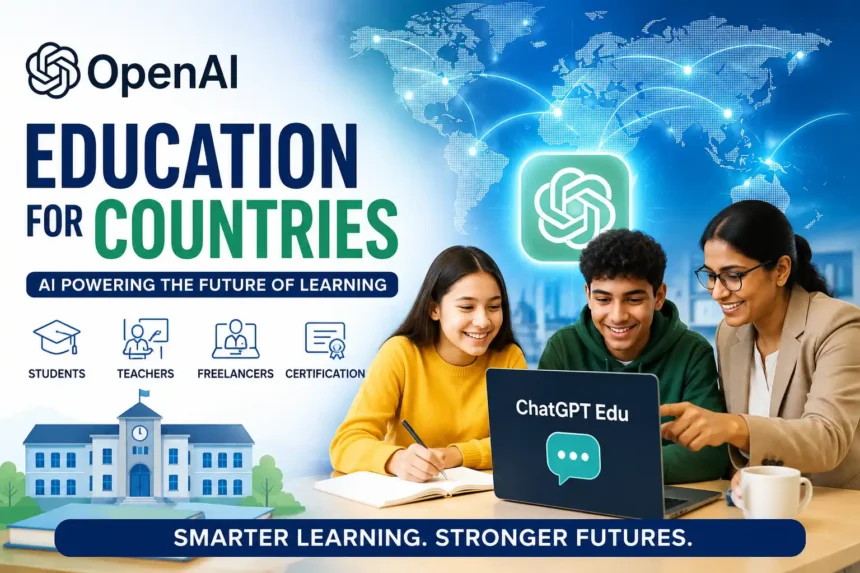
TL;DR: OpenAI has launched Education for Countries, a government-level initiative that puts AI tools like ChatGPT Edu directly into national school and university systems. The first cohort includes 8 countries, with Singapore recently joining. The program combines AI tool access, teacher training, certifications, and learning research. For students, educators, freelancers, and creators, this signals that AI in education has moved from optional to official. Here's what it means for you.
By 2030, nearly 40% of core workplace skills will change due to AI, according to the World Economic Forum. That’s not a distant projection. It’s a timeline many current students and teachers are already living inside. OpenAI’s Education for Countries program is a direct response to this reality. Rather than waiting for individual schools to figure it out, OpenAI is working with national governments to build AI into the foundation of formal education. This post breaks down what the program includes, which countries are involved, and what it means for students, teachers, freelancers, and content creators following the AI education space.
What Is OpenAI Education for Countries Program?
OpenAI Education for Countries is a government-partnership initiative designed to embed AI tools, training, and research into national education systems at scale. It’s part of OpenAI’s broader “OpenAI for Countries” strategy, which also covers health, cybersecurity, and start-up development.
The program is built around three core pillars. First, AI tools for learning: partner countries get access to ChatGPT Edu, GPT-5.2, Study Mode, and Canvas, each of which can be configured to match local curriculum needs. Second, large-scale research: OpenAI works with Ministries of Education and learning scientists to measure actual outcomes, including student performance and teacher productivity. Third, training and certifications: both students and educators receive structured AI skill development through OpenAI Academy programs and certifications aligned to national workforce goals.
The first cohort includes eight countries: Estonia, Greece, Italy’s Conference of University Rectors, Jordan, Kazakhstan, Slovakia, Trinidad and Tobago, and the United Arab Emirates. Singapore has since joined, and OpenAI has confirmed that the next cohort will be announced later in 2026.
Why This Matters More Than a Product Launch
Most AI education news covers individual tools: a new chatbot for students, a browser extension for teachers. This program is structurally different, and that difference matters.
When a government embeds AI into its national education framework, the technology stops being optional. It becomes part of the system. Teachers are trained on it. Curricula are shaped around it. Students are assessed using it. That shift, from voluntary adoption to institutional integration, is what separates this announcement from a typical product update.
The global AI in education market is projected to grow from $7.05 billion in 2025 to $112.3 billion by 2034, growing at roughly 36% annually. What drives that growth is not individual subscriptions. It’s programs like this one, where governments and university systems make structured, long-term commitments to AI infrastructure in learning environments.
The significance lies in what happens after tool access. OpenAI is not simply handing countries a login. It’s building evidence-based deployment models, sharing findings across the global network of partner countries, and designing the program around measurable learning outcomes. That’s a much longer-term play.
What ChatGPT Edu Actually Offers Schools
ChatGPT Edu is not the same product as the consumer version of ChatGPT. It’s a version built specifically for educational institutions, with privacy protections, compliance controls, and features designed for classroom and research use.
Under the Education for Countries program, partner countries get access to GPT-5.2, Study Mode, and Canvas, all customized to support local learning priorities. Study Mode, introduced in August 2025, is designed to promote genuine engagement with learning rather than shortcut-seeking. Canvas provides a shared workspace for collaborative writing and problem-solving.
For teachers specifically, OpenAI launched a dedicated ChatGPT for Teachers workspace in November 2025. Verified U.S. K-12 educators get free access to premium features through June 2027, including unlimited messages, file uploads, image generation, and the ability to build custom GPTs pre-loaded with their own curriculum and grade-level context.
The practical implication is that schools no longer need to adapt a general-purpose AI tool to their needs. The tools can be configured to teach local content, follow national standards, and operate within the privacy rules that education systems require.
How This Program Affects Students
The most direct benefit for students is access to AI-powered learning support that adapts to how they learn, not just what they’re studying.
AI-powered tutoring systems have been shown to improve student engagement and performance by up to 30%, according to research cited across multiple education studies. A 2025 survey also found that 59% of teachers reported AI enabled more personalized instruction, which directly affects student learning quality.
There’s also a literacy gap that this program can help close. According to Cengage’s 2025 AI in Education report, 65% of higher education students believe they know more about AI than their instructors. That creates an uneven classroom experience. When teachers are formally trained on the same tools students are using, the quality of AI-assisted instruction improves for everyone.
For students in participating countries, the access question also shifts. Instead of needing a personal subscription, AI tools become part of the school system. This matters most for students in under-resourced institutions where individual access is not practical.
If you’re a student looking to build these skills before your school catches up, the AI literacy guide on EduEarnHub walks through exactly what foundational knowledge you need. And if you’re in community college or a similar setting, this roundup of AI tools for community college students is a practical starting point.
What Educators Gain From This Program
For teachers, the program addresses one of the most consistent problems in AI adoption: the training gap.
According to one survey, 85% of teachers feel unprepared to manage AI in their classrooms, and 32% describe themselves as completely unprepared. That’s not a confidence problem. It’s a structural one. Most teachers have been expected to adopt AI without formal training, institutional support, or time built into their schedules.
The Education for Countries program tackles this directly. OpenAI’s ChatGPT Foundations for Teachers course is now available on Coursera and covers how ChatGPT works, how to personalize it for your classroom, and how to apply it to lesson planning and administrative tasks. OpenAI has also set a target to certify 10 million Americans by 2030, with the teacher track as one of the key pathways.
The upcoming OpenAI Luminaries program will go a step further. It’s an educator engagement track focused on co-design with teachers, practical classroom resources, and sharing examples across partner countries. Rather than designing AI tools and handing them to schools, OpenAI is building a feedback loop where teachers shape how the tools are used.
Neemesh has seen this dynamic in his own 15 years of STEM teaching. When he started integrating digital tools and AI explanations into his Maths and Physics classes, student quiz and test performance improved by 30 to 50% within 6 to 12 weeks. The tool mattered less than the structured approach to using it. That’s exactly what formal teacher training enables at scale.
Reducing administrative burden is the other side of this. Surveys show that 44% of educators who use AI report that it reduces their workload. When that load decreases, teachers can spend more time on instruction and student support, which is where their expertise actually lies.
Opportunities for Freelancers and Content Creators
When AI enters national education systems, the demand for supporting content and services grows quickly. That creates real opportunities for freelancers and creators who understand this space.
For freelance writers and content creators, the timing is worth noting. The global eLearning market is on track to exceed $400 billion by 2026, and the AI-in-Education sub-market is projected to reach $32 billion by 2030. Schools, edtech companies, and training providers all need explainers, course content, guides, and scripts. Writers who can accurately cover AI tools and educational applications are well-positioned for this demand.
For creators on YouTube, blogs, or social platforms, the content angles are substantial. Teacher training guides, student tutorials on Study Mode, explainers on how ChatGPT Edu works, and comparisons between AI tools for different subjects are all content categories with growing search interest. The audience is not just students. It includes school administrators, policy researchers, and parents trying to understand what AI in classrooms actually means.
Freelance consultants have a different kind of opportunity. Schools and universities in the next cohort of partner countries will need help with implementation. That includes curriculum adaptation, prompt strategy, staff onboarding, and content localization. Freelancers with a background in education, instructional design, or AI tools are in a position to offer that support directly.
If you’re thinking about how to position your services around this shift, the guide on high-paying freelance skills in 2026 covers how AI-related consulting and content roles are priced. And if you’re just starting, the freelancing beginner’s guide lays out the foundation.
It’s also worth noting that writers who combine AI tools with their skills earn about 22% more per hour compared to those who don’t. The entry-level AI jobs market is also responding: here’s a breakdown of entry-level AI roles and what they pay if you’re looking to move in that direction professionally.
What This Means for the Future of Education
OpenAI Education for Countries program is not an experiment. The evidence-collection structure, the government partnerships, the teacher certification pathway, and the expanding country cohort all point to a long-term build.
The pattern it follows is one seen in other technology-to-infrastructure transitions. First, individual early adopters find value in a tool. Then institutions begin pilot programs. Then, governments formalize adoption at the system level. AI in education has now reached that third stage.
For EduEarnHub readers, the practical takeaway is this: the skill gap between those who understand how to use AI tools in learning and work environments and those who don’t is becoming a formal policy concern, not just a personal productivity question. Programs like this one will produce certified, AI-trained graduates. Educators who complete formal training will have institutional backing for their practice. Freelancers and creators who build expertise in this niche now will have a significant head start when the next cohort of countries joins.
The more important question is not whether AI enters formal education. It already has. The question is whether you’re positioned to benefit from that shift when it reaches your sector, institution, or market.
What’s your next step: student, educator, or creator? Share your perspective in the comments below.
Frequently Asked Questions
What is OpenAI’s Education for Countries program? OpenAI’s Education for Countries is a government-level initiative that helps countries embed AI tools, teacher training, and learning research into their national education systems. The program provides access to ChatGPT Edu, GPT-5.2, Study Mode, and Canvas, alongside OpenAI certifications and collaborative research on learning outcomes. The first cohort includes Estonia, Greece, Italy, Jordan, Kazakhstan, Slovakia, Trinidad and Tobago, and the UAE, with Singapore recently added.
How will ChatGPT Edu be used in schools? ChatGPT Edu is a version of ChatGPT built for institutional use, with privacy controls and compliance features that consumer versions don’t offer. Under the program, it can be configured to support local curricula, national learning standards, and specific subject areas. Schools can use it for personalized tutoring, lesson planning support, writing assistance, and research workflows. Teachers can also build custom GPT models pre-loaded with their own course materials and grade-level context.
What do teachers gain from this program? Teachers in partner countries gain access to formal AI training through courses like ChatGPT Foundations for Teachers (available on Coursera), certifications that verify practical AI skills, and the upcoming OpenAI Luminaries track, which involves co-designing AI resources with educators. The program also reduces administrative workload by helping teachers use AI for grading support, lesson planning, and communication tasks, freeing up more time for direct instruction.
What does this mean for students? Students in partner countries gain access to AI-powered learning tools through their institutions, without needing personal subscriptions. The program supports personalized learning, study assistance, and concept explanation. More importantly, it closes the access gap between students who already use AI informally and those who don’t, while ensuring that the tools are deployed with age-appropriate safeguards and educator oversight.
Can freelancers benefit from the OpenAI Education for Countries program? Yes. As schools and governments expand AI education programs, demand grows for educational content writers, course creators, AI explainer creators, and implementation consultants. Freelancers with expertise in education, instructional design, or AI tools can offer services directly to schools, edtech platforms, and training providers. The eLearning market is projected to exceed $400 billion by 2026, which signals sustained demand for supporting content and services across this sector.