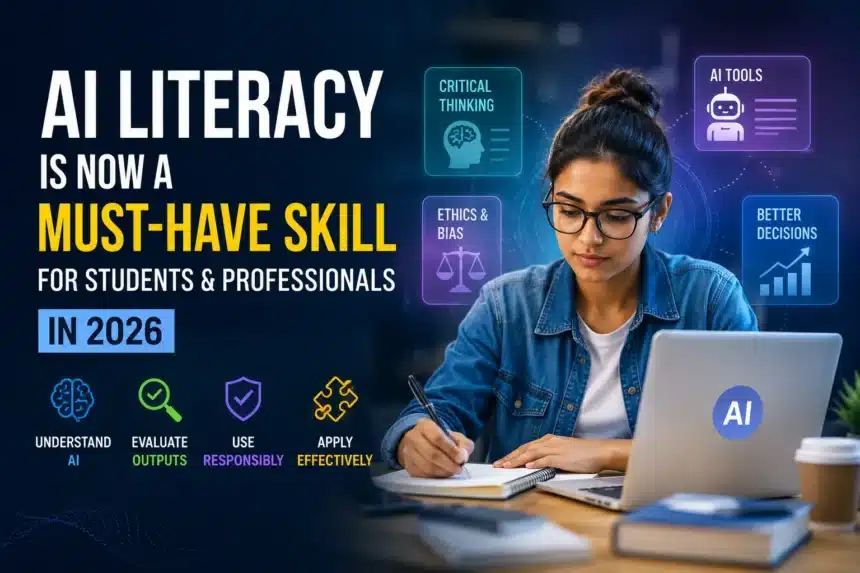
TL;DR: AI literacy is the ability to use, evaluate, and apply AI tools responsibly, and in 2026, it's no longer a tech-only skill. Students, freelancers, and working professionals all face the same reality: knowing how to use AI is one thing, but understanding what it produces and why it matters is different. This post breaks down what AI literacy means, why it's urgent, and how you can start building it today.
Most people assume that using ChatGPT a few times makes them AI-literate. It doesn’t.
There’s a gap between typing a prompt and actually understanding what comes back: whether the information is accurate, where the bias crept in, whether you’re about to send sensitive data to a server you shouldn’t trust, and whether the output is even the right tool for the task. That gap is where careers, assignments, and client projects fail.
AI literacy skills sit at the center of 2026’s most urgent professional conversation. Across industries, employers are not just looking for people who have tried AI. They want people who understand it well enough to use it without creating problems. And the data shows most people aren’t there yet.
What Is AI Literacy skills?
AI literacy is the ability to understand how AI works, use AI tools effectively for specific tasks, and critically evaluate what those tools produce.
It’s not about writing code or building machine learning models. It covers four practical things: reading prompts, checking outputs, recognizing bias, and knowing when AI fits a workflow and when it doesn’t. Think of it the way you’d think about internet literacy in 2005 or spreadsheet literacy in 1999. At some point, those skills moved from “useful bonus” to “expected baseline.” AI literacy is in that transition right now.
The U.S. Department of Education defines it as “the technical knowledge, durable skills, and future-ready attitudes required to thrive in a world influenced by AI.” That definition matters because it goes beyond tool use. It includes critical evaluation, ethical judgment, and the ability to design how AI fits into your work.
What AI literacy is not: memorizing which apps exist, or blindly using AI for every task. The skill is knowing when to use it, what to do with the output, and where human judgment has to lead.
Why AI Literacy Matters in 2026
The numbers tell a clear story about where this skill stands right now.
According to the 2026 State of Data & AI Literacy Report by DataCamp, 59% of enterprise leaders say their organization has an AI skills gap, even while most are already running some form of AI training. The gap isn’t between organizations that have AI and those that don’t. It’s between AI adoption and AI understanding.
Meanwhile, job postings requiring AI skills grew 144% year over year as of April 2026, according to Lightcast data. Overall job postings grew just 7% in the same period. The demand isn’t vague or aspirational. It’s showing up in hiring criteria right now.
The Bright Horizons Education Index (surveyed by The Harris Poll in late 2025) found that 55% of employees say access to AI training would make them more likely to stay with their employer. When companies provide structured AI training, adoption jumps to 76%, compared to just 25% without it. The training matters. So does building the literacy yourself if your employer isn’t offering it.
The World Economic Forum’s Future of Jobs Report 2025 projects that nearly 40% of the global workforce’s core skills will change within five years. AI and data top the list of fastest-growing skills required. The implication is direct: professionals who build AI literacy now are positioning themselves for those changes rather than reacting to them.
AI Literacy for Students
How Does AI Literacy Give Students a Real Advantage?
AI literacy gives students a measurable edge in three areas: learning efficiency, research quality, and career readiness. Students who know how to use AI tools thoughtfully can organize notes faster, check sources more systematically, and revise work more deliberately, without outsourcing the thinking itself.
The practical applications are straightforward. A student writing a research paper can use AI to summarize long sources and identify gaps, then verify each claim manually. Someone revising for an exam can use AI to generate practice questions and explain concepts from a different angle. These aren’t shortcuts. They’re workflow improvements that still require the student to do the intellectual work.
The more important part is knowing what not to do. Using AI to write an entire assignment and submitting it as original work creates two problems: academic integrity risk and the actual loss of learning. The student who doesn’t struggle through a concept misses the point at which real understanding forms. Research from ACM’s 2025 Computing Education Conference found that students who develop AI literacy through active, critical engagement with AI tools build stronger metacognitive skills than those who simply use AI passively.
For career readiness, AI literacy is already showing up in entry-level job requirements. Students who graduate with documented, applied AI skills have a real advantage over those who graduate knowing the tools exist but can’t demonstrate judgment about how to use them. If you’re a student exploring what skills to build, the AI tools for community college students guide on EduEarnHub covers practical starting points.
Neemesh observed this directly across 15 years of teaching computer science and STEM subjects. Students who learned to verify information before trusting it, whether from a textbook, a classmate, or an AI, consistently performed better on application-based questions. The critical evaluation habit transfers.
AI Literacy for Freelancers
The freelance market has changed structurally in 2026, and AI literacy sits at the center of that change.
According to Upwork’s 2026 In-Demand Skills report, the number of clients hiring freelancers for AI-related work grew 109% year over year. Clients aren’t just looking for output anymore. They want to know how the work gets done and whether the freelancer can use AI responsibly as part of their process.
The productivity data is significant. Among freelancers who use AI tools, 77% report productivity gains of 20% to 40%. Deliverables that previously took six hours now take two and a half. That’s not a slight improvement. It changes the economics of freelance work entirely: the same revenue for less time, or more revenue at competitive prices.
What this means in practice differs by type of work:
A content writer using AI for research, outline generation, and first-draft structuring can produce more pieces per week without reducing quality. A designer using AI for iteration and variation generation can show clients more options faster. A freelance researcher using AI to summarize sources can cover more ground before synthesis. In each case, the value isn’t the AI output itself. It’s the freelancer’s judgment applied to that output, the editing, the fact-checking, the professional experience that shapes the final deliverable.
Freelancers who want to understand how AI literacy connects to high-value skill development should look at the high-paying freelance skills guide on EduEarnHub, which covers how to position AI-adjacent skills for better rates.
AI Literacy for Professionals
Why Do Working Professionals Need AI Literacy in 2026?
AI literacy helps professionals use AI tools to improve real work outcomes, reports, communication, decision-making, and knowledge management, without creating new problems through over-trust, poor judgment, or data misuse.
The professional context introduces risks that don’t apply the same way to students or freelancers. A professional who submits an AI-generated report without verifying the data could pass incorrect information to leadership. One who uploads proprietary client details into a public AI tool could create a compliance problem. One who accepts AI output on a technical question without checking it could give bad advice.
DataCamp’s 2026 research found that the most important AI and data skills in 2026 are not deeply technical. They’re interpretive, applied, and judgment-driven. The highest-ranked skills across enterprise leaders include checking AI outputs critically, integrating AI into actual workflows, and knowing where human decisions must override AI recommendations.
This reflects a broader pattern. Organizations that build structured AI literacy programs are nearly twice as likely to report significant AI ROI compared to those without them. The ROI doesn’t come from using AI. It comes from using it well.
For professionals managing teams, there’s an additional layer: building a culture where AI tools are used with appropriate verification. That’s a leadership skill, not just a technical one. The professionals who understand both the capability and the limits of AI tools are the ones who can lead AI-assisted teams effectively.
Core Skills You Need
AI literacy isn’t one skill. It’s a cluster of related capabilities that build on each other.
Prompt writing is the practical foundation. Research published in ScienceDirect found that prompt quality directly predicts output quality, it’s a measurable, trainable skill, not a vague art. A specific, well-structured prompt with context, constraints, and a clear objective produces better results than a vague instruction.
Fact-checking and source verification is non-negotiable. AI tools generate confident-sounding output that can be partially or entirely wrong. Every factual claim an AI produces that you plan to use externally needs independent verification.
Bias and hallucination awareness means understanding that AI systems reproduce the imbalances in their training data and can invent information with full confidence. Both things happen regularly. Recognizing the signs of hallucination, inconsistencies, suspiciously specific statistics, and implausible claims is a core professional skill.
Data privacy and security cover knowing what not to upload. Personal data, proprietary business information, client names, financial records: none of these belong in public AI tools. Understanding this boundary is part of basic AI literacy, and organizations where employees don’t understand it are already creating compliance exposure.
Tool selection is the ability to match the right AI tool to the right task. Using a general-purpose chatbot for specialized medical or legal research produces worse outcomes than using it for drafting and brainstorming. Knowing what each tool is good for and where it fails is a practical skill built through use and comparison.
Human judgment remains the skill that scales all others. AI literacy isn’t about using AI for everything. It’s about knowing where AI adds value and where human thinking, relationships, ethics, and context have to lead. That distinction is what separates an AI-literate professional from someone who has simply adopted new tools.
How to Build AI Literacy
Building AI literacy doesn’t require a formal course, though those exist. It requires consistent, deliberate practice with tools in real situations.
Start with one or two tools that apply directly to your work. A student might start with a tool for summarizing research. A freelancer might start with one for drafting client communication. A professional might start with one for meeting notes or report outlines. The goal isn’t to try everything. It’s to build actual fluency in a narrow area first.
Practice writing prompts deliberately. Treat prompting as a craft: write a prompt, evaluate the output, identify what the prompt lacked, revise, and compare results. This iterative loop is how prompt quality improves, and it’s faster than any course because it’s grounded in your actual tasks.
Compare outputs across different tools for the same task. The differences reveal each tool’s strengths and weaknesses better than any external review. This comparison habit builds practical judgment quickly.
Use AI in actual workflows, not just experiments. The gap between trying AI in isolation and integrating it into real work is significant. Skills built in real contexts transfer better and reveal practical limits faster.
Learn the ethical and privacy basics. The EU AI Act, referenced by the World Economic Forum, now mandates that those deploying AI must ensure users have sufficient AI literacy. The direction of regulation globally is toward accountability for how AI is used. Understanding basic principles now saves problems later.
For free tools to practice with, NoCostTools.com has a range of productivity utilities useful for workflow integration alongside AI tools. The experience of building that platform revealed something consistent: users who engage with tools intentionally, rather than casually, get better outcomes and build skills faster.
Update your knowledge regularly. AI literacy is not a static skill. Tools change significantly across months, not years. The frameworks for evaluating them need to change with the tools.
Final Thoughts
AI literacy is the skill that separates people who benefit from AI and people who get burned by it. Students who develop it graduate more prepared. Freelancers who apply it earn more efficiently. Professionals who build it lead more effectively.
The urgency is real. Demand for AI literacy training increased 320% in corporate learning platforms in 2025, and that demand isn’t slowing. Organizations that close the gap between AI adoption and AI understanding are nearly twice as likely to see measurable ROI from the technology they’re already using.
The skill itself isn’t complicated to start. Pick one tool, use it in a real task, check what it produces, verify the important parts, and reflect on what the prompt could have done better. Repeat. That loop, done consistently, builds the practical judgment that AI literacy actually means.
If you’re a student, explore the AI tools for community college students guide to find tools matched to academic workflows. If you’re building a freelance career, the high-paying freelance skills guide covers how AI-adjacent skills translate into better rates. If you want a deeper foundation, becoming AI literate is a practical starting point for the skill-building process itself.
The question isn’t whether AI literacy matters. It does, and the data is consistent on that. The practical question is when you start building it. Have you already integrated AI into a regular workflow, or are you still using it occasionally and hoping that counts?
Frequently Asked Questions
What is AI literacy and why does it matter? AI literacy is the ability to understand how AI works, use AI tools effectively for real tasks, and critically evaluate what those tools produce. It matters because AI is now present in virtually every industry, and the ability to use it responsibly and accurately is becoming a baseline expectation for students, freelancers, and professionals alike. Using AI without understanding its limitations creates real risks: inaccurate outputs, privacy exposure, and over-reliance on tools that require human judgment to function well.
Why is AI literacy important for students? Students who develop AI literacy gain a practical advantage in research efficiency, study organization, and career readiness. More importantly, they learn to use AI without compromising their own learning. The skill involves knowing when AI helps — summarizing sources, generating practice questions, structuring arguments — and when it undermines learning by replacing the work that builds understanding. Academic integrity also depends on this judgment. Students who graduate with documented AI skills are more competitive in hiring, as employers increasingly list AI competency in entry-level criteria.
How do freelancers use AI literacy in their work? Freelancers use AI literacy to deliver better work faster while maintaining quality and client trust. This means using AI for research, drafting, iteration, and routine tasks while applying professional judgment to the final output. Freelancers with AI literacy know which tools suit which tasks, how to verify AI-generated content before it goes to clients, and how to describe their process transparently. According to Upwork’s 2026 data, demand for AI-related freelance skills grew 109% year over year. The freelancers positioned for that demand are those who’ve built real fluency, not just familiarity.
Why should professionals build AI literacy? Professionals face higher stakes for AI errors than in most other contexts. An incorrect AI-generated report, a privacy breach from careless data uploads, or a bad recommendation based on unverified AI output all carry professional consequences. AI literacy gives professionals the judgment to use AI tools for genuine productivity gains, drafting, research, summarization, and brainstorming, while applying the verification and critical thinking that prevents problems. Organizations with AI-literate workforces see significantly better outcomes from AI adoption than those without.
What is the career impact of AI literacy? AI literacy is shifting from a differentiator to a baseline requirement across job categories. Job postings requiring AI skills grew 144% year over year as of April 2026, while overall job postings grew just 7%. Professionals who build AI literacy now are better positioned for promotion, career transitions, and expanded freelance opportunities. The skills involved, prompt writing, critical evaluation, bias awareness, and workflow integration, also strengthen general analytical and communication abilities that apply across roles and industries.