If you spent 2024 learning to write clever prompts, you’ve probably noticed the goalposts moved. The phrase everyone’s using now is context engineering, and a lot of people are quietly panicking that the skill they just learned is already stale.
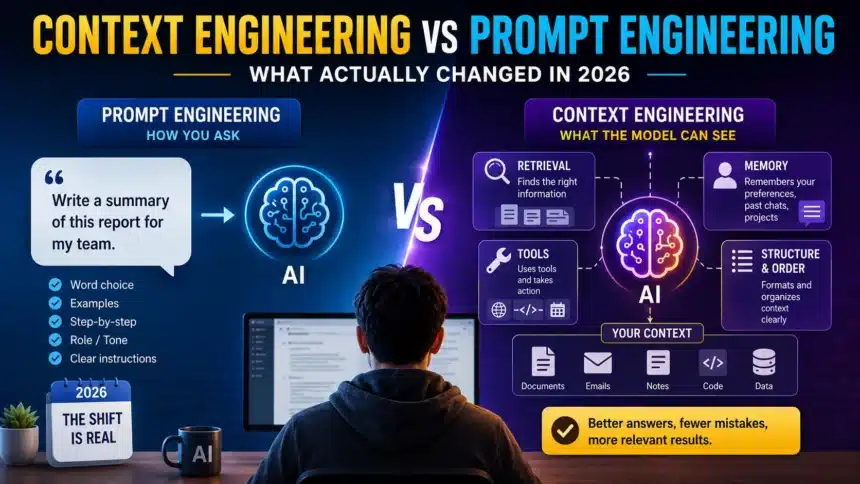
Here’s the short version. Prompt engineering is about how you ask. Context engineering is about everything the model can see when it answers: your files, your past messages, retrieved data, connected tools, and the rules running in the background. The debate over context engineering vs prompt engineering comes down to where the real control lives now that models got smart enough to forgive a clumsy question.
I’ll walk through what each one means, why the shift happened, which skill is worth your time, and how to start without a computer science degree.
Context engineering vs prompt engineering in one minute
Prompt engineering is the craft of wording an instruction so a model gives you what you want. Few-shot examples, chain-of-thought, role-playing (“you are a senior editor”). All of that.
Context engineering is the wider job of deciding what information reaches the model in the first place. The documents it can pull from, the memory it keeps between chats, the tools it can call, the order all of that arrives in.
Think of it like the difference between phrasing a question well and handing someone the right files before they answer. A sharp question to a clueless intern still gets you a bad answer. A vague question to someone holding all your project notes often gets you a good one.
That second scenario is where modern AI lives.
Why the shift happened
Two things changed at once.
First, the models got better at reading intent. You used to need careful phrasing because GPT-4 and Claude 3 would wander off if you weren’t precise. The 2026 models mostly understand what you mean even when your wording is sloppy. So the payoff from perfect phrasing shrank.
Second, context windows exploded. Some models now hold millions of tokens at once, which means you can feed them whole codebases, research folders, or a year of meeting notes. Suddenly the bottleneck became whether the right material is sitting in front of the model when it reads the question.
Andrej Karpathy is one of the people who pushed the term into the mainstream, and the industry ran with it. By early 2026 the conversation had moved from “write a better prompt” to “build a better information pipeline.”
The data backs the mood. In one 2026 State of Context Management report, 82% of IT and data leaders said prompting alone is no longer enough to run AI at scale, and 95% said they planned to invest in context-engineering training this year. A February 2026 study that ran close to 9,650 experiments on agent performance found that how you structure the context a model receives measurably changes how often it gets things right. The interesting twist in that study: file-based context helped frontier models but actually hurt some open-source ones, so the technique only pays off with the right model behind it.
So is prompt engineering dead?
No, and anyone selling you that line is overstating it.
Prompting still matters. The clearest evidence is that the two techniques work best together. Feed a model good retrieved context, then ask it to reason step by step over that context, and you get results neither approach delivers alone. The retrieval grounds it. The prompt steers it.
What’s actually happening is a demotion, not a funeral. Prompting went from being the whole job to being one layer of a bigger job. If your title was “prompt engineer,” the work hasn’t vanished. The scope around it grew, and the market expects you to handle that bigger scope.
I think the people who’ll struggle are the ones who learned prompt tricks as a closed skill set and stopped there. The people who’ll do well treat prompting as the easy 20% and spend their energy on the context plumbing.
What context engineering actually involves
This is where it gets concrete. When you engineer context, you’re making decisions about:
Retrieval. Where does the model get facts it wasn’t trained on? This is the RAG (retrieval-augmented generation) layer, pulling the right document chunk or database record into the chat so the model quotes reality instead of guessing.
Memory. What should the model remember across sessions? Your writing style, your project details, decisions you made last week.
Tools. What can the model do besides talk? Search the web, run code, query a calendar, edit a file.
Structure and order. How is all of that formatted and sequenced before the model sees it? The same facts in a messy dump versus a clean schema can produce different answers.
Every one of those is a choice. Make good choices and the model looks brilliant. Make bad ones and it hallucinates, forgets, or uses the wrong tool. That’s the craft.
Which skill should you learn first?
Depends who you are.
If you’re a student or a total beginner, start with prompting. It’s faster to learn, you’ll use it daily, and it builds the intuition you need before the bigger concepts make sense. Get comfortable giving clear instructions, using examples, and asking a model to show its reasoning.
If you’re a freelancer or a developer trying to build something real, like an agent, a chatbot, or an internal tool, you’ll hit the limits of prompting within a week. That’s your signal to learn retrieval, memory, and tool use. This is also where the money is moving. Job posts that used to say “prompt engineer” increasingly want someone who can wire up context pipelines and AI agents.
If you’re a working professional who just uses ChatGPT or Gemini at your desk, you’re already doing light context engineering without the label. Uploading the right file, turning on memory, connecting your email. Get deliberate about it and your everyday results jump.
A simple way to start today
You don’t need to build infrastructure to practice this. Try it inside a tool you already have.
- Pick a real task, say summarizing a long report and drafting an email about it.
- First, just ask the model cold with a clean prompt. Note the result.
- Now feed it context: upload the actual report, tell it who the email is for, paste an old email of yours so it copies your tone, and turn on memory if the tool has it.
- Ask again with a simpler prompt this time.
Watch how much better the second answer is, and notice that you barely touched the wording. That gap is context engineering doing the work. Once you feel it, you’ll start reaching for context before you reach for clever phrasing.
For anyone going deeper, the natural next steps are learning the basics of RAG, trying a no-code agent builder, and reading how tools like Claude Code or Gemini handle files and memory. Those move you from chatting with AI to building with it.
Common questions
Is context engineering hard to learn?
The concepts are simple. Retrieval, memory, tools, structure. Implementing them well takes practice, and the engineering side (RAG pipelines, vector databases) gets technical. But the thinking behind it is learnable by anyone who already uses AI tools.
Do I still need prompt engineering skills in 2026?
Yes. Prompting is the foundation and still affects output quality, especially for reasoning tasks. The two skills stack. Learn prompting first, then context.
Will context engineering get automated away too?
Some of it, probably. Tools keep getting better at handling retrieval and memory for you. But deciding what context matters for a given task is a judgment call, and judgment is the part that stays human longest.
What’s the highest-paying version of this skill?
Right now, building reliable AI agents and production systems that combine retrieval, memory, and tool use. Companies are spending real budget here because a model with the wrong context fails expensively.
The honest takeaway: prompting got you in the door, and context engineering is what the room expects now. Learn the first, then grow into the second. If you already use AI every day, you’re closer than you think.