Most Fiverr sellers treat pricing as a guessing game. Pick a number slightly lower than competitors, hope buyers don’t scroll past, and wonder why orders stay flat even after the gig description is polished and the thumbnail looks professional.
- How the Three-Tier System Works at a Glance
- Why Fiverr Pricing Is Different From General Freelance Pricing
- The Three-Tier Package System: What Each Level Is Actually For
- Price Anchoring: How to Make Your Target Package the Obvious Choice
- Price Points by Niche: Market Reference Ranges for 2026
- How Your Fiverr Pricing Tiers Affect Ranking
- When and How to Raise Your Fiverr Prices Without Losing Momentum
- Gig Extras and Add-Ons: The Hidden Revenue Layer
- FAQ: Common Questions About Fiverr Gig Pricing
- Conclusion
That approach misses the actual mechanics of how Fiverr’s package system works.
Pricing on Fiverr is not about finding the right number. It is about engineering a package structure that guides buyers toward a decision, satisfies the algorithm’s conversion expectations, and signals the quality level that attracts serious clients rather than price hunters. Every pricing decision carries algorithmic consequences, when buyers click into a gig but don’t purchase, Fiverr’s algorithm registers that as a failed conversion and progressively reduces the gig’s impressions. A poorly structured Fiverr gig pricing strategy doesn’t just cost individual sales. It suppresses the entire gig’s visibility over time.
This guide covers the complete system: package structure, anchoring psychology, real pricing case examples by niche, the conversion-ranking relationship, and a step-by-step framework for raising prices without losing momentum.
How the Three-Tier System Works at a Glance
Before going deep on each element, this table establishes the framework the entire article is built around. Every section below connects back to one of these three jobs.
| Package | Primary Job | Where Revenue Comes From | Expected Order Share |
|---|---|---|---|
| Basic | Remove buying friction | Entry-level buyers testing a new seller | 15–25% of orders |
| Standard | Capture the majority of revenue | Buyers who want real results, not just access | 60–70% of orders |
| Premium | Anchor perception of value | High-budget buyers + makes Standard look like value | 10–20% of orders |
The most common structural mistake on Fiverr is building three packages that are all variations of the same revenue goal. When each tier has a different job, not just a different price, the entire package system works as a conversion engine rather than a guessing exercise.
Why Fiverr Pricing Is Different From General Freelance Pricing
Understanding general freelance rate-setting principles is a useful starting point, but Fiverr operates under a structurally different set of rules. On a standard freelance engagement, a rate is quoted directly to a client in a one-to-one context. On Fiverr, three packages are displayed simultaneously on a single gig page, and buyers evaluate all three at once before making a decision.
That comparison dynamic changes everything about how pricing should be constructed. If you are still deciding whether Fiverr is the right platform for your skills, the Upwork vs Fiverr vs Freelancer comparison covers which platform suits which seller profile, this guide assumes Fiverr is the chosen platform and focuses entirely on package optimization.
The Shelf Display Problem
When a buyer lands on a gig page, they are not evaluating price in isolation. They are comparing what each tier offers relative to the others and deciding whether the step up from Basic to Standard feels worth the difference. This is closer to retail product shelf psychology than traditional freelance negotiation. The buyer’s question is not “is this price fair?”, it is “which of these three options makes the most sense for what I need?”
Package architecture is therefore a distinct skill from rate setting. The goal is not to price each tier independently but to design a structure where the relationship between tiers guides buyers toward the package that serves both their needs and the seller’s revenue targets.
How Fiverr’s Algorithm Connects Pricing to Ranking
The relationship between pricing and visibility is one of the most misunderstood dynamics on the platform. Fiverr’s algorithm prioritizes gigs based on performance metrics, order completion rate, on-time delivery, buyer satisfaction, and conversion rate. Conversion rate, specifically, is the metric most directly controlled by pricing structure.
A package structure that confuses buyers, presents misleading scope for the price, or creates an incomprehensible gap between tiers generates low conversion rates. The algorithm interprets low conversion as a quality signal and reduces impressions accordingly. This means the Fiverr gig pricing strategy decisions carry ranking consequences that extend well beyond any individual sale.
The Quality Signal That Price Sends
A counterintuitive but well-documented pattern in Fiverr’s marketplace is that very low prices often reduce orders rather than increase them. Many buyers, particularly those commissioning professional services for business use, interpret extremely low pricing as a signal of inexperience or low output quality. Fiverr’s own community guidance acknowledges that the era of $5 gigs as a standard positioning strategy has passed, and that ultra-low pricing now tends to attract the most demanding, lowest-paying clients rather than serious buyers.
The significance lies in understanding that pricing is a positioning tool as much as a revenue tool. A $15 Basic package and a $25 Basic package are not simply $10 apart in revenue terms, they communicate different things about the seller’s confidence in the value of their work.
The Three-Tier Package System: What Each Level Is Actually For
The most important reframe in Fiverr gig pricing strategy is understanding that each package tier has a specific functional job, and those jobs are not simply “small, medium, and large versions of the same service.”
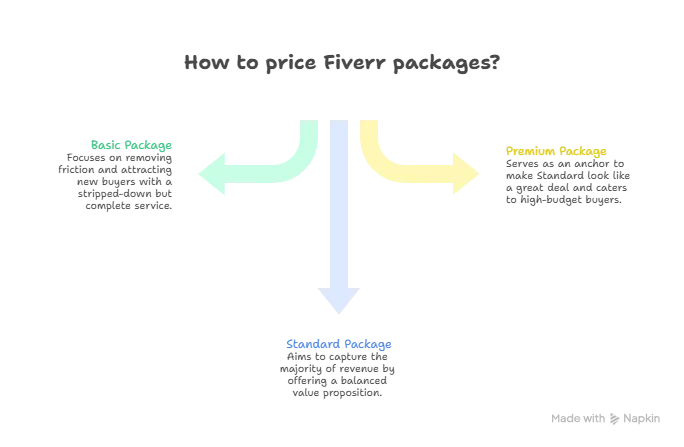
The Basic package’s job is to remove friction from the buying decision. The Standard package’s job is to capture the majority of revenue. The Premium package’s job is to make Standard look like exceptional value.
When sellers understand each tier as serving a distinct purpose rather than simply being a size variation, how to price Fiverr packages becomes a deliberate system rather than an arbitrary set of numbers.
What the Basic Package Is Actually For
Basic exists to lower the barrier to entry for buyers who are evaluating whether to trust a seller at all. It should deliver genuine, complete value within a narrower scope, not a teaser that forces an upgrade to receive what the gig title promised. A Basic package that withholds the core service creates buyer frustration, reduces conversion, and generates the kind of pre-order messages that consume seller time without converting to paid work.
The operative phrase is “stripped down but complete.” In practical terms:
- Writing: One article at a shorter word count (500–700 words), standard delivery window, one revision cycle
- Graphic design: One concept, standard file formats (PNG, JPEG), longer turnaround
- Video editing: Shorter video length (up to 3 minutes), standard export quality, no captions or motion graphics
- Data entry / VA: Limited volume, specific task type only, standard spreadsheet tools only
The Basic package scope also communicates where the gig sits in the market. It tells buyers what entry-level access to this service looks like — and that signal matters for attracting the right buyer profile.
What the Standard Package Is Actually For
Standard is where the majority of orders should land. It is the “obvious choice”, meaningfully better than Basic at a price increment that doesn’t feel like a penalty for wanting more. The Standard package adds value through levers that buyers genuinely care about: faster delivery, more revisions, higher output volume, or additional deliverable elements that remove work the buyer would otherwise need to do themselves.
Effective Standard package additions include:
- Delivery time reduced by 30–50% relative to Basic
- One to two additional revision cycles
- Higher word count, more deliverable units, or additional concepts
- Supplementary files or formats (vector files, editable source documents)
- One added element the buyer would likely need anyway (meta description for a blog post, brand color palette for a logo, subtitle captions for a video)
The logic is cause and effect: the Standard package should feel like an obvious upgrade, not an upsell. When buyers look at Basic and Standard side by side and feel that Standard is clearly the better deal at a reasonable price premium, the conversion decision becomes easy.
What the Premium Package Is Actually For
Premium serves two functions simultaneously. For buyers with the largest budgets or the most comprehensive requirements, it provides the complete, full-service version of the offering. For the majority of buyers, it functions as the anchor, the high reference point that makes Standard feel like the rational, value-conscious choice.
This is the anchoring principle in practice. When Premium is priced at three to four times Standard, Standard becomes the “smart buyer’s pick.” When Premium is priced at only 1.5 times Standard, both packages feel expensive relative to what buyers expected to pay.
Premium should include:
- Rush or priority delivery
- All source files and highest-resolution export formats
- Multiple concepts or variations
- Extended or unlimited revisions within a defined window
- The most comprehensive scope version of every element in lower tiers
Price Anchoring: How to Make Your Target Package the Obvious Choice
Anchoring works when a higher reference point makes a lower price feel like value. Applied to Fiverr, Premium is the anchor, Standard is the target, and Basic is the entry point.
The anchoring ratio that produces consistent results:
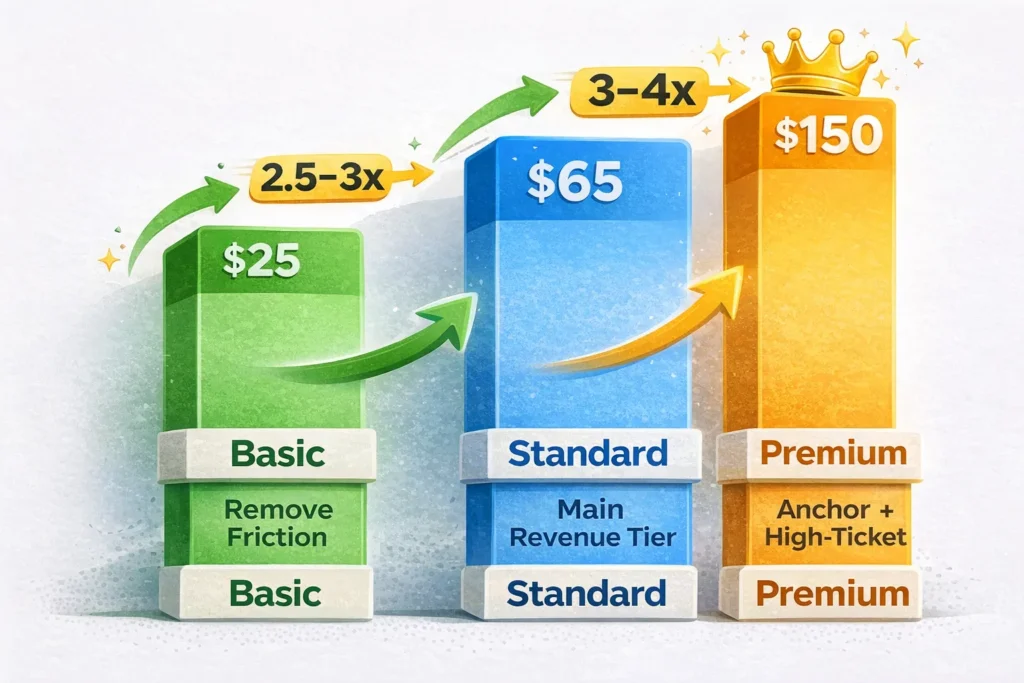
- Basic → Standard: 2.5–3x
- Standard → Premium: 3–4x
Infographic Spec: The Package Ratio Visual
Build this in Canva using three stacked bars of increasing height, labeled Basic / Standard / Premium. Add the ratio multipliers as annotations between each bar (2.5–3x and 3–4x). Add the three job labels from the summary table below each bar. This single visual communicates the entire pricing framework faster than any paragraph and should sit directly below the anchoring formula.
Real Pricing Case Examples by Niche
Theory is useful. Seeing the formula applied to real package structures makes it executable. The following three examples show how the anchoring ratios translate into actual Fiverr pricing across different service categories.
Case Example 1: Freelance Blog Writer
A blog writing seller positions around SEO content for small business clients. The niche has moderate competition and a buyer profile that values turnaround time and deliverable completeness over raw word count.
| Package | Price | What’s Included |
|---|---|---|
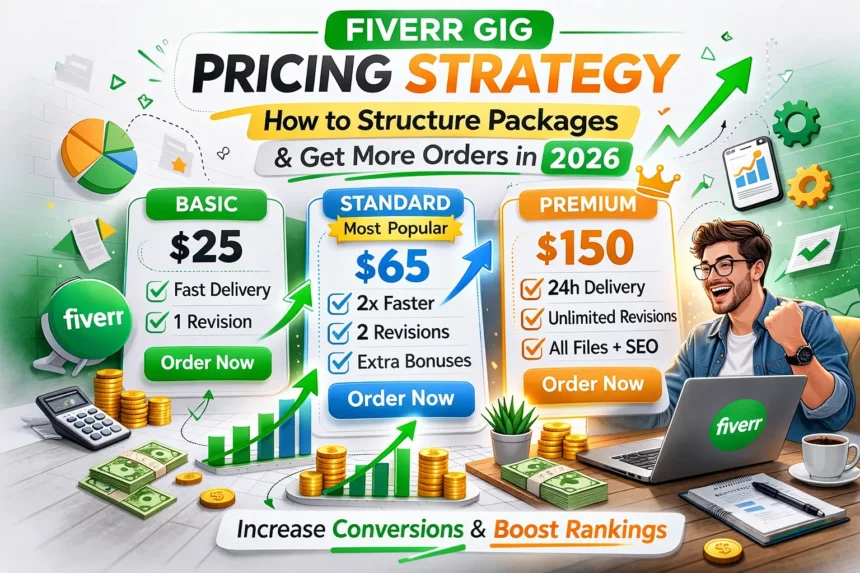
| Basic | $25 | 500-word blog post, 3-day delivery, 1 revision |
| Standard | $65 | 1,000-word SEO post, 2-day delivery, 2 revisions, meta description |
| Premium | $150 | 2,000-word long-form post, 1-day delivery, unlimited revisions, keyword research report |
Why it works: Standard at $65 is 2.6x Basic, within the target ratio. Premium at $150 is 2.3x Standard, slightly below the ideal 3x, but the word count doubling and unlimited revisions create strong perceived value. The meta description in Standard is the “one added element the buyer needs anyway”, it removes a task without requiring a full upgrade. This structure consistently produces 65–70% of orders landing on Standard.
Case Example 2: Logo Designer
A logo designer targets early-stage startups and small business owners. Design buyers are quality-sensitive, which means the Basic package needs to signal professionalism even at the lowest tier, not just affordability.
| Package | Price | What’s Included |
|---|---|---|
| Basic | $35 | 1 logo concept, PNG and JPEG files, 5-day delivery, 2 revisions |
| Standard | $95 | 3 logo concepts, PNG + SVG vector files, 3-day delivery, 3 revisions, brand color palette |
| Premium | $250 | 5 concepts, full brand kit (logo + icon + typography + color palette), source files, 2-day delivery, unlimited revisions |
Why it works: Standard at $95 is 2.7x Basic. Premium at $250 is 2.6x Standard. The vector files in Standard are a meaningful upgrade, PNG files alone are not sufficient for professional print use, so Standard becomes the minimum viable purchase for buyers with real business needs. The full brand kit in Premium creates a clear high-ticket offer for buyers who want a complete identity system rather than just a logo.
Case Example 3: YouTube Video Editor
A video editor targets YouTube creators in the 1,000–50,000 subscriber range who need consistent editing without hiring a full-time editor.
| Package | Price | What’s Included |
|---|---|---|
| Basic | $30 | Up to 5-minute video, jump cuts only, 3-day delivery, 1 revision |
| Standard | $85 | Up to 15-minute video, jump cuts + transitions + music sync + captions, 2-day delivery, 2 revisions, 1080p export |
| Premium | $220 | Up to 30-minute video, full editing suite + color grading + motion graphics intro, 1-day delivery, unlimited revisions, source project file |
Why it works: Standard at $85 is 2.8x Basic and adds captions — the single most-requested YouTube editing add-on — without requiring Premium. The motion graphics intro in Premium is a genuine differentiator that entry-level editors can’t replicate, which protects the Premium tier from feeling like padding. The source project file in Premium serves creators who want to make their own edits later, targeting a specific buyer type who would otherwise hesitate on Premium.
The Gap Problem: When Package Jumps Lose Buyers
A gap of more than ten times between Basic and Premium creates a specific conversion problem. Buyers who see what is available in the Premium tier, realize they cannot afford it, and look back at Basic feel that they are settling rather than buying. That psychological friction reduces conversion even on the lower tiers.
Equally, a gap of less than 1.5 times between Standard and Premium collapses the anchor effect entirely. If Standard costs $65 and Premium costs $80, buyers rationally question why the tiers exist, and the package structure communicates poor design rather than meaningful value differentiation.
Does Charm Pricing Work on Fiverr?
Charm pricing, prices ending in 9 ($29, $49, $99) rather than round numbers, produces measurable conversion differences in retail contexts. On Fiverr, the application is tier-specific. Charm pricing works well for Basic and Standard packages where affordability perception matters. Round numbers ($100, $150, $200) signal precision and quality confidence at Premium levels, where buyers are evaluating capability more than cost.
The practical recommendation: price Basic and Standard using charm pricing, price Premium using round numbers.
Price Points by Niche: Market Reference Ranges for 2026
The following ranges reflect current Fiverr marketplace positioning by niche. New sellers should enter at the lower end of each range; sellers with established review profiles should target the midpoint or above. If you are still identifying the right category to enter, the Best Fiverr Niches for Beginners guide covers which categories offer the most accessible entry points in 2026.
Writing and Content Creation
- Basic: $15–$35
- Standard: $50–$100
- Premium: $150–$300
Positioning note: pricing below $15 for Basic in this category signals low quality to most buyers rather than accessibility.
Graphic Design (Logo and Branding)
- Basic: $25–$50
- Standard: $75–$150
- Premium: $200–$400
Positioning note: design buyers tend to be more quality-sensitive than price-sensitive. Pricing too low signals a lack of professional experience more acutely than in other niches.
Video Editing
- Basic: $20–$50
- Standard: $75–$150
- Premium: $200–$500
Virtual Assistance and Data Entry
- Basic: $10–$25
- Standard: $35–$75
- Premium: $100–$200
Positioning note: differentiation through tool specificity, naming exact software such as Excel, Airtable, HubSpot, or Pipedrive, carries more conversion weight than pricing alone in this niche.
How Your Fiverr Pricing Tiers Affect Ranking
The connection between Fiverr pricing tiers and algorithmic visibility operates through conversion rate as an intermediary signal. This mechanism is worth understanding in mechanical detail because it changes how sellers should think about every pricing decision.
Why Misleading Pricing Is an Algorithmic Risk
When a gig title promises a service but the Basic package delivers something meaningfully narrower, buyers experience a mismatch that typically results in two outcomes: they leave without ordering, or they send a pre-order message that consumes time without converting. Both register as failed conversions. Over time, a pattern of high impressions with low conversion causes the algorithm to reduce visibility, which creates a compounding cycle where lower visibility leads to fewer orders, fewer reviews accumulate, and the gig stalls entirely.
The structural fix is alignment: the gig title, the Fiverr gig description, and the Basic package should all describe the same core service at the same scope level. Premium adds scope. Basic delivers the promise.
The Buyer Satisfaction Loop
Fiverr’s algorithm places significant weight on buyer satisfaction signals, public reviews, private feedback ratings, and dispute rates. These signals compound over time and, past a certain threshold, carry more ranking weight than keyword optimization alone. Correct pricing relative to scope produces satisfied buyers. When a buyer pays $65 for Standard and receives exactly what that tier described, on time, at the promised quality, the review is positive, the private feedback is strong, and the algorithm registers a high-quality transaction.
Overpricing produces the opposite effect: buyers feel they received less than the price suggested, review sentiment declines, and private feedback drops without the seller understanding why.
Pricing and the New Seller Momentum Phase
For sellers without reviews, the initial pricing phase serves a specific strategic purpose: generating the order volume and review accumulation that unlocks algorithmic visibility. A few initial orders at competitive pricing establish the performance baseline that supports higher prices over time. Pair this with the client acquisition strategies in the first Fiverr client guide to accelerate the review accumulation phase.
This is a deliberate phase, not a permanent positioning. Enter at the lower end of the market range, collect ten to fifteen reviews at 4.8 stars or above, then execute the incremental pricing increase strategy below.
When and How to Raise Your Fiverr Prices Without Losing Momentum
The Three Signals That Tell You It’s Time
Three concrete indicators suggest current pricing is below market-clearing level:
1. Queue consistently full: When delivery is backed up more than five to seven days regularly, demand exceeds capacity at the current price. The market is willing to pay more.
2. Review milestone reached: After ten reviews at 4.8 stars or above, pricing credibility exists to support a higher tier. The review threshold is when buyer risk perception shifts from “unknown seller” to “proven seller.”
3. Repeat buyer pattern: When the same clients return without price objections across multiple orders, market tolerance for higher pricing is confirmed. Repeat buyers are the strongest validation signal available.
How to Execute a Price Increase Without a Ranking Drop
Incremental increases are significantly safer than large single jumps:
- Raise one package at a time, typically Standard first
- Increase in 20–30% increments, not doubles
- Never execute during a slow performance period, wait for stable impressions and consistent orders
- Monitor conversion rate for two to three weeks after each change. A drop of more than 25–30% indicates the new price exceeds current market tolerance
- Never change tags, title, or description simultaneously with a price change, isolating variables is essential for understanding what caused any performance shift
The Discount-to-Raise Strategy
An underused tactic for sellers with established buyer relationships: offer a time-limited discount to repeat clients before executing a price increase. This creates genuine urgency, generates a fresh review cycle right before the pricing change takes effect, and maintains positive algorithmic signals, order volume, buyer satisfaction, during the transition.
The sequence: notify repeat buyers of the upcoming change, offer a final-order discount at the previous rate, collect the resulting orders and reviews, then implement the new pricing with fresh social proof supporting the higher tier.
Gig Extras and Add-Ons: The Hidden Revenue Layer
Package pricing covers the visible structure of a gig. Gig extras represent a fourth revenue tier that operates under different buyer psychology than package selection — and most sellers either ignore it entirely or underuse it.
What Gig Extras Enable
Beyond standard packages, Fiverr allows sellers to offer add-ons for individual elements a buyer might want without committing to a full package upgrade. Common extras include extra-fast delivery, additional revision cycles, source file access, and commercial use licensing. Fiverr also supports milestone-based payments for complex projects, hourly rate structures for open-ended work, and subscription pricing for recurring services.
What this enables is average order value growth without changing package prices. A Standard order at $65 with a $25 extra-fast delivery add-on generates $90 from a buyer who would not have purchased Premium at $150.
How to Price Extras Strategically
Extras should be priced at a premium relative to equivalent scope inside a package, because buyers who select extras are already converted and operating with lower price sensitivity. Extra-fast delivery commands 30–50% of the Standard package price. Source file access commands 20–30% of Premium pricing. Additional revision cycles price most effectively at $10–$25 depending on niche.
The Add-On That New Sellers Underuse Most
Extra revisions are the highest-conversion add-on for buyers who feel uncertain about the output before ordering. Capping revisions in packages at one or two cycles and offering unlimited revisions as a paid add-on captures quality-conscious buyers without inflating package prices, and protects sellers from unlimited revision demands on fixed-price packages simultaneously.
FAQ: Common Questions About Fiverr Gig Pricing
How much should a beginner charge on Fiverr?
Research the market by searching the target service keyword on Fiverr and filtering results by “New Seller.” Entry pricing should sit slightly below the average for established sellers, not at the absolute floor. In most content and design categories, a Basic package priced between $15 and $35 positions above the quality-signal threshold while remaining accessible. Pricing at $5–$10 in most niches now tends to attract the most demanding clients rather than serious buyers, creating a difficult early review environment.
Does changing your Fiverr gig price affect ranking?
Price changes do not directly reset ranking signals, but they affect conversion rate, which influences ranking indirectly. A price increase that reduces conversion rate will cause the algorithm to progressively reduce impressions. The safest approach is incremental changes with a two to three week monitoring window before evaluating whether the adjustment is working.
Should all three Fiverr packages be priced differently?
Yes, identical or near-identical pricing eliminates the anchoring effect and makes the tier structure meaningless to buyers. Each package should be meaningfully differentiated in both scope and price, following the 2.5–3x ratio between Basic and Standard and the 3–4x ratio between Standard and Premium.
What is a good conversion rate for a Fiverr gig?
Community data consistently suggests a conversion rate above 5%, orders divided by gig page views, is strong for an established gig with a solid review profile. If conversion rate falls below 2–3% on a gig with reasonable impressions and a strong thumbnail, the most common causes are pricing misaligned with the value the title suggests, or a scope gap between what the title promises and what Basic delivers.
Can I offer discounts on Fiverr packages?
Yes, Fiverr allows sellers to issue discount codes and promotional pricing to returning buyers. This is most strategically useful immediately before a planned price increase, as described in the Discount-to-Raise strategy above. Using discounts reactively, as a response to low order volume, typically attracts price-sensitive buyers rather than solving the underlying structure or description problem causing the shortfall.
Conclusion
A Fiverr gig pricing strategy is a system, not a number.
The three-tier structure has one job per level: Basic removes friction, Standard captures the majority of revenue, and Premium anchors buyer perception of value. Conversion rate connects every pricing decision directly to algorithmic visibility, which means package structure carries consequences that compound over time in both directions.
Start by auditing the current anchoring ratio. If the gap between Basic and Premium exceeds ten times, or falls below four times, the structure needs rebalancing before anything else changes. Set a review milestone for the next price increase, after ten reviews at 4.8 stars or when the queue runs consistently full, and execute using the incremental method with isolated variable changes.
Pricing structure determines whether buyers who land on the gig page convert. The copy layer that brings those buyers to the page in the first place is covered in the Fiverr gig description formula guide, which applies the same system-level thinking to title optimization, keyword placement, and the five-part description structure. Together, these two elements form the complete gig optimization framework.
Related reading: How to Get Your First Client on Fiverr | Best Fiverr Niches for Beginners | How to Set Freelance Rates in 2026