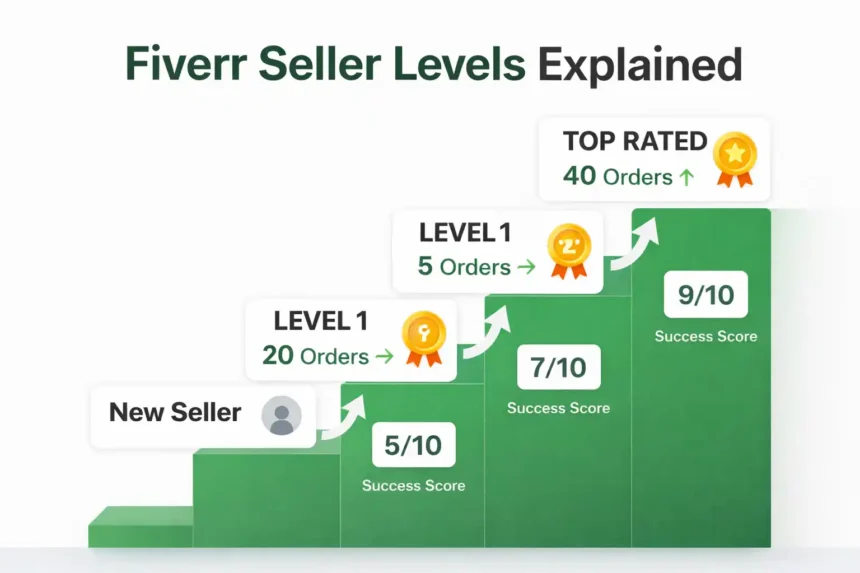
TL;DR: Fiverr organizes sellers into four levels: New Seller, Level 1, Level 2, and Top Rated. Each level has specific requirements around orders completed, earnings, ratings, and a metric called the Success Score. Fiverr evaluates these metrics on the 15th of every month. Missing even one threshold on evaluation day means no promotion. This guide covers every requirement, every benefit, and the fastest path through each level.
- What Are Fiverr Seller Levels and Why Do They Matter?
- All 4 Fiverr Seller Levels: Requirements at a Glance
- When Does Fiverr Evaluate Your Level? The 15th Rule Explained
- Fiverr Success Score: The Metric Most Sellers Don’t Understand
- What You Actually Get at Each Level: Benefits Compared
- How to Progress Faster: One Strategy Per Level
- Can You Lose Your Fiverr Level? How Demotion Works
- Wrapping Up
- Frequently Asked Questions
You completed 10 orders. Sixty days passed. You expected Level 1.
It didn’t come.
This is the most common frustration among new Fiverr sellers. The platform doesn’t promote you automatically based on time or order count alone. Fiverr seller levels are earned through a specific combination of metrics, all evaluated on a single date each month.
Understanding the Fiverr seller levels system is not optional if you want consistent gig visibility. Higher levels directly affect how often buyers find your gigs, how many gigs you can run, and what kind of support Fiverr gives you. This guide breaks down every requirement, every benefit, and the practical steps that move you from New Seller to Top Rated.
What Are Fiverr Seller Levels and Why Do They Matter?
Fiverr seller levels are a four-tier system that classifies sellers based on performance: New Seller, Level 1, Level 2, and Top Rated. According to Fiverr’s official level documentation, levels are performance-based, not time-based.
This distinction matters. A seller who completes 5 quality orders in 60 days can reach Level 1. A seller who has been on the platform for two years but maintains poor metrics stays at New Seller.
The practical impact is significant. Higher levels give sellers access to more active gigs, better placement in search results, and priority customer support. For buyers, levels act as a trust signal. A Level 2 seller’s gig often converts better than an identical gig from a New Seller, even at the same price. This matters because buyer decisions are made in seconds, and visible credibility reduces friction at the point of purchase. If you’re still building your profile, read this guide on writing your Fiverr gig description before focusing on level progression.
All 4 Fiverr Seller Levels: Requirements at a Glance
The table below covers every requirement across all four levels. These figures are sourced from Fiverr’s help center and verified against current platform data.
| Requirement | New Seller | Level 1 | Level 2 | Top Rated |
|---|---|---|---|---|
| Active Days | — | 60 days | 120 days | 180 days as L2 |
| Orders Completed | — | 5 | 20 | 40 |
| Unique Clients | — | 3 | 10 | 20 |
| Earnings | — | $400 | $2,000 | $10,000 |
| Min Rating | — | 4.4/5 | 4.6/5 | 4.7/5 |
| Response Rate | — | 80%+ | 90%+ | 90%+ |
| Success Score | — | 5/10 | 7/10 | 9/10 |
| How Awarded | Auto | Auto | Auto | Manual Review |
A few points worth noting. The unique client count is separate from total orders. One client placing five repeat orders counts as one unique client, not five. This is a threshold many sellers underestimate when planning their early strategy.
Top Rated Seller is the only level awarded manually. Fiverr’s editorial team reviews the account directly, looking at consistency, communication quality, and professionalism over time. Choosing the right niche on Fiverr affects how quickly you accumulate unique clients, since high-demand niches attract a wider range of buyers.
When Does Fiverr Evaluate Your Level? The 15th Rule Explained
Fiverr evaluates every seller account on the 15th of each month. Promotions and demotions both happen on this single date.
This is the rule most new sellers miss. The evaluation window is rolling: 60 days for Level 1, 120 days for Level 2. All your required metrics must be met simultaneously on that date. Meeting the thresholds on the 14th doesn’t carry forward to the following day.
The practical implication: if you complete your 5th order on March 14th, your Level 1 evaluation happens on April 15th. The March 15th window has already closed. According to data compiled by SpyOpinion, sellers who miss promotions most frequently do so because they reach the order count threshold in the last few days of the evaluation window, after the 15th has passed.
The optimal strategy is to build strong metrics well before the 15th. Consistent performance across the full evaluation window is what the system rewards, not a last-week sprint.
Fiverr Success Score: The Metric Most Sellers Don’t Understand
The Success Score is a 1-to-10 rating Fiverr calculates based on six performance areas: order completion rate, on-time delivery, communication quality, buyer satisfaction (both public and private reviews), revision handling, and dispute resolution.
According to Fiverr’s Success Score documentation, the score is relative, not absolute. Fiverr compares your performance against other sellers in the same price range. A seller charging $50 per gig is benchmarked against other $50 sellers, not against the entire platform.
This is the key insight that most sellers overlook. You can have a 4.8-star rating and still carry a Success Score of 4 if sellers in your category consistently outperform you on private feedback, revision frequency, or cancellation rates.
The score required for each level is 5/10 for Level 1, 7/10 for Level 2, and 9/10 for Top Rated. The fastest way to improve the score is to reduce revision requests. Clear project briefs, specific deliverables, and strong upfront communication before starting orders reduce the chances of revisions and disputes. Both reduce the score.
This peer-relative model mirrors how performance metrics work across other platforms. On Upwork, the Job Success Score also functions as a relative metric, comparing a freelancer’s outcomes against others in similar categories. The implication is the same: improving absolute numbers is not enough if the field around you is improving faster.
What You Actually Get at Each Level: Benefits Compared
Knowing the requirements is only half the picture. The benefits at each level are what make progression worth the sustained effort.
| Benefit | New Seller | Level 1 | Level 2 | Top Rated |
|---|---|---|---|---|
| Max Active Gigs | 7 | 10 | 20 | 30 |
| Custom Offer Limit | $5,000 | $5,000 | $10,000 | $10,000 |
| Customer Support | Standard | Standard | Priority | Dedicated |
| Seller Plus Eligible | No | Limited | Yes | Yes |
| Promoted Gigs Access | No | Limited | Full | Full |
According to data from Jobbers.io’s Fiverr seller analysis, the jump from Level 1 to Level 2 is where most sellers see a meaningful change in order volume. The combination of 20 active gig slots, full Promoted Gigs access, and priority support creates a compounding effect on visibility.
Level 2 also unlocks full Seller Plus eligibility, which gives access to buyer request insights and early access to new platform features. For Top Rated sellers, dedicated customer support means a named account manager. This matters when disputes arise or when account issues need fast resolution.
If you want to understand how level affects search placement directly, this breakdown of ranking your Fiverr gig covers the algorithm signals that level status influences.
How to Progress Faster: One Strategy Per Level
Each level has a specific bottleneck. Addressing it directly is more efficient than trying to improve every metric at once.
New Seller to Level 1: The bottleneck is usually unique clients, not total orders. One client who orders five times still counts as one unique client. Set competitive pricing for your first packages to attract a range of buyers quickly. Three to five different clients is the actual threshold that matters here. This also means your Fiverr gig pricing strategy should favor accessibility early rather than maximum profit per order.
Level 1 to Level 2: The bottleneck at this stage is usually the Success Score. Most sellers at Level 1 have adequate ratings but struggle to push the Success Score above 7. The fastest lever is response time. Keeping your response time under one hour significantly improves the communication quality component of the score. Set up mobile notifications and respond to every inquiry promptly, even if only to acknowledge receipt and set a timeline for the full reply.
Level 2 to Top Rated: This path requires preparation for a manual review, not just hitting numeric thresholds. Fiverr’s team looks at account consistency over the full 180-day window as Level 2. A comparison of Level 2 vs Top Rated seller profiles shows that Top Rated sellers typically combine high order volume with unusually low dispute rates relative to their order count. That combination is what the review team is looking for.
Can You Lose Your Fiverr Level? How Demotion Works
Yes. Fiverr evaluates sellers for demotion on the same 15th-of-the-month schedule used for promotions. If your rolling window metrics fall below the threshold for your current level, Fiverr demotes you automatically at the next evaluation.
For Top Rated Seller specifically, one Terms of Service warning in the last 30 days creates an automatic demotion risk. The platform treats TOS violations as a direct signal of professionalism, and Top Rated status requires a clean compliance record throughout the evaluation period.
Level demotion has a real consequence on visibility. Fiverr’s search algorithm weights seller level as a ranking signal, so a demotion translates directly to fewer impressions on your gigs. The mitigation strategy is straightforward: check the “Level Overview” section of your seller dashboard at least once per week. Fiverr shows your current standing against each requirement clearly, so you can see if any metric is trending toward a threshold before the 15th arrives.
Wrapping Up
Fiverr seller levels follow a specific logic: performance is measured on a rolling window, evaluated once per month, and scored relative to peers in your price range, not against fixed absolutes. Three factors determine whether you advance: consistent metrics across the full evaluation window, a Success Score that keeps pace with sellers in your category, and a unique client count that reflects genuinely different buyers.
The path from New Seller to Level 2 is replicable with the right focus. The path to Top Rated requires sustained performance over at least 180 days at Level 2, followed by a manual review. Both are achievable when you understand which metric is actually the bottleneck at your current stage.
Start by checking your Success Score in the seller dashboard. That single number tells you more about your promotion timeline than your public star rating does.
Which level are you currently at, and what metric is holding you back? Share your situation in the comments below.
Frequently Asked Questions
How long does it take to reach Level 1 on Fiverr?
The minimum time to reach Level 1 is 60 active days, but time alone doesn’t guarantee promotion. You must also complete 5 orders with 3 unique clients, earn at least $400, maintain a 4.4-star rating or higher, keep an 80% response rate, and achieve a Success Score of 5 or above. All of these must be met simultaneously on the 15th of the month.
Does Fiverr evaluate levels automatically?
Yes, for New Seller, Level 1, and Level 2. Fiverr’s system evaluates all seller metrics on the 15th of each month and adjusts levels accordingly. Top Rated Seller is the only exception: it requires a manual review by Fiverr’s editorial team rather than an automated algorithm decision.
What happens if I don’t meet Level 1 requirements by the 15th?
Your account stays at New Seller until the next evaluation date on the following month’s 15th. The rolling evaluation window continues, and Fiverr reassesses whether all requirements are simultaneously met at that point. There is no penalty for not qualifying, only a delay in promotion.
Is Top Rated Seller the same as Fiverr Pro?
No. Top Rated Seller is awarded based on sustained performance metrics and a manual review of your account history. Fiverr Pro is a separate application process where sellers submit their portfolio for vetting by Fiverr’s Pro team. A seller can hold Top Rated status without being Pro, and a Pro seller can join at any level depending on their account history.
Can I lose my Fiverr seller level?
Yes. Demotion happens on the same 15th-of-the-month schedule as promotions. If your metrics in the evaluation window fall below your current level’s requirements, Fiverr demotes you automatically. Top Rated Sellers also face demotion risk from any Terms of Service warning issued in the past 30 days, regardless of whether other metrics remain strong.