If you have searched for AI jobs and felt like every role requires 3+ years of experience you do not have, this guide is specifically for you. The AI hiring landscape has shifted significantly in 2026, and companies are creating entry-level roles for freshers, career switchers, and self-taught learners who understand modern AI tools and can apply them to real-world problems.
Entry level AI jobs 2026 are among the fastest-growing career opportunities in India and globally. The artificial intelligence job market saw entry-level positions increase by 74% between 2024 and 2025, and that trajectory has continued into 2026 as generative AI adoption accelerates across every major industry. Understanding how the AI skills gap affects hiring decisions helps explain why companies are actively recruiting beginners rather than waiting for experienced candidates who simply do not exist in sufficient numbers.
This roadmap covers the top entry-level AI roles in 2026, realistic salary expectations, the skills that actually get candidates hired, and a structured 6–12-month learning plan to move from zero experience to your first AI job offer.
Key Takeaways
- Entry-level AI salaries in India range from ₹6L–₹15L
- AI jobs grew 74% between 2024–2025
- Beginners can enter AI within 6–12 months
- Python, SQL, and machine learning are core skills
- Generative AI tools like LangChain and LLM APIs are becoming essential
Current AI Job Market Overview
The AI job market in 2026 reflects a structural shift rather than a temporary hiring trend. Businesses across technology, finance, healthcare, and e-commerce have moved beyond experimentation, they are now building AI into core products and workflows, which creates sustained demand for people who can implement, maintain, and improve AI systems.
Several market signals are worth understanding before choosing a career path:
- Salary Range: Entry-level AI jobs in India range from ₹6L to ₹15L annually, with higher ranges in metro cities and AI-first companies
- Global Demand: Over 2.3 million AI jobs worldwide, with approximately 40% requiring less than two years of experience
- Industry Adoption: 85% of companies plan to increase AI hiring in 2026 according to industry surveys
- Remote Opportunities: 67% of AI roles offer remote or hybrid work arrangements, expanding access beyond metro cities
The significance here lies in the structural advantage this creates for beginners. Unlike previous technology waves, where entry-level candidates competed against a deep bench of experienced professionals, the AI field is young enough that a motivated learner with a strong portfolio and 6–12 months of focused preparation can realistically compete for roles at reputable companies.
Industries Hiring Entry Level AI Professionals
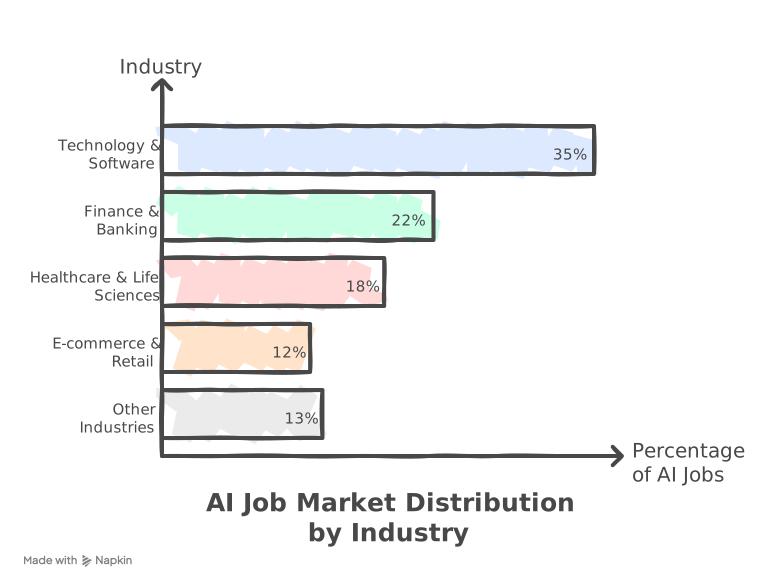
Technology & Software (35% of positions), Product companies building AI features, AI-first startups, and traditional tech companies integrating AI into existing platforms represent the largest hiring segment. These roles tend to offer the strongest salary growth trajectories.
Finance & Banking (22% of positions), AI helps detect fraud, analyze risk, automate trading strategies, and improve customer service. Indian banks and fintech companies are among the most active hirers of AI talent at the entry level.
Healthcare & Life Sciences (18% of positions), Medical image analysis, disease prediction, and drug discovery represent high-value applications where AI is reducing research timelines by years. This sector offers strong long-term stability.
E-commerce & Retail (12% of positions), Recommendation engines, inventory optimization, and customer behavior analysis drive significant revenue. Companies like Flipkart, Myntra, and Meesho maintain active AI hiring pipelines.
Other Industries (13% of positions), Education, manufacturing, logistics, and consulting are all actively recruiting AI talent with varying technical requirements.
Top Entry Level AI Jobs in 2026
1. AI / Machine Learning Engineer (Associate)
Average Salary: ₹8L – ₹15L annually
This is the most technically demanding entry-level role, but also the highest compensated. Associate ML Engineers work within product or platform teams to implement pre-trained models, prepare training datasets, evaluate model performance, and integrate AI into applications. The role requires solid Python skills and a working understanding of machine learning fundamentals, it does not require original research or deep theoretical knowledge at the entry level.
Most hiring managers for this role care more about demonstrated project work than academic credentials. A candidate with a deployed recommendation system or sentiment analysis tool on GitHub has a structural advantage over a degree holder with no portfolio.
Skills Required: Python, machine learning fundamentals, data preprocessing, Git, familiarity with Scikit-learn or TensorFlow basics
2. Data Analyst with AI Skills
Average Salary: ₹6L – ₹12L annually
Data analysts interpret structured datasets and help businesses make decisions, and in 2026, the role has expanded to include AI-assisted analysis, automated reporting, and support for machine learning teams. This is often the most accessible entry point into the AI field for candidates without strong programming backgrounds. Understanding how to become a data analyst with no prior experience provides a practical starting framework.
The analytical skills built in this role, pattern recognition, hypothesis testing, and communicating insights to non-technical stakeholders, transfer directly into more senior AI positions over time.
Skills Required: SQL, Excel, Python or R, Power BI or Tableau, statistics fundamentals
3. AI Content Specialist
Average Salary: ₹5L – ₹9L annually
AI content specialists create training data for language models, optimize prompts, evaluate AI outputs for quality and accuracy, and help improve model behavior through structured feedback. This role requires minimal coding and is well-suited for candidates with strong writing ability and attention to detail.
The demand for this role reflects a broader trend: building reliable AI systems requires far more human oversight and data curation than most organizations anticipated. Companies training or fine-tuning proprietary models need specialists who understand both language nuance and AI limitations.
Skills Required: Strong writing ability, understanding of AI limitations and hallucination patterns, systematic attention to detail
4. AI Product Support Specialist
Average Salary: ₹6L – ₹11L annually
These professionals assist users of AI tools, troubleshoot system issues, document technical processes, and channel user feedback into product improvements. The role sits at the intersection of customer service and technical knowledge, making it a strong entry point for candidates transitioning from non-technical backgrounds.
Skills Required: Customer service experience, technical aptitude, problem-solving ability, clear written communication
5. Junior AI Research Assistant
Average Salary: ₹7L – ₹13L annually
Research assistants support senior researchers by reviewing literature, designing experiments, preparing datasets, and assisting in model development. This role is most suitable for candidates with academic backgrounds in computer science, mathematics, or related fields who want to build toward research-focused careers.
Skills Required: Research methodology, Python, statistical analysis, and academic writing
6. AI Training Data Coordinator
Average Salary: ₹5L – ₹8L annually
Training data coordinators manage data labeling projects, maintain quality standards for datasets, coordinate annotation teams, and support data pipeline operations. This role requires project management ability more than great technical skills, and provides a strong foundation for understanding how AI systems are built from the ground up.
Skills Required: Project management, data quality assessment, basic programming knowledge, attention to detail
Emerging Entry Level AI Jobs in 2026
The growth of generative AI has created several new career paths that did not exist in meaningful numbers before 2024. These roles represent some of the highest-growth opportunities in the current market.
AI Prompt Engineer
Salary Range: ₹7L – ₹15L
Prompt engineers design instructions that guide AI models toward better outputs. The role involves systematic testing of prompts, analyzing model behavior, optimizing response quality, and designing AI workflows for specific business applications. Understanding how to build income-generating AI applications using tools like ChatGPT and Midjourney builds directly relevant skills for this role.
This role requires logical thinking and structured experimentation more than traditional coding ability, which makes it accessible to candidates from diverse backgrounds.
Key Skills: LLM fundamentals, systematic prompt testing, LangChain basics, understanding of model limitations
Generative AI Specialist
Salary Range: ₹9L – ₹18L
Generative AI specialists build applications using large language models and multimodal AI systems. This includes integrating LLM APIs, building AI-powered chatbots, developing content generation tools, and connecting AI capabilities to existing software infrastructure. The role requires more technical depth than prompt engineering and represents a natural career progression path.
Key Skills: OpenAI/Anthropic API integration, LangChain or LlamaIndex, vector databases, Python, basic backend development
AI Automation Specialist
Salary Range: ₹8L – ₹16L
Automation specialists integrate AI into business workflows, replacing repetitive manual processes with intelligent systems. This role bridges operational understanding and technical implementation, making it valuable across industries that have extensive back-office operations. The broader implications of AI on workforce structure help explain why this role has grown so rapidly in hiring volume.
Key Skills: Workflow automation tools, AI API integration, process analysis, basic scripting
Essential Skills for Entry Level AI Jobs
Technical Skills
Python Programming — Python is the primary language of AI development. At the entry level, candidates need proficiency with Pandas for data manipulation, NumPy for numerical operations, and Scikit-learn for machine learning. Familiarity with TensorFlow or PyTorch basics adds significant value but is not mandatory for most entry-level roles.
SQL and Databases — AI professionals work constantly with structured data. Candidates who can write complex queries, perform data aggregation, and understand database structure have a meaningful advantage in both data analyst and ML engineering roles.
Machine Learning Fundamentals — Understanding the difference between supervised and unsupervised learning, how regression and classification algorithms work, and how to evaluate model performance forms the conceptual foundation for most technical AI roles. Candidates do not need to implement algorithms from scratch, understanding when and why to apply them matters more.
Statistics and Mathematics — Probability, linear algebra, and hypothesis testing underpin AI model behavior. A working knowledge of these concepts, sufficient to interpret results and identify data problems, is more valuable than advanced theoretical depth at the entry level.
2026-Specific Skills: Generative AI
The AI landscape has shifted toward generative AI tools and frameworks. Candidates who understand how large language models work, how to use LLM APIs effectively, and how to build basic AI-powered applications with tools like LangChain or LlamaIndex hold a structural advantage over candidates with only traditional ML knowledge. Building AI literacy across these newer tool categories has become a baseline expectation for many 2026 job listings.
Key tools to learn: ChatGPT API, Claude API, LangChain, LlamaIndex, vector databases (Pinecone, Chroma), and basic RAG (Retrieval-Augmented Generation) architecture.
Soft Skills
Communication and problem-solving ability consistently appear in AI job descriptions because AI projects fail far more often due to poor problem framing than technical limitations. The ability to explain AI outputs to non-technical stakeholders, write clear documentation, and translate business requirements into data problems is a genuine differentiator at the entry level.
Best AI Certifications for Beginners in 2026
Certifications signal structured learning to employers and help candidates stand out in competitive applicant pools. The following credentials carry meaningful weight in hiring decisions:
Google Cloud Professional Machine Learning Engineer — Demonstrates cloud AI deployment capability, valued by companies using Google Cloud infrastructure.
AWS Certified Machine Learning – Specialty — Strong signal for candidates targeting companies in the AWS ecosystem, which includes a large portion of Indian tech startups.
Microsoft Azure AI Fundamentals (AI-900) — An accessible entry-level certification covering core AI concepts, suitable for candidates early in their learning journey.
DeepLearning.AI Specializations (Coursera) — Andrew Ng’s Machine Learning and Deep Learning specializations are widely recognized by hiring managers as evidence of structured foundational knowledge.
Hugging Face NLP Course — A free, practitioner-oriented course that builds directly relevant skills for generative AI roles.
Certifications work best when paired with portfolio projects. A certification without demonstrated project work carries less weight than a strong GitHub repository without formal credentials.
6–12 Month AI Career Roadmap for Beginners
Phase 1: Foundations (Months 1–2)
The goal of this phase is to build the programming and data skills that every subsequent AI topic depends on. Many beginners skip this phase in favor of directly learning machine learning, this creates gaps that surface in technical interviews.
Start with Python fundamentals through Codecademy or freeCodeCamp, then move into data manipulation with Pandas. Parallel to this, work through a structured statistics course (Khan Academy covers the necessary ground) and complete a foundational SQL curriculum using SQLBolt or Mode Analytics. Practicing coding problems on LeetCode alternatives reinforces algorithmic thinking that will appear in technical screens.
Weekly target: 1–2 hours of coding practice daily, plus one small project per week (a data parser, a simple web scraper, a dataset cleaning script).
Phase 2: Machine Learning Fundamentals (Months 3–4)
With Python and data skills established, candidates should work through Andrew Ng’s Machine Learning Specialization on Coursera, it remains the most respected introduction to the field. Complete 3–4 hands-on ML projects using real datasets from Kaggle: a regression model, a classification task, and one clustering project. Each project should be documented and published on GitHub with a clear README explaining the problem, approach, and results.
This phase also represents the right time to explore Scikit-learn deeply and begin building familiarity with model evaluation metrics beyond accuracy, precision, recall, F1 score, and AUC-ROC, which appear in most ML interviews.
Phase 3: Deep Learning and Generative AI (Months 5–6)
Introduction to deep learning frameworks (TensorFlow or PyTorch) and neural network fundamentals prepares candidates for roles in ML engineering and generative AI. More importantly, in 2026, candidates should dedicate significant time to understanding LLM APIs and building basic generative AI applications, an AI chatbot using the OpenAI or Claude API, a document Q&A system using RAG architecture, or a prompt optimization experiment with measurable outputs.
These projects signal both technical capability and awareness of where the industry is actually moving, which resonates strongly in interviews.
Phase 4: Portfolio and Job Preparation (Months 7–9)
A portfolio of 5–7 diverse projects covering data analysis, traditional ML, and at least one generative AI application provides the evidence base that hiring managers need. Deploy at least two projects on cloud platforms or make them publicly accessible. Demonstrated ability to ship working software matters more than theoretical knowledge at the entry level.
Optimize your LinkedIn profile with specific technical skills, project descriptions with impact metrics, and active engagement in AI communities. Apply broadly across roles, such as data analyst, AI content specialist, and automation specialist, which provide legitimate entry points into organizations where internal mobility into more technical AI roles is possible.
Salary Expectations for Entry Level AI Jobs in India (2026)
| Experience Level | Salary Range | Key Factors |
|---|---|---|
| 0–1 year | ₹6L – ₹12L | Skills portfolio, location, company type |
| 1–2 years | ₹10L – ₹18L | Proven projects, certifications, domain knowledge |
| 2–3 years | ₹15L – ₹25L | Specialization, leadership exposure |
Location and Company Type Premiums
Location significantly affects base salary. Bangalore and Hyderabad offer a 20–30% premium over the base range, Mumbai and Delhi 15–25%, and Pune and Chennai 10–15%. Tier-2 city roles typically reflect base range figures.
Company type matters as much as location. Big Tech companies (Google, Microsoft, Amazon) offer 40–60% above base range. AI-first startups offer 20–40% premium and often include equity. Traditional enterprises reflect a base range, and IT services companies tend to run 10–20% below base for similar technical roles.
Skills premiums worth knowing: MLOps knowledge adds ₹2–4L, cloud platform expertise adds ₹1–3L, domain specialization (healthcare, fintech) adds ₹2–5L, and generative AI application experience is increasingly commanding a separate premium in 2026 hiring negotiations. Understanding salary negotiation dynamics applies directly to AI roles as well — compensation is almost always negotiable at the offer stage.
How to Land Your First AI Job
Build a Portfolio That Demonstrates Real Problem-Solving
Employers in 2026 consistently prioritize demonstrated project work over academic qualifications. A GitHub profile with 5–7 well-documented projects, covering data analysis, machine learning, and at least one generative AI application, provides more hiring signal than most certifications. Each project should include a clear problem statement, the approach taken, the results achieved, and what was learned. Quantifiable outcomes (accuracy metrics, processing time improvements, user-facing functionality) make projects significantly more compelling.
Resume Strategy
The resume for an AI role should lead with a technical skills section listing specific languages, frameworks, and platforms with honest proficiency levels. The project section should describe 4–5 relevant projects with impact metrics and GitHub links. A professional summary should be specific: mention the types of AI problems you have worked on, the tools you use, and the role you are targeting. Generic summaries that could apply to any tech role are filtered out quickly.
Interview Preparation
Technical interviews for entry-level AI roles typically cover Python coding challenges, SQL queries, machine learning concepts, and project walkthroughs. The most common failure mode is candidates who can explain concepts but cannot apply them in a live coding context. Consistent practice on coding platforms in the weeks before interviews addresses this directly.
Common interview questions to prepare for:
“Explain the difference between supervised and unsupervised learning.” Supervised learning uses labeled data to train models for prediction tasks like classification and regression. Unsupervised learning identifies patterns in unlabeled data through clustering and dimensionality reduction techniques.
“How do you handle overfitting in a machine learning model?” Cross-validation, regularization techniques (L1/L2), feature selection, and increasing training data volume are the primary interventions, with the appropriate choice depending on the model type and dataset size.
“Walk me through a project you built.” Structure: problem definition → data collection → exploratory analysis → feature engineering → model selection → evaluation → deployment → results and what you would do differently.
Networking
Online communities accelerate learning and create referral opportunities that direct applications rarely provide. Kaggle competitions build both skills and visibility. Contributing to open-source AI projects on GitHub demonstrates initiative. LinkedIn engagement with AI professionals, commenting substantively on their posts, sharing project updates, generates profile visibility that passive applications do not.
Common Mistakes to Avoid
Focusing exclusively on theory without building projects. Every concept learned should immediately connect to a practical project. Candidates who can discuss the gradient descent conceptually but have never trained a model on real data struggle consistently in technical rounds.
Skipping Python and SQL fundamentals. Jumping directly to machine learning without strong programming foundations creates gaps that appear in every downstream task, data preprocessing, model implementation, and debugging all require solid coding skills.
Ignoring the business context of AI. Understanding why a company would build a specific AI system, what problem it solves, and what the ROI calculation looks like is what separates candidates who grow quickly from those who stagnate at the entry level. Study business cases alongside technical content.
Limiting job search scope to obvious “AI Engineer” titles. Data analyst roles, automation specialist positions, and AI content specialist jobs all provide legitimate entry points into organizations. Internal mobility from these positions into more technical AI roles is common and well-established.
Using the same application materials for every role. Customizing the resume and highlighting the most relevant projects for each specific job description meaningfully improves response rates. Generic applications signal low effort to hiring managers who review hundreds of submissions.
Not quantifying achievements. “Built a recommendation system” is weaker than “Built a recommendation system that improved simulated click-through rate by 23% on the MovieLens dataset.” Specific numbers, even from practice projects, make portfolio work more credible and memorable.
Frequently Asked Questions
What skills do I need for entry level AI jobs in 2026?
Python programming, SQL, basic machine learning concepts, and data analysis form the technical foundation required for most entry-level roles. In 2026, familiarity with generative AI tools, particularly LLM APIs and basic prompt engineering, has become an additional baseline expectation at AI-focused companies. Soft skills, including clear communication and structured problem-solving, are equally weighted by most hiring managers, particularly for roles that involve working with cross-functional teams.
Can freshers get AI jobs without a technical degree?
Many AI professionals in 2026 entered the field through self-learning, online certifications, and portfolio projects rather than formal degrees. Employers at product companies and AI-first startups frequently prioritize demonstrated skills over academic credentials. The practical path requires building a strong GitHub portfolio, completing recognized certifications from providers like Google, AWS, or DeepLearning.AI, and targeting roles that value applied capability, such as data analyst, AI content specialist, or automation specialist positions.
How long does it take to learn AI for entry-level jobs?
Most beginners with no prior programming experience require 9–12 months of consistent daily practice to reach a competitive level for entry-level roles. Candidates who already have programming experience or a quantitative academic background can reach readiness in 4–6 months. The critical factor is daily hands-on practice combined with portfolio project development, passive learning through videos, without building projects consistently underestimates the time required.
Which AI jobs can I get without coding in 2026?
Several entry-level AI roles require minimal coding. AI Content Specialist positions focus on training data creation and prompt optimization. AI Product Support Specialist roles center on troubleshooting and user feedback. AI Ethics Consultant roles, increasingly in demand as responsible AI practices become standard, require analytical and communication skills more than programming. AI Trainer roles develop educational and onboarding content for AI tools. These roles typically offer ₹5L–12L annually.
Is AI a good career in India in 2026?
AI represents one of the strongest career trajectories available in India in 2026, combining strong salary growth, high remote work availability, and demand that significantly exceeds supply at all experience levels. The skills developed in AI roles, data analysis, statistical reasoning, systems thinking, and software development are broadly transferable across industries, which provides career resilience beyond the AI sector itself. The relationship between AI skills and high-paying career outcomes is well-documented across Indian hiring data.
Should I specialize in a specific AI area as a beginner?
The most effective approach for beginners is to build generalist foundations across data analysis, machine learning fundamentals, and generative AI tools for the first 6–12 months. Specialization becomes valuable and strategically meaningful once you have enough practical exposure to identify where your strongest skills and interests align. High-demand specializations in 2026 include LLM application development, MLOps, computer vision, and AI for healthcare. Choosing a specialization based on a specific industry domain, such as fintech or e-commerce, accelerates career progression because domain expertise combined with AI skills is genuinely scarce.
How do I build an AI portfolio without prior work experience?
Start with guided projects from online courses, then modify them significantly with different datasets or problem framings. Use public datasets from Kaggle, government open data portals, or free APIs to solve real problems that interest you. Participating in Kaggle competitions, even a mid-leaderboard finish, demonstrates systematic problem-solving to employers. Deploy at least two projects using free cloud services such as Render, Railway, or Hugging Face Spaces to demonstrate end-to-end capability. Document every project thoroughly: what problem it addresses, why the approach was chosen, what the results showed, and what you would improve.
What are the highest-paying entry-level AI roles in 2026?
AI/ML Engineering Associate and Generative AI Specialist positions offer the highest compensation at the entry level, typically ranging from ₹9L–₹18L at product companies and AI-first startups. These roles require the strongest technical skills but also offer the fastest salary growth trajectories. Data analyst roles with strong AI tool fluency offer a reliable ₹6L–₹12L range with lower technical barriers to entry. Location, company type, and portfolio quality drive significant variation within each range.
The AI job market in 2026 presents one of the clearest structural opportunities for career entry that the technology sector has produced in recent years, significant demand, constrained supply of experienced candidates, and a skills profile that motivated learners can realistically build within a year. The path requires consistent daily practice, a portfolio built on real problems rather than tutorials alone, and a willingness to apply across the full range of entry-level roles rather than only the most obvious job titles.
The most important variable is starting. The candidates who begin building skills and projects today will hold a meaningful advantage over those who wait until they feel fully prepared.
Sources
The data and market insights referenced in this article are drawn from the following research publications:
- McKinsey Global Institute — The State of AI Report, Enterprise AI adoption rates, investment patterns, and workforce impact across sectors.
- Stanford University Human-Centered AI — AI Index Report, Annual measurement of AI progress across research, education, policy, and the economy.