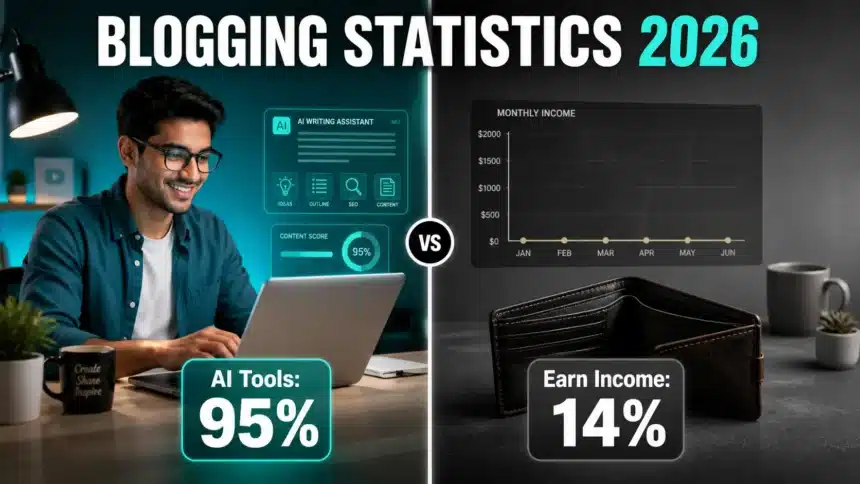
TL;DR: 95% of bloggers now use AI tools, yet only 14% earn any income from their blogs. Website and blog content remain the #1 ROI channel for B2B marketers. But 96.55% of all web pages get zero organic traffic from Google. This article compiles 48+ verified data points from Orbit Media, HubSpot, Semrush, Ahrefs, and RankIQ to show where blogging stands in 2026, who is earning, and what the traffic reality actually looks like.
95% of bloggers use AI. Only 14% earn anything. That gap is not a coincidence, it’s the whole story of blogging in 2026, up from 65% just two years ago (Orbit Media, Annual Blogger Survey 2025). Yet only 14% of bloggers earn any income from their blogs (Colorlib, 2025). And 96.55% of all web pages receive zero organic traffic from Google (Ahrefs, large-scale study, ~14 billion pages analyzed).
These three numbers tell the full story of blogging in 2026: adoption is high, AI is everywhere, but results remain concentrated in a small group.
We aggregated data from Orbit Media, HubSpot, Semrush, Ahrefs, RankIQ, Pew Research, SparkToro, Colorlib, the Content Marketing Institute, and the Productive Blogging Income Survey to build this roundup. Every stat traces to a primary source. Conflicts between sources are noted where they exist.
Key Takeaways
- 95% of bloggers use AI at least sometimes, up from 65% in 2023 (Orbit Media, Annual Blogger Survey 2025)
- Only 14% of bloggers earn any income from their blogs; just 7% earn $1,000 or more per month (Colorlib, 2025)
- Food blogs earn the highest median income at $9,169 per month, followed by personal finance at $9,100 (RankIQ, 2024)
- 96.55% of all web pages get zero organic traffic from Google (Ahrefs, large-scale study)
- Zero-click rate hits ~83% when a Google AI Overview is present on the search results page (Similarweb, 2025)
- Website, blog, and SEO is the #1 ROI channel for B2B marketers (HubSpot, State of Marketing 2026)
- Posts over 2,000 words earn 77% more backlinks than shorter content (Ahrefs)
- Businesses with blogs generate 67% more leads than those without (HubSpot)
- 77% of internet users regularly read blog posts (HubSpot, State of Marketing 2026)
- Content marketing costs 62% less than outbound and generates 3x more leads (Demand Metric)
- Bloggers who update old content see traffic lifts of up to 106% (Orbit Media, 2025)
- Marketers who blog are 13x more likely to achieve positive ROI from their marketing (HubSpot, State of Marketing 2026)
1. Industry Size and Readership
600 million blogs and 7.5 million posts are published every single day. Those numbers sound like saturation. The data suggests a different reading: volume is not the barrier. Attention is.
The bloggers and businesses gaining ground in 2026 are not publishing more. They’re publishing content that ranks, earns links, and holds reader attention long enough to convert. This matters because the 77% of internet users who read blogs regularly are not reading everything. They’re reading what shows up in search and what they trust.
| Metric | Value | Source |
|---|---|---|
| Blogs worldwide | 600M+ | Internet Live Stats, 2025 |
| Daily blog posts published | 7.5 million | Internet Live Stats, 2025 |
| Internet users who read blogs regularly | 77% | HubSpot, State of Marketing 2026 |
| Fortune 500 companies with public blogs | 77% | Backlinko / Master Blogging, 2024 |
| Active bloggers in the United States | 32 million+ | Colorlib, 2025 |
| WordPress market share (all websites) | 43% | W3Techs, 2025 |
| Content marketing industry projection | $107.5B by 2026 | Grand View Research |
Note on market size: Two figures circulate widely and measure different things. The blogging platforms market (WordPress, Wix, Tumblr, etc.) was valued at $5 billion in 2024 (Verified Market Reports). The broader content marketing industry, which includes blogging as a channel, is projected at $107.5 billion by 2026 (Grand View Research). These are not interchangeable.
2. Blogging Income and Monetization
Only 14% of bloggers earn any income at all. The gap between those who earn and those who don’t is not primarily about writing quality. The data points to strategy, niche selection, and time invested.
Among bloggers who do monetize, income concentrates heavily in a few niches. Food and personal finance consistently outperform every other category. The reason this works is that both niches attract high-intent readers who are actively looking to act: cook something specific, or solve a financial problem.
| Metric | Value | Source |
|---|---|---|
| Bloggers who earn any income | 14% | Colorlib, 2025 |
| Bloggers earning $1,000+/month | 7% | Colorlib, 2025 |
| Bloggers earning $100K+/year | 1–2% | Colorlib, 2025 |
| Food blog median monthly income | $9,169 | RankIQ, 2024 |
| Personal finance blog median monthly income | $9,100 | RankIQ, 2024 |
| Travel blog average monthly income | ~$5,000 | RankIQ, 2024 |
| Veteran blogger average monthly income | $5,624 | Productive Blogging Income Survey, 2025 |
| Time to consistent part-time income | 6–18 months | Industry consensus, 2026 |
Context worth noting: The Productive Blogging Income Survey 2025 found that bloggers with 1,000 or more published posts averaged $7,981 per month, down from $11,578 the prior year. The data suggests AI-generated content is compressing earnings even for established publishers, not just newcomers.
The top monetization methods among earning bloggers are affiliate marketing (used by approximately 70% of monetized blogs), display advertising (62%), and digital products such as courses and templates. Bloggers using both Mediavine and Raptive for ad management account for 72% of those earning $2,000 or more per month (Productive Blogging Income Survey, 2025).
If you want context on income ranges across digital work more broadly, the freelancer incomebreakdown for 2026 covers comparable data by skill and platform.
3. AI Adoption in Blogging
Bar chart comparing AI adoption among bloggers: 65% in 2023 vs 95% in 2025, based on Orbit Media Annual Blogger Survey 2025.
Source: Orbit Media, Annual Blogger Survey 2025 (808 respondents, 12-year longitudinal dataset)
The question is no longer whether bloggers use AI. 95% of them do. The real question is how they use it, and that distinction now determines whether AI helps or hurts performance.
Orbit Media’s 2025 Annual Blogger Survey, the most rigorous longitudinal study of blogging behavior, with 808 respondents and 12 years of comparable data, found that marketers who use AI to write complete drafts report below-benchmark marketing results. Those who use AI for research, editing, and ideation, while writing in their own voice, perform above the benchmark.
| Metric | Value | Source |
|---|---|---|
| Bloggers using AI at least sometimes | 95% | Orbit Media, Annual Blogger Survey 2025 |
| AI adoption rate in 2023 (comparison) | 65% | Orbit Media, Annual Blogger Survey 2025 |
| Bloggers using AI for idea generation | 66% | Orbit Media, Annual Blogger Survey 2025 |
| Bloggers using AI to write headlines | 58% | Orbit Media, Annual Blogger Survey 2025 |
| Bloggers using AI to write outlines | 54% | Orbit Media, Annual Blogger Survey 2025 |
| Marketers planning AI use in content in 2026 | 94% | HubSpot, State of Marketing 2026 |
| Using AI to write complete drafts: result correlation | Below benchmark | Orbit Media, Annual Blogger Survey 2025 |
What this enables, for bloggers who get it right, is a meaningful reduction in production time without sacrificing the human judgment that readers and search engines reward. Average post-writing time dropped from 4 hours 10 minutes in 2022 to 3 hours 25 minutes in 2025, largely due to AI-assisted drafting (Orbit Media, 2025).
For a breakdown of the specific tools bloggers are using across research, writing, and SEO tasks, see the AI tools guide for freelancers and content creators.
4. Content Strategy and Performance
Length matters, but it’s not the only lever. Posts over 2,000 words earn 77% more backlinks than shorter content (Ahrefs). However, the average blog post in 2025 is only 1,350 words, and that number has been declining for two consecutive years as AI enables faster, shorter publishing cycles (Orbit Media, 2025).
The data suggests a clear gap between what performs and what most bloggers publish. Refreshing old content consistently delivers measurable returns. Format selection matters as much as length.
| Metric | Value | Source |
|---|---|---|
| Average blog post length (2025) | 1,350 words | Orbit Media, Annual Blogger Survey 2025 |
| Posts over 2,000 words: additional backlinks | 77% more | Ahrefs, large-scale study |
| Bloggers who update old content regularly | 71% | Orbit Media, Annual Blogger Survey 2025 |
| Traffic lift from refreshing old content | Up to 106% | Orbit Media, 2025 |
| Average time to write one blog post | 3 hrs 25 min | Orbit Media, Annual Blogger Survey 2025 |
| How-to articles: share of blog format types | 76% | Orbit Media, Annual Blogger Survey 2025 |
| Posts with relevant images: additional views | 94% more | HubSpot |
| Marketers prioritizing blogs: ROI likelihood | 13x more likely | HubSpot, State of Marketing 2026 |
The pattern that emerges: blogs that consistently win in 2026 treat their content library as a compounding asset. They write longer pieces for competitive terms, update regularly, and add images and original data where it counts.
5. SEO and Traffic Reality in 2026
Chart showing zero-click search rates and AI Overview prevalence across 2025, based on Similarweb, SparkToro/Datos, and Semrush data.
Zero-click WITH AI Overview
~83%
Zero-click WITHOUT AI Overview
~60%
CTR drop at #1 rank (with AIO)
58%
Sources: Semrush AI Overviews Study 2025 (10M+ keywords); SparkToro/Datos Q1 2025 State of Search; Similarweb 2025; Ahrefs Feb 2026
This is the section most blogging statistics articles leave out. 96.55% of all web pages receive zero organic traffic from Google (Ahrefs, study of approximately 14 billion pages). That is not a rounding error. It is the actual competitive landscape every blogger operates in.
AI Overviews have changed the traffic math. When Google shows an AI-generated answer at the top of a search results page, users click organic results far less often. The data from multiple independent studies point in the same direction.
| Metric | Value | Source |
|---|---|---|
| Web pages with zero organic traffic from Google | 96.55% | Ahrefs, large-scale study (~14B pages) |
| Zero-click rate when AI Overview is present | ~83% | Similarweb, 2025 |
| Zero-click rate when no AI Overview | ~60% | Similarweb, 2025 |
| CTR drop for #1 organic ranking with AI Overview | 58% | Ahrefs, February 2026 |
| US organic click rate, March 2024 vs March 2025 | 44.2% → 40.3% | SparkToro / Datos, Q1 2025 State of Search |
| AI Overview prevalence, US desktop (peak, July 2025) | 24.6% | Semrush, AI Overviews Study 2025 |
| AI Overview prevalence, US desktop (stabilized, Nov 2025) | 15.7% | Semrush, AI Overviews Study 2025 |
| Organic traffic share of all web traffic (projected 2026) | 53% | SEO Inc., 2026 |
Pew Research context (July 2025, 68,879 real queries analyzed): When an AI Overview appears, only 8% of users click an organic result — versus 15% without an AI Overview. Only 1% of users click the citation links inside the AI Overview itself. This is the most methodologically rigorous user behavior study on this question to date.
The implication is not that SEO is dead. It is that the blogs still earning organic traffic in 2026 are the ones that either rank in the top positions for non-informational queries, or appear as sources inside AI Overviews. Both paths require the same thing: authoritative, well-sourced content.
For a deeper look at the AI Overview data and what it means for content strategy, see the AI Overviews and zero-click search statistics report published earlier this year.
6. Business Blogging ROI
The ROI case for business blogging is consistent across every major study. Businesses with blogs generate 67% more leads than those without (HubSpot). Small businesses see even larger effects: 126% more lead growth compared to non-blogging competitors (DemandSage, 2026).
This matters for freelancers and independent creators because the same mechanics apply at any scale. A blog that earns authority in a specific niche generates compounding returns: more indexed pages, more inbound links, more qualified traffic over time.
| Metric | Value | Source |
|---|---|---|
| B2B businesses with blogs: lead generation lift | 67% more leads | HubSpot |
| Small businesses blogging: lead growth vs non-bloggers | 126% more | DemandSage, 2026 |
| Website, blog, and SEO: ROI rank for B2B marketers | #1 channel | HubSpot, State of Marketing 2026 |
| Content marketing vs outbound: cost and lead volume | 62% less cost, 3x more leads | Demand Metric |
| Websites with blogs: additional indexed pages | 434% more | HubSpot |
| B2B buyers who read blogs before purchasing | 71% | Backlinko, citing DemandGen Report |
| Marketers reporting higher blogging ROI in 2024 vs 2023 | 50% | HubSpot, State of Blogging 2025 |
| Businesses increasing blog budget for 2025 | 45% | HubSpot, State of Blogging 2025 |
The reason this works, even in a zero-click environment, is that business blogs serve multiple functions beyond traffic. They build topical authority that influences AI citations, they support email list growth, and they create content assets that other channels distribute. Traffic is one output. It is not the only one.
If you’re building a freelance or consulting business and want to understand how content fits into a broader income strategy, the Upwork strategy guide for 2026 is worth reading alongside this data.
Blogging by the Numbers
| Metric | Value | Source |
|---|---|---|
| Blogs worldwide | 600M+ | Internet Live Stats, 2025 |
| Daily blog posts published | 7.5 million | Internet Live Stats, 2025 |
| Internet users who read blogs | 77% | HubSpot, State of Marketing 2026 |
| Fortune 500 companies with blogs | 77% | Backlinko / Master Blogging, 2024 |
| Bloggers earning any income | 14% | Colorlib, 2025 |
| Bloggers earning $1,000+/month | 7% | Colorlib, 2025 |
| Food blog median monthly income | $9,169 | RankIQ, 2024 |
| Personal finance blog median monthly income | $9,100 | RankIQ, 2024 |
| Bloggers using AI at least sometimes | 95% | Orbit Media, Annual Blogger Survey 2025 |
| AI adoption in 2023 (comparison point) | 65% | Orbit Media, Annual Blogger Survey 2025 |
| Marketers planning AI use in content (2026) | 94% | HubSpot, State of Marketing 2026 |
| Average blog post length (2025) | 1,350 words | Orbit Media, Annual Blogger Survey 2025 |
| Posts over 2,000 words: additional backlinks | 77% more | Ahrefs |
| Traffic lift from refreshing old content | Up to 106% | Orbit Media, 2025 |
| Web pages with zero organic Google traffic | 96.55% | Ahrefs, large-scale study |
| Zero-click rate with AI Overview present | ~83% | Similarweb, 2025 |
| CTR drop at #1 position with AI Overview | 58% | Ahrefs, February 2026 |
| B2B businesses with blogs: lead generation lift | 67% more | HubSpot |
| Small businesses blogging: additional lead growth | 126% more | DemandSage, 2026 |
| Website, blog, SEO: B2B marketers’ #1 ROI channel | #1 | HubSpot, State of Marketing 2026 |
Methodology and Sources
This article compiles data from primary research reports, official surveys, and reputable aggregators with disclosed methodology. No secondary blogs are cited as sources. Where source figures conflict, the conflict is noted explicitly.
Primary sources used:
- Orbit Media, Annual Blogger Survey 2025 — 808 respondents, 12-year longitudinal dataset. Used for AI adoption, content length, update frequency, and time-per-post figures. orbitmedia.com
- HubSpot, State of Marketing 2026 — 1,500+ global marketers surveyed. Used for readership, ROI channel rankings, AI adoption in marketing, and lead generation figures. hubspot.com
- HubSpot, State of Blogging 2025 — 500+ marketers from blog-maintaining businesses. Used for ROI trends and budget data. hubspot.com
- Semrush, AI Overviews Study 2025 — 10M+ keywords analyzed, 200,000+ keywords tracked over 10 months, 11,000 domains evaluated. Used for AI Overview prevalence data. semrush.com
- Ahrefs, large-scale study — ~14 billion pages analyzed. Used for zero-traffic figure (96.55%) and long-form content backlink data. ahrefs.com
- SparkToro / Datos, Q1 2025 State of Search — US and EU/UK click behavior study. Used for organic click rate year-over-year comparison. sparktoro.com
- Similarweb, 2025 — Clickstream analysis. Used for zero-click rate figures by AI Overview presence. similarweb.com
- Pew Research Center, July 2025 — 68,879 real queries analyzed. Used for user click behavior with and without AI Overviews. pewresearch.org
- RankIQ, 2024 — Niche income data by blog category. Used for food, personal finance, and travel income figures. rankiq.com
- Colorlib, 2025 — Income distribution data compiled from multiple blogger surveys. Used for 14% earning figure and income tier breakdowns. colorlib.com
- Productive Blogging Income Survey, 2025 — Annual primary survey of bloggers. Used for veteran blogger income and year-over-year earnings comparison. productiveblogging.com
- Content Marketing Institute, 2025 — B2B content marketing annual report. Used for B2B channel and format data. contentmarketinginstitute.com
- DemandSage, 2026 — Business blogging statistics. Used for small business lead growth figure. demandsage.com
- Demand Metric — Content marketing vs outbound cost and lead volume comparison. demandmetric.com
- W3Techs, 2025 — Website technology usage data. Used for WordPress market share. w3techs.com
- Grand View Research — Content marketing industry projection. Used for $107.5B by 2026 figure. grandviewresearch.com
- Verified Market Reports — Blogging platforms market size ($5B, 2024). Separate from content marketing industry figure. verifiedmarketreports.com
- Internet Live Stats, 2025 — Blog and daily post volume data. internetlivestats.com
- Backlinko, citing DemandGen Report — B2B buyer behavior data. backlinko.com
Source conflict noted: Multiple sources cite different AI adoption figures. Orbit Media (95%) and WPBeing / BloggersPassion (~80%) differ because they use different survey populations and definitions of “AI use.” This article uses Orbit Media as the primary source — it has the largest documented methodology, the longest comparable dataset (12 years), and the most specific use-case breakdowns.
Market size note: The blogging platforms market ($5B, Verified Market Reports 2024) and the content marketing industry ($107.5B, Grand View Research) measure different things and should not be compared directly.
Last updated: May 2026. We update this page quarterly as new primary research becomes available.