TL;DR: Most Fiverr sellers lose orders not because their gig is weak, but because their profile doesn’t convert. Your Fiverr profile does two jobs: it signals keywords to the algorithm, so your gig ranks, and it builds trust with buyers so they place an order. This guide walks through every profile section, with exact character limits, keyword placement rules, and sample copy, so your profile works as a sales system, not just a placeholder page.
Imagine your gig is getting 500 impressions a week. The traffic is real. But orders? Zero.
The problem often isn’t the gig itself. It’s the profile behind it. When a buyer clicks on your gig and sees an incomplete bio, a low-quality photo, and a skills section with three entries, they leave. They don’t message you. They don’t order. They just leave.
Fiverr profile optimization is the step most sellers skip because it feels less urgent than writing gig descriptions or setting prices. The data tells a different story. Fiverr’s official seller resources confirm that a complete, well-structured profile directly affects both search visibility and buyer conversion. This guide covers every section of your Fiverr profile, in the order it matters most, with practical instructions you can act on today.
Why Your Fiverr Profile Is a Conversion System, Not a Resume
Your Fiverr profile operates on two separate layers, and most sellers only build one of them.
The first layer is algorithmic. Fiverr’s search engine reads text fields in your profile, including your bio, skills, and linked accounts, to understand what you offer and where to surface your gig. The more relevant and well-placed your keywords are, the better your chances of ranking.
The second layer is human. Once a buyer finds your gig through a search, they click through to your profile before deciding to order. At that point, your profile photo, bio quality, portfolio, and certifications determine whether they stay or leave.
This matters because most sellers treat their Fiverr profile like a CV: they fill it in once, add a few bullet points about their experience, and move on. A CV tells an employer about your past. A sales page shows a buyer what they’ll get. The distinction drives every decision in this guide.
If you’re building a full freelance strategy beyond Fiverr, this guide explains how to get long-term clients on Upwork using a similar conversion-first approach.
Fiverr Profile Photo: What the Algorithm and Buyers Both Want
The algorithm doesn’t process your profile photo. Buyers do, and their behavior in response to it affects your ranking anyway.
Here’s how that works. Click-through rate, the percentage of buyers who click your gig after seeing it in search results, is one of the signals Fiverr’s algorithm uses to determine ranking. A strong profile photo increases click-through rate. A higher click-through rate improves your position in search. The photo’s effect on the algorithm is indirect, but it’s real.
For buyers, the photo is the first visual signal of professionalism and trust. Research into freelance marketplace behavior consistently shows that buyers spend less than three seconds evaluating a profile photo before forming an impression.
The rules for a strong Fiverr profile photo are specific:
- Use a real headshot, not a logo or illustration
- Use a plain, solid-colored background (white or light gray works best)
- Face the camera with a neutral or friendly expression
- Dress as you would for a professional client meeting
- Keep file size under 1MB for fast loading
One thing that disqualifies otherwise good photos: heavy filters or low resolution. A blurry photo signals low effort, and buyers notice.
Fiverr Profile Optimization Tips to Increase Orders
Your Fiverr bio has a 600-character limit. That’s roughly the length of three tweets. Every word either earns its place or wastes space.
The bio is the most heavily weighted text field for Fiverr’s internal search algorithm, according to analysis from Zenlance’s Fiverr ranking research. This means two things: keyword placement in your bio directly affects whether your gig appears in search, and a bio stuffed with keywords reads as spam to buyers and hurts conversion.
The goal is to write one bio that satisfies both conditions. The following three-part structure works:
Part 1: Lead with your primary keyword, who you help, and the result you deliver. Example: “I help e-commerce brands get more conversions through SEO-optimized product descriptions.”
Part 2: Add two to three lines of specific credibility. Name the tools, industries, or experiences that make you capable of delivering that result. This is where you mention relevant certifications, software expertise, or years of experience.
Part 3: Close with a soft call to action. “Message me before ordering” is the most effective closing line on Fiverr. It invites buyers to start a conversation, which increases your response rate metric, which in turn improves your ranking.
Keyword placement rule: your primary keyword must appear in the first two sentences. Use one natural variation later in the bio. Fiverr’s community blog confirms that over-optimization, meaning repeating the same keyword three or more times in a 600-character space, triggers ranking penalties.
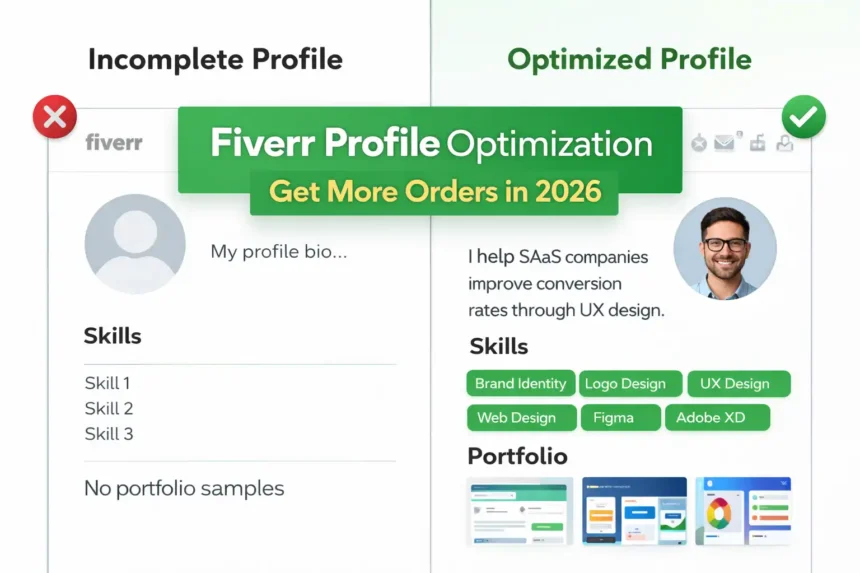
Before (weak bio): “I am a professional writer with 5 years of experience. I write articles, blogs, web content, and more. Contact me for great work.”
After (optimized bio): “I help SaaS companies grow organic traffic through long-form SEO content. With five years of writing for B2B tech brands, I produce research-backed articles that rank and convert. Message me before ordering so I can confirm your project is a fit.”
The difference isn’t length. It’s specificity. If you want to go deeper on applying this to your gig copy, the guide on writing a high-converting Fiverr gig description covers the same principles for your gig title and description.
Profile optimization increases impressions, but your Success Score determines whether those impressions convert to orders and level progression.
Skills, Languages, and Certifications: The Sections Most Sellers Skip
Fiverr allows up to 15 skills on your profile. Most sellers add three or four and leave the rest empty. Each empty skill slot is a missing keyword signal.
Each skill you add tells Fiverr’s algorithm one more thing about what you offer. If you’re a graphic designer who does logo work, brand identity, social media graphics, and pitch deck design, those are four separate skill signals. Adding only “graphic design” as your single skill leaves all the others invisible to search.
The skills section is also buyer-facing. When buyers filter search results by skill category, your profile only appears if that skill is listed. Sellers who skip this section disappear from entire buyer segments.
Languages work similarly. Fiverr buyers frequently filter by seller language and proficiency level. Fill this section honestly. If your written English is conversational, marking it as “Fluent” sets expectations you may not meet, which leads to disputes. If it’s genuinely strong, marking it accurately positions you for clients who filter by language.
Certifications carry two functions. They show buyers that you’ve invested in formal learning, which builds trust. They also serve as an additional trust signal in Fiverr’s algorithm. You can add both Fiverr-native skill tests and external certifications from platforms like Google, HubSpot, Coursera, and LinkedIn Learning.
Portfolio Section: How to Show Work When You Have No Fiverr Orders Yet
This is the most common blocker for new sellers. The assumption is that a portfolio requires completed Fiverr orders. It doesn’t.
Fiverr’s portfolio section accepts any relevant work samples. The source of the work doesn’t matter. Personal projects, work done for employers, student assignments, volunteer work, and spec pieces created specifically to demonstrate your skills are all acceptable. The only requirement is that the work is relevant to what you’re selling.
Fiverr’s help documentation on profile setup confirms there is no restriction on sample origin. What matters is quality and context.
Three to five strong samples outperform ten mediocre ones. Buyers don’t scroll through a large portfolio looking for the best piece. They look at the first two or three and make a decision. Lead with your strongest work.
Context matters as much as quality. A sample labeled “Logo” tells a buyer nothing. A sample labeled “Logo design for a sustainable food startup: the client needed a clean, modern mark that communicated both freshness and trust” tells them what you can do and for whom. This approach works on building a freelance portfolio with no client experience: the context you add around work transforms a sample into evidence.
Neemesh applied this principle when building the initial portfolio for NoCostTools. The early tool demos weren’t built for clients. They were built as use-case demonstrations. Adding specific context around each one, what problem it solved, who it was designed for, how it performed, increased the trust buyers placed in the samples before any client work existed.
Accepted formats: images (JPG, PNG), PDFs, and video links. For service-based sellers like writers or developers, screenshots of published work with the URL visible add an extra layer of credibility.
A strong portfolio also helps freelancers increase their rates over time: clients who can see the quality of your work before ordering are willing to pay more for it.
Linked Accounts, Website, and Social Proof: What to Fill and What to Skip
Fiverr gives you the option to link a professional website, LinkedIn, and social media accounts. Not all of these carry equal weight, and one of them can hurt you.
Your professional website, if you have one, should always be linked. Fiverr’s official documentation notes that a professional website URL is reviewed by Fiverr’s moderation teams as an additional credibility indicator when accounts are evaluated for Level badges and Pro status.
LinkedIn is the second most valuable link. Buyers in B2B niches, corporate communications, and professional services routinely check LinkedIn before placing an order. A complete, consistent LinkedIn profile that matches your Fiverr positioning reinforces trust.
Social media accounts are worth linking only when they’re professionally relevant. If you’re a social media manager, linking your actively managed accounts makes sense. If you’re a data analyst, your personal Instagram adds no value and may introduce noise.
Personal social accounts should be left unlinked. The goal of this section is to extend professional credibility, not to give buyers access to your personal life.
When to Update Your Fiverr Profile (and When Not To)
The most damaging mistake experienced sellers make is treating their profile like a work in progress, they keep editing every week.
Fiverr’s community blog confirms that frequent profile edits signal instability to the algorithm. When Fiverr detects repeated changes to profile text fields, it temporarily depresses rankings while it re-evaluates the account. Sellers who edit their bio weekly, wondering why their rankings aren’t improving, are often causing the problem they’re trying to fix.
The right approach is to optimize the profile properly once, then leave it stable for at least three to four weeks before evaluating results. For ranking your Fiverr gig effectively, profile stability is as important as keyword quality.
Update your profile when:
- You’ve completed a new certification worth adding
- Your service focus has meaningfully shifted to a different niche
- Your profile has been untouched for three or more months
- You’ve identified a factual error (a wrong tool name or outdated specialization)
Don’t update your profile when:
- You’re impatient because results haven’t arrived in the first week
- You’ve made small cosmetic changes and want to see if they make a difference
- You’ve seen a competitor’s bio and want to copy their structure
The three-to-four-week stabilization window gives the algorithm time to process your profile as it stands. Restarting that clock every week by making changes means your profile is never evaluated in its optimized state.
Profile optimization principles carry over across platforms. If you’re also working toward Upwork Top Rated status, the same logic applies: a stable, keyword-consistent profile outperforms one that’s constantly being revised.
Final Takeaways
A Fiverr profile that converts has the same structure whether you’re a new seller or an established one: a real headshot, a bio with a primary keyword in the first two sentences and a call to action in the last line, 15 skills filled out, honest language proficiency, relevant portfolio samples with specific context, and linked accounts limited to professionally relevant ones.
None of this requires Fiverr orders to implement. It requires roughly two to three hours of focused setup and four weeks of patience before you evaluate results.
The sellers who get consistent inbound orders from Fiverr aren’t necessarily the most experienced in their niche. They’re the ones who built their profile as a sales system rather than a form to fill out. Set the foundation correctly, then direct your energy toward understanding how to set your freelance rates so that when orders do arrive, you’re pricing them correctly from the start.
Have you audited your Fiverr profile recently, or has it been sitting untouched since you first created it? Share where you’re at in the comments.
Frequently Asked Questions
How long should a Fiverr profile bio be? Fiverr allows a maximum of 600 characters for the profile bio, which is roughly 80 to 100 words. You don’t need to use every character, but shorter bios tend to underperform because they leave keyword signals and trust signals on the table. Aim for 500 to 600 characters: enough to establish credibility, place your primary keyword naturally, and close with a call to action.
Can I add portfolio samples from work done outside Fiverr? Yes. Fiverr’s portfolio section has no restriction on where work samples come from. You can upload personal projects, work created for employers, student assignments, volunteer work, or samples created specifically to demonstrate your skills. The source of the work is not visible to buyers. What matters is the quality of the sample and the context you provide around it.
Does a Fiverr profile photo affect ranking? Not directly. Fiverr’s algorithm doesn’t process image content. However, your profile photo affects click-through rate, which is a behavioral signal the algorithm does track. A professional, high-quality headshot increases the percentage of buyers who click on your gig after seeing it in search results. Higher click-through rate improves ranking position over time, making the photo an indirect but meaningful ranking input.
How many skills should I add to my Fiverr profile? Add as many as are genuinely relevant to your service, up to the 15-slot maximum. Each skill functions as an additional keyword signal for Fiverr’s search algorithm, and buyers who filter by skill category will only see your profile if that skill is listed. Most sellers add three to five and leave the rest empty. Filling out all relevant skills is one of the lowest-effort, highest-impact changes you can make to a profile.
How often should I update my Fiverr profile? Update your profile only when there’s a meaningful reason: a new certification, a niche shift, or a profile that’s been untouched for three or more months. Frequent edits signal instability to Fiverr’s algorithm and can temporarily reduce rankings while the system re-evaluates your account. After any update, give the profile at least three to four weeks of stability before judging results.