
Most Upwork freelancers are stuck in a cycle they never planned for, finish a project, write more proposals, wait, win something, finish it, repeat. The work itself is fine. The exhaustion comes from the constant restart: a new client, a new context, new trust to build, a new negotiation every single time.
The freelancers who break out of that cycle are not more talented. They convert their existing clients. A single client retained for six months is worth five to ten one-off projects in terms of earnings, time saved, and JSS stability. Yet most freelancers end a project, get paid, leave a message saying “great working with you,” and never hear from that client againThis guide covers the specific mechanics of building long-term clients on Upwork in 2026: how to identify the clients worth pursuing before the project starts, the end-of-contract sequence that opens the door to ongoing work, and the exact messaging framework for proposing a retainer without sounding transactional. Long-term clients also stabilize your Job Success Score, which directly affects your ability to qualify for Top Rated status on Upwork.
What Is a Retainer Client on Upwork?
A retainer client is a client who pays a freelancer a recurring amount, weekly, monthly, or milestone-by-milestone, for ongoing work rather than a single defined project. The retainer model replaces the proposal-win-deliver cycle with a stable, predictable income stream from a client who already trusts the work.
On Upwork, retainers are typically structured in one of two ways: a recurring hourly contract in which the freelancer logs hours each week, or a fixed-price contract with monthly milestones that renew by mutual agreement. Neither is formally labeled a “retainer” by Upwork’s contract system, the structure is determined by how the freelancer and client agree to work, not by the platform.
Retainer vs. One-Off Project: The Income Difference
| Factor | One-Off Project | Retainer Client |
|---|---|---|
| Proposal effort | Every project | One time |
| Income stability | Low | High |
| Client relationship | Short-term | Long-term |
| JSS impact | One outcome | Multiple positive signals |
| Upwork fees | 20% on new clients | Drops to 5% after $10,000 |
| Average earnings over 6 months | 1× project fee | 3–6× same initial fee |
| Time spent on briefing | High (each project) | Low (established process) |
The income difference is not just additive, it is structural. Retainer clients reduce the number of proposals required to sustain a target monthly income, thereby lowering client acquisition costs and the time spent on platform administration.
There is also a direct Upwork platform advantage: the fee tier drops from 20% to 10% after $500 earned with a single client, and to 5% after $10,000. A freelancer billing $2,000/month on a retainer crosses the 5% tier in five months, and, from that point, earns 15 percentage points more per dollar from that client than they would from new clients at 20%.
How to Identify Clients Likely to Hire Repeatedly
The right moment to assess a client’s retainer potential is before accepting the contract, not after delivery. Certain signals in a job post and client history reliably predict whether a client builds long-term relationships with freelancers or treats every project as a one-time transaction. Choosing the right niche increases the likelihood of working with clients who need ongoing work rather than one-off projects. Some categories structurally produce retainer clients far more often than others.
5 Signals in a Job Post That Predict Repeat Business
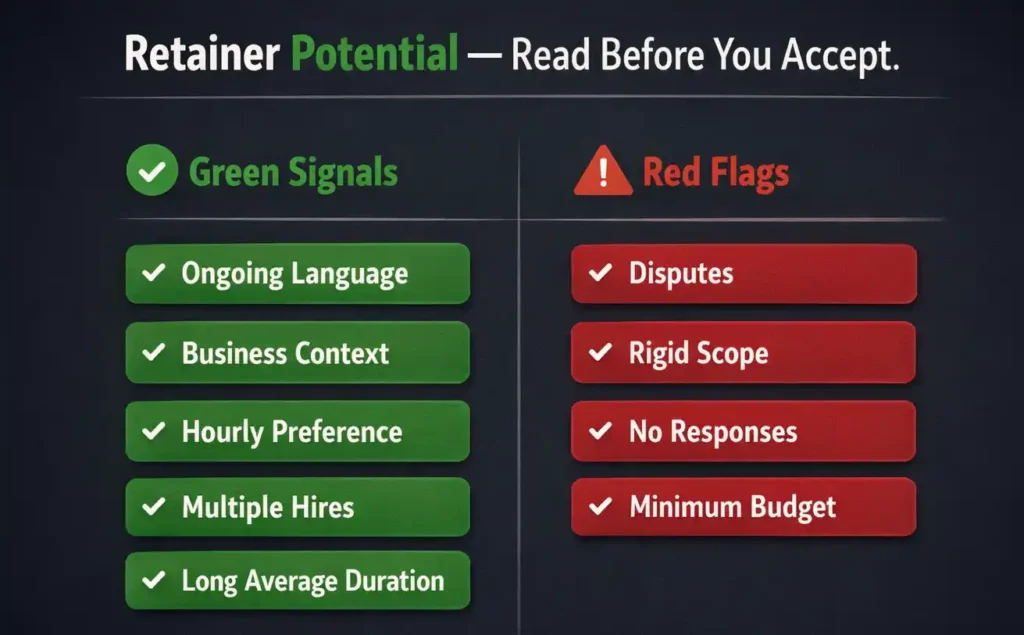
1. Ongoing language in the description. Phrases like “we regularly need,” “this is part of a larger project,” “we’re building out,” or “looking for someone to grow with us” signal that the client has a pipeline of work, not a single deliverable.
2. A specific business context. Clients who describe their company, goals, and how the output will be used are thinking operationally. Clients who describe only the task, with no context or purpose, are more likely to be transactional.
3. Hourly contract preference. A client choosing to hire on an hourly basis (vs. fixed price) is implicitly open to ongoing work. The hourly structure is the natural home for retainer arrangements.
4. Multiple previous hires in the same category. A client who has hired five writers, four developers, or three designers over the past year is not hiring for a one-time need. They are managing a recurring demand.
5. A long average engagement duration in the hire history. Upwork publicly displays clients’ hiring history, and the average contract length is visible. Clients with average engagement durations above 3 months are demonstrably building working relationships, not just buying deliverables.
How to Read a Client’s Hire History Before Accepting
On any job post, scroll to the client’s review history. Look at three data points: the number of hires, the average contract duration, and whether the same freelancers appear multiple times. A client who rehires the same person two or three times is the highest-signal indicator that retainer potential is real.
Building a profile that earns direct invitations from these clients, rather than competing on open proposals, is the upstream action that increases the probability of landing them in the first place.
Red Flags: Clients Who Will Never Rehire
Not every client is worth the energy of a retainer pitch. Cut the process short when the following signals appear:
- Disputes in the review history: a client who has left or received dispute-related feedback has demonstrated a conflict pattern that rarely resolves with a different freelancer
- Extremely detailed scope with rigid milestones: over-specified contracts signal a client who thinks in transactions, not relationships
- No response to mid-project messages: a client who goes silent during delivery will not engage with a retainer conversation
- Budget set at the absolute platform minimum: clients who anchor on the lowest possible price are rarely willing to commit to ongoing fees
Identifying these signals early and deprioritizing retainer effort with these clients preserves time for the relationships that will actually convert.
The End-of-Contract Sequence That Plants the Seed
Most freelancers miss the retainer opportunity not because they failed to ask, but because they asked too late, after the contract closed and the client has already mentally moved on. The end-of-contract sequence repositions ongoing work as a natural next step, not an upsell.
The Day-by-Day Sequence (Final 2 Weeks of a Project)
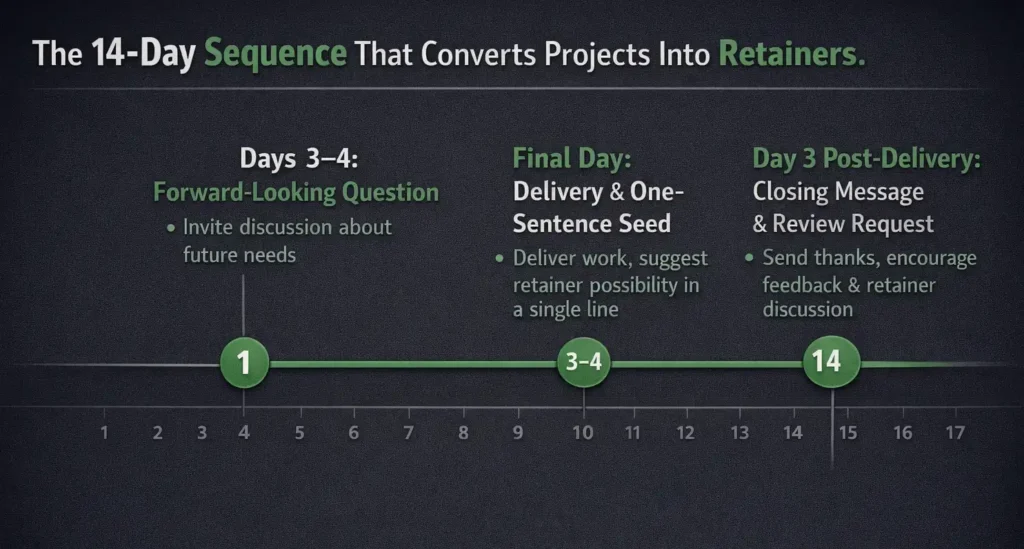
Day 1 of final week: Send a progress update that references something beyond the current deliverable. Example: “Finished the first three sections, noticed the keyword structure here would work well for the next phase of the content plan too.” This signals strategic thinking without asking for anything.
Day 3–4 of final week: During a natural check-in, ask one forward-looking question. “Once this goes live, are you planning to build on it, or does this complete the series?” This opens the door without pressure, the client answers on their own terms.
Final delivery day: Send the completed work with a summary note that includes one observation about what could come next. Keep it one sentence, not a pitch, just a planted idea. “The structure here sets up well for the X section if you decide to continue.”
3 days after delivery: Send the closing message (see below).
The Exact Closing Message That Opens the Door
This message should arrive after the client has received the work, had time to review it, and before the contract officially closes. The purpose is to make the transition to ongoing work feel natural rather than sudden.
“Really enjoyed working on [project name] — the [specific element] came together well. If you find yourself needing [type of work] on a recurring basis, I’d be glad to set up an ongoing arrangement rather than going through the proposal process each time. Happy to outline what that would look like if useful.”
Three elements make this message work: it is specific (references the project), it is low-pressure (no ask, just an offer to outline), and it positions the retainer as convenient for the client, not as a revenue opportunity for the freelancer.
Asking for a testimonial at this moment—before the contract closes- is a parallel action that strengthens JSS and public credibility simultaneously. The closing message and the review request can be sent together without either feeling transactional if the project delivery has been strong.
Timing: When to Raise a Retainer (and When Not To)
The right moment is during or immediately after a successful delivery, never mid-project when the outcome is still uncertain, and never more than a week after the contract closes when the client’s attention has shifted elsewhere.
Retainer conversations that happen at the wrong time, too early, too late, or during a difficult delivery, are consistently rejected, not because the client doesn’t want ongoing work, but because the timing signals poor judgment.
Understanding how long-term contracts affect JSS also informs the timing decision: a well-closed long-term contract contributes positive signals to the JSS calculation in ways that a series of short contracts cannot replicate.
How to Propose a Retainer Without Sounding Pushy
The retainer pitch fails most often because it centers the freelancer’s income needs rather than the client’s operational needs. A client who hears “I’d like to set up a monthly retainer” processes that as a financial commitment request. A client who hears “this would reduce the time you spend briefing new people every month” processes it as a workflow solution. The retainer opportunity often begins earlier than most freelancers realise, a well-structured proposal sets expectations for future collaboration before the first contract even starts.
The 3-Part Retainer Message Framework
Part 1 — Reference the specific pain the retainer solves. What issues does the client currently face without an ongoing arrangement? Re-briefing, inconsistent quality, time spent on proposals, output gaps? Name it specifically based on what was learned during the project.
Part 2 — Describe the arrangement in operational terms. Not “I’d like to work with you monthly” but “we’d set up a fixed block of [X hours / X deliverables] per month with a consistent brief process, no back-and-forth on scope each time.”
Part 3 — Make it easy to say yes or no. Offer a trial arrangement, one or two months, rather than an open-ended commitment. Clients who would decline a permanent retainer often accept a trial, and trials convert to long-term arrangements at high rates once the workflow is established.
Two Retainer Pitch Templates
Template A — Direct (for clients who signaled interest):
“Based on [project], it looks like [type of work] is something you’ll need regularly. Rather than posting a new job each time, I can hold [X hours / X deliverables] per month for your projects at a fixed monthly rate. This keeps the brief process simple and guarantees availability. Want me to send over a quick outline of how that would work?”
Template B — Soft Float (for clients who haven’t signaled yet):
“A few clients I work with find it useful to set up a small monthly block rather than going through proposals each time — saves the briefing overhead and keeps things moving. If that’s ever useful for [their type of project], happy to explain what it looks like. No pressure either way.”
Template B does not ask for a commitment, it plants the option. Some clients respond immediately; others come back three weeks later when the next need arises. Both outcomes are wins.
How to Use Upwork’s “Propose New Contract” Feature
Once a client expresses interest, the next practical step is to use Upwork’s built-in “Propose New Contract” feature, accessible from the Messages panel once a contract is active. This sends the client a formal contract proposal within the platform rather than requiring them to post a new job, reducing friction and keeping the arrangement on-platform (important for both JSS and payment protection).
For the contract structure itself, a freelance contract template that covers recurring scope protects both sides, particularly around revision limits, scope definition per cycle, and termination notice periods. These details matter more in retainer arrangements than in one-off projects because the stakes compound over time.
How to Price a Retainer Differently From Project Work
Retainer pricing follows a different logic from project pricing, and the most common mistake is treating them the same way.
Why Hourly Retainers Are a Trap
Pricing a retainer at an hourly rate creates a perverse incentive: the client monitors logged hours, questions efficiency, and resists the arrangement as soon as the monthly bill changes. The value of a retainer, predictability for both sides, is undermined by hourly billing because unpredictability is baked into the model.
Setting rates that reflect value rather than time is the foundational principle that makes retainer pricing work. A retainer should be priced on output or outcomes per cycle, not hours. This protects the freelancer’s income when work is completed efficiently and reduces the client’s incentive to audit time.
Retainer Pricing Models
| Model | Structure | Best For |
|---|---|---|
| Flat monthly deliverables | Fixed fee for X pieces / X tasks per month | Writers, designers, social media managers |
| Milestone-per-sprint | Fixed fee per 2-week sprint with defined scope | Developers, consultants, strategists |
| Availability retainer | Monthly fee for priority access + defined hours cap | High-value consultants, specialists |
| Hybrid (base + variable) | Fixed base fee + per-task rate above the threshold | Clients with unpredictable volume |
The flat monthly deliverables model is the simplest for both parties to understand and is the easiest to convert from a one-off project. Start there unless the client’s workflow naturally fits a different structure.
The Upwork Fee Reduction Advantage
Neemesh’s recommendation on this point is direct: this is the most underutilized argument for proposing a retainer to a client, and it works in both directions. A freelancer billing $2,000/month on an ongoing contract crosses the $10,000 cumulative threshold with a single client in five months, at which point Upwork’s fee drops to 5% on all additional earnings with that client. The freelancer earns more per dollar. The savings can be partially passed on to the client as a loyalty discount, making the retainer financially attractive for both parties.
How Upwork’s Contract System Handles Ongoing Work
Understanding the platform mechanics prevents structural errors that unnecessarily complicate retainer arrangements.
Hourly Contract vs. Recurring Fixed Milestones
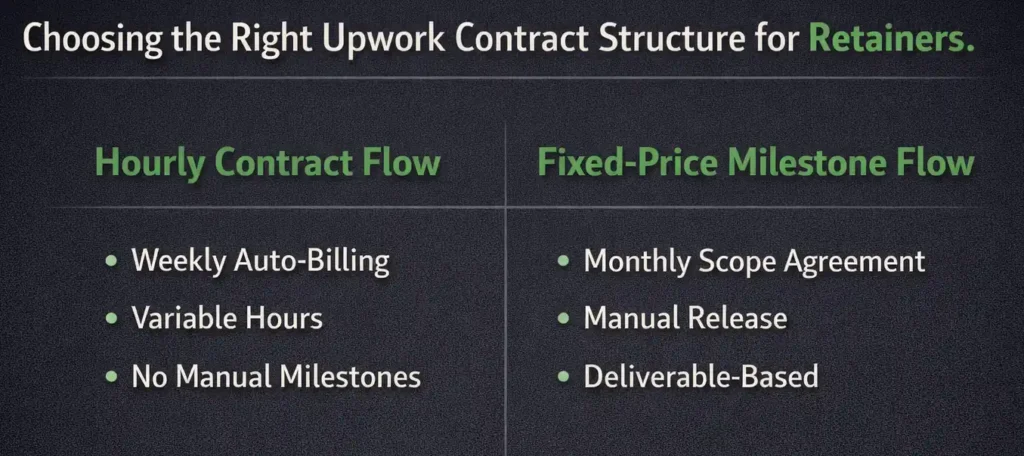
Upwork’s hourly contract is the natural fit for retainers where work volume varies week to week. The client’s payment method is charged automatically based on logged hours (up to the weekly limit set at contract start), which removes the friction of invoicing each cycle.
Fixed-price contracts require manual milestone creation and release, which means both parties need to agree on and create a new milestone each month. This adds a minor administrative step but provides greater control over scope definition per cycle. For freelancers who prefer deliverable-based retainers over hourly ones, a fixed-price model with monthly milestones is the more appropriate structure.
How to Structure Monthly Milestones Inside a Fixed-Price Contract
At the start of each month, the freelancer creates a new milestone describing that month’s scope and releases it to the client for approval. The client funds it; work proceeds; and the freelancer requests release upon completion. This mirrors a standard retainer invoice cycle but operates entirely within Upwork’s payment protection system, which matters for both parties.
For work that has transitioned from high-paying niche skills to long-term engagements, the fixed-price milestone structure also creates natural review points, moments where the arrangement can be renegotiated upward as the scope or complexity of work grows.
Key Takeaways
- Identify retainer-ready clients before starting — hire history, ongoing language, and hourly contract preference are the three highest-signal indicators
- The end-of-contract sequence starts on Day 1 of the final week — not after the contract closes
- The closing message should offer, not ask — positioning the retainer as convenient for the client converts at a higher rate than framing it as a request
- Price retainers on output, not hours — hourly billing creates friction; deliverable-based models create stability
- The Upwork 5% fee tier is a genuine retainer argument — $10,000 with one client unlocks it, and the savings can be shared with the client as a loyalty rate
- Hourly contracts suit variable-volume retainers; fixed-price monthly milestones suit deliverable-based retainers — choosing the wrong structure creates unnecessary administration
Frequently Asked Questions
How Do You Ask a Client for a Retainer on Upwork Without Losing the Relationship?
The most reliable approach is to frame the retainer as an operational convenience for the client rather than a financial arrangement for the freelancer. The soft float template, which explains the structure rather than asking for a commitment, preserves the relationship regardless of whether the client says yes. Clients who feel no pressure are more likely to return to the conversation when their next need arises.
What Is a Realistic Retainer Rate on Upwork in 2026?
Retainer rates vary by category and the Upwork fee tier with that specific client. A content writer billing $75/hour on a new client relationship takes home $60/hour after the 20% fee. The same writer on a $10,000+ retainer relationship takes home $71.25/hour after the 5% tier.
The practical implication: retainer rates should account for the fee tier in the calculation. Freelancers who have reached the 5% tier with a client can offer a modest loyalty discount while still earning more per hour than they would from new clients at the 20% rate.
Can Retainer Clients Be Managed Entirely Through Upwork?
Yes. Upwork’s messaging system, contract management, milestone structure, and payment processing support full retainer management on the platform. Keeping the arrangement on Upwork protects both parties under the platform’s payment protection terms and contributes to JSS calculation, which matters for maintaining Top Rated status. Moving retainer work off-platform violates Upwork’s terms of service and removes all payment dispute protection.
How Long Does It Typically Take to Convert a Client Into a Retainer?
The fastest conversions, two to four weeks from initial contract to retainer agreement, happen when the retainer conversation is introduced during the project rather than after it. The closing message alone, sent after delivery, typically produces responses within one to two weeks. Clients who do not respond to the initial message often return weeks later when the next need arises, the message functions as much as a planted idea as a direct ask.
What Should a Retainer Proposal Include?
A retainer proposal on Upwork should specify: the monthly deliverable or hour block, the rate per cycle, the brief process (how work will be scoped each month), the revision policy, and the notice period for ending the arrangement. For clients who need a formal document, adapting a standard freelance contract template to include recurring scope language is the fastest way to produce a professional retainer agreement without starting from scratch.
Conclusion
The gap between a freelancer who earns inconsistently and one who builds a stable monthly income on Upwork is rarely about skill. It is almost always about the system, specifically, whether there is a deliberate process for converting completed projects into ongoing relationships.
The retainer strategy outlined here is a sequenced system, not a single conversation. It starts with identifying the right clients before the project begins, builds through a structured end-of-contract sequence, and closes with a pitch that positions ongoing work as operationally useful rather than financially convenient for the freelancer.
Neemesh recommends selecting one active or recently completed project this week and applying the closing message. A single retainer conversion, even at a modest monthly rate, changes the monthly income math.
Have you tried converting a one-off client into a retainer? What was the sticking point, the ask, the pricing, or the client’s availability? Drop a comment below. Reactions and answers help shape the next version of this guide.