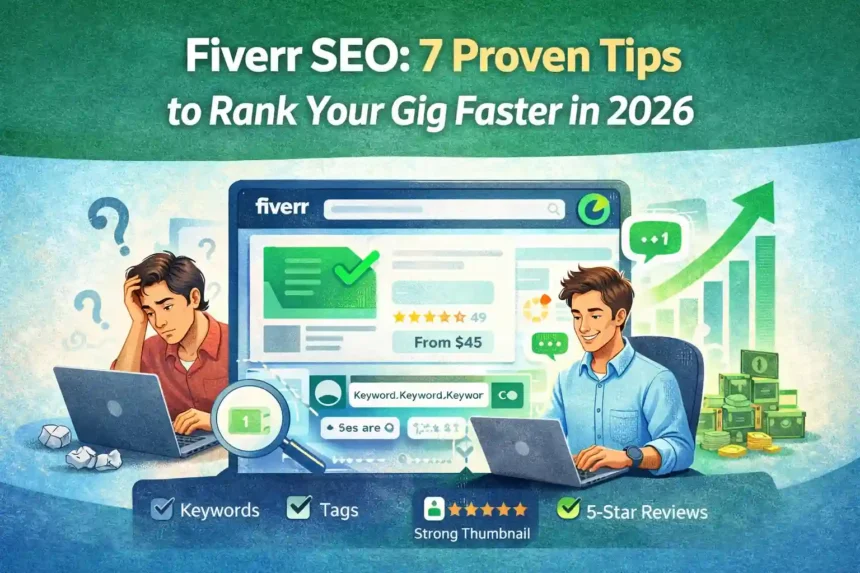
TL;DR: Fiverr SEO is the process of optimizing your gig so Fiverr’s search algorithm ranks it above competitors. The algorithm weighs keyword relevance, click-through rate, order completion, response time, and buyer satisfaction. To rank your Fiverr gig in 2026: start with long-tail keyword research, optimize your title and description naturally, use all five tags with intention, strengthen your thumbnail CTR, secure your first five reviews fast, and protect your performance score consistently.
You built the gig. You set the price. You waited. Nothing happened.
This is the most common experience on Fiverr, and the reason is rarely the seller’s skill. The real problem is that the Fiverr SEO system works like a search engine, and most sellers treat it like a job board. They post a gig and assume buyers will find them. That’s not how it works.
Fiverr shows gigs based on relevance and performance signals, not creation date. If your gig isn’t optimized for both, it sits invisible while a competitor with a weaker service but a stronger profile ranks above you.
This guide walks through 7 practical tips to fix that, in order of impact.
What Is Fiverr SEO and How Does the Algorithm Actually Work?
Fiverr SEO is the practice of optimizing your gig title, description, tags, and profile so Fiverr’s search engine surfaces your gig when a buyer searches for the service you offer.
Fiverr’s algorithm weighs several factors simultaneously. Keywords tell the system what your gig is about. Click-through rate (CTR) tells it whether buyers find your gig worth clicking. Conversion rate tells whether they follow through. And performance signals, including on-time delivery, order completion, response time, and buyer ratings, tell it whether you’re a reliable seller to recommend.
The weight of each factor shifts based on your seller history. For newer gigs with no order data, keywords carry more weight. As you build a track record, performance signals take over. This means the optimization work you do early determines whether the algorithm has enough data to start promoting you at all.
The significance here is structural: Fiverr SEO is not a one-time setup. It’s an ongoing system that rewards consistency.
Why Most Fiverr Gigs Stay Invisible (And It’s Not Your Skill)
Most gig failures come down to the same four patterns.
Keyword mismatch. The seller targets a keyword like “graphic design” when buyers are searching for “minimalist logo for Shopify store.” Broad keywords are dominated by high-volume sellers. New gigs don’t stand a chance there.
Weak thumbnails. If a buyer scrolls past your gig image without clicking, Fiverr registers a low CTR. Over time, this signals to the algorithm that your gig isn’t worth showing. A strong thumbnail is not a design luxury. It’s a ranking factor.
Zero early orders. Fiverr needs performance data to promote a gig. Without those first few orders and reviews, the algorithm has nothing to work with. The gig sits in a low-visibility state indefinitely.
Slow response time. Fiverr tracks how quickly you respond to messages. Sellers who respond within an hour consistently outperform those who respond in 12 or 24 hours, all else being equal.
Your gig is likely invisible because of one or more of these gaps, not because you aren’t good at your service. The next seven tips address each gap directly.
Tip 1: Keyword Research, The Foundation of Fiverr SEO
Keyword research is how you find the exact phrases buyers type into Fiverr’s search bar. The goal is not to find the most popular keywords. The goal is to find specific, high-intent phrases where your gig can realistically appear.
The most reliable method: open Fiverr and start typing your service into the search bar. The autocomplete suggestions are real searches from real buyers. A search like “logo design” auto-fills into “logo design for restaurant,” “logo design minimalist,” “logo design for clothing brand.” Each of those is a viable keyword with less competition than the parent term.
This is what Fiverr’s own community blog describes as the most important strategy for sellers: finding the phrases that connect your specific offer to buyers who know exactly what they want. Specific keywords attract buyers with higher buying intent and lower competition for new sellers.
The principle here is identical to broader SEO. When Neemesh applied keyword specificity to tool landing pages on NoCostTools.com, targeting utility-specific phrases rather than generic tool categories, organic traffic grew 150% in three months. The same logic applies to Fiverr: a gig titled for a narrow, specific search captures a buyer who has already decided what they want. That buyer converts at a much higher rate than one who stumbles across a generic listing.
Use 2–4 long-tail keywords for your gig. Then build your title, description, and tags around them.
Tools to support your research:
- Fiverr’s search autocomplete (free, real buyer data)
- Competitor gigs in your category (see what top sellers use in their titles)
- Google Keyword Planner or Ubersuggest (for search volume benchmarks)
Tip 2: Optimize Your Gig Title for Search and Clicks
Your gig title does two things at once. It tells Fiverr’s algorithm what your gig is about, and it tells a buyer whether to click. Both matter.
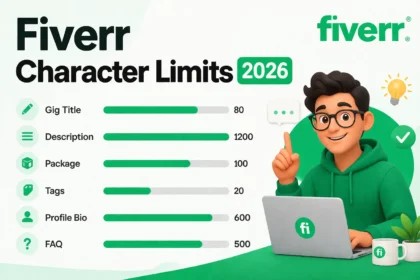
The primary keyword should appear at the start of the title. Fiverr’s algorithm scans titles first when determining relevance, so placement matters. Keep the title under 80 characters so it displays without truncation in search results.
The title should read naturally. Keyword stuffing, which is cramming multiple keywords into a title without regard for readability, signals low quality to both the algorithm and the buyer.
Compare these two titles:
- Weak: “Logo Design Logo Graphic Design Minimalist Brand Logo”
- Strong: “Minimalist Logo Design for Your Brand or Small Business”
The second title uses the keyword clearly, communicates a benefit, and reads like a real professional wrote it. That combination improves both search relevance and click-through rate.
One thing to avoid: making your title too clever or abstract. Buyers search for services in plain language. Your title should match that language, not describe your creative process.
Tip 3: Write a Gig Description That Ranks and Converts
The gig description serves two audiences. The algorithm reads it to understand context and keyword relevance. The buyer reads it to decide whether to trust you with their project.
The first 100 words of your description carry the most weight for keyword relevance. Your primary keyword should appear naturally within that opening. Then use 3–5 additional variations of the keyword throughout the rest of the description.
Structure matters as much as content. Most buyers don’t read descriptions word-for-word. They scan. A description that opens with the buyer’s problem, explains how you solve it, and ends with a clear call to action converts better than one that opens with your credentials.
A practical structure that works:
- State the buyer’s need in the first sentence
- Explain what you deliver and how it helps them
- List 3–5 specific deliverables using bullet points
- End with a CTA (“Message me before ordering so I can confirm your project fits”)
The CTA matters for a specific reason. It encourages buyers to message you, which boosts your response rate metrics and gives you a chance to close the sale before they move on to a competitor.
For internal reference, the principles behind a strong Fiverr description are closely related to those in a well-structured freelance proposal: open with the client’s need, demonstrate understanding, then present your solution.
Tip 4: Use All Five Tags, And Use Them Right
Fiverr gives every seller five tag slots. Most sellers use two or three, and those they do use tend to repeat the same keyword. Both habits limit search visibility.
As LinkedIn research on Fiverr’s ranking system confirms, tags help the algorithm understand the context of your gig and match it to a wider set of search queries. Using all five tags with varied, specific phrases means your gig can appear for multiple related searches rather than just one.
A good tag strategy for a logo design gig might look like this:
- “minimalist logo design”
- “logo for small business”
- “brand identity design”
- “logo designer for clothing brand”
- “modern business logo”
Each tag expands the gig’s search surface area. Tags that duplicate the title keyword add little. Tags that cover adjacent buyer searches add meaningfully.
Avoid irrelevant tags. If Fiverr detects that buyers click your gig for a keyword but don’t convert, it reads that as a relevance mismatch and reduces your ranking for that term.
Tip 5: Improve Your CTR With a Thumbnail That Gets Clicked
A gig thumbnail is the first thing a buyer sees in search results. If it doesn’t stop the scroll, no amount of keyword optimization will rescue the gig’s ranking.
Fiverr tracks CTR as a direct signal. A gig that gets clicked more than its competitors at the same search position gets promoted. One that gets skipped gets pushed down.
Three principles drive a stronger thumbnail:
Clarity over creativity. A buyer scanning 20 results in three seconds needs to understand immediately what you offer. A clear text overlay stating your service (not your name, not a tagline) communicates your value faster than any illustration.
Contrast and simplicity. High-contrast color combinations (dark text on a light background, or the reverse) are more visible in crowded grids. Cluttered thumbnails with multiple fonts, icons, and colors tend to perform worse than clean, focused ones.
Add a gig video. Fiverr’s data consistently shows that gigs with a short introductory video outperform those without. The video doesn’t need to be produced. A clear 30-second clip where you introduce yourself and explain what you deliver builds buyer trust faster than any written description.
If your current thumbnail isn’t generating clicks, treat it as a conversion problem, not a design problem. Change one element at a time, then track the change in gig impressions and clicks over two weeks.
Tips 6 and 7: Get Your First 5 Reviews, Then Protect Your Performance Score
These two tips are paired because they represent two distinct phases of Fiverr SEO: the launch phase and the maintenance phase.
Getting your first 5 reviews (Tip 6)
A new gig with zero reviews sits at a structural disadvantage. Fiverr has no performance data, so it won’t promote the gig aggressively. The fastest way through this phase is to reduce friction for buyers.
Lower your starting price to a level that feels like low risk. Add clear package tiers so buyers understand exactly what they get. Respond to every inquiry within an hour. Promote your gig externally through LinkedIn, Pinterest, or a personal blog.
External traffic is worth noting here. When buyers arrive at your gig from outside Fiverr and place an order, Fiverr registers that external demand as a positive signal. For freelancers who already create content or have a social presence, directing that audience to the Fiverr gig during the launch phase is one of the most efficient ways to build early momentum. The Pinterest scaling guide on EduEarnHub covers practical approaches to building that kind of external traffic channel. It connects directly with what’s useful for a Fiverr launch.
Protecting your performance score (Tip 7)
Once you have reviews and the algorithm starts promoting your gig, performance maintenance becomes the ranking driver. Fiverr measures:
- Order completion rate (keep this above 90%)
- On-time delivery (late deliveries hurt ranking for up to 60 days)
- Response time (under 1 hour significantly outperforms slower responders.)
- Buyer satisfaction (private ratings from buyers affect your ranking even when the public review is positive)
Cancellations are the most damaging single event for a gig’s ranking. One cancellation can suppress visibility for weeks. If a project scope is unclear, clarify it in messages before accepting the order. That one step prevents most cancellation scenarios.
The underlying logic is straightforward: Fiverr’s business depends on buyers finding reliable sellers. The algorithm rewards the sellers who make that outcome predictable.
For context on how pricing strategy intersects with performance maintenance, particularly during the phase where you’re raising rates after establishing reviews, the freelance rates guide on EduEarnHub covers the adjustment framework in detail.
Bonus: Advanced Fiverr SEO Moves for 2026
Once the foundation is in place, these three practices extend your ranking potential.
Refresh your gig every 4–6 weeks. Editing your title, description, or thumbnail signals activity to Fiverr’s algorithm. Gigs that are updated periodically tend to maintain visibility better than those left untouched for months. Even small changes, like rewording the first paragraph or updating a tag, register as freshness signals.
Use Fiverr Promoted Gigs selectively. Fiverr’s paid promotion tool places your gig above organic results for targeted searches. It works best after you have reviews, because the promoted listing needs strong conversion data to justify continued spend. Promoting a gig with no reviews accelerates clicks but not orders, which can hurt your conversion metrics.
Build external traffic deliberately. LinkedIn posts documenting client results, Pinterest pins linking to your gig, or articles on your blog that demonstrate your expertise all drive external traffic. Fiverr notices when buyers arrive from outside the platform. That signal, combined with strong on-platform performance, reinforces your gig’s authority in search rankings.
Common Fiverr SEO Mistakes That Hurt Rankings
These are the errors that most often stall a gig even after initial setup:
Keyword stuffing in the title or description. Fiverr’s algorithm has matured. Overloading a title with keywords reduces its readability, which hurts CTR, which hurts ranking. Natural language consistently outperforms keyword-heavy copy at the conversion stage.
Choosing too broad a niche. A gig titled “I will do graphic design” competes with thousands of established sellers. A gig titled “I will design a minimalist logo for fashion brands” competes with dozens. Narrowing the niche is not limiting. It’s a precision play that improves visibility and attracts buyers who already know what they want.
Ignoring response time. Many sellers treat response time as a formality. In practice, response time is a ranking input. Sellers who respond within an hour consistently appear higher in search than those who respond daily, assuming similar performance metrics otherwise.
Offering too many gig types. A common mistake among new sellers is creating 10 gigs across different categories to maximize exposure. Fiverr’s algorithm responds better to sellers who build depth in one niche than those who spread across many. One strong, well-reviewed gig outranks five mediocre ones.
The broader lesson: Fiverr SEO failures are almost always about spreading thin rather than going deep. The platform rewards focus.
How Long Does Fiverr SEO Take to Work?
The timeline varies, but a general framework helps set realistic expectations.
Weeks 1–2: Your gig gets indexed and appears in low-competition long-tail searches. Impressions are low but growing. This is the phase where response time and gig freshness matter most.
Weeks 3–4: If you’ve promoted externally and secured 1–2 early orders, your gig starts appearing more regularly. CTR data begins to influence your ranking position.
Month 2 and beyond: With 5+ reviews and consistent performance metrics, the algorithm has enough data to promote your gig more aggressively. This is when organic order volume typically begins to compound.
The sellers who give up at week 3, before the algorithm has enough data to act, are the ones who conclude that Fiverr SEO doesn’t work. The ones who stay consistent past that inflection point are the ones who report meaningful organic traction.
If you’re still exploring whether Fiverr is the right platform for your skills, the comparison between best freelancing platforms for beginners in 2026 covers Fiverr versus Upwork and Freelancer in detail, which can help you decide where to focus your energy first.
Conclusion
Fiverr SEO comes down to three things working together: keyword precision, strong CTR, and consistent performance.
Keywords get you found. Your thumbnail and title determine whether someone clicks. Your delivery and ratings determine whether Fiverr keeps promoting you. Weaken any one of these three, and the others can’t compensate.
The sellers who rank well on Fiverr in 2026 are not necessarily the most talented. They’re the ones who treat their gig as a product that needs ongoing optimization, not a listing they set up once and forgot.
Start with one optimized gig in a specific niche. Get the keywords right, the thumbnail strong, and the first five reviews as fast as possible. Then maintain your performance signals without compromise. The ranking will follow.
For the next step, read how to start freelancing in 2026 from scratch for the broader framework that Fiverr SEO fits into.
What’s the biggest challenge you’re facing with your Fiverr gig right now? Share it in the comments below.
Frequently Asked Questions
What is Fiverr SEO?
Fiverr SEO is the process of optimizing your gig’s title, description, tags, and performance signals so Fiverr’s search algorithm ranks it higher in buyer search results. It combines keyword strategy with behavioral signals like CTR, order completion rate, and response time. A well-optimized gig appears in front of buyers who are actively searching for your specific service.
How long does it take to rank a Fiverr gig?
Most gigs begin gaining visibility within 2–4 weeks of setup, assuming active promotion and at least one or two early orders. Meaningful organic traction typically starts in the second month, after the algorithm has gathered enough performance data to rank the gig with confidence. Sellers who give up before this point miss the compounding phase entirely.
How important are keywords on Fiverr?
Keywords are the primary signal Fiverr uses to match your gig with relevant buyer searches. Without the right keywords in your title, description, and tags, your gig won’t appear for the searches that matter, regardless of how good your service is. Long-tail keywords are particularly effective for new sellers because they reduce competition and attract buyers with specific, high-intent needs.
How many tags should I use on Fiverr?
You should use all five tag slots. Each tag expands the range of searches your gig can appear in. Using only two or three tags leaves visibility on the table. The tags should be varied, covering related but distinct phrases, rather than repeating the same keyword in slightly different forms.
Does Fiverr SEO still work in 2026?
Yes. Fiverr’s search algorithm continues to reward gigs that combine relevant keywords with strong buyer signals. What has changed is that performance metrics like CTR, conversion rate, and buyer satisfaction now carry more weight than they did in earlier versions of the algorithm. Keyword optimization alone is no longer sufficient. Sellers who optimize both the discoverability and the performance side of their gig see the strongest results in 2026.