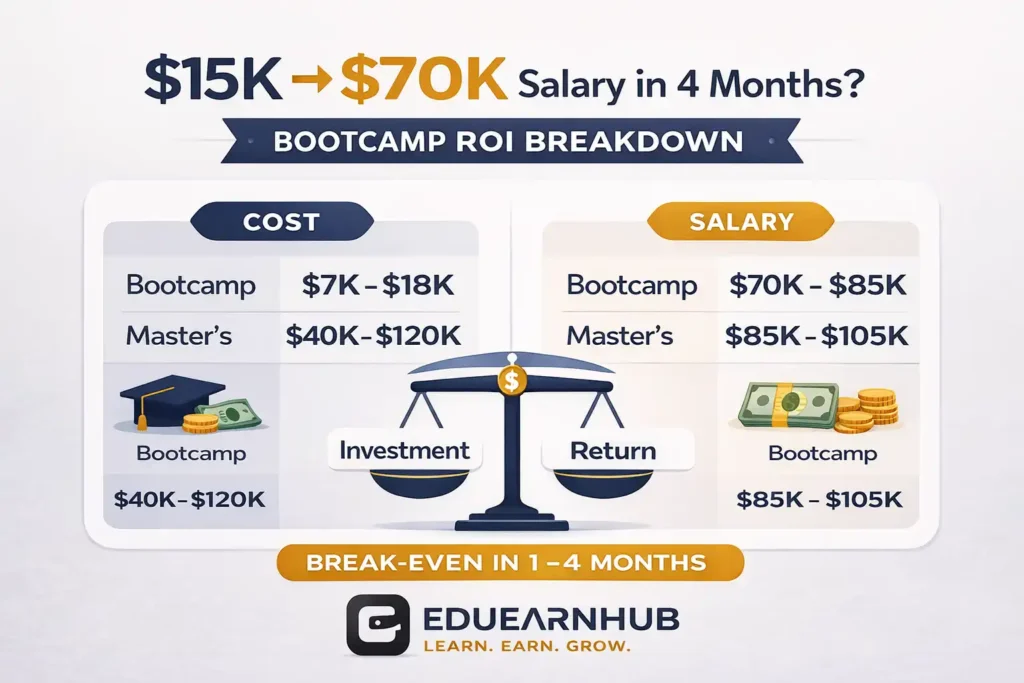
TL;DR: Data science bootcamps cost $7,000–$18,000 and take 3–9 months to complete, compared to $40,000–$120,000 and two years for a master’s degree. Course Report data shows bootcamp graduates earn an average first salary of $70,698, with break-even possible in as little as four months. But financial ROI is only half the equation. The real question is whether a bootcamp’s structured curriculum, peer cohort, and career services create lasting professional value for your specific situation in 2026.
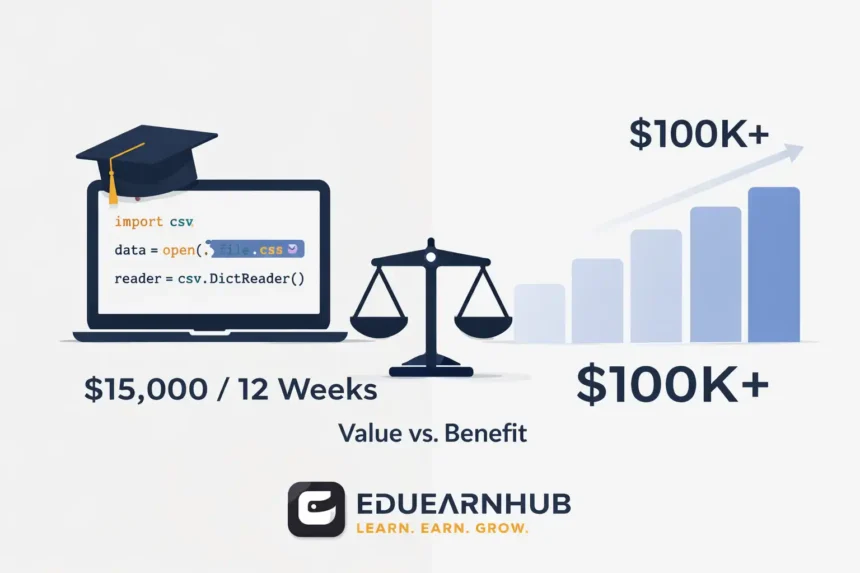
Harvard Business Review once called the data scientist role the “sexiest job of the 21st century.” Today, data science bootcamps are selling a $15,000 shortcut to that title, and to a starting salary above $100,000. The pitch is appealing: 12 weeks, a portfolio, and a job guarantee.
But 2026 looks different from 2020. Entry-level tech job postings dropped 40–50% between 2022 and 2024, and the market is now crowded with bootcamp graduates competing for the same junior roles. This makes the question more important than ever: does the cost of a data science bootcamp actually justify what you get in return? While data science is a top-tier field, it is just one part of the high-paying online careers in 2026 landscape.
This guide separates two distinct ideas: Value (the financial return on your investment) and Benefit (the long-term career growth you keep). Understanding both is the only way to make a sound decision.
What Does “Value” Actually Mean for a Data Science Bootcamp?
Value, in financial terms, is straightforward: what does your money return relative to what you paid? For data science bootcamps, the core inputs are tuition cost, time spent, and starting salary after graduation.
Average bootcamp tuition sits at $13,584, with most programs falling between $7,000 and $18,000. A traditional master’s degree in data science runs $40,000 to $120,000 and requires two or more years to complete. The Bureau of Labor Statistics projects 35% job growth for data science roles through 2032, which means the demand side of the equation remains strong.
The break-even math is where bootcamps look most attractive. A junior data scientist earning $70,000–$86,000 annually can recover a $13,000 tuition investment within one to four months of employment. That’s a faster payback period than almost any other form of education.
Income Share Agreements (ISAs): Safety Net or Debt Trap?
Many bootcamps offer an ISA, where students pay nothing upfront and instead give back a percentage of their income after landing a job. App Academy’s ISA, for example, requires 15% of income for up to 36 months, capped at $31,000, with graduates averaging $80,971 in starting compensation.
The hidden math matters here. On a $75,000 starting salary, a 15% ISA rate means payments of $11,250 per year. Over 36 months, that totals $33,750, which is more than double what many bootcamps charge upfront. ISAs are also largely unregulated financial products, meaning the terms vary widely between programs. They reduce upfront risk, but they transfer long-term financial exposure back to the student. Read the cap, the payment window, and the income threshold before signing.
The Professional Benefit a Bootcamp Delivers
Beyond the spreadsheet, bootcamps offer structural advantages that self-study rarely replicates. This is where the professional benefit lives, and it compounds over time in ways a tuition number can’t capture.
Structured Learning Path vs. Tutorial Hell
Self-directed learners often cycle through YouTube tutorials, Coursera courses, and documentation without building coherent skills. A bootcamp’s curriculum is sequenced with intention: foundational Python before machine learning, statistics before modeling, and capstone projects that force integration of everything learned.
Neemesh has observed this pattern consistently across 15 years of teaching STEM and computer science. When students follow a structured learning path with checkpoints and instructor feedback, their measurable performance improves 30–50% faster than students using unguided self-study. The same principle applies to adult learners in a bootcamp environment. Accountability and sequence matter.
Cohort-Based Learning and the Network Effect
A bootcamp cohort is a built-in professional network. Peers who struggle through the same problems together often become the first referral network when job searching begins. This peer-to-peer learning also reinforces concepts through teaching and discussion, which is a pedagogically stronger approach than passive video consumption.
Career Services and Hiring Partnerships
Portfolio reviews, mock technical interviews, and direct pipelines to hiring partners are often the most underappreciated parts of a bootcamp. Between 50% and 70% of employers view bootcamp graduates as equivalent to degree holders, depending on the company culture and role type. Career services close that gap by preparing graduates for the specific environments where they’ll be evaluated. This is the practical benefit that moves a resume from the pile to the interview stage.
For readers exploring entry-level AI career paths, understanding how employers evaluate non-traditional credentials is essential preparation.
When Do Data Science Bootcamps Under-Deliver?
A data science bootcamp is not a guaranteed outcome. The conditions under which they under-deliver are specific and predictable, and worth understanding before committing $15,000.
The Credential Ceiling
Only approximately 5% of working data scientists list a bootcamp as their highest credential, while 65% or more hold a master’s or doctorate. For senior individual contributor roles, research positions, or jobs at FAANG-level companies, a bootcamp certificate often hits a hard ceiling. It opens doors to analyst and junior data science roles. It does not, in most cases, substitute for graduate education at the senior level.
The Breadth vs. Depth Problem
A 12-week program covering Python, SQL, statistics, machine learning, and data visualization is covering a lot of ground in a short window. The result is often a working familiarity with these tools, not deep expertise. Employers who conduct rigorous technical interviews can identify this gap quickly.
This doesn’t disqualify bootcamp graduates, but it does mean that learning doesn’t stop at graduation. Continuous upskilling in GenAI, cloud platforms, and MLOps is increasingly required for career progression beyond entry-level.
Vetting the Institution
Many bootcamps advertise 90% placement rates. CIRR-audited data from programs that participate in independent reporting shows actual placement rates between 64% and 78%. The gap between marketing claims and verified outcomes is large enough to affect your decision materially. Before enrolling, ask whether a program publishes CIRR-audited outcomes. If it doesn’t, treat the placement statistics with appropriate skepticism.
Bootcamp vs. Master’s Degree vs. Self-Study: An Honest Comparison
| Criteria | Bootcamp | Master’s Degree | Self-Study |
|---|---|---|---|
| Total Cost | $7K – $18K | $40K – $120K | $0 – $2K |
| Time to Job-Ready | 3 – 9 Months | 2 Years | 12 – 24 Months |
| Starting Salary Range | $70K – $85K | $85K – $105K | $70K – $90K |
| Employer Perception | Acceptable (varies) | Gold Standard | Portfolio-Dependent |
| Senior Role Access | Limited | High (FAANG open) | Limited |
| Support Level | High | Medium | None |
The Hybrid Approach
The strongest value-to-benefit ratio often comes from a hybrid model. Completing foundational certifications through platforms like Coursera or DataCamp (typically $300–$468 per year) builds technical grounding at low cost. Adding a bootcamp’s career coaching layer on top of that foundation maximizes the return on the higher-cost investment.
For professionals exploring high-paying tech skills in 2026, data science is consistently in the top tier, which makes any pathway that credibly leads to those skills worth examining.
The Long-Term Benefits That Don’t Show Up on a Cost Sheet
The full benefit of a data science bootcamp often becomes visible two to three years after graduation, not at the first job offer.
Career Pivot as a Long-Term Strategy
Approximately 72% of bootcamp students are career changers, not recent graduates. These professionals come from fields like marketing, finance, education, and operations. For them, the benefit isn’t just a new job title. It’s a structural salary lift: career changers report an average salary increase of 38% compared to their pre-bootcamp income.
This is where bootcamps genuinely outperform the alternatives. A self-study path from a mid-career role in a different field is slow and lacks credibility signals. A master’s degree requires two years and significant tuition. A bootcamp compresses that pivot into under a year with a portfolio to show for it.
Technical Literacy Beyond the Data Scientist Title
Not every bootcamp graduate becomes a data scientist. Many move into data analyst roles, product management, or marketing operations, and that’s not a failure outcome. Data-driven decision-making as a transferable skill increases professional value by 25–35% in adjacent roles that weren’t previously data-heavy.
Understanding how to become AI literate in a professional context has become a foundational requirement across almost every industry. A bootcamp’s technical training accelerates that literacy in a way that is directly applicable to non-data-science roles.
For graduates who want to apply data skills independently, starting freelancing in data analysis or consulting is a growing path with meaningful income potential, particularly for those with domain expertise in a previous industry.
Is a Data Science Bootcamp the Right Move for You?
A Decision Framework for 2026
This question doesn’t have a universal answer. The return on a bootcamp depends on three personal variables that no marketing page will account for.
Prerequisite Knowledge
Bootcamps are most effective for people who already have a baseline in logic, mathematics, or programming. At a minimum, comfort with algebra and basic statistics significantly reduces the cognitive load of the curriculum. Without that foundation, the pace of a 12-week program makes it very difficult to develop real depth in any of the core areas. Most strong programs now offer a free prep course or trial week. Use it.
Financial Runway
Job searching after graduation takes time. Plan for a three-to-six-month window between finishing a bootcamp and starting employment. If the financial pressure to accept any offer forces a role that underutilizes new skills, the long-term career benefit diminishes. A stable six-month runway, separate from tuition costs, is the realistic floor for a safe investment.
Learning Style
Some learners thrive in structured, scheduled, accountable environments. Others do their best work independently, at their own pace. Asynchronous learning options are available in many programs, but the cohort-based dynamics that drive much of a bootcamp’s professional benefit depend on synchronous participation. Be honest about which environment produces your best output before choosing a format.
Red Flags to Watch For
Avoid any program that guarantees a job. Employment outcomes depend on the student’s performance, portfolio quality, and market conditions, none of which a bootcamp controls. Also avoid programs with curricula that haven’t updated their tool stack in the last 18 months. A 2026 data science curriculum that doesn’t include GenAI tools, cloud-based data pipelines, or modern MLOps practices is teaching to a market that has already moved on.
For those considering the freelance route with their new skills, understanding how to set freelance rates before entering the market helps avoid underpricing hard-won expertise.
The Final Verdict: Value Is What You Pay. Benefit Is What You Keep.
A data science bootcamp is a legitimate accelerant for the right person in the right conditions. The financial ROI is real when the graduate is job-ready, the market is right, and the program has verifiable placement outcomes. The professional benefit compounds when structured learning, mentorship, and career services combine to produce a portfolio-backed candidate who can interview with confidence.
But a certificate alone doesn’t move hiring managers in 2026. What is a GitHub repository with real projects, a network activated during the bootcamp, and a demonstrated ability to solve problems with data. A bootcamp creates the conditions for those outcomes. The student has to produce them.
Before committing financially, audit a free prep course. If the curriculum feels paced appropriately for your current skill level and the instructors are responsive, those are more reliable signals than any placement statistic. The best investment you can make before spending $15,000 is one well-spent free week.
Have you completed a data science bootcamp, or are you currently weighing the decision? Share your experience in the comments below.
Frequently Asked Questions
How long does it take to recoup the cost of a data science bootcamp? The break-even period depends on the starting salary and tuition cost. With an average starting salary of $70,698 and tuition of $13,584, most graduates recoup their investment within one to four months of employment. This calculation assumes direct employment after the job search period, which Course Report data suggests averages six months post-graduation for most bootcamp graduates.
Are data science bootcamps worth it without a STEM background? A STEM background helps but is not required. The more relevant factors are comfort with logical reasoning, basic mathematics, and a willingness to spend the pre-bootcamp period building foundational skills. Most reputable programs publish a prep curriculum. Completing it honestly will tell you more about your readiness than any admissions conversation.
What is an Income Share Agreement, and is it a good deal? An Income Share Agreement (ISA) is a deferred payment model where students pay nothing upfront and instead contribute a percentage of their post-graduation income for a fixed period. The terms vary widely, but a common structure requires 10–15% of income for 24–48 months with a payment cap. ISAs reduce upfront financial risk but can cost significantly more than direct tuition if starting salaries exceed the threshold quickly. Always calculate total ISA exposure against the upfront tuition before deciding which option costs less.
How do employers view data science bootcamp graduates vs. degree holders? Employer perception varies by company culture and role type. Between 50% and 70% of employers view bootcamp graduates as equivalent to degree holders for analyst and junior data science positions. For senior individual contributor roles, research-oriented positions, or companies with formal degree requirements, a master’s or doctoral credential carries significantly more weight. Career services and portfolio quality help bridge the gap at the entry level.
Can you learn data science for free, and is it as effective as a bootcamp? Free learning is possible and legitimate through platforms like Kaggle, fast.ai, and MIT OpenCourseWare. The technical knowledge available at no cost is substantial. What free paths lack is structure, accountability, peer learning, and career services. For highly self-directed learners with existing professional networks, free learning can produce competitive outcomes. For those who need structured progression and career support to stay on track, a bootcamp’s full structure justifies the cost difference.