TL;DR: In 2026, AI has made generic content cheap, but persuasion has never been more valuable. Copywriting handles written persuasion, ads, emails, and sales pages. Remote Sales handles verbal persuasion, high-ticket phone and video calls. Together, they form a complete "persuasion stack" that makes you a direct revenue driver for any business. This guide maps out the exact steps for both skills, from your first week of learning to your first $10k month.
A business in 2026 can generate 500 generic blog posts using AI for almost nothing. But one phone call that closes a $5,000 coaching program? That still needs a skilled human.
This is the reality of high-income skills 2026. The demand for volume content has collapsed. The demand for persuasion, written and verbal, has gone in the opposite direction.
Copywriting and Remote Sales are two sides of the same coin. One converts readers. The other converts listeners. If you understand both, you stop being a freelancer and start being a revenue engine. That’s a very different, and much better-paid, position to be in.
This guide covers the full roadmap for each skill, what they actually pay in 2026, and how to combine them into a path toward consistent $10k months.
Pro Tip: Still deciding which online career to pursue? The Ultimate Guide to High-Paying Online Careers 2026 compares every major path, data science, digital marketing, freelancing, so you can choose with full information before committing to a learning roadmap.
Why Copywriting and Remote Sales Are the Fastest High-Income Skills in 2026
Copywriting and Remote Sales are among the fastest routes to high income in 2026 because they sit at the intersection of what AI cannot do and what every business must have: the ability to consistently persuade people to buy.
This matters because the copywriting industry has split into two distinct tiers. According to direct-response copywriting analyst Rob Palmer, Tier 1, basic product descriptions, generic email blasts, and formulaic ad copy have been effectively commoditized by AI tools. The cost of producing this work has collapsed toward zero. Tier 2, strategic sales pages, multi-step email sequences, and high-ticket funnel architecture have become more valuable than ever. The middle ground has largely disappeared.
The same bifurcation applies to sales. Automated outreach handles cold email and basic lead nurturing. But closing a $3,000 to $25,000 offer on a Zoom call? That still requires human judgment, emotional intelligence, and real-time adaptability.
The Persuasion Stack: Where Each Skill Fits
The visual below shows how Copywriting and Remote Sales map onto a business’s revenue funnel. Copywriting builds the pipeline at the top; Remote Sales closes it at the bottom.

The reason this combination works so well is structural. Copywriting operates at the top of the revenue funnel, it creates interest and generates leads. Remote Sales operates at the bottom, it converts those leads into paying clients. A professional who understands both ends of this funnel becomes, in practical terms, a complete revenue team in one person.
As Search Engine Land noted in January 2026, we’re entering a period where brands with less traffic but stronger persuasion will consistently outperform those relying on content volume. The implication is clear: persuasion skill, not content output, is the structural advantage in 2026.
For readers who want to understand how copywriting fits within the broader landscape of digital career options, the Digital Marketing Strategy skills guide on EduEarnHub provides useful context.
2026 Reality Check: The AI-Proof Factor
AI can write. It cannot empathize.
In 2026, the market is flooded with AI-generated text that is grammatically correct, structurally sound, and emotionally hollow. Businesses know this. Their customers feel it.
Copywriting is no longer about filling pages. It is about strategic empathy, understanding a specific human problem at a specific moment, and choosing the exact words that make a person feel seen, understood, and ready to act.
A copywriter who solves human problems with words is not replaceable by a tool that generates human-shaped text. The skill being rewarded in 2026 is not the ability to write. It is the ability to understand why someone buys, and that begins with being human.
The Copywriting Roadmap: From Zero to Writing Copy That Converts
Most people who start learning copywriting make the same mistake. They focus on writing. The skill isn’t writing, it’s understanding why people make decisions, and then constructing language that works with that psychology.
Here’s the three-stage roadmap that produces results.
Stage 1: Core Psychology (Weeks 1 to 4)
Before writing a single word of copy, study how humans decide. The three triggers that drive most purchase decisions are: Fear of Missing Out (the prospect sees others gaining something they don’t have), Greed (a clearly understood gain is on the table), and Social Proof (others like them have already taken the step).
These aren’t tricks. They’re the logical structure of how people weigh decisions under uncertainty. A copywriter who can identify which trigger applies to a specific audience, and then write to that trigger, will consistently outperform someone who is simply a “good writer.”
Stage 2: Micro-Skills Mastery (Months 2 to 4)
Copywriting breaks into two main formats, and the learning path for each is different.
Short-form copy includes Facebook and Google ads, email subject lines, and social media hooks. The goal is to stop a scroll or earn an open. The constraint, limited characters, limited attention, forces precision. This is where most beginners should start, because feedback is fast and iteration is cheap.
Long-form copy includes sales pages, VSL scripts (video sales letters), and email sequences. These pieces guide a reader through a complete persuasion journey, from problem awareness to purchase decision. Industry analysts note that sophisticated email sequences, the kind that deploy social proof at the right moment, agitate the problem at the right depth, and introduce scarcity with real logic, represent the highest-value work in the field right now.
The skill is not choosing one format. It’s learning how each format works and when to use it.
Stage 3: AI Augmentation (Month 4 onward)
In 2026, the most productive copywriters use AI tools extensively for research, generating variations, testing angles, and accelerating first drafts. According to industry analysis published in early 2026, AI handles ideation and draft production, while human writers add personality, empathy, and strategic direction.
The distinction matters. A copywriter who uses AI as a direction-setter, feeding it a well-constructed brief, evaluating its output with trained judgment, and adding the emotional layer that converts, is dramatically more productive than one who either ignores AI entirely or outsources all thinking to it.
When Neemesh built EduEarnHub’s content strategy, the approach that drove measurable ranking improvements wasn’t producing more content, it was using AI tools to generate structural outlines and variation options, then applying strategic judgment to refine what actually served the reader’s intent. The same principle applies directly to copy: AI accelerates the mechanical parts; human expertise determines what works.
What Does a Copywriter Actually Earn in 2026?
A skilled copywriter in 2026 earns significantly more than most people expect, with income that varies sharply by specialization and how they structure their engagements.
ZipRecruiter’s March 2026 data puts the average annual copywriter salary at $76,412, with top earners at the 90th percentile reaching $121,500 per year. Freelance specialists, particularly those in SaaS, e-commerce, and financial services, tend to earn above these benchmarks because they are paid based on results rather than time.
Analysis from The Interview Guys puts realistic monthly earnings for specialized freelance copywriters between $3,000 and $10,000 per month, with hourly rates ranging from $75 to $200 for experienced practitioners.
The three main income structures are:
Retainer model: A fixed monthly fee, typically $1,500 to $3,000 per client, in exchange for a defined scope of copy each month. This is the most predictable structure and the easiest to budget around.
Project model: A set fee per piece, which varies by format. Email copywriters typically charge $300 to $500 per email. Sales pages command $2,000 to $10,000+, depending on the offer size and the copywriter’s track record.
Revenue share model: The copywriter takes a percentage, usually 5% to 10%, of sales generated by the copy. This carries more risk but offers the highest ceiling. A copywriter on a revenue share arrangement for a high-converting sales page can earn multiples of what a flat-fee arrangement would produce.
For guidance on structuring these pricing models as a freelancer, the freelance rates guide on EduEarnHub covers the mechanics in practical detail.
The Remote Sales Roadmap: The Closer’s Edge
Remote Sales in 2026 follows a clear progression from entry-level appointment setting to high-ticket closing. Understanding where you start and where the income ceiling opens up is what makes the roadmap actionable.
Step 1: Appointment Setting (The Entry Point)
Appointment setting is the starting position in remote sales. The job is straightforward: contact pre-qualified leads, establish initial interest, and schedule a call with a closer.
No prior sales experience is required. ZipRecruiter’s data shows average remote appointment setter earnings of around $50,455 per year, with top performers reaching $78,000. Commission-based setters in high-ticket markets report monthly earnings of $2,000 to $5,000 within the first six months.
The value of this role isn’t the income, it’s the education. Appointment setters learn how to handle objections, qualify leads, and understand what moves a prospect toward a buying conversation. These are the foundational skills for closing.
Step 2: High-Ticket Closing (Where the Income Opens Up)
High-ticket closing means converting pre-qualified leads into clients on live calls, typically for offers priced between $2,000 and $25,000. The closer doesn’t generate leads, they receive them from setters or marketing systems, and their job is to run a consultative conversation that ends in a decision.
According to remote sales industry data, high-ticket closers earn 10% to 20% commission per deal. A closer working with a $5,000 coaching program who closes four deals per week earns $2,000 to $4,000 in that week alone. Top-tier closers consistently report $10,000 to $30,000 per month.
Current job listings on Indeed and ZipRecruiter confirm that full-time closers on established sales teams earn $8,000 to $20,000+ per month, with top performers exceeding this. The online education sector, projected to reach $325 billion by 2025, operates largely through high-ticket sales conversations, which means the supply of closing opportunities continues to grow.
Step 3: The Tech Stack
Remote sales runs on three tools. Zoom or a similar video platform handles the calls itself. A CRM, either HubSpot for smaller operations or Salesforce for larger ones, tracks lead status, call notes, and pipeline movement. Slack handles team communication and leads handoffs.
Proficiency in CRM software is a baseline requirement for virtually every remote closing role. This isn’t a barrier, both HubSpot and Salesforce offer free learning resources, but it’s worth building before applying for positions.
Copywriting vs. Remote Sales: Which Skill Should You Learn First?
The right starting point depends on how you work best, not which skill pays more.
The most honest answer is that both lead to comparable income ceilings, the path to get there just looks different.
Quick Comparison: Copywriting vs. Remote Sales
| Feature | Copywriting | Remote Sales |
|---|---|---|
| Primary Tool | Keyboard + AI prompts | Voice + Video (Zoom) |
| Best For | Thinkers and researchers | Talkers and problem-solvers |
| Income Type | Monthly retainers | High-ticket commissions |
| Learning Curve | 3 to 6 months | 1 to 3 months |
| Income Stability | Predictable (retainers) | Variable (commission-based) |
| First Milestone | Portfolio of 3 spec ads | 50 booked appointments |
| Entry Barrier | Portfolio required | No degree needed |
The pattern is clear. If you work better alone, prefer written communication, and think in structured arguments, copywriting is the better starting point. If you communicate well in real time, enjoy people, and can handle the income variability of commission work, remote sales is the faster path.
It’s worth comparing this to other high-income paths. The Data Science Bootcamp ROI analysis shows that data science offers more stability but requires a significantly longer learning investment, typically 12 to 18 months, before first income. Copywriting and Remote Sales are the faster paths if the goal is meaningful income within six months.
How to Find Your First Client or Closer Role in 2026
The path to first income in both skills follows the same logic: start where the barrier to entry is lowest, build evidence of results, and raise your rates from there.
For Copywriters:
The first goal is a working portfolio. Write three to five spec pieces, real copy for real products, even if unpaid, that demonstrate you understand persuasion structure. A spec Facebook ad for a SaaS product and a five-email welcome sequence for a fitness brand are enough to start conversations.
Platforms worth targeting in 2026 include LinkedIn (with the remote filter applied), Contra, and direct outreach to founders and marketing directors in niches you understand. The best freelancing platforms guide on EduEarnHub covers which platforms are worth the time and which are not.
Once you have two or three clients, shift toward retainer arrangements. One client paying $2,000 per month on a retainer is more valuable than five project clients generating $400 each, because retainers compound, you get better at the client’s audience, the copy improves, and the relationship deepens.
For Remote Sales:
Appointment setting roles are the correct first step. Most don’t require a resume with sales experience, they require demonstrated communication skills and basic CRM familiarity. Many high-ticket sales organizations hire and train setters directly.
After 60 to 90 days as a setter, with a documented show-up rate and call booking record, the transition to a closing role becomes straightforward. At that point, you have the most valuable asset in sales: a track record with verifiable numbers.
Specialized sales boards, LinkedIn’s remote jobs filter, and direct applications to online education and SaaS companies are the most productive sourcing channels in 2026.
For those starting entirely from scratch, the complete freelancing guide for 2026 covers the foundational steps before pursuing either of these specific paths.
Ready to pitch your first client? The freelance proposal guide on EduEarnHub gives you the exact framework for writing proposals that win, not just get read.
What Does $10k/Month Actually Look Like? (Income Scenarios)
The $10k/month figure gets used a lot. Here’s what the math looks like in practice for each path, so you can work backward from the goal to the daily numbers.
| Role | Scenario | Math to $10k/Month |
|---|---|---|
| Copywriter | 4 monthly retainers | 4 clients × $2,500/month each |
| Remote Closer | 10 closed deals | 10 sales × $5,000 deal × 20% commission |
| Combo (both) | Split model | 2 retainers ($5,000) + 4 commissions ($5,000) |
The copywriter path requires building four retainer clients, which takes three to five months of portfolio building and outreach, but produces predictable, recurring income once established. The closer path requires closing ten deals in a month, which is achievable for an active closer working warm leads at four to six calls per day. The combo model is the most resilient: if retainer clients slow down, commissions fill the gap, and vice versa.
The interactive income calculator above. Let’s adjust retainer rate, deal size, commission percentage, and deal volume to see our path to the $10k milestone.
Your First 30 Days: The Action Roadmap
Reading about a skill is not the same as building one. This checklist gives you a concrete week-by-week structure for the first month, regardless of which path you choose.
- Week 1: Read Influence by Robert Cialdini. It is the foundational text on human persuasion psychology, the same triggers that drive copywriting and sales conversations. Understanding why people say yes is the prerequisite for everything else.
- Week 2: Pick one niche. Health and wellness, SaaS, or EdTech are three markets with strong demand and good pay in 2026. Generalists compete on price; specialists compete on expertise. Choose one and go deep.
- Week 3 (Copywriting path): Write three spec ads. Pick three real products in your chosen niche and write a Facebook ad, a Google search ad, and a 300-word sales page section for each. These become your portfolio. (Sales path): Complete 10 mock sales calls. Record yourself. Review the recordings for objection handling, pacing, and clarity. This is uncomfortable and worth every minute.
- Week 4: Build your LinkedIn profile with “high-income skill” keywords. Your headline, about section, and featured section should clearly signal your niche and the type of clients you serve. This is where inbound opportunities come from as your credibility builds.
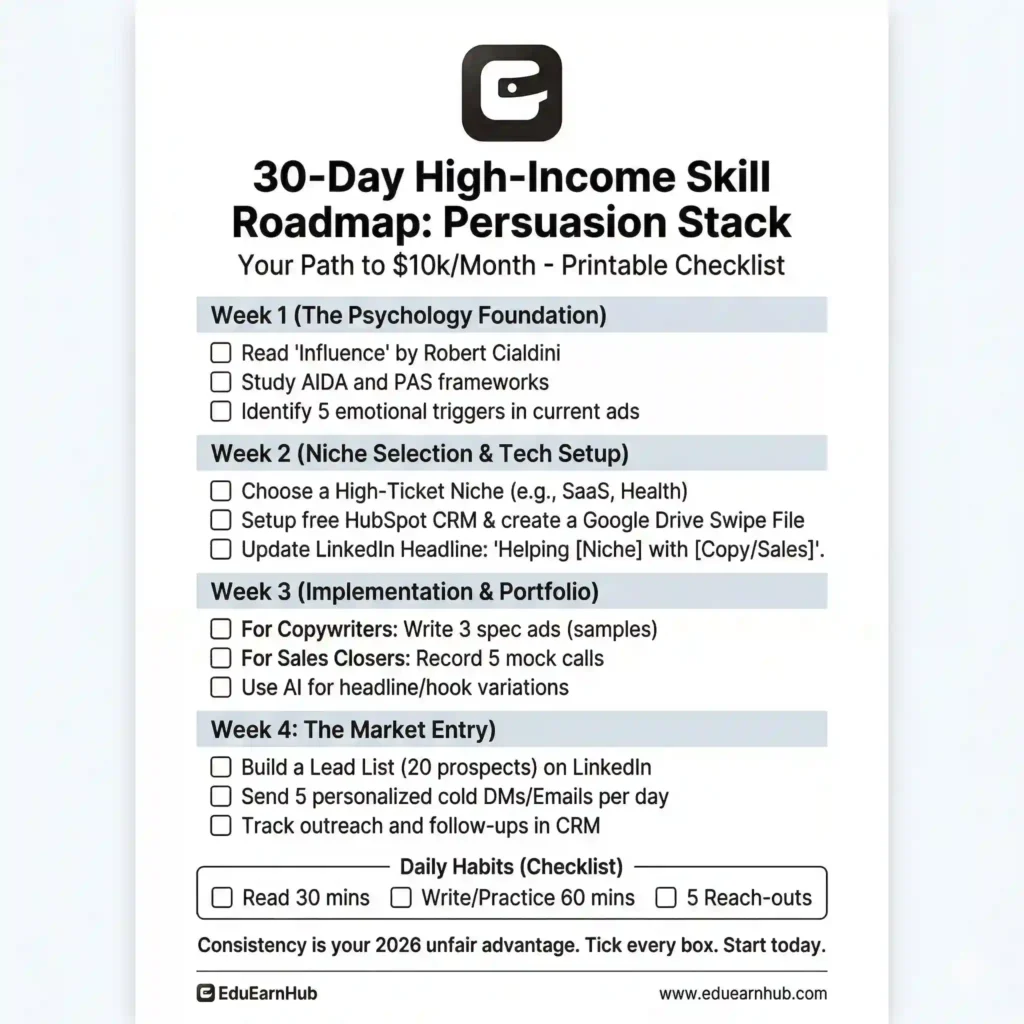
The first 30 days won’t produce $10k. They will produce the foundation that makes $10k possible in month five or six.
The Bottom Line
The structural shift in 2026 is not subtle. AI has lowered the floor on generic content and basic outreach. What it has not, and cannot, lower is the value of genuine persuasion: the ability to understand why people buy, and to communicate in a way that makes them want to.
Copywriting and Remote Sales are the two most direct paths into that value layer. One operates in writing, the other in conversation. Together, they cover the full revenue journey from first impression to closed deal.
The learning investment is short relative to most high-income career paths. The income ceiling is high and performance-driven. And the demand, driven by an expanding online economy that still needs humans to convert attention into revenue, shows no sign of contracting.
The skills are learnable. The market exists. The path is mapped.
Start with the Ultimate Guide to High-Paying Online Careers 2026 if you want to see how copywriting and sales compare to every other viable path, then come back here and begin Week 1.
Have you started learning either of these skills already, or are you still figuring out which one fits your working style? Share your thinking in the comments below.
Frequently Asked Questions
Can I learn copywriting or remote sales without a degree?
Neither field requires a degree. Copywriting rewards a demonstrated ability to write persuasively and understand buyer psychology, skills built through practice and study, not credentials. Remote sales, particularly at the appointment-setting level, require communication skills and CRM familiarity. Most organizations hiring for these roles evaluate candidates on track record and practical demonstration rather than educational background.
How long does it take to make $5,000 per month as a copywriter?
The timeline varies by focus and effort, but a structured learner who spends consistent time building skills and a portfolio can typically reach $3,000 to $5,000 per month within four to six months. The key factors are niche specialization (SaaS, e-commerce, and financial services pay the highest rates), pricing structure (retainers over one-off projects), and the quality of the portfolio used to attract initial clients.
What is appointment setting, and is it a good entry point into remote sales?
Appointment setting is the entry-level role in remote sales. The job involves contacting pre-qualified leads, presenting a basic value proposition, and scheduling a discovery or sales call with a closer. It requires no prior sales experience, can be done fully remotely, and typically pays $2,000 to $5,000 per month for commission-based setters in high-ticket markets within the first six months. It’s the most practical way to learn sales fundamentals while earning, with a clear progression path to closing roles.
How much do high-ticket closers earn in commission in 2026?
High-ticket closers typically earn 10% to 20% commission per deal closed. On a $5,000 offer, that’s $500 to $1,000 per sale. Active closers running four to six calls per day and maintaining a reasonable close rate can reach $8,000 to $20,000 per month. Top performers working with premium offers, coaching programs, SaaS products, or consulting services priced above $10,000, report monthly earnings exceeding $30,000. Income is variable and performance-dependent, which is the trade-off for its uncapped ceiling.
Can I do both copywriting and remote sales at the same time?
It’s possible, but not advisable at the start. Both skills have a learning curve that rewards focused attention. The more practical approach is to reach a baseline of competency and income in one skill first, typically three to four months, and then begin building the other. The two skills complement each other well at an advanced level: a copywriter who understands the sales conversation produces better copy, and a closer who understands copy writes more effective follow-up sequences. Many high-earning professionals in digital marketing eventually operate in both capacities.