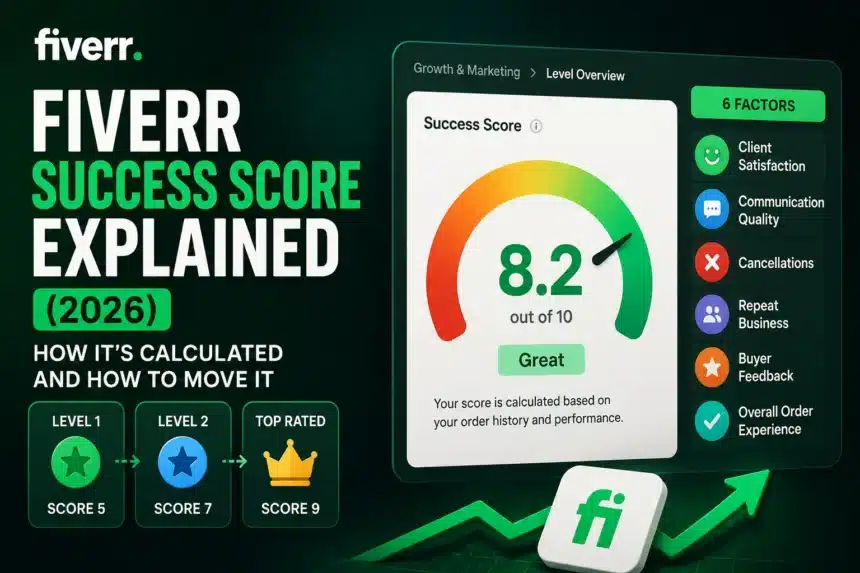
TL;DR: The Fiverr Success Score is a private 1-to-10 metric, visible only to you. It’s built from 6 areas of your order process: client satisfaction, communication, cancellations, repeat business, buyer feedback, and overall order experience. You need a 5 for Level 1, a 7 for Level 2, and a 9 for Top Rated review. The score is peer-relative, weighted heavily toward your highest-volume gig, and it moves slowly by design. Cancellations damage it more than anything else.
I’ve watched sellers with 4.9-star ratings sit stuck below Level 2 for 6 months. I’ve also watched a 4.7-rated seller in the same category cross into Top Rated review. The variable both groups missed was the same one: the Fiverr Success Score.
The star rating is what buyers see. The Success Score is what decides whether your seller level moves.
And most sellers I talk to don’t know what’s inside it.
Let me walk through how the score actually works, which of the 6 factors pull it down hardest, and the moves that have helped sellers I know recover from drops below 5.
What the Fiverr Success Score actually is
It’s a 1-to-10 metric Fiverr calculates from your order history, evaluated separately for each of your gigs and then rolled up into one overall number. Only you can see it. It lives inside your seller dashboard under Growth & Marketing → Level Overview.
Buyers don’t see it. They see your seller level (New, Level 1, Level 2, or Top Rated) and your public star rating.
Per Fiverr’s official help center, the Success Score evaluates each gig across six key areas related to the order process and your relationship with clients. Each area pulls from quantitative data (completion rates, order timelines, revision counts) and qualitative data (review tone, private buyer feedback, the texture of your messages).
Three things sellers usually misunderstand about it.
Star rating and Success Score are different systems. A 4.9 average doesn’t automatically produce a high Success Score. They measure different layers of the same orders, and they often disagree.
It’s peer-relative. Your score reflects how you perform compared to other sellers in your price range. So your absolute numbers can stay flat while your score drops, just because sellers around you got better.
It moves slowly. Fiverr’s community team has confirmed the score is weighted and built over time. One bad week won’t kill a strong score. One bad quarter can.
The 6 factors inside your Success Score
Each gig gets evaluated across the same 6 areas. Your overall Success Score is a weighted roll-up of those gig-level scores.
Here’s what each one measures and what damages it.
1. Client satisfaction
This tracks both public and private review patterns.
Buyers submit 2 separate ratings after every order. The public star rating goes on your profile. The private satisfaction score is invisible to you. Both feed this factor.
A buyer can leave you 5 public stars and 3 private stars on the same order. Sellers with strong public ratings and mediocre Success Scores almost always have a gap on the private side. You can’t see it, so you can’t fix it directly. The only fix is to improve the actual order experience: tighter scope, faster replies, cleaner delivery.
2. Communication quality
This goes deeper than response rate (which is a separate metric on its own).
It looks at how clearly you scope the work before starting, whether you send mid-project updates without being asked, and how you handle questions during the order.
Fiverr’s official Success Score documentation flags poor communication (slow, unclear, or missing updates) as a direct drag on this factor. Sellers who front-load communication (clear scope agreement before they touch the work) consistently score better here than sellers who only reply when asked.
3. Cancellations
This is the biggest lever in the entire model.
A cancellation after work has begun produces a stronger negative signal than any other event Fiverr tracks. It doesn’t matter whose fault it was. The system reads it the same way: this order broke down.
One exception: according to Fiverr’s help center documentation, unresponsive buyers (the ones who go silent after placing an order) don’t damage your score. The leveling system accounts for them separately.
The practical takeaway is simple. Preventing a cancellation is worth far more than recovering from one. And the single most common cause of avoidable cancellations is accepting orders outside your gig scope because you didn’t want to say no to the income.
4. Repeat business
This factor rewards sellers whose clients come back.
A returning buyer is the strongest satisfaction signal Fiverr can read, stronger than a 5-star review on a single order. A repeat order means somebody chose you a second time when they had the whole platform available.
Even a small base of returning clients (3-5 buyers who order from you more than once per quarter) moves this factor noticeably.
5. Buyer feedback
This one looks specifically at the feedback behavior itself: whether buyers leave reviews, and what those reviews actually say.
It’s close to client satisfaction but narrower. A buyer who closes an order silently produces a neutral signal. A buyer who writes a detailed review with specifics about what you did well produces a much stronger positive signal than a quick 5 stars with no comment.
Asking for reviews matters here, but the way you ask matters more. (More on that below.)
6. Overall order experience
This is the composite layer. It looks at how smooth each order was from start to finish.
Here’s where most sellers get the wrong instinct. They assume that offering revisions, extending a deadline, or issuing a partial refund automatically counts against them. It doesn’t. Fiverr’s documentation judges these actions on whether they improved the client’s experience.
A seller who handles a difficult order well, using a revision and a 1-day extension to land a satisfied buyer, can score high on this factor. The same difficult order that ends in a cancellation scores poorly.
How the score is weighted (the part most sellers miss)
If you have 2 gigs, one with a score of 8 and one with a score of 6, your overall is not 7. It might be 6. It might be 6.4. The calculation is weighted, with bigger and more recent gigs pulling harder on the result.
Fiverr’s community team explained this directly: the Success Score is weighted, and not all gigs are created equal. The gigs that carry the most weight in your overall score are:
- The gigs with the highest order volume
- The gigs with the most recent orders
Two implications matter.
Your biggest gig dictates your score. A single gig with 60 completed orders matters more than 5 gigs with 5 orders each. If your overall score is stuck, start the investigation at your highest-volume gig. Save the newest gig for later.
Recent orders weigh more than older ones. A 1-star review from last month moves the needle more than a 1-star review from 14 months ago. This cuts both ways: recent strong performance recovers a score faster than sellers expect, but a cluster of recent problems pulls it down quickly, even if your long-term track record looks clean.
I’ve seen this play out in the forums repeatedly. One seller posted with gig scores of 8, 8, 8, 7, 4, 4, 4, and an overall score stuck at 6 for a year. The 3 low-volume gigs at 4 were dragging the whole profile because the weighting math doesn’t reward your best gigs equally with your worst ones.
Your Level Overview page shows individual gig scores under “Scores by Gig.” That’s where you diagnose. Not the overall number.
What Success Score do you need for each level
| Seller Level | Minimum Success Score |
|---|---|
| New Seller | No minimum |
| Level 1 | 5 |
| Level 2 | 7 |
| Top Rated Seller | 9 |
Important nuance from Fiverr’s official documentation: a 10 is not required for success or for Top Rated status. Meeting the threshold is enough.
And the Success Score is one of 6 level criteria. You also need to hit thresholds on star rating, completed orders, unique clients, earnings, and response rate, all measured on the 15th of each month. Missing 1 means no promotion that cycle, even if the other 5 look great.
For the complete breakdown of every threshold at every tier, the Fiverr seller levels guide covers each level in depth.
Why your Success Score isn’t moving (5 common reasons)
This is the question I get most.
Reason 1: The peer baseline shifted under you.
Your score gets benchmarked against other sellers in your price range. If you held your performance steady while sellers around you improved, your score drops without anything changing on your end. Sometimes, “I’m doing the same things I always did” is the actual diagnosis.
Reason 2: Private feedback is dragging you.
You can’t see private scores. If your public ratings look strong but your Success Score sits at 6, this is the most likely cause. Asking for better public reviews won’t help. The actual move is to tighten the order experience itself: scope clarity before start, mid-project updates, and delivery that matches what the buyer expected.
Reason 3: Your highest-volume gig has a problem you haven’t isolated.
Because volume drives weight, a cluster of cancellations or low-private-score orders on your main gig will hold your overall score down even when your other gigs are doing fine. Check individual gig scores in Level Overview. Don’t look at the overall number.
Reason 4: Cancellations from 2-4 months ago are still in the weighting window.
Recent matters more, but “recent” covers a longer span than sellers expect. A cluster of cancellations from a difficult quarter can keep your score pinned for months after you’ve stopped doing whatever caused them. The score recovers as good orders accumulate and pull the weighted average forward.
Reason 5: You took on work that wasn’t your gig.
This is the root cause of most score damage I see. A buyer comes in with a request that’s adjacent to what your gig actually does. You say yes because you want the order. The order goes sideways because the scope was wrong from minute one. You cancel, the buyer leaves a sour private score, and the gig takes a hit on 3 factors at once (cancellation, satisfaction, experience).
Decline scope mismatches before the order starts. Every time.
How to actually improve your score (per factor)
Generic advice doesn’t help. Here’s what to do for each of the 6 factors specifically.
Client satisfaction. Set scope expectations inside the order requirements page before you start working. Use bullet points: “Here’s what I’ll deliver. Here’s what’s not included. Here’s what I’ll need from you.” After delivery, add a line: “If anything needs adjustment, message me before closing the order.” That single sentence reroutes potential negative private scores into revision requests, which damage you far less.
Communication quality. Reply to new buyer messages within 4 hours when you can, 24 hours minimum. For orders longer than 2 days, send a midpoint check-in even if there’s nothing to report. (“Quick update: I’m on schedule, currently working on the second draft, should have something for you by tomorrow afternoon.”) This is not required by Fiverr. It moves the communication factor anyway.
Cancellations. Decline scope mismatches up front. If an order goes sideways mid-project, offer a partial refund and revision before agreeing to cancel. A complicated order that lands at “buyer satisfied with partial refund” scores better than the same order at “cancelled.” Per Fiverr’s own guidance, talking to the buyer early (before a small issue becomes a big one) is the most reliable cancellation prevention.
Repeat business. Over-deliver slightly on first orders with new buyers. A small bonus (an extra revision round, a faster turnaround than promised, a related asset thrown in) increases return-order probability without cutting your price. In the delivery message, mention 1 related service you offer. Don’t list all of them. Just 1.
Buyer feedback. After a successful delivery, add a short note: “If you’re happy with the work, a quick review really helps me out as I grow on Fiverr.” Don’t ask for 5 stars specifically (that’s against Fiverr’s TOS and the buyer can flag it). The guide to getting your first Fiverr review covers the exact wording that works inside the rules.
Overall order experience. There’s no shortcut here. Fiverr’s community blog frames it directly: focus on steady, consistent quality. The score builds slowly over time, with roughly 50 consistent orders being the rough inflection point I’ve seen in seller stories. A single exceptional delivery won’t get you there on its own.
What happens when your score drops below threshold
Two scenarios, depending on how far it falls.
Scenario 1: Below your level’s threshold, but not critically low.
Fiverr’s freelancer levels documentation describes a 30-day grace period when any of the 6 metrics drop below the threshold for your current level. You keep your level during the 30 days while you work to bring the metric back up. If you recover within the window, no demotion.
This is where diagnosis beats panic. Open your Level Overview, find the specific factor with the worst signal, and work on that one. Spreading effort across all 6 in 30 days is how sellers waste the grace period.
Scenario 2: Critically low.
If the Success Score falls critically low, Fiverr labels the account “low performance,” which directly affects gig visibility. Gigs sink in search, impressions drop, and the order volume you need to recover the score becomes harder to generate.
I’ve read forum threads like this every week. One seller’s gig disappeared from search results after a 60-day cancellation cooldown, even after completing 15 new 5-star orders. The recovery math is brutal once you’re in “low performance.” Fewer impressions mean fewer orders, which means fewer chances to build the score back.
Monitor early. If you see a metric trending down on the Level Overview page, act before evaluation day. The 30-day grace period only protects sellers who notice the slip in time. By the time the “low performance” label hits, your gig visibility is already tanking.
Bottom line
Three things matter most.
Open your Level Overview and check your individual gig scores. The diagnosis lives in the breakdown.
Fix your highest-volume gig first. That’s where the weight sits.
Prevent cancellations above everything else. No other factor moves the needle harder, in either direction.
For sellers tracking Success Score as part of a broader level progression plan, the Fiverr seller levels guide covers every threshold and timeline from New Seller through Top Rated. And if you’re still building your first orders and reviews, the Fiverr profile optimization guide walks through the profile elements that produce better first impressions and more consistent order quality.
What’s your current Success Score sitting at, and which factor do you think is dragging it? Drop it in the comments. I read everyone.
Frequently asked questions
What is the Fiverr Success Score, and how is it different from a star rating?
The Success Score is a private 1-to-10 metric visible only to you, calculated from 6 areas of your order process: client satisfaction, communication, cancellations, repeat business, buyer feedback, and overall order experience. The star rating is public, sits on your profile, and reflects what buyers click after each order. They measure different things and often disagree. A seller with a 4.9-star rating can have a Success Score of 6 if their private feedback or cancellation pattern is weak.
What Success Score do I need for Level 1, Level 2, and Top Rated?
Level 1 needs a 5. Level 2 needs a 7. Top-rated review needs a 9. A 10 is not required for any level. All 6 level criteria (Success Score, star rating, completed orders, unique clients, earnings, response rate) need to be met simultaneously on the 15th of the month for promotion.
Why isn’t my Fiverr Success Score going up?
Usually 1 of 4 reasons: peer-relative competition got stronger in your price range; private buyer feedback is dragging you even though public ratings look fine; your highest-volume gig has a pattern of cancellations or low-private-score orders that’s pulling the weighted average down; or recent cancellations (2-4 months back) are still inside the active weighting window. Open Level Overview and check individual gig scores to find the specific factor with the worst signal.
Do cancellations hurt my Fiverr Success Score?
Yes, more than anything else. A cancellation after work has begun is the single most damaging signal in the model, regardless of who initiated it. The one exception is unresponsive buyers; per Fiverr’s documentation, those don’t damage your score because the system accounts for them separately.
Can buyers see my Fiverr Success Score?
No. Buyers only see your seller level (New, Level 1, Level 2, or Top Rated) and your public star rating. The Success Score, including the individual gig-level breakdown, is visible only to you through the Level Overview page in your dashboard.